

Every so often, you find yourself standing at one of those weird crossroads of technology and humanity—like when my brother first met ChatGPT and sounded more awestruck than when he discovered our family car had cupholders. In the rush toward a Jetsons future, it's the decidedly Flintstone skills—curiosity, adaptability, and, frankly, showing you give a darn about people—that win the day. This post isn’t another 'robots will save us' pep talk. If you’ve ever watched the internet turn a humble wine store into an empire, you know: it’s the humans who leverage the tools, not the other way around. Let’s dissect what being “prehistorically” human can mean for your AI-powered customer experience strategy—and why treating your DMs and comment sections like Main Street in Bedrock might just be your unfair advantage.
1. Flintstone Mindset, Jetsons Tools: What Winning Really Looks Like in CX 2025
As we race toward a future shaped by AI in customer experience, it’s easy to believe that the most advanced technology will always win. But here’s the paradox: the more we become like the Jetsons, my belief is those who act like the Flintstones will win. In other words, as automation and AI adoption strategies accelerate, the value of human authenticity and old-school values—community, care, and genuine connection—actually increases.
The Paradox: Human Authenticity Gets More Valuable as AI Transforms CX
Customer experience trends for 2025 show that CX roles are among the first and most affected by AI advances. AI can automate routine interactions, answer questions instantly, and even predict customer needs. But what AI still can’t replicate is the uniquely human touch: empathy, adaptability, and creative problem solving. These are the skills that set you apart in a world where AI is everywhere.
'Weaponize' Your Humanity: Empathy, Adaptability, Creative Problem Solving
To future-proof your customer experience career, you need to weaponize your humanity. This means leaning into the skills that AI can’t easily copy:
- Empathy: Understanding and relating to customer emotions.
- Adaptability: Navigating unexpected situations with grace.
- Creative Problem Solving: Finding solutions where scripts and algorithms fall short.
These human skills vs AI automation are your double offense in the digital age.
Story Time: Building a Brand by Replying to Thousands of Wine Tweets
Let’s get practical. In the early days of Twitter (2007–2011), I spent 7–11 hours a day manually replying to tweets about wine. I wasn’t just posting into the void—I was jumping into the comments, answering questions, and genuinely caring about people’s experiences. This relentless engagement built a loyal community and a personal brand that AI is only now beginning to simulate.
This wasn’t about using technology for technology’s sake. It was about using new tools to amplify timeless values: listening, responding, and showing up for people. That’s what made the difference.
Social Skills as Double Offense: Confessions of a Habitual DM-Replier
I’ve always believed that the real magic happens in the DMs and comment sections. While most brands were broadcasting, I was building relationships one message at a time. This “Thank You Economy” approach—where every interaction is a chance to show gratitude and care—remains your strongest moat in the AI era.
The more we become like the Jetsons, my belief is those who act like the Flintstones will win.
The ‘Thank You Economy’ Philosophy for the AI Era
In a world where AI can handle the basics, your competitive edge is acting “prehistoric” in the best way possible. That means:
- Prioritizing real conversations over automated replies
- Investing time in building trust, not just transactions
- Showing up consistently, even when it’s not scalable
This approach is more than nostalgia—it’s a proven strategy. As CX professionals, you’re at a historical crossroads. The organizations that blend Jetsons tools with Flintstone values will stand out as AI commoditizes routine interactions.
Manual Engagement vs. AI-Assisted Engagement: A Comparison
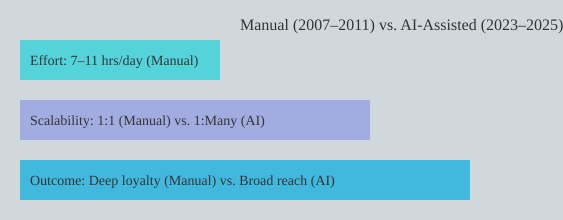
| Engagement Era | Effort | Scalability | Outcome |
|---|---|---|---|
| Manual (2007–2011) | 7–11 hrs/day | 1:1 | Deep loyalty, strong personal brand |
| AI-Assisted (2023–2025) | 1–2 hrs/day | 1:Many | Broad reach, faster response, risk of commoditization |
As AI in customer experience becomes fully integrated, your ability to blend technology with authentic, human engagement will define what winning really looks like in CX 2025.
2. The Evolution of AI Agents: From Fancy FAQs to True Customer Companions
From Scripts to Smart, Context-Aware Assistants
If you work in customer experience, you’ve probably noticed the conversation around AI agents in customer service is still a bit hazy. Many teams are still debating, testing, or even fearing what’s next. But make no mistake: the evolution is happening fast. In business, speed is a huge advantage—just like in sports. Those who move quickly to adopt new tools often win big.
Back in 1997, launching an e-commerce website was cutting-edge. The first online wine store in the US was a leap into the unknown, at a time when most people still waited in line for their turn on the internet. Fast forward to today, and the pace of change is even faster. AI agents have moved from simple, script-driven bots to smart, context-aware assistants that can handle complex, personalized customer needs.
Timeline: Customer Service Automation from Phone Trees to Agentic AI (1997–2025)
| Year | Milestone | Key Capability |
|---|---|---|
| 1997 | First e-commerce wine store launches in US | Manual phone/email support |
| Early 2000s | Email support becomes standard | Ticketing systems, basic automation |
| 2010s | Chatbots and IVRs (phone trees) rise | Scripted responses, limited context |
| 2023 | Large agencies integrate AI into CX | Conversational AI, some personalization |
| 2025 (projected) | Agentic AI becomes CX standard | Autonomous, decision-making, hyper-personalized |
AI’s Knack for Hyper-Personalized Interactions: What It Means for You
Today’s AI agents in customer service can do more than just answer FAQs. They remember your preferences, anticipate your needs, and even resolve issues before you ask. This is what hyper-personalized interactions look like in real life: an AI that knows your order history, suggests solutions based on your past behavior, and adapts its tone to match your mood.
By 2025, industry forecasts predict that 70% of top-performing CX organizations will deploy agentic AI—autonomous bots that make decisions and take action within your workflows. These AI-driven CX executions are designed to boost resolution speed and customer satisfaction.
Agentic AI vs. “Dumb Bots”: Spot the Difference
- Dumb Bots: Scripted, rule-based, can only answer what they’re programmed to.
- Agentic AI: Autonomous, learns from context, makes decisions, and adapts in real time.
If you’ve ever felt frustrated by a chatbot that couldn’t understand your question, you’ve met a “dumb bot.” In contrast, agentic AI can handle complex requests, escalate when needed, and even follow up proactively.
Story: The Day My Brother Met ChatGPT (and Why It Freaked Him Out, in a Good Way)
A few months ago, my brother—who’s not exactly a tech enthusiast—tried ChatGPT for the first time. He started with a simple question about his phone bill, expecting the usual runaround. But the AI not only understood his issue, it pulled up his account details (securely), explained the charges, and offered a solution—all in natural language. He was stunned. “It’s like talking to a real person, but faster and less annoying,” he said. That’s the power of agentic AI in action.
Key AI Capabilities Driving CX Transformation
- Real-time context awareness
- Autonomous decision-making
- Workflow integration
- Hyper-personalized recommendations
- Proactive issue resolution
“AI agents are evolving from basic automation to proactive, context-aware assistants.”

3. Human Touch 2.0: Skills AI Can’t Steal (Yet)
Empathy, Intuition, and Adaptability: Outperforming Automation When Problems Get Messy
When it comes to human skills vs AI automation, there’s one truth you can’t ignore: AI is powerful, but it’s not a substitute for genuine human connection. When customer issues get complicated or emotions run high, it’s your empathy, intuition, and adaptability that make the difference. AI can process data and automate responses, but it can’t read between the lines, sense frustration in a customer’s tone, or pivot in the moment the way you can. These are the moments when your human touch outshines even the most advanced algorithms.
The ROI of a Basketball: Tools Are Only as Good as Their User
Consider this analogy: the ROI of a basketball in LeBron James’ hands is measured in billions of dollars. In the hands of an average person, it might result in injuries and a negative bank balance. The same goes for AI tools. They’re only as valuable as the person wielding them. You are the mechanic, and the tool—no matter how advanced—doesn’t do the work for you. The real magic happens when you combine your unique skills with the power of AI.
| Tool/User | ROI |
|---|---|
| Basketball (LeBron James) | Billions USD |
| Basketball (Average Person) | Negative $50,000 (injuries, costs) |
| AI-generated messages (2024 estimate) | 30% lower perceived authenticity vs. human-sent |
Listening to Customers: The Secret to Brand Loyalty
If you want to future-proof your customer experience, start by really listening. Not just responding to comments or messages, but actually engaging with what your customers are saying. When you show that you care—by replying thoughtfully, addressing concerns, and remembering details—you build trust and loyalty that no chatbot can replicate. This is where AI and human collaboration shines: let AI handle the repetitive tasks, but make sure you’re the one showing up for the moments that matter.
A real-world example: Many successful personal brands were built not by broadcasting, but by spending hours engaging directly with people online. That level of authentic engagement—what some call “scaling the unscalable”—is what sets you apart in a digital world.
Empathy vs. Efficiency: Finding Your Personal Balance
AI brings efficiency, but you bring empathy and adaptability. The challenge is finding the right balance. Customers can tell the difference between a generic, automated message and a heartfelt, human response. In fact, research shows that AI-generated messages are perceived as 30% less authentic than those sent by humans. When you prioritize emotional intelligence, you create experiences that are memorable and meaningful.
Human skills such as empathy and creativity remain essential alongside AI automation.
Wild Card: Does an AI Bot’s Thank-You Note Feel Meaningful?
Imagine receiving a thank-you note from an AI bot. Does it feel as meaningful as one written by a real person? Most people say no. That’s because authenticity matters. Customers crave genuine connection, and they can spot the difference. While AI can help you scale communication, it’s your personal touch that makes people feel valued.
Creative Problem-Solving in an AI-Saturated Workspace
In a world where AI handles more and more tasks, your ability to think creatively and solve problems becomes your superpower. AI can suggest solutions based on past data, but it can’t dream up new ideas or adapt to unexpected challenges the way you can. AI and emotional intelligence are not in competition—they’re partners. But when it comes to creativity, empathy, and adaptability, you’re still in the driver’s seat.
As technology evolves, remember: it’s not about the tools you use, but how you use them. The future belongs to those who combine the best of AI with the irreplaceable power of human connection.
4. AI Adoption Strategies: From Tabletop Theory to Hands-On Mastery
Why Being a Practitioner (Not Just a Planner) Is Your Secret Edge
AI adoption strategies are everywhere, but the real winners in customer experience (CX) are not just the ones who talk about AI—they’re the ones who roll up their sleeves and use it. In today’s rapidly evolving landscape, you can’t afford to be a bystander. The biggest edge you can give yourself and your organization is to become a practitioner of AI tools for customer engagement. This isn’t just theory; it’s a proven path to outsized results.
"The luxury of having the ability to have your hands on the steering wheel of these tools right now is one of the great opportunities of your career."
The Myth of 'Set and Forget' AI Tools—Why You Need Skin in the Game
It’s tempting to believe that AI-driven CX execution is as simple as flipping a switch. Many organizations fall into the trap of thinking they can set up an AI tool and let it run on autopilot. But here’s the truth: AI adoption in SMBs and even Fortune 500s demands ongoing, hands-on involvement. The best results come from leaders and teams who know the tools inside and out—not just on paper, but in practice.
Story: Still Writing Your Own Instagram Posts? That’s the Kind of Gritty Involvement That Pays Off
Take a page from the playbook of industry leaders who refuse to outsource the most critical parts of their digital presence. For example, GaryVee—a CEO with a massive following—still writes his own Instagram posts. Why? Because direct involvement keeps him close to his audience and the tools that shape their experience. This gritty, hands-on approach is exactly what separates those who win with AI from those who just talk about it.
Execution Over Talk: What Most Organizations Get Wrong
Most companies are still stuck in the gray zone. They have AI adoption strategies on paper, but real execution is missing. They delegate, outsource, or simply dabble. But history shows that the organizations who get their hands dirty—those who become day-to-day practitioners—are the ones who capture disproportionate rewards. Whether you’re a senior leader or just starting out, now is the time to get deeply familiar with AI tools for customer engagement.
Proactive Customer Engagement Starts With Knowing the Tools INSIDE OUT
You can’t deliver authentic, proactive customer engagement unless you understand the AI tools powering your CX. This is not a job to be handed off to an intern or a third-party agency. When you know the ins and outs of your AI-driven workflows, you can spot opportunities, troubleshoot issues, and create experiences that feel truly personal. This hands-on mastery is what drives real value for your customers—and your business.
Case Study Peek: Fortune 500s vs. Scrappy Upstarts—Who’s Better at ACTION?
Let’s look at the data. In 2023, a 3,000+ person agency applied AI for both Fortune 500 companies and SMBs. The results? The organizations that moved early and handled AI directly outperformed the field. Scrappy upstarts, unburdened by bureaucracy, often leap ahead by being hands-on practitioners. Meanwhile, many larger companies are still drafting strategies instead of executing. By 2026, the majority of organizations are projected to have formal AI adoption strategies—but the winners will be those who master execution, not just planning.
| Year | Insight |
|---|---|
| 2023 | 3,000+ person agency applies AI for Fortune 500 and SMBs—hands-on teams outperform passive strategists |
| 2026 | Projected majority of organizations will have formal AI adoption strategies—but execution remains the differentiator |
Key Takeaways for AI-Driven CX Execution
- Being a practitioner gives you a real, sustainable edge in AI adoption.
- ‘Set and forget’ is a myth—ongoing involvement is essential.
- Direct, hands-on mastery leads to proactive, authentic customer engagement.
- Execution beats strategy alone—get your hands on the tools and lead from the front.
5. The Unlikely Heroes: Why CX Leaders Are Poised to Take Center Stage
In the race to future-proof customer experience, a surprising group is stepping into the spotlight: customer experience (CX) leaders. While CTOs and CIOs have long been the loudest voices in the room when it comes to technology, the future of customer service AI is putting CX professionals front and center. You are no longer just the voice of the customer—you are the voice of reality at the AI–human frontier, and your influence is set to skyrocket as we approach 2025.
CX Professionals: Unique Influence at the AI–Human Frontier
Unlike many other roles, CX practitioners are already living at the intersection of AI and human collaboration. You see firsthand how AI tools impact real customers, not just in theory but in daily practice. This gives you a unique authority when discussing what works, what doesn’t, and what needs to change. Your insights are grounded in actual customer interactions, not just academic research or boardroom speculation. As organizations rush to adopt new customer experience trends for 2025, your practical knowledge is more valuable than ever.
Comparative Visibility and Career Trajectory: CX Leaders vs. IT/CTO Roles (1985–2025)
| Year | Developer/IT Roles | CX/Customer Service Roles |
|---|---|---|
| 1985 | Back-office, low visibility; rare path to C-suite | Frontline, low strategic influence |
| 2000 | Rising influence with dot-com boom; some CTOs join executive teams | Still seen as cost center; limited voice in strategy |
| 2025 (projected) | Established C-suite presence; expected to partner with CX | Projected 30% of most influential leaders have CX backgrounds (Fortune 500 study); potential pipeline to CEO |
Lessons from History: The Rise of Developers to CEOs
Think back to 1985. If you were a coder, few would have predicted you might one day become a CEO. Yet, as technology became central to business, developers who understood both the tech and the business rose to the top. Today, we’re seeing the same pattern emerge for CX professionals. As AI transforms the customer experience, those who understand both the technology and the human side are becoming invaluable. Lightning could strike twice—this time, for you.
Practitioner Insights Trump Academic Theory
Inside organizations, there’s a growing realization: real-world experience matters more than theory. Your practitioner insights—what you’ve seen, tested, and learned—are now prized above academic models. You are the ones who can say, “Here’s what actually happens when we deploy this AI tool with real customers.” This practical wisdom is shaping enterprise AI direction, often in partnership with CTOs and CIOs. As one industry leader put it:
"You will look back at this moment with either phenomenal joy... or with regret that you did not squeeze the opportunity harder."
Building Your Personal Brand in the AI Era: Practical Tips
- Share your stories: Document and share real examples of AI and human collaboration in your CX work.
- Network with tech leaders: Build relationships with IT, CTO, and data teams to stay ahead of customer experience trends 2025.
- Speak up internally: Don’t wait for permission—bring your frontline insights to executive discussions.
- Invest in learning: Stay curious about AI, automation, and analytics to keep your expertise relevant.
Wild Card: What If the Next Fortune 500 CEO Is a Former Customer Service Rep?
Imagine a world where the next Fortune 500 CEO started as a customer service rep. It’s not as far-fetched as it sounds. With projections showing that by 2025, 30% of the most influential leaders will have CX backgrounds, the path from the contact center to the C-suite is wide open. The skills you’re building today—empathy, adaptability, and a deep understanding of AI and human collaboration—are exactly what tomorrow’s leaders will need.
6. Tangents, Anomalies, and Other Unplanned Realities of the AI-CX Frontier
The Myth of Straight Lines: Why No One’s Career Goes According to Plan
If you look at the career paths of most people thriving in the AI-CX (Customer Experience) space, you’ll notice something: almost none of them followed a straight line. Maybe you started as a wine connoisseur and now you’re a tech CEO. Or perhaps you walked into a college dorm room, heard the dial-up internet screech, and realized your life would never be the same. These random pivots and unstructured opportunities are more than just detours—they’re often the very moments that set you up for future success.
The truth is, the most disruptive innovations—think AR/VR, live social shopping trends 2025, or AI agents with quirky, human names—rarely come from following a rigid plan. Instead, they spring from left field, catching even the most seasoned professionals off-guard. As you navigate technological shifts in business, remember: flexibility and curiosity are your best assets.
Getting Comfortable with the Unexpected
Emerging tech is rewriting the rules of customer engagement. Just a decade ago, few would have predicted that live social shopping would become a dominant force, with forecasts suggesting that by 2025, 60% of Gen Z will shop this way. Or that AR glasses could soon replace smartphones as our primary device—something tech analysts now expect by the mid-2030s.
So, how do you prepare for a future that refuses to sit still? By getting comfortable with the unexpected. When you embrace the possibility of sudden career leaps or industry pivots, you position yourself to spot opportunities others might miss. The next time you’re faced with a left-field trend—like AI agents evolving from faceless bots to digital personalities with names—lean in. These oddball shifts often signal where the market is headed.
AI May Be Predictable, But Humans Will Surprise You Every Time
AI is built on patterns, data, and probabilities. But humans? We’re unpredictable. We invent new slang, change our shopping habits overnight, and fall in love with the quirkiest tech. That’s why, even as AI agents evolution continues, the most successful CX strategies will always leave room for surprise and delight.
Consider live social shopping trends 2025: AI can recommend products, but it’s the spontaneous, authentic interactions between hosts and viewers that drive engagement. Similarly, AR glasses may become the new UI, but it’s how people use them—at concerts, in classrooms, or while cooking dinner—that will shape their true impact.
Time Management for Tech Professionals: Finding Your ‘Enough’
When you’re surrounded by chaos and constant change, time management becomes a survival skill. The temptation is to chase every new trend or spend endless hours planning for a future that may never arrive. As one industry leader put it:
“I like spending a lot of time thinking about tomorrow, but I don’t like wasting my time on tomorrow.”
The key is to find your ‘enough.’ Spend time exploring new technologies and trends, but don’t let them distract you from delivering value today. Unstructured opportunities—those random meetings, side projects, or chance encounters—often pay off later, even if they seem like tangents in the moment.
Oddball Trends and Playful Realities
- Live social shopping in 2025: Not just a fad—an estimated 60% of Gen Z will shop this way, blending entertainment and commerce.
- AR glasses as the new UI: By the mid-2030s, expect your glasses to replace your phone. What does this mean for apps, interfaces, and how we interact with brands?
- AI agents with names: As AI agents evolve, we’ll likely start naming them—just as we did with cars, ships, and even our favorite gadgets. What will you call yours?
Play the Long Game (and Have a Little Fun)
Navigating technological shifts in business isn’t about predicting every twist and turn. It’s about staying curious, being flexible, and remembering that the best ideas often come from the most unexpected places. So, as you future-proof your customer experience with AI and authenticity, don’t forget to play the long game—and have a little fun along the way.
7. FAQ: Everything You Were Too Embarrassed to Ask (or Didn’t Have Time For)
Let’s face it: the future of customer experience (CX) can feel as strange as Bedrock meeting Orbit City. If you’ve ever sat through a talk on AI adoption strategies or the future of customer service AI and left with more questions than answers, you’re not alone. Here are the questions you might have been too shy to ask—or simply didn’t have time for—about blending AI tools for customer engagement with authentic, human service.
What’s the difference between agentic AI and regular automation?
It’s easy to lump all AI agents in customer service under one label, but there’s a key distinction. Regular automation is like a conveyor belt: it follows a set of rules and does the same thing every time. Think of it as the classic “press 1 for billing” phone tree. Agentic AI, on the other hand, acts more like a helpful assistant. It can make decisions, learn from interactions, and adapt its responses based on context. In other words, agentic AI doesn’t just follow a script—it tries to understand the customer’s needs and respond intelligently. This is the future of customer service AI: smarter, more flexible, and more personal.
Is it possible to ‘fake’ empathy at scale? Should we?
Empathy is a hot topic in CX, and AI tools for customer engagement are getting better at sounding “human.” But can you really automate empathy? The truth is, AI can mimic empathy by recognizing keywords, tone, and sentiment, then responding with pre-programmed phrases. While this can help customers feel heard, it’s not a substitute for genuine human connection. Should you use it? Only as a supplement. The best CX leaders use AI to handle routine tasks, freeing up real people to deliver authentic empathy where it matters most. Remember: customers know the difference between a heartfelt “I’m sorry” and a machine-generated one.
How do you balance AI tools and human touch in daily workflows?
This is the million-dollar question for anyone navigating AI adoption strategies. The answer is continuous learning and curiosity. Start by mapping out your customer journey and identifying pain points where AI agents in customer service can help—like answering FAQs or routing requests. Then, make sure your team is trained to step in for complex or emotional issues. The goal isn’t to replace humans, but to free them up for the work that requires creativity, judgment, and empathy. The best future of customer service AI is one where technology and people work together seamlessly.
Wild card: If I’m not a ‘tech person,’ what’s one simple way to become a CX leader in the AI age?
You don’t need to code or build robots to lead in this new era. The single most important skill is curiosity. Ask questions, experiment with new tools, and stay open to change. Attend webinars, read case studies, and connect with peers who are also exploring AI tools for customer engagement. The willingness to learn—and to admit what you don’t know—is what sets future-proof CX leaders apart. Remember, even the Jetsons had to learn how to use their gadgets.
Do AR glasses mean the end of mobile phones for CX teams?
Not yet. Augmented reality (AR) glasses are exciting and may someday transform how teams interact with customers, but mobile phones are still the backbone of most CX operations. For now, AR is best seen as a complement, not a replacement. Keep an eye on this space, but don’t feel pressured to swap out your devices just yet.
What are quick wins for CX leaders right now, regardless of company size?
Start small. Automate repetitive tasks with AI agents in customer service, use chatbots to answer common questions, and gather feedback with AI-driven surveys. These steps can improve response times and free up your team for higher-value work. Most importantly, keep learning and encourage your team to do the same. The future of customer service AI belongs to those who stay curious and never stop asking—even the “dumb” questions.
In the end, future-proofing your customer experience isn’t about choosing between the Flintstones and the Jetsons. It’s about blending the best of both: the warmth of human connection and the power of smart AI tools for customer engagement. Keep asking questions, keep learning, and you’ll be ready for whatever comes next.
TL;DR: Master the blend: double down on your human skills while getting hands-on with AI tools, and you’ll future-proof your CX role for years to come. Play the long game, stay curious, and always care more than your competition. That’s how you’ll thrive—no matter how futuristic your toolbox gets.
Post a Comment