

Last week, I asked ChatGPT to proofread my grocery list. It returned it with Oxford commas and a sassy sidebar about my snack choices. My first reaction? Laughter. My second: is this digital assistant quietly bench-pressing for me, while my own mental muscles slack off on the treadmill? Turns out, this question isn't so far-fetched. Recent buzz from MIT reveals that letting AI do our thinking has real, measurable consequences for our brains. So let's pull back the curtain on what happens to your memory, creativity, and risk for long-term brain decline when you let ChatGPT do the heavy lifting.
1. The MIT Memory Decline Study: When AI Picks Up the Pen, Does Your Brain Drop the Ball?
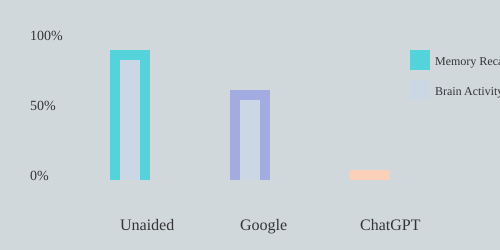
The MIT memory decline study offers eye-opening insights into the cognitive impact of ChatGPT and other AI writing tools. Conducted with 54 students from top Boston universities—including MIT and Harvard—this research split participants into three groups: one wrote essays using ChatGPT, another used Google, and the last group wrote without any digital assistance. Over four months, each participant completed four essays, allowing researchers to track changes in brain activity and memory integration processes.
The results were striking. MIT found a 47% collapse in activity and brain connections when people wrote with ChatGPT compared with writing unaided. EEG scans revealed that the ChatGPT group had the weakest overall brain activity, while those writing without any tools showed the most active and connected neural networks. Google users fell in between, suggesting a gradient effect based on tool reliance.
When it came to memory, the differences were even more pronounced. 83% of ChatGPT users couldn't remember what they had just written and failed to correctly quote their own finished essay in the study. In contrast, unaided writers demonstrated the highest memory recall and neural connectivity. Google users again scored in the middle, highlighting the risk of cognitive decline as reliance on AI increases.
This study also explored the ownership of learning. ChatGPT users reported feeling little or no connection to their written work. They struggled to recall content and did not feel that the essays reflected their own thinking. This lack of engagement suggests that overreliance on AI chatbots may bypass deep memory processes, reducing your ability to retain and integrate new information.
‘MIT found a 47% collapse in activity and brain connections when people wrote with ChatGPT compared with writing unaided.’
‘83% of ChatGPT users couldn't remember what they had just written and failed to correctly quote their own finished essay in the study.’
The MIT memory decline study highlights a clear risk: using ChatGPT as your daily writing assistant may put your brain in low gear, leading to cognitive atrophy and weaker active brain function. If you want to keep your mind sharp and maintain a sense of ownership over your learning, consider how often you let AI pick up the pen for you.
2. Cognitive Load and Lifelong Learning: Use It, Don’t Lose It
Think of your brain like a muscle. Cognitive load models describe how much “mental weight” you lift each day. If you suddenly switch from a 20 lb dumbbell to a 2 lb one, your muscles weaken. The same goes for your mind: do less, lose strength. Overreliance on AI and chatbots can lower your daily cognitive load, leaving your brain ‘out of shape’ and raising your cognitive decline risk.
Research consistently shows that regular mental engagement—what you might call a “brain workout”—delays the onset of dementia. Education studies reveal a clear link: people who stay in school longer and keep learning throughout life have a much lower dementia risk. As one expert put it,
“People who do not engage in lifelong learning have a higher risk, significantly higher [of Alzheimer’s].”The more you challenge your brain with new skills, ideas, and problems, the stronger your neural circuits become.
“The more you engage the neurons in your brain, the stronger they are.”
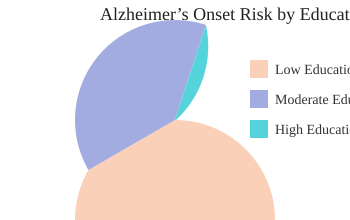
One study compared Alzheimer’s onset in three groups: those with little schooling, those with moderate education (like high school), and those with advanced degrees. The results were striking—Alzheimer’s appeared earliest in the low-education group, and much later in those with more education. This suggests that lifelong learning is one of the most powerful dementia risk factors you can control.
This is especially important for children and teens. Child development AI tools and digital shortcuts may make life easier, but young brains need mental challenges to build resilience. Child brain health depends on regular, effortful learning—just like adult brains.
In summary, consistent brain engagement isn’t just about staying sharp for today. It’s about protecting yourself from cognitive decline risk tomorrow. Use it, don’t lose it.
3. The Double-Edged Sword: AI at Work, School, and Home (with Wildcard Worries)
AI tools like chatbots and large language models promise to make life easier—at work, in school, and even at home. But as with calculators before them, there’s a hidden cost to this convenience. We often embrace convenience before understanding consequence. When you let AI handle your tasks, your brain doesn’t get the workout it needs. As one expert warns,
“If you misuse these large language models... your brain's going to go downhill.”
Short-Term Convenience vs. Long-Term Brain Health
Most people act on short-term incentives, whether it’s grabbing fast food or scrolling through social media. Now, problematic internet use and overreliance on AI are the new frontiers. Even when you know something isn’t good for you, the lure of instant results is hard to resist. Just as 75% of Americans are obese despite knowing the risks, many continue to use AI for quick answers, ignoring the long-term cost to brain health.
| Behavior | Short-Term Reward | Long-Term Cost |
|---|---|---|
| Fast Food | Tasty, convenient | Obesity, health issues |
| Social Media | Dopamine hits | Anxiety, attention loss |
| AI Tools | Instant answers | Mental atrophy, loss of ownership |
Children and Adults: Both at Risk
Children’s brains are especially vulnerable. Reports show kids spend 7-8 hours a day on screens, risking under-engagement and lasting cognitive consequences. Adults aren’t immune either—overusing AI can lead to neural circuit degradation, much like unused muscles weaken over time.
Real-Life Example: When AI Gets It Wrong
Take my niece, for example. She used ChatGPT to write a book report. It sounded great, but the AI got the plot wrong! Not only did she miss out on learning, but she also lost a sense of ownership over her work. This is a growing problem: the more you let AI do the thinking, the less satisfaction and growth you get from your own efforts.
Wildcard Worries: Emotional Effects of AI
There’s another twist—AI emotional effects. Some people are forming attachments to AI companions, blurring the line between tool and friend. This unpredictable side of overreliance on AI raises new questions about mental health and ownership of learning.
4. Can AI Ever Be Good for Your Brain? Smarter Use, Stronger Mind
When it comes to AI and brain health, the real question isn’t whether AI is good or bad for you—it’s how you use it. AI isn’t the enemy; mindless convenience is. If you treat AI as a shortcut and let it do all the work, your critical thinking skills and active brain function will suffer. As one expert put it,
“If you don't interact and you don't keep your brain working, that's the danger.”
Active Engagement: The Key to Cognitive Benefits
Using AI as a tool for learning engagement means more than just asking for answers. It’s about dialoguing, questioning, and challenging what AI gives you. Imagine you’re a student debating with a teacher rather than copying homework. When you upload your own data—like notes, research, or past projects—and ask AI to build on it, you’re not just consuming information; you’re leading the thinking process. This approach supports ownership of learning, creativity, and memory.
- Ask, challenge, and revise: Treat AI as your sparring partner. Push back, ask “why,” and request different perspectives.
- Question the output: Don’t accept AI’s answers blindly. As another expert said,
“You have to learn how to question what you're getting... that's the way we work in school.”
- Build on your own knowledge: Use AI to elevate what you know, not replace your thinking.
Ownership and Creativity: Making AI Work for You
When you stay actively involved, you strengthen your brain’s ability to analyze, remember, and create. This is the difference between brain-enhancing and brain-dulling AI use. If you simply “pass it off” to AI, you lose the chance to develop your own ideas and skills. But if you make AI your partner in learning, you keep your mind sharp and engaged.
| AI Use Style | Impact on Brain |
|---|---|
| Passive (Copy-Paste) | Reduces critical thinking, weakens memory |
| Active (Question, Debate, Revise) | Enhances cognitive skills, supports learning engagement |
Current evidence suggests that mindful, interactive use of AI is rare—most people default to over-delegation. To truly benefit, you must stay in the driver’s seat, making AI a tool for stronger, smarter thinking.
Frequently Asked Questions (FAQ)
Is it safe for kids to use ChatGPT for homework?
Current research and expert opinion suggest caution when it comes to children using AI tools like ChatGPT for learning. While these tools can provide helpful explanations, overreliance can limit the brain’s natural development, especially in areas related to memory, creativity, and critical thinking. Studies show that direct, attentive interaction with adults is crucial for healthy brain growth in children. AI cannot replace the nuanced feedback and value-based learning that comes from real human relationships. If you allow your child to use AI, make sure it’s for support and not as a substitute for their own thinking or for meaningful adult guidance.
Can using AI really increase my risk for dementia?
Emerging evidence, including the MIT study discussed here, points to a potential link between heavy AI use and reduced brain activity. When you let AI do the cognitive heavy lifting—like writing essays or solving problems—your brain’s engagement drops significantly. Over time, this “cognitive offloading” may weaken neural circuits, making you more vulnerable to cognitive decline and even increasing your risk for dementia. The principle is simple: use it or lose it. Lifelong learning and mental effort are key to keeping your brain healthy and resilient.
What’s one habit I can change right now to protect my brain health?
The most impactful habit you can adopt is to actively engage your brain every day. This means doing tasks yourself before turning to AI for help. For example, write your own thoughts, solve problems by hand, or recall information from memory before checking with ChatGPT or similar tools. Regular physical exercise is also a powerful way to boost brain health, as it improves blood flow, reduces inflammation, and supports memory. Small changes—like taking a walk, practicing deep breathing, or spacing out your learning—can make a big difference.
Are there ways to use ChatGPT that actually boost memory and creativity?
Yes, but it requires active participation. Instead of passively accepting AI-generated answers, use ChatGPT as a partner: ask it to quiz you, critique your writing, or challenge your ideas. Engage with the information, question it, and try to recall or explain it in your own words. This approach keeps your brain involved, helping to encode new memories and spark creative thinking. Remember, AI and brain health can go hand in hand if you use technology as a tool for growth, not a crutch.
In summary, your relationship with AI is what shapes its impact on your brain. By staying engaged, balancing convenience with effort, and prioritizing real-world learning and relationships, you can harness technology’s benefits while protecting your cognitive future.
TL;DR: Relying too much on AI tools like ChatGPT could lower your brain's natural workout, possibly upping the risk for cognitive decline and dementia. Mindful, active engagement—rather than pure convenience—is your best bet for brain health.
Post a Comment