
Picture this: You’re eleven, your dad’s vanished—again—and your family’s on the brink of being run out of town. Not the standard start for a future titan of industry, right? That’s exactly where John D. Rockefeller began. Before you cast him as either villain or visionary, let’s wander through some of the grit, lucky breaks, strategic genius, and weird turns that shaped America’s first billionaire. (Oh, and expect a few eyebrow-raisers along the way—because no empire is built without at least a little mischief.)
Growing Up Rockefeller: A Wild Ride Through Adversity
When you think of the Rockefeller family history, images of unimaginable wealth and power probably come to mind. But John D. Rockefeller’s journey didn’t begin in boardrooms or mansions—it started in a small, drafty farmhouse in rural New York, where hardship was the family’s daily bread. If you want to understand the roots of Rockefeller business strategies and the relentless drive that defined his empire, you have to look at the wild, unpredictable world he grew up in.
The Devil Bill Era: Scams, Secrets, and Survival
John’s father, William “Devil Bill” Rockefeller, was a man of many faces—none of them trustworthy. He was an athlete, a ventriloquist, a hunter, a hypnotist, and even an animal trainer. But most famously, he was a con artist. Bill would vanish for weeks or months, leaving his family to fend for themselves, only to reappear with lavish gifts and mysterious cash. The truth? He was living a double life, sometimes under the name Dr. William Levingston, scamming the desperate with fake remedies and even marrying another woman in secret.
This soap opera of a childhood meant that John, the eldest of at least five siblings, had to grow up fast. When Bill was gone, John’s mother leaned on him for support—financial, emotional, and practical. The family moved from town to town, often in disgrace, after Bill’s schemes or scandals caught up with them. The instability forced John to become the de facto head of the household before he was even a teenager.
Early Hustle: From Turkey Eggs to Microloans
Even as a child, John’s entrepreneurial spark was unmistakable. At age ten, he followed a wild turkey into the woods, stole its eggs, and raised the hatchlings. When they matured, he sold some for profit and kept the rest to repeat the process. This was just the beginning. He soon started making small loans to neighbors—an early sign of the Rockefeller business strategies that would later dominate American industry.
John’s work ethic was forged in adversity. He balanced school with backbreaking farm labor, all while managing the family’s finances. His mother, a woman of deep faith, instilled in him a sense of duty and discipline that would become the backbone of the John D. Rockefeller biography.
Adversity Breeds Ambition
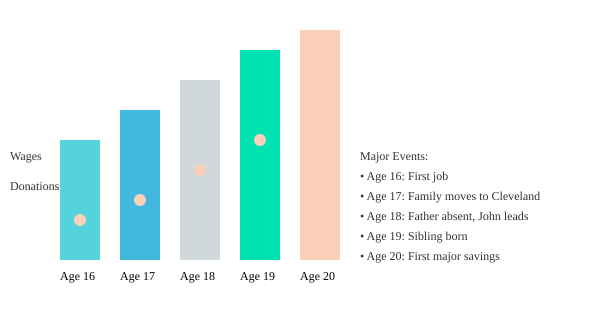
By sixteen, John was supporting his mother and siblings, with another baby on the way. College was out of reach—his family needed him more. He dropped out of school before graduation, prioritizing responsibility over personal ambition. Even then, he gave about 10% of his meager salary to charity, a habit he maintained for life.
John’s first job hunt was a string of humiliating rejections. He knocked on doors, faced disappointment after disappointment, but never gave up. When he finally landed a job as a bookkeeper, earning $50 for six months’ work (about $11,000 a year in today’s money), he was so proud that he celebrated September 26—his “Job Day”—every year for the rest of his life.
"I am bound to be rich." – John D. Rockefeller, his daily affirmation
SVG Chart: Rockefeller’s Wages and Donations (Ages 16-20)
An Unlikely Entry: Early Hustle and Cleveland’s Opportunity
When you think of the John D. Rockefeller biography, it’s easy to imagine a man born for business. But Rockefeller’s entry into the world of commerce was anything but typical. Just two months before his graduation, at only 16, John left school and set his sights on something bigger in Cleveland. His first ambition? Independence—especially from his unreliable father. Armed with a list of the city’s largest railroads, banks, and merchants, Rockefeller knocked on doors, only to be laughed at for his age. But rejection didn’t stop him. After six relentless weeks, he landed a bookkeeping job at a small firm, thanks to his impeccable penmanship. They didn’t even tell him his wage—he was just happy to work.
That first day, September 26th, became so important to Rockefeller that he celebrated it as ‘Job Day’ for the rest of his life—more significant to him than his own birthday. This quirky tradition revealed his core values: discipline, gratitude, and a deep hunger for self-made success. The job taught him the basics of business—dealing with suppliers, paying bills, and managing accounts. One day, his boss left a $4,000 check in the safe. Rockefeller, knowing the combination, couldn’t resist holding it, mesmerized by the fortune it represented. He began a daily ritual: “I am bound to be rich.”
At the end of his first year, Rockefeller earned $50—just over 50 cents a day. But his hard work paid off, and his salary rose to $300 a year (about $11,000 today). This raise gave him something priceless: independence from his father and the ability to help his family. Even as a teenager, he donated 10% of his salary to charity, a habit that would shape his later philanthropy.
Creative Hustle: The Birth of Clark & Rockefeller
After two years, a recession hit, and Rockefeller’s firm faltered. But the experience had given him confidence. He partnered with Maurice Clark, a 28-year-old chemist, to launch a produce business. Their method was bold: they needed a $5,000 loan but publicly claimed they were investing $10,000, building an image of financial strength. This clever Rockefeller business strategy—perception over reality—convinced banks to lend them money. It was a creative hustle that would define his style for years to come.
Clark & Rockefeller hustled hard, buying and reselling grain, fish, beans, and meat. Rockefeller’s shyness masked a mature, trustworthy persona; soon, even older businessmen called him “Mr. Rockefeller.” Their biggest challenge was scaling up, but their network and reputation helped them outmaneuver better-funded competitors.
War and Opportunity: Economic Impact on the Oil Industry
The outbreak of the Civil War changed everything. As a devout Baptist, Rockefeller opposed slavery, but he also had a family to support. Instead of enlisting, he paid $300 for a substitute and equipped several Union soldiers—a controversial but strategic choice. The war supercharged the Northern economy, and Cleveland became a key hub. Local food prices soared, and Clark & Rockefeller’s profits quadrupled, reaching $177,000 in 1862 (over $500,000 today). As Rockefeller later reflected,
“Not bad for a 23-year-old.”
The war also accelerated entrepreneurship across the North. Rockefeller’s ability to adapt—pivoting from produce to oil refining as whale oil supplies dwindled and kerosene demand soared—set the stage for the Standard Oil Company formation. With just a $4,000 investment, he and Clark entered the oil business, using loans and strategic networking to outmaneuver larger rivals. Their story shows how, in times of upheaval, creative hustle and bold image-building can trump actual capital.
Standard Oil: The Art of Monopoly and Ruthless Efficiency
When you look at the Standard Oil Company history, you see a story of bold risks, sharp strategy, and relentless ambition. John D. Rockefeller’s leap of faith began in 1865, when he bought out his business partner Maurice Clark for $72,500—a staggering sum that’s over $1.3 million in today’s money. This buyout happened during a time of wild market chaos, where oil prices could swing from as low as $0.10 to as high as $14 per barrel overnight. The oil industry was booming, but it was also unpredictable and cutthroat.
Rockefeller’s genius was in what he chose not to do. Instead of getting caught up in the risky business of drilling for oil, he focused on refining it. This was a calculated move in risk management. Drilling was a gamble—oil fields could dry up or flood the market, causing prices to crash. Refining, on the other hand, allowed Rockefeller to control quality, costs, and, most importantly, supply. This focus on refining set the foundation for the Standard Oil monopoly and its legendary efficiency.
Vertical Integration: Building an Empire from the Ground Up
Standard Oil’s rise wasn’t just about refining. Rockefeller understood the power of vertical integration business—controlling every step from raw crude to the final product. He expanded into building pipelines, warehouses, and even barrel-making factories. This meant Standard Oil could cut costs at every stage, squeeze out inefficiencies, and undercut competitors. Every move was about consolidating power and eliminating risk.
Secret Deals and Ruthless Partnerships
But the real secret to Standard Oil’s dominance was in its backroom deals and strategic partnerships. When Rockefeller brought in Henry Flagler, the company’s competitive edge—and ruthlessness—reached new heights. Flagler’s philosophy was simple:
“The only way to win was to completely crush your enemy.”Together, they set out to do just that.
One of their most powerful moves was negotiating secret shipping deals with the railroads. At the time, oil was transported by train, and three major railroads dominated the market: New York Central, Erie, and the mighty Pennsylvania Railroad. When the Pennsylvania Railroad pulled out of Cleveland, many thought the city’s refining industry was doomed. But Rockefeller saw opportunity where others saw disaster.
He struck exclusive deals with the Erie and New York Central railroads. In exchange for a guaranteed, high-volume business, Standard Oil received a 75% discount on shipping rates—paying just $165 per barrel when the official rate was $240. These secret partnerships not only slashed Standard Oil’s costs but also squeezed out competitors who couldn’t match these rates. This was monopoly power Standard Oil in action, and it set the stage for the company’s domination.
| Key Data | Details |
|---|---|
| Buyout of Maurice Clark | $72,500 (1865) |
| Equivalent in Today’s Money | $1,350,000+ |
| Oil Price Swings | $0.10 to $14 per barrel |
| Railroad Shipping Deals | 75% discount; $165 vs. $240 per barrel |
Through Rockefeller business consolidation, secret alliances, and a relentless drive for efficiency, Standard Oil transformed from a risky side venture into the most powerful force in the oil industry. Every move—every partnership, every negotiation—was a calculated step toward monopoly and market domination.
Collusion, Competition, and the Gilded Age’s Shadiest Deals
When you explore the Standard Oil monopoly history, you quickly see how John D. Rockefeller and his partner Henry Flagler didn’t just outcompete rivals—they rewrote the rules of business. Their tactics during the Gilded Age set the stage for the rise of antitrust laws Standard Oil would later face, and nowhere was this more apparent than in Cleveland’s oil refining industry.
Cleveland’s Oil Panic: How Standard Oil Upended a City
In the early 1870s, Cleveland was a bustling hub for oil refining. But when news broke that the largest railroad, the Pennsylvania Railroad, was pulling out of the city, panic spread. Refineries began shutting down or leaving, and the local economy teetered on the edge. The New York Central and Erie Railroads, both of which had invested heavily in Cleveland, suddenly found themselves losing customers and revenue.
Rockefeller’s Ruthless Railroad Collusion
While others panicked, Rockefeller saw opportunity. He recognized that the Erie and New York Central railroads were desperate for business. Instead of joining the exodus, he used their vulnerability to his advantage. In a move that would become infamous in Standard Oil trust lore, Rockefeller negotiated deals that would change the industry forever.
- Erie Railroad Deal: Standard Oil secured a jaw-dropping 75% discount on official shipping costs. In exchange, Rockefeller promised a daily order of 60 carloads of refined oil—guaranteeing the railroad steady business.
- New York Central Deal: Rockefeller agreed to pay $1.65 per barrel shipped, when the official rate was $2.40. Again, the promise of consistent, large shipments was too tempting for the railroad to refuse.
'Standard Oil would get a 75% discount on the railroad’s official shipping costs.'
These deals didn’t just save Cleveland’s refining industry for Standard Oil—they devastated competitors. With such favorable rates, Standard Oil could undercut rivals on price and force them out of business or into selling out. The Pennsylvania Railroad, left out of these arrangements, suffered massive losses and watched as Standard Oil’s grip tightened.
Wartime Tactics: Alliances, Sabotage, and Ruthless Competition
Business during this era was often described as “war.” Industrial rivals formed secret alliances, sabotaged each other’s operations, and fought for survival. Rockefeller’s collusion with the railroads was a prime example of this wartime mentality. By manipulating shipping rates and guaranteeing massive daily shipments, Standard Oil made it nearly impossible for independent refiners to compete.
The Fallout: Monopoly Power and Public Backlash
By 1900, Standard Oil controlled up to 90% of the U.S. oil industry. Dozens—if not hundreds—of competitors were absorbed or destroyed. Cleveland became the nation’s top oil refining center, but at a steep cost to local businesses and the broader economy. Market manipulation became an open secret, fueling public outrage and calls for government intervention.
The impact of these deals was felt far beyond Cleveland. As Standard Oil’s monopoly power grew, so did the movement for antitrust laws Standard Oil would eventually face. The impact of Standard Oil breakup would reshape American business, but the seeds were sown in these shadowy deals and ruthless tactics.
Wild Card: The Human Cost and Improbable Scenarios
When you look at the rise of John D. Rockefeller and the Standard Oil empire, it’s easy to focus on the numbers: profits, barrels, and market share. But behind every blockbuster deal, there’s a human story—families uprooted, workers struggling to survive, and entire towns vanishing almost overnight after the oil dried up. The Rockefeller family history is not just about riches; it’s about the real cost of ambition and the unpredictable fallout of unchecked capitalism.
The Human Toll: Ghost Towns and Broken Dreams
During the oil boom, towns sprang up in Pennsylvania and Ohio almost instantly, fueled by the promise of “black gold.” But as soon as the wells ran dry, these places became ghost towns—empty shells of what they once were. Historians estimate dozens of such towns appeared and disappeared, leaving behind broken dreams and economic ruin. Workers who had flocked to these boomtowns found themselves jobless and stranded, their livelihoods wiped out by the same forces that made Rockefeller rich.
Rivalries Fit for Tabloid Covers: Rockefeller vs Carnegie
The Rockefeller vs Carnegie rivalry wasn’t just a business competition—it was a bitter, personal feud that defined an era. These two titans of industry clashed over everything from market dominance to philanthropy. Their battles were so fierce that they even drew in U.S. Presidents, turning business into a high-stakes political drama. Rockefeller’s secretive deals and relentless drive made him many enemies, and his career is filled with stories of betrayal and revenge that would be right at home in today’s tabloids.
Improbable Scenarios: What If Rockefeller Had Failed?
Imagine if Rockefeller’s early failures had stuck—if he’d never landed that first job, or if his oil investments had gone bust. Modern American capitalism might look entirely different. Without Standard Oil’s model of vertical integration and monopoly power, the rise of mega-corporations could have been delayed by decades. Would we still see the same level of Rockefeller influence on American capitalism? Or would a more competitive, less ruthless system have emerged?
The Double-Edged Sword of Monopoly Power
There’s no denying that Rockefeller’s empire brought wonders: efficient production, lower prices, and eventually, massive Rockefeller philanthropy—over $500 million given to causes like education and medicine. But these benefits came at a steep price. As one observer put it,
“Rockefeller’s story is at times inspiring and at times chilling—it’s an example of what happens when greed and ambition go completely unchecked.”
Monopolies like Standard Oil created massive inequality, concentrating wealth and power in the hands of a few while leaving many behind.
Rockefeller in the 21st Century: Would Devil Bill’s Tricks Survive?
Picture Rockefeller as a modern CEO. Would his father’s “Devil Bill” tricks—fake names, secret deals, and double lives—survive in the age of social media outrage and relentless transparency? Today, scandals break in seconds, and public opinion can turn overnight. The paradox of Rockefeller—a churchgoing philanthropist and a cutthroat tycoon—raises a question: can anyone truly reconcile those roles, or is the pursuit of empire always shadowed by ruthlessness?
Rockefeller’s image remains complicated: feared, admired, and hated. His story proves that business history is never just dry mathematics—it’s a wild card, shaped by improbable scenarios, personal drama, and the very real human cost of ambition.
Redemption, Regulation, and Philanthropy: Standard Oil’s Demise and Legacy
As you follow the story of John D. Rockefeller and Standard Oil, you witness a dramatic shift from unchecked ambition to a new era of regulation and redemption. By the early 1900s, public anger against monopolies was rising. The antitrust laws Standard Oil would inspire were still in their infancy, but the tide was turning. Much of this change was fueled by the relentless work of investigative journalists—most notably Ida Tarbell. Her groundbreaking Ida Tarbell exposé Rockefeller in McClure’s Magazine exposed the secret deals, intimidation, and ruthless tactics that had built the Standard Oil empire. Tarbell’s reporting didn’t just inform the public; it galvanized the growing antitrust movement and set a new standard for investigative journalism.
Legal pressure mounted as the government responded to public outcry. In 1911, the U.S. Supreme Court delivered a historic decision: Standard Oil was found guilty of violating antitrust laws and ordered to break up. This impact of Standard Oil breakup was immediate and far-reaching. The company was split into 38 independent firms, including names you still recognize today—Exxon, Mobil, Chevron, and Amoco. These companies became the backbone of the modern oil industry, proving that even after its dissolution, Standard Oil’s influence would endure.
| Breakup Date | Number of Companies Created | Rockefeller’s Total Donations | Standard Oil’s Peak Market Share |
|---|---|---|---|
| 1911 | 38 | $500 million+ | ~90% US oil industry |
The Standard Oil breakup didn’t just change the oil business—it became the template for modern antitrust law. The case established the government’s authority to regulate monopolies and protect competition, shaping the way American business would be governed for generations. If you look at today’s antitrust debates, you’ll see echoes of the Standard Oil case in every major decision.
For Rockefeller, the breakup marked a turning point. No longer at the helm of Standard Oil’s daily operations, he turned his energy and vast fortune toward philanthropy. Guided by his religious upbringing and a sense of duty, Rockefeller’s later years were defined as much by giving as by gaining. Through the Rockefeller Foundation, established in 1913, he and his advisors—especially Frederick Gates and his son, John Jr.—channeled resources into medicine, education, and global health. The philanthropic contributions Rockefeller Foundation made were unprecedented: Rockefeller’s personal donations exceeded $500 million, a sum worth tens of billions today.
- Founded the University of Chicago, transforming it into a world-class institution
- Funded medical research that helped eradicate diseases like hookworm and yellow fever
- Supported scientific research and public health initiatives worldwide
Rockefeller’s philanthropy legacy is as complex as his business career. While his methods in business were often ruthless, his charitable giving set new standards for private philanthropy. As one historian put it:
"Rockefeller’s legacy includes both his role in shaping American capitalism and his extensive philanthropic contributions."
Despite the breakup, the impact of Standard Oil breakup is still visible. The companies born from Standard Oil—like Exxon and Chevron—dominate the oil industry today. The legal precedent set by the case continues to influence antitrust enforcement. And Rockefeller’s philanthropic vision endures through the institutions and research he funded, proving that even the most controversial legacies can have lasting, positive effects.
Conclusion: Why Rockefeller Still Matters—And What You Take Away
When you explore the John D. Rockefeller biography, you’re not just reading about a man who became the world’s first billionaire. You’re diving into the story of someone who fundamentally reshaped American business, government, and society. Rockefeller’s journey from poverty to the absolute peak of wealth and power is both inspiring and chilling—a masterclass in ambition, strategy, and the dangers of unchecked influence.
Rockefeller’s Playbook: Ambition, Innovation, and Ruthlessness
Rockefeller’s rise wasn’t just about hard work. He pioneered techniques like vertical integration—controlling every step from raw material to final product—and market manipulation, which are now foundational case studies for business students. His ability to negotiate secret deals, outmaneuver rivals, and exploit every opportunity turned Standard Oil into a near-total monopoly, controlling about 90% of the U.S. oil market at its peak. These strategies are still dissected in classrooms and boardrooms, shaping how we think about competition and power.
Philanthropy and Fallout: Two Sides of the Same Coin
Rockefeller’s legacy isn’t just about business. He donated over $500 million to causes ranging from education to medical research, setting the standard for modern philanthropy. At the same time, his ruthless tactics led to public outcry, bitter rivalries, and eventually the breakup of Standard Oil into 38 separate companies under new antitrust laws. This dual legacy—of generosity and controversy—shows how capitalism can bring out both the brightest and darkest sides of human nature.
What If Rockefeller Had Lost?
Imagine if Rockefeller’s rivals had won. Would the U.S. have become the industrial superpower it is today? His dominance forced competitors to innovate or disappear, driving rapid growth but also concentrating power in unprecedented ways. The Standard Oil monopoly history is a reminder that the line between progress and exploitation is often razor-thin. Rockefeller’s story forces you to ask: Is it better to have one giant pushing the limits, or a field of smaller players keeping each other in check?
Lessons for Today: Regulation, Responsibility, and the Human Factor
Every debate about regulation, monopoly, and social responsibility echoes Rockefeller’s era. The antitrust laws that broke up Standard Oil still shape how we govern big business. His story is a living warning about what happens when ambition and greed go unchecked, but also a testament to the power of vision and discipline. As you reflect on Rockefeller philanthropy and legacy, remember that business, government, and personal values often collide in unpredictable ways.
“He changed American capitalism forever, for better or worse.”
- Standard Oil’s market share at breakup: ~90%
- Rockefeller’s donations: $500 million+
- Number of spinoff companies: 38
Ultimately, the story of John D. Rockefeller endures because it’s messy, human, and endlessly relevant. Whether you see him as a genius, a villain, or something in between, his influence on American capitalism is undeniable—and the questions he raised about power, ethics, and opportunity are still with us today.
FAQ: Rockefeller Edition—Your Curiosities Answered
What made Rockefeller different from other Gilded Age tycoons?
If you’re reading a John D. Rockefeller biography, you’ll quickly notice he wasn’t just another top-hatted tycoon. Unlike many of his rivals, Rockefeller started at the very bottom—his childhood was marked by poverty, an absent con-artist father, and a mother who drilled in discipline and faith. While others inherited fortunes or relied on family connections, Rockefeller built his empire from scratch, fueled by a relentless drive and a knack for turning adversity into opportunity. His dual nature—innovator and ruthless competitor—set him apart. As Rockefeller himself might have said, “No empire is built without at least a little mischief.”
How did Standard Oil really operate behind closed doors?
Standard Oil Company wasn’t just a business—it was a well-oiled machine, running on secrecy, strategy, and sometimes, a dash of subterfuge. Rockefeller treated business like war. He formed secret alliances with railroads, securing shipping rates his competitors couldn’t dream of. He bought out rivals quietly, often before they knew they were losing. Behind closed doors, decisions were made with cold calculation: dominate or be dominated. The company’s inner circle, including partners like Henry Flagler, shared Rockefeller’s appetite for discipline and, at times, ruthlessness. The result? A monopoly so powerful, it made even presidents nervous.
Was Rockefeller a hero or a villain—or both?
Rockefeller’s story is as inspiring as it is chilling. He rose from rags to riches, embodying the American Dream, but he also crushed competitors and manipulated markets. Some saw him as a visionary who brought order and efficiency to a chaotic industry; others viewed him as the ultimate robber baron. The truth? He was both. His philanthropy—donating over $500 million—changed education and medicine forever. Yet, his business tactics left scars on the landscape of American capitalism. In Rockefeller’s world, the line between hero and villain was as slippery as oil.
Did breaking up Standard Oil really help consumers?
The impact of the Standard Oil breakup in 1911 was seismic. The company was split into 38 separate entities, including modern giants like ExxonMobil and Chevron. In the short term, competition increased and prices dropped, benefiting consumers. But over time, many of these “baby Standards” grew into powerful corporations themselves. The breakup proved that while you can divide an empire, you can’t always dilute its influence.
What’s left of Standard Oil today?
If you fill your tank at Exxon, Mobil, Chevron, or Amoco, you’re still feeling the ripple effects of Rockefeller’s empire. These companies are direct descendants of Standard Oil, proof that Rockefeller’s legacy is as enduring as ever. The DNA of Standard Oil runs through the veins of the modern energy industry.
How much did Rockefeller actually donate to charity?
Rockefeller’s philanthropy legacy is legendary. Over his lifetime, he gave away more than $500 million—an astronomical sum at the time. He funded universities, medical research, and public health initiatives, forever changing the landscape of American philanthropy. His giving was as strategic as his business moves, aimed at creating lasting impact.
What can modern entrepreneurs learn from his strategies (and mistakes)?
Rockefeller’s life is a masterclass in ambition, discipline, and innovation—but also a cautionary tale about unchecked power. Modern entrepreneurs can learn the value of resilience, strategic partnerships, and relentless focus. But they should also heed the warning: when ambition turns ruthless, the consequences can echo for generations. In the end, Rockefeller’s story reminds us that business empires are built not just on brilliance, but on the choices—good and bad—made behind closed doors.
TL;DR: John D. Rockefeller’s life smashed together ambition, hardship, innovative business moves, and controversial decisions, birthing both a dynasty and a cautionary tale—he changed American capitalism forever, for better or worse. Read on if you crave the true story, warts and all.
Post a Comment