

Quick confession: Before AI fueled million-dollar businesses, there was a guy struggling to book his own dentist appointment. True story—one missed call later, the inspiration for today’s AI goldmines was born. Forget overnight riches and buzzwords. This blog is a tour through quirky, unexpected AI business ideas, straight from experience (and the occasional scheduling disaster). We'll explore services you can start solo, side hustles with surprising earning power, and how to tackle the mysterious 'AI startup ladder'. Prepare for numbers, tangents, the occasional rant, and a uniquely human take on where AI business is *really* heading next year.
1. Unusual Suspects: AI Businesses With Surprising High Income Potential
When most people think of high income AI startups, they imagine complex robotics or cutting-edge research. Yet, the real goldmines in AI business models 2025 are often the least hyped, most practical solutions—niche platforms that solve everyday business headaches. From AI appointment setter platforms to inbox managers, these “unusual suspects” are quietly generating thousands per day for savvy founders.
The Unexpected Rise of Niche AI Business Models
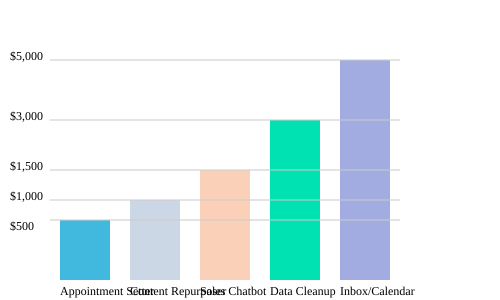
Consider the AI appointment setter platform. Many businesses lose sales simply because no one answers the phone—something I’ve experienced firsthand. Enter AI appointment setters: tools like Atlas automate inbound calls and book appointments, replacing costly human labor with a tireless digital agent. As shown in a real Atlas demo, the AI handles objections, confirms times, and even sends follow-ups. The result? “You could be making $500 to $1,000 a day easily just by talking to businesses that want to make more money.”
- AI Appointment Setter: $500–$1,000/day (Atlas demo)
- AI Content Repurposing Service: $750–$1,000/day; one freelancer earns $30,000/month from just 7 clients
- AI Sales Chatbot: $1,000–$1,500/day; Get Revio hit $60,000/month in 7 months
- AI Data Cleanup Agency: $1,500–$3,000/day; Precision.co scaled to $700,000 in 7 months
- AI Inbox/Calendar Manager Business: $3,000–$5,000/day; Fixer soared from $1M to $10M in 5 months—“Fixer went from $1 million in annual revenue to over $10 million in just the last 5 months.”
Why the Lowest-Hype Ideas Mean the Highest Payoffs
AI business models in 2025 that focus on real pain points and specific niches often grow fastest. Platforms like Atlas, Get Revio, and Fixer prove that even obscure tools can become revenue rockets. These models require moderate effort and skill, but the startup costs are low, and the demand is massive. The lesson? Sometimes, the most lucrative AI businesses are the ones hiding in plain sight.
2. The Not-So-Secret Startup Ladder: From "Zero" to Your First AI Sale
Forget complex playbooks—the AI startup ladder process is refreshingly simple. Anyone can launch a high-income AI business with no employees, thanks to no-code platforms and virtual tools. Here’s the four-step ladder that turns “zero” into your first sale, and, potentially, into a million-dollar AI tools business.
The Four-Step AI Startup Ladder
| Step | Action | Goal |
|---|---|---|
| 1. Validate | Pick a niche & reach out | Prove people want your AI solution |
| 2. Pre-sell | Send offer doc & payment link | Get paid before building |
| 3. Deliver | Over-deliver fast (within 48 hours) | Build trust & momentum |
| 4. Build | Productize & automate | Scale your AI business |
Step 1: Validate (Pick a Niche & Test)
Start by choosing a specific group—like med spas, lawn care businesses, or agency founders. Reach out directly. Don’t guess what people want—ask them. For example, one founder cold-called a frazzled CEO and discovered a goldmine: rental property headaches. That insight led to an AI assistant tailored for property managers.
Step 2: Pre-sell (Get Cash Before Building!)
Once you spot real interest, pre-sell your solution. Create a simple document outlining your offer and include a Stripe link for payment. This step is powerful: you collect cash before writing a single line of code. If you’re new to Stripe, it’s as easy as Googling “Stripe payment link.”
Step 3: Deliver (Over-Deliver Fast)
As soon as someone pays, drop everything and deliver results—ideally within 48 hours.
“Getting a customer a win in the first 48 hours is how you build your reputation.”Early wins drive trust, referrals, and momentum. Yes, it might be manual at first, but speed matters.
Step 4: Build (Productize for Scale)
Now, take what you’ve sold and turn it into a repeatable, automated service. This is where you stabilize and scale—so your AI business can grow without adding employees.
Iterative, customer-first validation reduces risk and speeds up profitable launches in AI. The step-by-step “validate pre-sell deliver build AI” approach ensures you never waste time building the wrong thing.
3. The Big Cost/Benefit Reveal: Real Numbers for Real AI Business Builders
When it comes to launching high-income AI startups, understanding the true cost, effort, and earnings potential is essential. Below is a transparent look at what it really takes to build a million-dollar business with AI tools, based on real-world case studies like Youratlas.com, Get Revio, Fixer, and Precision.co.
Comparing Cost, Effort, and Income: What You Need to Know
Most AI startup models promise big returns, but the reality is more nuanced. While the cost to start is often low—thanks to affordable AI solutions and minimal upfront investment—the effort required is almost always “medium.” This means you’ll need to learn some sales, configuration, or operations skills to deliver value and build trust. The myth of “low effort, high income” is just that—a myth. Every successful AI business builder puts in focused effort to match the right solution to the right customer.
Lessons from the Field: Manual Work as a Secret Weapon
Many founders try to automate everything too soon and end up losing money or missing early growth. As one expert puts it:
"It may take some manual work at the beginning, but getting a customer a win in the first 48 hours is how you build your reputation."
Early hands-on work not only drives momentum but also helps you refine your offer and secure referrals—key ingredients for scaling any AI startup.
Cost/Effort/Income Comparison Table
Here’s a quick reference comparing the five unconventional AI business models for 2025:
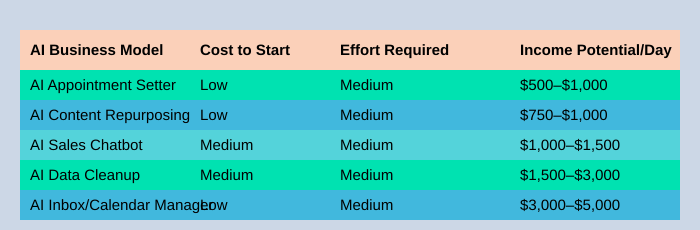
These numbers are based on actual deals and arrangements, not inflated by hype. The learning curve is real, but the path to AI business success is open to anyone willing to combine smart tools with focused, customer-centric effort.
4. Bumps, Rants, and Wild Cards: Lessons They Never Put in a Startup Guide
When ‘Nobody Knows AI’: Real-World Surprises
Despite the buzz, most companies are still new to operational AI. As one expert puts it,
"Trust me, they don’t [know AI]. And if they do, their number one bottleneck is anybody on the team that knows how to do this stuff."This gap is a goldmine for entrepreneurship AI technology. Even large businesses are eager for simple, pain-solving solutions—if you can explain them in plain English.
The Value of Identifying Pain: Real Conversations Win
Forget market research reports. The best real money-making AI opportunities come from talking to actual decision-makers. For example, when one founder called a CEO to pitch an AI inbox calendar manager business, the CEO didn’t want another dashboard—he just wanted help managing rental properties and remote tasks. The lesson: pain points reveal themselves in conversation, not in surveys.
Wild Card: Pitching to the AI Skeptic
Imagine pitching an AI inbox manager to a self-proclaimed Luddite. At first, they’re skeptical. But when you show how AI can automate 95% of their email and calendar headaches, the lightbulb goes on. Speed, simplicity, and trust—not technical perfection—win the deal. This is how companies like Fixer grew from $1 million to $10 million in five months, earning $27,000 a day by solving real problems.
Done Is Better Than Perfect: Iterate Fast
Many founders believe they need the perfect product before launch. In reality, building the perfect solution first is a losing proposition. Quick customer wins matter more. As seen with Precision.co, which made $700,000 in seven months as an AI data cleanup agency, getting paid upfront and iterating with clients is the path to AI data cleanup agency profitability.
FAQ: The Messy, Unfinished Business of Launching
- Q: What if my product isn’t perfect?
A: That’s normal. Most clients care more about results than polish. - Q: How do I find real pain points?
A: Talk to potential buyers. Listen more than you pitch. - Q: Is it risky to sell before building?
A: It’s the fastest way to validate demand and avoid wasted effort.
| Startup | Revenue | Timeframe | Service |
|---|---|---|---|
| Precision.co | $700,000 | 7 months | AI Data Cleanup Consulting |
| Fixer | $10,000,000 | 5 months | AI Inbox/Calendar Management |
Conclusion: Where To Point Your AI Compass in 2025
As the AI landscape evolves, the most lucrative AI business models 2025 will not be the flashiest or most hyped. Instead, they will be the ones grounded in reality—solving specific, often overlooked pain points with practical solutions. The next wave of high income potential AI startups will be built not on grand promises, but on delivering real value to real people, starting with the everyday operational headaches that slow them down.
The story of the AI inbox and calendar manager is a perfect example. While it may seem simple compared to the latest generative AI breakthroughs, its power lies in its direct impact on operational efficiency. By automating time-consuming tasks like email triage and scheduling, this kind of solution can buy back hours for busy professionals—hours that translate into measurable value. As revealed in recent conversations with entrepreneurs, even the most successful leaders struggle with the mundane: managing rental property emails, coordinating across time zones, and handling household logistics. These are not glamorous problems, but they are persistent, and people are willing to pay for relief.
This is the hidden goldmine: hyper-targeted, pain-solving AI solutions operational efficiency consistently outperform broad, unfocused tech ideas when it comes to real revenue. The lesson for aspiring founders is clear—start small, focus on a weird or niche problem, and iterate quickly. Don’t underestimate the business potential of a solution that simply works better than a human assistant for a specific task. The path to a million-dollar AI business in 2025 is paved with specificity, validation, and relentless execution.
In the end, the best advice for those looking to launch an AI startup next year is to listen closely to the pain points people mention in passing. Validate your idea not with likes or retweets, but with paying customers. Build something that saves time, reduces friction, and delivers value fast. The AI compass for 2025 doesn’t point toward the most dazzling technology—it points toward the most practical, personal, and persistent problems you can solve. That’s where the real gold lies, waiting to be unearthed by founders willing to dig in.
TL;DR: If you want to start a profitable AI business in 2025, consider niche opportunities like automated appointment setters, content repurposing, AI sales chatbots, data cleanup agencies, and inbox/calendar management. Real examples, step-by-step guides, and honest data included.
Post a Comment