

I used to think having the fanciest workflow or coolest multi-agent system was my ticket to AI riches. Spoiler: I was so wrong. That all changed the day I landed a client—not by dazzling them with technical jargon, but by promising to give them their Friday afternoons back. Turns out, most businesses care a lot less about 'AI' and a lot more about their bottom line. But here’s the wild bit: slap ‘AI’ on an age-old automation, and—suddenly—old solutions get neon-lit. Feeling skeptical? Let’s unpack why real money in AI doesn’t come from clever tools, but from actually solving nasty business headaches. And yes, I do mean those awkward, time-sucking, hair-pulling problems owners lose sleep over. Ready for some unvarnished honesty, questionable analogies, and tactical steps you can steal? Let’s dive in.
Stop Chase the Shiny—Why AI Business Impact Isn’t About the Tools (An Awkward Taxi Analogy)
Let’s get one thing straight: when it comes to AI business impact, most companies don’t care about the technical wizardry behind your solution. They care about results—saving time, cutting costs, and freeing up focus for what matters. If you’re still leading with “AI agents,” “multi-agent workflows,” or “cutting-edge automations,” you’re missing the point. It’s not about the tools. It’s about the outcomes.
AI Is the Neon Sign—But the Menu Hasn’t Changed
Think about the recent explosion of AI buzzwords. Suddenly, “AI automation” is everywhere. But here’s the awkward truth: automation isn’t new. I spent years in business intelligence at Goldman Sachs, and automation was already a staple. The only difference now? Slap “AI” on it, and suddenly, business owners are paying attention. It’s like putting a neon sign on an old diner—the food hasn’t changed, but now everyone wants a taste.
But here’s the catch: just because you’ve got a flashy sign doesn’t mean your food is any better. Most small and mid-size businesses (SMBs) still have little to no automation in place. AI draws their attention, but unless you deliver real AI business solutions that solve actual pain points, you’re just adding to the noise.
Businesses Want Outcomes, Not Features
Here’s a hard truth: Businesses don’t fanboy over AI itself. They fanboy over the outcomes. When you walk into a sales meeting and start talking about nodes, HTTP requests, or multi-agent architectures, you’re speaking a different language than your customer. They’re not interested in how many tools you’ve stacked together. They want to know:
- How much time will this save my team?
- How much money will this cut from my expenses?
- How much more can we focus on what matters?
That’s it. Time, money, focus. If your AI productivity boost doesn’t hit one of these, you’re not selling a solution—you’re selling a toy.
The Awkward Taxi Analogy: Getting from A to B
Imagine a business owner needs to get from point A to point B. Do they care if the ride is a Tesla, a yellow cab, or even a horse-drawn carriage? Not really. They care about getting there quickly, cheaply, and reliably. The vehicle is just a means to an end. The same goes for AI automation benefits: your client wants the destination (the result), not a tour of the engine.
Selling AI Agents and Templates? That Market’s Saturated
Right now, everyone is selling AI agents, templates, and generic workflows. It’s a crowded space, and most of these offerings are indistinguishable. The real value—and the real money—comes from tailored, outcome-focused AI business solutions that address a specific business problem. When you can diagnose a pain point and clearly show how AI solves it, you stand out from the crowd.
Personal Anecdote: The Power of Value-Based Outcomes
Let me share a quick story. My most practical, high-ROI YouTube videos aren’t the ones that rack up the most views. The flashy builds with multiple agents and complex architectures get the attention, but the videos that actually solve a real business pain are the ones that deliver the most value. When I sold my first $1,200 workflow, I didn’t pitch the technical specs. I simply said, “This will save you hours every week on content creation.” That’s what closed the deal. The client didn’t care if it was powered by AI or a virtual assistant or duct tape—they cared about the outcome.
Data-Driven Proof: AI Delivers Tangible Business Impact
Let’s look at the numbers:
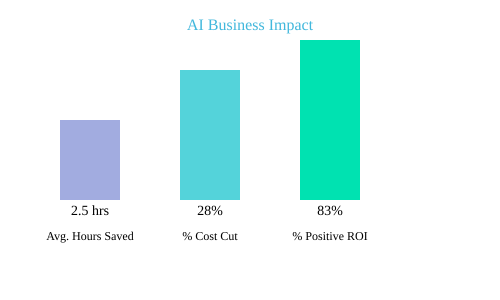
- 83% of organizations using AI platforms see a positive ROI within 3 months.
- Businesses cut costs by an average of 28% using AI solutions.
- AI saves employees an average of 2.5 hours per day.
"Businesses don’t fanboy over AI itself. They fanboy over the outcomes."
SVG Chart: AI Business Impact at a Glance
Key Takeaways: Results Trump Tools Every Time
- Most businesses care about time, money, and focus—not your tech stack.
- Flashing “AI” is just a way to get attention. The real AI business impact comes from solving real problems.
- Value-based outcomes like “save 10 hours weekly” close deals—features and buzzwords don’t.
- Stop selling the ride. Start selling the destination.
How AI Solutions Trump Templates: Case Studies, Industry Trends, and the ‘Medicine Cabinet’ Test
When it comes to AI business solutions, the difference between selling a tool and solving a real business problem is night and day. In today’s crowded market, generic AI agents and workflow templates are everywhere. Anyone can buy a bundle of “done-for-you” templates and resell them, but this approach quickly becomes a race to the bottom on price. The true value—and pricing power—comes when you shift from selling tools to delivering outcomes that matter. Let’s break down why AI solutions outperform templates, using real-world AI use cases, industry trends, and a simple analogy that sticks: the ‘medicine cabinet’ test.
Why Templates Are Commoditized (and Solutions Aren’t)
Think about it: if you need to get across town, you don’t care whether you ride in a Prius, a Tesla, or a horse-drawn carriage. You just want to arrive quickly, affordably, and without hassle. Businesses feel the same way about AI—they don’t “fanboy” over the tech itself, but over the outcomes it delivers. That’s why selling AI-centric tools or template libraries doesn’t work. The market is saturated, and price competition is fierce.
For example, LinkedIn outreach bots are everywhere. You could build the flashiest, most complex bot, but if you pitch it as just another “LinkedIn agent,” nobody cares. But reframe it as an AI-powered lead generation system that delivers qualified sales leads without ad spend, and suddenly, you have their attention. The shift is simple: stop selling the tool, start selling the result.
Case Study: Automating Client Onboarding—From Hours to Dollars
Let’s look at a concrete AI use case. Imagine a business where the team spends five hours a week onboarding new clients. That’s over 200 hours a year. By implementing an AI automation solution that handles 80% of onboarding tasks, you save those 200+ hours annually. At $50 per hour, that’s $10,000 back in the company’s pocket every year. When you present this outcome—“I’ll save you $10,000 a year for a $3,000 investment”—the conversation shifts from cost to value. This is the power of AI pain point identification and solution framing.
The ‘Medicine Cabinet’ Test: It’s About Relief, Not the Pill
Here’s the analogy that brings it home:
"Think of it like medicine. The pill is the tool. The outcome is pain relief. That’s exactly how businesses see AI."If you have a headache, you don’t care if it’s Advil, Tylenol, or an herbal remedy—you just want the pain gone. The same goes for AI. Your clients don’t care if you use GPT-4, a custom workflow, or an off-the-shelf agent. They want their business headache—lost time, wasted money, or lack of focus—gone. This is why AI solutions that directly address specific pains are so powerful.
Industry Trends: Where AI Solutions Deliver the Most Value
- Data-Heavy Sectors: AI adoption trends show the highest uptake in industries like IT, healthcare, finance, and retail—where data volume and process repetition are high.
- Quantifiable Results: 83% of organizations see ROI from AI within three months, and by 2025, 78% will use AI in at least one business function.
- Automation Benefits: AI saves businesses $80 billion annually in customer support and HR automation alone.
These trends prove that when you solve a specific, quantifiable pain, you unlock real value—and clients are willing to pay for it.
Template Shops vs. Solution Selling: A Side-by-Side Comparison
| Industry | Template/Agent Selling (Hours Saved/Year) |
Solution Selling (Hours Saved/Year) |
Solution Selling (Dollars Saved/Year) |
|---|---|---|---|
| IT | 50 | 250 | $12,500 |
| Healthcare | 40 | 220 | $11,000 |
| Finance | 60 | 300 | $15,000 |
| Retail | 30 | 180 | $9,000 |
Source: Industry averages based on AI automation benefits and reported ROI.
How to Frame Your AI Offer: Diagnose, Solve, Value, Price
- Diagnose: Identify the business pain point. Where is time, money, or focus leaking?
- Solve: Build a system that fixes that exact pain.
- Value: Translate the fix into numbers—hours saved, dollars saved, revenue gained.
- Price: Anchor your offer around the value delivered, not the cost of the tool.
When you use this framework, you move from selling a generic agent to delivering a custom AI business solution that solves a real problem. That’s how you win in today’s market—and why businesses care about outcomes, not tools.
The Diagnose-Solve-Value-Price Framework: Ditching Geek Speak, Finding What Hurts, and Making Math Magical
Most people selling AI tools make the same mistake: they lead with the tech. They talk about APIs, models, and automation platforms. But here’s the truth—your clients don’t care about your “hammer.” They care about the value you deliver. If you want to move from being just another AI freelancer to a trusted AI consultant, you need a new approach: the Diagnose-Solve-Value-Price framework. This is how you create real AI business impact, quantify value, and price your work with confidence.
Step 1: Diagnose the Pain—Don’t Pitch, Ask
Never start by pitching your favorite AI tools. Instead, start with questions. My favorite opener: “Where are you losing the most time in your business?” This instantly shifts the conversation from features to pain points. Your job is to uncover bottlenecks, repetitive tasks, or processes that drain time and money.
- Ask about weekly routines: “What do you wish could run itself?”
- Dig into numbers: “How many hours does your team spend on this each week?”
- Look for patterns: Are there processes that repeat across clients or projects?
This diagnostic approach is what separates true AI consulting strategies from “just another automator.” You’re not selling a tool—you’re identifying what hurts and where the biggest wins are hiding.
Step 2: Solve the Problem—Prototype, Don’t Overcomplicate
Once you know the pain, design a solution. But don’t get lost in technical details. Sometimes, a one-hour prototype demo is all it takes to prove value. Show how AI can automate a key process or eliminate a bottleneck. The goal is to deliver an AI productivity boost that’s easy to see and understand.
- Build a simple demo or workflow video.
- Focus on the outcome, not the tech stack.
- Keep the scope clear—avoid vague promises that lead to scope creep.
Clients don’t want to see your workflow; they want to see their problem disappear. A clear, focused prototype builds trust and sets the stage for value-based pricing.
Step 3: Quantify the Value—Make the Math Magical
This is where you turn solutions into dollars. AI value quantification is your secret weapon. Translate hours saved and errors reduced into real business impact. Here’s a personal example:
- I worked with an agency that spent 10 hours a week onboarding new clients.
- At $25/hour, that’s $250/week, or $12,000/year.
- By automating 60% of the process, I saved them $7,200/year.
- My implementation fee was $3,000—paid back in just 5 months.
“It’s not an expense anymore. It’s an investment that has a clear, measurable return that already pays for itself in 5 months.”
When you can show this kind of math, you move the conversation from “cost” to “ROI.” Suddenly, your AI solution isn’t an expense—it’s a business investment with a clear payback.
| Process Automated | Hours Saved/Week | Annual Savings | Implementation Fee | Payback Period |
|---|---|---|---|---|
| Client Onboarding | 10 | $12,000 | $3,000 | 5 months |
| 60% Automation | 6 | $7,200 | $3,000 | 5 months |
This is the power of AI value quantification. It gives you pricing leverage and makes your offer irresistible.
Step 4: Anchor Your Price—Charge for Impact, Not Hours
Here’s where most beginners go wrong: they quote too low or too vague. They price by the hour or by the tool, not by the value delivered. This leads to scope creep, disappointment, and lost trust. Instead, anchor your price to the business impact you create.
- Clarify the project scope up front: what’s included, what’s not.
- Show the client the math: “You’ll save $7,200/year. My fee is $3,000.”
- Position your work as an investment, not an expense.
When you price based on AI business impact, you avoid endless negotiations and set yourself apart as a true AI partner. A basic prototype or demo video can often close the deal faster than a long technical build—because the value is clear and immediate.
Simple Chart: Bottlenecks to Value-Based Pricing
- Diagnose: Find the bottleneck (e.g., onboarding takes 10 hours/week)
- Solve: Build a targeted AI solution (automate 60% of onboarding)
- Value: Quantify the savings ($7,200/year back to the business)
- Price: Anchor your fee to the value delivered ($3,000 pays for itself in 5 months)
That’s the magic of the Diagnose-Solve-Value-Price framework. You ditch the geek speak, find what hurts, and make the math work for everyone.
Wild Card! Random Human Truths and What I Wish Someone Had Told Me When I Started with AI for Businesses
Embrace the Messy Middle: Scrappy Prototypes Win Trust
Let’s get real: AI automation for small business isn’t about building the flashiest tool or the most complex workflow. It’s about solving the annoying, repetitive headaches that eat up your client’s day. When I first started with AI freelancing solutions, I thought every client wanted a polished, end-to-end platform. So, I spent 20 hours building a gorgeous workflow—only to realize nobody wanted it. The next week, I landed a client with a 15-minute video pitch and a scrappy prototype that just worked. Lesson learned: simple, honest communication beats complex tech every time.
Documentation: Write the Scope Before You Need It
Here’s a tangent that will save you hours of pain: nobody reads a scope document until they’re already confused—write it anyway. It’s not glamorous, but clear documentation (scope, terms, boundaries) protects you and your client. Spell out what’s included, what’s not, and the timeline. This avoids confusion, scope creep, and those awkward “I thought you meant…” conversations. In AI consulting strategies, clarity is your best friend.
Don’t Fall in Love with Your Tech—Fall in Love with the Problem
If you remember one thing, let it be this:
“Don’t overengineer. Just be resourceful and solve problems.”It’s easy to get attached to your clever code or the latest AI tools for business efficiency. But your clients don’t care about your tech stack—they care about their headaches disappearing. The best AI agency growth stories come from people who listen, repeat back the pain, and poke for the numbers that matter (hours, cost, error rates).
Wild card tip: Ask a business owner what they’d pay to never deal with one annoying process again. Sometimes, their answer is shockingly low—think “pizza-level cheap.” Other times, it’s a number that makes you realize you’re undercharging. Either way, you’ll learn what actually matters to them.
Mini-Table: Top Three AI Quick Wins for Small Businesses by Niche
| Niche | AI Quick Win | Impact |
|---|---|---|
| Marketing Agencies | Automated lead qualification & reporting | Save 5-10 hours/week, reduce manual errors |
| Real Estate Teams | Inbound lead triage & document collection | Faster response times, smoother closings |
| E-commerce Brands | Customer support ticket deflection | Lower support costs, happier customers |
These aren’t hypothetical. They’re based on real, repeatable pains I’ve seen across dozens of projects. The trick is to spot the bottleneck, build a quick prototype (even if it’s ugly), and show the client how much time and money they’ll save.
Human Connection: The Ultimate Wild Card
Here’s the secret sauce that most AI tools business efficiency guides miss: people want to hire people, not faceless screens. When you demo your solution, turn your camera on. Let your personality show. A scrappy, functional prototype—delivered with a smile and a clear explanation—will beat a fancy, silent screen share every time. Human connection builds trust, and trust is what turns demos into deals.
Confessions, Quirks, and Real-World Data
- Mistake confession: I once spent days perfecting a workflow that solved a problem nobody actually had. Now, I ask more questions and build less until I’m sure it matters.
- Embrace quirks: Offering a perfectly functional, boring solution beats a snazzy one nobody asked for. Don’t be afraid to show your process, even if it’s rough around the edges.
- Build fast, prototype faster: You don’t need a week to impress a client. Spend 15 minutes mapping the flow, an hour building a clickable demo, and 15 minutes recording a walkthrough. That’s it.
Why Small Businesses Are Still Missing Out
Here’s a wild stat: Over 50% of large US companies (5,000+ employees) currently use AI, but few small businesses leverage it properly. With AI adoption projected to reach a $1.85 trillion market size by 2030, there’s a massive opportunity for AI consulting strategies and AI agency growth—if you focus on real business problems, not just shiny tools.
Key Takeaways for AI Freelancers and Agencies
- Write the scope, even if nobody reads it—until they do.
- Prototype fast and prioritize business results over coder pride.
- Don’t overengineer. Just be resourceful and solve problems.
- Let your human side shine—trust wins more deals than tech.
Making AI Work for You: Picking a Niche, Talking Like a Human, and Other Unboring Tactics
If you want to make AI work for you—and not just sell the latest tool—start by narrowing your focus. The most successful AI consultants and solution builders don’t try to “boil the ocean.” Instead, they pick one sector where problems and wins repeat, and then they dig deep. As one expert put it:
"The goal here is simple. Choose one group so that problems repeat and your wins compound."
Why Niche Focus Beats Generalization in AI
Industry focus isn’t just a buzzword—it’s your shortcut to expertise and value. When you pick a niche, you start to see the same pain points, bottlenecks, and opportunities over and over. This means you can build repeatable AI solutions, refine your approach, and scale faster.
Look at the data: By 2025, IT, marketing, and sales will be the most common business functions for AI adoption, with 78% of organizations integrating AI into their workflows. Industries like IT and telecom are leading the charge, thanks to massive data volumes and a constant need for automation. The AI-RAN Alliance even highlights how AI is set to transform telecom worldwide.
Other top AI user industries—healthcare, finance, retail—aren’t just early adopters for fun. They have complex, repeatable processes and a dire need for efficiency. That’s why AI in industries like these is growing so quickly, and why AI market growth projections keep climbing.
Picking Your Niche: Where Do You See Repeatable Pain?
Start with what you know. Look at your past projects, content you’ve created, or even your personal interests. When you think about AI pain point identification, picture real, repeatable problems:
- Marketing agencies struggling with lead qualification, client onboarding, reporting, and content operations.
- Real estate teams juggling inbound lead triage, showing coordination, and document collection.
- E-commerce brands needing customer experience ticket deflection, returns automation, product content, and ops reporting.
- Coaches overwhelmed by application filtering, calendar triage, and content repurposing.
Your goal in this step is simple: create a short list of niches where you’re confident enough to have real conversations.
Start with Five to Ten Real Conversations—Diagnose, Don’t Pitch
The best way to validate your niche is to talk to real businesses. Don’t start with a sales pitch. Instead, treat these as informational interviews. Reach out with a message like:
"Hey [Name], I’m mapping the top drains in [X niche]. In 15 minutes, I’ll try to quantify your biggest bottleneck and share where AI actually helps and where it doesn’t. No pitch unless you ask—I’m genuinely just trying to learn how I can provide value to businesses."
These conversations often turn into discovery calls—and sometimes even paid work.
LRP Framework: Listen, Repeat, Poke for Business Pain Discovery
On the call, use the LRP framework:
- Listen: Let them describe their week or their processes.
- Repeat: Reflect back the pattern to confirm you understand.
- Poke: Ask questions to quantify the pain.
For example, if a business owner says onboarding and reporting eats 6-8 hours a week, ask:
- Whose hours are those? What’s their hourly value?
- How often does this process result in an error?
- Where are you paying people to copy and paste or chase info?
- What interrupts you most between 9 and noon?
- If I could remove one weekly fire, which one changes your week?
The outcome: a ranked list of business pain points with rough numbers—hours, cost, frequency, mistake rate, and so on.
Industry Wild Card: AI in IT and Telecom
Don’t overlook the explosive growth of AI in IT and telecom. These sectors are surging because of their huge data and automation needs. If you have experience or interest here, it’s a smart place to focus. Use industry keywords and local context in your outreach and content—this helps you get found by buyers searching for AI business functions in their specific vertical.
Use Trigger Questions to Find the “One Thing”
Sometimes, the best way to identify a high-value AI solution is to ask a simple trigger question:
"If I could remove one weekly fire, which one changes your week?"
This approach uncovers the processes that, if fixed, would have the biggest impact. These are the pain points that make your AI solution a no-brainer.
SEO Note: Speak Their Language, Get Found
When you create content or reach out to prospects, use industry-specific keywords. If you’re targeting AI in IT and telecom, mention automation, data management, and network optimization. If you’re focused on e-commerce, talk about returns automation and CX ticket deflection. This isn’t just for Google—it’s how buyers in your vertical recognize that you “get” their world.
Compounding Value: Small Wins Add Up Fast
Don’t underestimate the value of small, focused wins. When you solve one pain point in a niche, it’s easier to solve the next—and your expertise compounds. That’s how you build a reputation, get referrals, and scale your AI in industries practice.
The Contrarian’s FAQ: Unfiltered Answers to the Weird, Worrying, and Wonderful About Selling AI Solutions
Let’s get real: the AI job market impact is on everyone’s mind, and the hype around AI generative models is only getting louder. If you’re trying to sell AI business solutions, you’re probably fielding the same questions over and over—from clients, colleagues, and even yourself. Here’s the unfiltered FAQ you actually need, with myth-busting, practical advice, and a few stories you won’t hear from the average “AI expert.”
| Question | Contrarian Answer |
|---|---|
| Will AI take my job or make me obsolete? | Maybe. But probably not in the way you think. According to recent data, “AI is expected to replace 16% of jobs globally by 2025 but also create 9% new roles.” That’s a net 7% loss, which is significant, but it’s not the apocalypse. The winners will be those who adapt—by learning how to use AI generative models to solve real business problems, not just automate tasks for the sake of it. If you focus on outcomes and value, you’ll stay relevant. |
| How do I price if I’m new? | Don’t price by the hour—price by the value you deliver. AI value quantification is your secret weapon. If your solution saves a business $10,000 a year, charging $3,000 is a no-brainer, even if it only took you a few hours to build. Your client isn’t paying for your time; they’re paying for the outcome. Be clear, be confident, and always anchor your price to the business value you create. |
| What if the client just wants a chatbot? | Ask why. A chatbot is just a tool. If the client’s real pain point is customer support overload, frame your solution around reducing ticket volume or response time. Remember, AI business solutions are about solving problems, not selling shiny tech. And always, always test before launch—unless you want your bot to call the CEO “Grandma” (yes, that happened; yes, it was awkward). |
| There’s always a cheaper tool. How do I defend my value? | Cheaper isn’t better if it doesn’t solve the problem. The AI market is flooded with $20 templates and “done-for-you” bots, but most don’t move the needle. Your job is to show how your solution ties directly to time, money, or focus saved. Use numbers, case studies, and clear communication. If your client only cares about price, they’re not your client—or they’ll be back when the cheap fix fails. |
| What if the client keeps changing the goalposts? | Write down your scope. Refer to it. Repeat. Scope creep is real, especially in fast-moving AI projects. The best way to protect yourself (and your sanity) is to document everything: objectives, deliverables, timelines, and what’s not included. When the client asks for “just one more thing,” point to the scope. Clear communication beats most project pitfalls. |
Myth-Busting: AI Won’t Save a Broken Business
Here’s a hard truth: AI won’t fix a business that’s fundamentally broken. If your client’s processes are a mess, AI will only make the chaos faster. AI generative models and automations amplify what works—they don’t magically create value out of thin air. Diagnose the real pain points first, then build solutions that actually matter.
Edge Case: When Cheaper Isn’t Better
In the AI business solutions world, there’s always a cheaper tool. But you’re not selling a tool—you’re selling a result. If your client asks why your solution costs more than a $99/month SaaS, walk them through the math. Show them the hours saved, the mistakes avoided, and the revenue gained. AI value quantification isn’t just a buzzword; it’s your best defense against the race to the bottom.
Quick Scenario: Scope Creep Survival
Every AI consultant has faced the “moving target” client. The only way to win is to own your process. Write down your scope, refer to it often, and don’t be afraid to say, “That’s outside our current agreement—let’s discuss what it would take to add it.” This not only protects your time, but also builds trust and credibility.
Bonus Anecdote: The ‘Grandma’ Chatbot Incident
Nothing humbles you faster than a chatbot that accidentally refers to the CEO as “Grandma.” Always test your builds in real-world scenarios, and remember: your tech is only as good as the buy-in from the humans using it. The best AI business solutions are the ones embraced by the team, not just installed by IT.
Conclusion: The Real Secret to Selling AI Solutions
The AI wave brings both risk and opportunity. The market for AI generative models and business solutions is projected to hit $644 billion by 2025, but only those who focus on solving real problems will win. Don’t get lost in the hype or the race to the cheapest tool. Diagnose, solve, quantify value, and price with confidence. And above all, remember: you’re not just selling AI—you’re selling better outcomes, less stress, and more time for your clients to grow. That’s the real future of the AI job market impact, and it’s yours to shape.
TL;DR: If you want to make real money with AI, stop fixating on tech buzzwords and start diagnosing and solving tangible business problems. Businesses pay for saved time, clear focus, and measurable ROI—not just fancy tools. Use the diagnose-solve-value-price framework, anchor your pitches in real outcomes, and keep it human. Solutions, not gizmos, win every time.
Post a Comment