

What if your greatest success was born from your worst mistakes? I remember once buying a brand-new gadget that crashed within days, leaving me swearing never to trust shiny brands again—until, like so many, I found myself lured back by their next irresistible product. Apple’s journey is a testament to that strange, magnetic pull. Behind every slick Apple launch lurks a backstory full of blunders, boldness, and boardroom drama that even the best binge-worthy shows couldn’t match. So grab your metaphorical seatbelt: today we’re dissecting the head-spinning saga that is Apple Inc., uncovering not just the triumphs, but also the cringe-worthy missteps and human quirks behind the world’s most valuable brand.
The Apple Origin Myth: Garages, Grit, and Audacity (1976–1981)
The story of Apple Inc. history begins not in a boardroom, but in a cramped Los Altos garage. In 1976, Steve Jobs and Steve Wozniak—two friends who met as teenagers—set out to challenge the giants of the computer world. At the time, computers were massive, intimidating machines reserved for corporations, research labs, and government agencies. These behemoths filled entire rooms and cost a fortune, operated only by trained experts. The idea of a computer in every home seemed like science fiction.
But the world was on the edge of a revolution. The invention of the microchip changed everything, shrinking computers from towering cabinets to something you could (almost) accidentally sit on. Suddenly, what once required a roomful of hardware could fit on a single chip, smaller than a coin. This technological leap set the stage for a new era—one where two young dreamers could dare to take on industry titans like IBM.
Betting the Farm at 21: The Audacity of Apple’s Founders
Imagine being 21 years old and deciding to compete with a company like IBM—a behemoth that would go on to earn $31.44 billion in revenue by 1984, supplying computers to giants like NASA and Boeing. For Jobs and Wozniak, this was more than a business venture; it was a leap of faith, the kind that causes midnight anxiety attacks and sleepless nights. They poured their energy, savings, and reputations into building something the world had never seen: a personal computer for everyone.
The Apple II: Product Innovation That Changed Everything
The result of their efforts was the Apple II, launched in 1977. Unlike earlier kits that required users to solder parts together, the Apple II was ready to use straight out of the box. It was the first mass-market personal computer, a true breakthrough in Apple product innovation. The Apple II’s colorful graphics, expandability, and approachable design set it apart from anything else on the market.
- 1977: Apple’s first year saw $775,000 in revenue—a huge sum for a fledgling company.
- 1978: Revenue soared to $7.9 million, showing the explosive demand for personal computers.
- 1979: Apple hit $47 million, a sevenfold increase over the previous year.
- 1980: Revenue doubled again to $117 million, and Jobs became a millionaire at just 26.
- 1981: Apple went public, reaching $334 million in revenue and a valuation of $1.7 billion.
This rapid growth was unheard of in Apple corporate history. The Apple II’s success set the foundation for Apple’s future product-driven strategy, proving that innovation and user-friendly design could win over the masses—even against industry giants.
David vs. Goliath: Apple’s Underdog Mythos
IBM’s dominance cast a long shadow, but it also fueled Apple’s underdog narrative. While IBM supplied the world’s largest organizations, Apple was the scrappy newcomer, challenging the status quo from a suburban garage. This “David vs. Goliath” story became central to Apple’s identity and public image—a company built on grit, audacity, and the belief that technology should empower individuals.
Culture of Chaos and Genius: Early Apple Days
Inside Apple, the culture was a wild mix of rebellious innovation, offbeat personalities, and grand, sometimes messy ideas. Jobs’s leadership style was intense and demanding, but it inspired a team willing to push boundaries and question conventions. As Jobs later reflected:
"You can't connect the dots looking forward. You can only connect them looking backwards."
This spirit of risk-taking and relentless pursuit of excellence became the DNA of Apple, shaping its products and its people.
Apple vs. IBM: Revenue Growth Comparison (1977–1981)
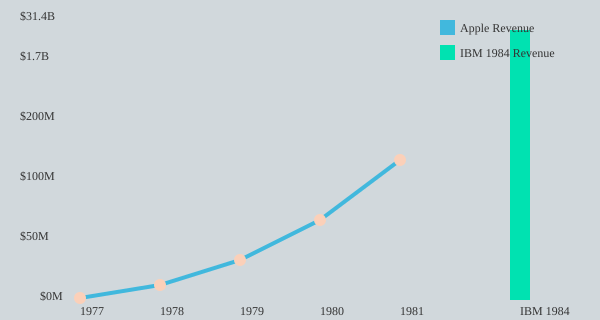
The garage, the grit, and the audacity of Apple’s early years became the stuff of legend—fueling a mythos that continues to inspire entrepreneurs and innovators around the world.
Vision Meets Mayhem: The Steve Jobs Management Experiment (1981–1985)
Between 1981 and 1985, Apple was a company defined by both its meteoric ambitions and its internal chaos. At the center of this whirlwind stood Steve Jobs, whose management style became legendary for its mix of brilliance, volatility, and relentless perfectionism. This era offers some of the most striking lessons from Apple failures, as Jobs’ vision collided with the realities of product development and market demands.
Steve Jobs’ Management Style: Inspiration and Intimidation
Steve Jobs’ leadership was as inspiring as it was infamous. He was a visionary who could electrify a room with his ideas, yet his perfectionism often manifested as impatience and outbursts. Employees at Apple quickly learned to avoid him in the hallways and elevators, fearing that a single unimpressive comment could lead to instant termination. As one observer put it:
"You bleed money like it's endless. You belittle the very people building your machines. And worst of all, you refuse to listen to anyone but your own ego."
Jobs’ management style was a wild card—one moment he would dismiss an idea as “stupid,” only to present it as his own breakthrough the next day. This unpredictable behavior created an atmosphere of both awe and anxiety within Apple’s ranks.
Obsessed with Aesthetics: Apple Product Development Philosophy
Jobs’ obsession with design and the customer experience was legendary. He believed that every detail mattered, from the look of the circuit boards to the packaging of the product itself. This philosophy, while groundbreaking, often led to costly missteps. The Lisa computer, launched in 1983, is a prime example. Priced at a staggering $10,000—compared to IBM’s $1,565 PC—Lisa was packed with features that few users needed or wanted. The result was a commercial flop, a classic case of Apple product failures rooted in over-engineering and misreading the market.
- Lisa (1983): $10,000 price tag, over 64,000 memory circuits, and features that served Jobs’ vision more than customer needs.
- IBM PC (1981): $1,565, focused on affordability and compatibility, quickly dominating the market.
Micromanagement and In-House Development: A Costly Gamble
Unlike IBM, which licensed PC DOS from Microsoft and encouraged third-party software, Jobs insisted that Apple engineers build everything in-house. This approach, driven by his desire for control and perfection, led to ballooning costs and delayed timelines. Millions were spent developing features that only Jobs truly valued, while competitors raced ahead by leveraging outside innovation. This Apple product development philosophy—prioritizing internal creation over practicality—proved to be a double-edged sword.
When Vision Trumps Practicality: The Cooling Fiasco
Jobs’ relentless pursuit of aesthetics sometimes overruled basic engineering sense. He famously demanded a silent cooling system for the Macintosh, declaring that fans were “ugly” and noisy. The result? Early Macintoshes overheated and crashed within days of purchase, forcing Apple to spend millions fixing a problem that could have been avoided with a simple fan. This episode stands as a stark lesson from Apple failures: leadership brilliance alone can’t compensate for user-unfriendly, overpriced products.
The ‘Unboxing Experience’: Packaging Over Performance
Jobs’ fixation extended even to the product’s packaging. He insisted that opening a Macintosh should be a dramatic, memorable event, leading Apple to spend a fortune on box design. While this created the legendary ‘unboxing experience’—a concept now emulated across the tech industry—it also added to the Macintosh’s already high price. At launch, the Macintosh cost $2,495, nearly 60% more than IBM’s PC.
- Wild Card: Jobs’ quirks were notorious—he even parked his Mercedes in handicap spots just to save a few steps, sparking both admiration and exasperation among employees.
During these years, Steve Jobs’ management style pushed Apple to the edge of both genius and chaos. His focus on aesthetics and the customer ‘wow factor’ created legendary moments—but also costly product failures and internal turmoil that nearly brought the company to its knees.
Dysfunction Junction: Boardroom Drama, CEO Swaps, and the Great Ousting
Apple’s corporate history is a masterclass in how leadership changes can spark both innovation and chaos. In the early 1980s, as Apple grew from a scrappy startup into a major player, Steve Jobs realized he needed what he called “adult supervision.” Enter John Sculley, the celebrated Pepsi executive, recruited with the famous pitch: “Do you want to sell sugar water for the rest of your life, or do you want to come with me and change the world?” Jobs believed Sculley’s corporate polish could help Apple win over conservative business customers and bring stability to the company’s wild, creative culture.
But this leadership change set the stage for one of Silicon Valley’s most infamous boardroom dramas. The Apple boardroom became a battleground—a real-life version of Succession, but with more circuit boards and fewer family feuds. Jobs, the mercurial visionary, clashed with Sculley’s buttoned-up management style. Sculley admired Jobs’ genius at first, but soon witnessed the darker side: Jobs could be ruthless, firing employees on a whim and berating engineers for ideas he’d later claim as his own. The culture at Apple grew tense, with staffers avoiding Jobs out of fear and uncertainty.
Jobs’ perfectionism sometimes bordered on obsession. He demanded that the Macintosh be not only revolutionary but also beautiful—right down to the packaging. He insisted on developing everything in-house, driving up costs and delaying launches. Most famously, he rejected the use of cooling fans in the Macintosh because he found them ugly and noisy, resulting in overheating machines that frustrated early adopters. Meanwhile, Apple’s Lisa computer, packed with features nobody needed, launched at a staggering $10,000—far out of reach for most customers. These decisions, driven by Jobs’ vision, began to hurt Apple’s bottom line.
As Apple’s financial performance faltered, Sculley and the board grew increasingly uneasy. Jobs, frustrated by Sculley’s interventions, attempted to orchestrate a coup while Sculley was away on business. The board, unimpressed by Jobs’ declaration—
“Without me, none of you would be sitting here. Without me, Apple wouldn't exist.”—decided it was time for a change. In a dramatic showdown, Jobs was ousted from the company he had built. The board’s message was clear: “You don’t get to decide. We do. And we just did. You’re fired.”
The aftermath of Jobs’ departure marked a turning point in Apple leadership changes. Sculley, now in control, focused on short-term financial performance. He raised the price of the Macintosh from $1,995 to $2,495, prioritizing margins over accessibility. On paper, Sculley’s reign looked like a success: Apple’s revenue soared from $1.9 billion in 1985 to $8 billion by 1993. Stock prices and profits climbed, but something vital was lost. The creative spark that had defined Apple faded, and the company’s product pipeline began to dry up. Innovation slowed, and Apple’s unique culture—built on risk-taking and bold ideas—gave way to corporate caution.
| Year | Revenue | Macintosh Price |
|---|---|---|
| 1985 | $1.9B | $1,995 |
| 1993 | $8B | $2,495 |
The irony of this era in Apple corporate history is striking. While Sculley delivered impressive financial growth and appeased shareholders, he neglected the very qualities that had made Apple special. The boardroom power struggles and leadership changes triggered instability and a loss of culture. Cutthroat decisions, focused on quarterly results, devastated creativity and long-term strategy. Apple’s story during these years is a cautionary tale: leadership changes can bring stability, but if they come at the cost of vision and innovation, even the most promising company can lose its way.
From Bleeding to Blazing: Apple’s Corporate Turnaround (1997 and Beyond)
By the mid-1990s, Apple was in deep trouble. Once a pioneer in the personal computer industry, the company had lost its way. Between 1992 and 1997, Apple’s market value dropped by a staggering 80%. Financial losses mounted, layoffs swept through the workforce, and rumors of a buyout or bankruptcy were everywhere. Shelves in electronics stores were filled with unsold, dusty Macintosh computers. Even loyal employees began to abandon ship, and investors had lost all hope. Apple’s financial performance was so dire that the company was losing over a billion dollars every year, bleeding cash with no clear path to recovery.
The brand that once symbolized innovation was now seen as a relic. Most retailers gave Apple computers little shelf space, and the public perception was that the company’s best days were behind it. In a desperate move, Apple even took out full-page ads in newspapers, explaining its problems and pleading for patience from its dwindling customer base.
Corporate Turnaround Strategies: The Return of Steve Jobs
In 1997, just as Apple teetered on the edge of bankruptcy, a dramatic twist changed everything. Through the acquisition of NeXT, Steve Jobs returned to the company he had co-founded—and been forced out of—over a decade earlier. His arrival marked a turning point, not just for Apple’s product direction, but for its entire corporate spirit.
Jobs wasted no time in implementing bold corporate turnaround strategies. He brought ruthless clarity and focus to Apple’s operations. One of his first moves was to slash the bloated product lineup. Instead of dozens of confusing models, Jobs insisted on a simple grid: consumer and professional, desktop and portable. This radical simplification allowed Apple to concentrate its limited resources on a handful of products that could truly stand out.
Cutting Costs and Betting on Big Ideas
Jobs’ approach was simple but audacious: cut what wasn’t working, and bet big on a few key innovations. He killed off underperforming products and projects, streamlined the company’s operations, and focused on design and user experience. This was a classic example of how great corporate turnarounds require ruthless clarity, focus, and a little audacity.
The first major fruit of this new vision was the iMac, released in 1998. With its colorful, all-in-one design and user-friendly approach, the iMac became a symbol of Apple’s rebirth. It was more than a computer—it was a statement that Apple was back, and ready to lead again.
“Today is the beginning of the greatest corporate comeback in history.”
Market Value Growth: From Brink to Boom
The results of these Apple corporate turnaround strategies were nothing short of astonishing. Apple’s market value growth after 1997 is now legendary. The company went from losing over a billion dollars a year to becoming the world’s first $3 trillion company. The iMac was just the start; soon, breakthrough products like the iPod, iPhone, and iPad would follow, each redefining its category and driving Apple’s financial performance to new heights.
| Year/Period | Key Moment | Impact |
|---|---|---|
| 1992–1997 | Market value drops 80% | Apple nears bankruptcy |
| 1997 | Steve Jobs returns | Corporate turnaround begins |
| 1998 | iMac release | Pivotal post-comeback moment |
| 2022 | Apple becomes first $3 trillion company | Mind-bending recovery |
The ‘Crazy’ Factor: Breaking the Rules
Looking back, Jobs’ moves seemed risky—even reckless. But sometimes, the only way back from the brink is to break all the old rules. Apple’s corporate turnaround wasn’t just about better products; it was about a new way of thinking. Jobs’ resilience and unconventional leadership are now iconic, showing that the line between genius and chaos can be razor-thin—but with the right vision, it can also be the path to greatness.
When Products Flop, and Why That’s (Sometimes) a Good Thing
Apple’s journey is littered with high-profile product failures—each one a headline-grabbing lesson in the risks and rewards of innovation. From the infamous Lisa to the Newton and the early overheating Macs, these Apple product failures were disasters by the numbers. But, as history shows, failure can be a powerful catalyst for reinvention—if you’re willing to learn fast and move on.
Apple’s Most Notorious Faceplants
- Lisa (1983): Priced at a staggering $10,000, Lisa was Apple’s first attempt at a personal computer with a graphical user interface. While IBM sold its PC for $1,565, Lisa’s cost was sky-high, largely due to overengineered features that most users didn’t need. The result? Lisa flopped, selling only about 10,000 units and quickly becoming a cautionary tale in tech history.
- Newton (1993): Apple’s early foray into handheld computing, the Newton, promised to revolutionize note-taking and personal organization. Instead, it became a punchline due to its unreliable handwriting recognition and high price. Despite years of development, the Newton failed to gain traction and was discontinued, costing Apple hundreds of millions.
- Early Macintosh Models (1984): The original Macintosh launched at $2,495—much higher than competitors. Steve Jobs’ obsession with aesthetics led to costly packaging and a fanless design, causing the machines to overheat and crash. Customers were left with expensive computers that “got heated like a freaking toaster” and offered little practical advantage.
Were They Ahead of Their Time—or Just Glorified Doorstops?
Each Apple product failure sparked intense debate. Some argued these devices were simply too advanced for their era, while others saw them as examples of overengineering and misplaced priorities. Lisa, for instance, introduced concepts like protected memory and a graphical interface—features that would later become industry standards. But in the moment, these innovations were overshadowed by poor market fit and sky-high prices.
The Newton, too, was a bold vision of mobile computing, but its technology wasn’t ready. Its handwriting recognition was unreliable, and its battery life was poor. The world would eventually embrace smartphones and tablets, but the Newton’s time had not yet come.
Lessons from Apple Failures: The Dangers of Overengineering
One of the clearest lessons from Apple’s product innovation missteps is the danger of building for ego rather than customer needs. Steve Jobs’ insistence on developing everything in-house, from software to packaging, led to ballooning costs and missed deadlines. Apple spent millions on features that few customers valued, while competitors like IBM focused on affordability and compatibility.
As one observer noted, “Apple spent a fortune on just the packaging of the Macintosh just because Steve Jobs wanted the customers to have a dramatic experience of opening the bloody Macintosh box.” These choices made Apple’s products expensive and, at times, impractical.
What If Lisa Had Succeeded?
It’s worth imagining: if Lisa had been a runaway hit, would Apple have become the world’s design standard-bearer, or would it have doubled down on bloated, overengineered gadgets? Sometimes, failure is the only thing that forces a company to rethink its approach. The Lisa’s flop pushed Apple to reconsider its priorities, streamline its designs, and focus on what customers actually wanted.
How Failure Fueled Apple’s Innovation Mojo
Apple’s willingness to fail fast and adapt became a cornerstone of its long-term survival. After each flop, the company made strategic pivots—abandoning costly projects, overhauling processes, and embracing riskier, more focused launches. Many of Apple’s most iconic products, from the iMac to the iPhone, emerged after periods of crisis and reflection.
“You’ve got to be willing to fail. You’ve got to be willing to crash and burn starting a company.”
Apple’s history of product failures is a treasure trove of hard-won lessons. Each misstep taught the company to listen to its customers, avoid overengineering, and never stop reinventing itself. In the world of Apple product innovation, sometimes a flop is just the beginning of something extraordinary.
The Secret Sauce: Customer Obsession and Relationship Magic
When people talk about Apple’s rise, fall, and spectacular rebirth, they often point to innovation or design. But beneath the surface, Apple’s true secret sauce is its relentless customer obsession—a philosophy that turns ordinary buyers into lifelong brand devotees. At Apple, customer relationship management (CRM) wasn’t just a tool or a department. It was a way of life, woven into every interaction, every product, and every detail of the user journey.
Apple’s Core Strength: Cult-Like Loyalty Through Relationship Magic
Apple’s approach to customer relationship management is legendary. The company doesn’t just sell products; it builds relationships and communities. From the moment a customer steps into an Apple Store, the experience is intentionally seamless. Friendly staff greet visitors, answer questions, and offer hands-on demos—no pressure, just genuine help. This focus on delight drives return business, even from skeptics who may have doubted Apple’s products at first.
Apple’s CRM philosophy extends far beyond the sale. Personalized follow-ups, easy appointment scheduling at the Genius Bar, and proactive support emails all reinforce the sense that every customer matters. As one industry observer put it,
"Apple uses CRM to create seamless experience for every customer."
The Emotional Power of the Apple Experience
Ask any Apple fan about their first unboxing, and you’ll likely hear an emotional story. The packaging is meticulously designed, turning a simple act into a brand ritual. The box slides open with a satisfying hiss, revealing the product nestled like a treasure. This attention to detail is no accident—it’s a deliberate part of Apple’s product development philosophy. Every touchpoint, from packaging to setup, is crafted to delight and surprise.
This emotional connection is so strong that it transforms customers into advocates. Many recall their first Apple unboxing as a genuinely memorable event, a moment that cemented their loyalty. This is the magic of relationship-building at its finest: a seamless user experience that turns buyers into lifelong fans.
Wild Card: Would Apple Fans Buy Anything?
Consider this: what if Apple suddenly released a dull, generic laptop—no sleek design, no innovative features, just a plain machine with the Apple logo? Would loyalists revolt, or would they still buy it just for the sticker? The answer reveals the depth of Apple’s relationship magic. For many, the connection goes beyond the product itself. It’s about trust, anticipation, and the belief that Apple understands their needs better than anyone else.
Customer Delight as Industry Standard
Apple’s obsession with customer delight didn’t just build loyalty; it reshaped the entire tech industry’s expectations. Competitors scrambled to match Apple’s seamless user journeys, memorable packaging, and personalized support. Today, customer relationship management is recognized as a core driver of market dominance, not just for Apple but for any brand aiming for long-term success.
Modern Tools Inspired by Apple’s Holistic Approach
Apple’s CRM magic wasn’t about fancy software—it was about understanding and anticipating customer needs at every stage. But in today’s fast-paced world, businesses need tools that can help them deliver a similar experience. Modern solutions like ODO CRM are inspired by Apple’s holistic approach to managing relationships.
- ODO CRM is an all-in-one business management platform designed to transform how companies connect with customers.
- Its intuitive interface keeps everything organized and accessible, allowing users to view customer interactions at a glance.
- The kanban view tracks progress through each stage of the pipeline, with every crucial detail visible on easy-to-read cards.
- Built-in communication tools—like scheduling calls, meetings, and sending emails—are all in one place, making follow-ups effortless.
- Customizable dashboards and accurate revenue forecasts keep businesses in control, echoing Apple’s data-driven approach to delighting customers.
Just as Apple’s CRM philosophy turned customers into lifelong fans, modern tools like ODO CRM empower businesses to deliver an Apple-like experience—seamless, personal, and unforgettable. The first app is even free for life, making it easier than ever to put customer delight at the heart of your business.
Legacy and Lessons: After Jobs, Apple’s Next Act
When Steve Jobs passed the torch to Tim Cook in 2011, the world watched Apple with a mix of awe and anxiety. Jobs had been the company’s creative heartbeat, the visionary who led Apple from the brink of collapse to the summit of American business history. Many wondered if Apple could survive—let alone thrive—without its iconic founder. Yet, what followed was not a slow fade, but a new chapter of astonishing growth and transformation. The story of Apple’s next act is not just about products or profits; it is about the power of leadership evolution and the ability of a company to outlast even its brightest stars.
Tim Cook’s Role: Operational Excellence and Strategic Expansion
Tim Cook’s leadership style could not have been more different from Jobs’. Where Jobs was dramatic and mercurial, Cook was calm, methodical, and quietly relentless. He focused on what he knew best: operational excellence. Cook’s mastery of Apple’s global supply chain and his focus on scalability allowed the company to meet soaring demand and expand into new markets with unprecedented efficiency. Under his stewardship, Apple’s product ecosystem broadened, becoming even “stickier” as devices and services worked together more seamlessly than ever before.
Cook’s approach proved that leadership changes can propel companies to new heights—if they blend innovation with pragmatic execution. He did not try to imitate Jobs’ creative genius; instead, he built on it, ensuring that Apple’s culture of innovation was supported by world-class execution.
Apple Financial Performance: From Milestone to Milestone
The numbers tell a story of their own. Under Tim Cook, Apple became the first company in history to reach a market value of $3 trillion. This staggering leap in valuation was not just a testament to the iPhone’s enduring popularity, but also to the company’s ability to reinvent itself and push boundaries. As one observer put it,
"The company has proven its ability to reinvent itself and push boundaries."
| Era | Market Value | Key Product Launches |
|---|---|---|
| Steve Jobs | $350 billion (2011) | iPod, iPhone, iPad |
| Tim Cook | $3 trillion (2024) | Apple Watch, AirPods, Services Expansion |
Apple’s financial performance under Cook has been nothing short of historic. Revenue and profits soared, driven not just by hardware, but by a rapidly growing services business and new product categories that deepened customer loyalty.
Apple Product Evolution: The Power of the Ecosystem
After Jobs, Apple’s product evolution accelerated. The Apple Watch and AirPods became cultural phenomena, while the company’s services—like Apple Music, iCloud, and Apple Pay—cemented the “ecosystem lock.” This strategy made it harder than ever for customers to leave the Apple universe, further boosting revenue and market share. The company’s willingness to expand its product line, while maintaining its signature focus on design and user experience, proved that Apple’s real magic lies in continual reinvention.
Lessons from Apple Corporate History: Reinvention Beyond Icons
The greatest lesson from Apple’s corporate history is that true strength comes from building a company that can outlast its icons. The fear that Apple would collapse after Jobs was understandable, but misplaced. Instead, the company’s next act under Tim Cook showed that operational mastery and quiet leadership can be just as vital as visionary genius. Apple’s future-proofing efforts and strategic pivots—guided by Cook’s steady hand—demonstrate that the company’s legacy is not tied to any one individual, but to its culture of relentless improvement.
In the end, Apple’s journey from Jobs to Cook is a testament to the power of reinvention. The company’s ability to push boundaries, adapt, and thrive ensures that its wild ride is far from over. As Apple continues to evolve, its greatest legacy may be the lesson that the real magic is not in any single product or leader, but in the company’s unwavering commitment to continual reinvention.
TL;DR: Apple’s journey is equal parts chaos and genius—a tale of hard falls, stubborn comebacks, and relentless focus on innovation and customers. If you’re hungry for lessons in leadership, creativity, or business strategy, their story leaves no stone unturned (or product box unopened). Buckle up for a wild, inspiring ride!
Post a Comment