

It started with a bad cup of coffee (and an even worse boss). I figured, how hard could it be to run this show? Turns out, much harder than I thought. Like the vast majority of new business owners, I believed technical skill was all it took for sustainable success. Spoiler alert: It’s not. If you’re even faintly considering launching your own venture or are knee-deep in the mess already, let’s talk honestly about what it really takes to keep your business off the casualty list—straight from someone with the scars to prove it.
Facing the Grim Stats and Fatal Assumptions (A Wake-Up Call)
If you’re dreaming of small business success, it’s time for a reality check. The numbers are sobering: half of all small businesses fail within their first year. Of those that survive, 75% will be gone by year five. The odds are stacked against you, and the risks are real.
| Milestone | Failure Rate |
|---|---|
| Year 1 | 50% |
| Year 5 (cumulative) | 75% |
Why do so many businesses fail? According to Michael E. Gerber’s The E-Myth Revisited, most founders fall into the trap of believing that technical skill equals business mastery. This fatal assumption is at the heart of many business failures. You might be an expert baker, designer, or mechanic, but running a company demands far more than just technical know-how. It requires understanding entrepreneurial roles, the business development process, and applying proven business growth strategies to avoid business failure.
I learned this lesson the hard way. When I started my first business, I thought being great at my craft was enough. Instead, I found myself working twice as hard for less freedom. The dream of being my own boss quickly turned into a nightmare. As Gerber puts it:
"You were about to go from hating the idiot boss to becoming the idiot boss yourself."
Entrepreneurial self-delusion is common. Many founders believe that passion and skill will carry them through. But without a systematic approach to business development, you risk becoming overwhelmed, overworked, and ultimately, another statistic. To achieve small business success, you must step back, rethink your assumptions, and build a business that works for you—not the other way around.
You’re Not Just One Person—Meet the Entrepreneur, the Manager, and the Technician
Every small business owner wears three hats, whether you realize it or not. These are the core entrepreneurial roles that shape your work culture and business management style. Understanding and balancing these roles is critical for sustainable growth. Neglecting one can lead to burnout, chaos, or stagnation.
- The Entrepreneur is the dreamer—the visionary who sees opportunities and imagines what could be. This role is all about big ideas and bold moves.
- The Manager brings order, structure, and systems. They crave predictability and love a well-labeled filing cabinet (I admit, even my paperclips have a home).
- The Technician is the doer. They get stuff done, focusing on the hands-on work. If you’ve ever thought, ‘If you want it done right, do it yourself’, you are a technician.
But here’s the challenge: these roles compete inside you, just like the eternal fight between the ‘skinny guy’ and the ‘fat guy’ when dieting. The Entrepreneur wants to chase every new idea, the Manager wants to keep things under control, and the Technician just wants to do the work. This inner battle shapes your decisions under stress and influences your business’s sustainability.
On a good week, I flip between visionary chaos and an obsession with organization. One day I’m mapping out the future, the next I’m color-coding folders. But if you let one role dominate, your business suffers. Too much Technician, and you’re stuck in the weeds. Too much Manager, and you smother innovation. Too much Entrepreneur, and you create chaos without results.
| Role | Symptoms |
|---|---|
| Entrepreneur | Visionary chaos |
| Manager | Organizational compulsions |
| Technician | Technical tunnel vision |
Recognize these roles within yourself. Balancing them is the heart of effective business management and a healthy work culture.
The Three Phases of Business Growth (And Where Most People Wipe Out)
Every small business travels a rocky road from startup to success, passing through three distinct phases: Infancy, Adolescence, and Maturity. Understanding these stages—and the traps at each—is the key to building a scalable business model and avoiding self-destruction.
Phase 1: Infancy – Technician-Driven Chaos
Infancy is where most business owners wipe out. You’re doing it all: sales, service, admin, even cleaning. The excitement of launching quickly turns into exhaustion—12- to 14-hour days, seven days a week, are common. There are no systems, just you juggling every job. As the saying goes:
'You don’t have a business. You have a job—and it’s the worst kind of job.'
Most business failures happen here, not from lack of effort, but from lack of systematizing operations. Without a clear business development process, burnout is inevitable.
Phase 2: Adolescence – Scrambling for Help
Survive Infancy, and you’ll hit Adolescence—the scramble to delegate. You hire your first employees, hoping to reclaim your life. But without documented systems, delegation becomes dangerous. Suddenly, your business runs on other people’s habits, not your vision. You may wake up to find your processes have vanished into chaos. The biggest risk here: letting go of control before you’ve built a foundation for others to follow.
Phase 3: Maturity – Systematizing for Scalability
Maturity is the promised land, but few reach it. Here, you focus on systematizing operations—creating repeatable processes, checklists, and automation. The business becomes system-dependent, not people-dependent. This is where a true scalable business model emerges, and sustainable growth strategies take root. Delegation is no longer risky because your systems run the show, not personalities.
Unfiltered tip: You don’t become a ‘real’ business until systems—not people—run the show. Systematizing operations is the only way to survive the transition from technician-led chaos to a resilient, scalable business.
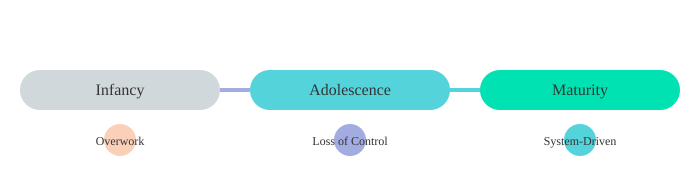
Table: Common Delegation Mistakes and How to Fix Them
Proper delegation is one of the toughest transitions in small business management, especially as you move from doing everything yourself to leading a team. Many owners fall into the trap of abdicating responsibility—handing off tasks without clear direction—rather than systematizing operations and truly delegating. As seen in the “Harry” scenario, this can lead to chaos, missed deadlines, and a business that no longer feels like your own. Below is a table outlining the most common delegation mistakes, their consequences, and best practices for fixing them using proven business management strategies.
| Mistake | Consequence | Best Practice Fix |
|---|---|---|
| No Documentation | Staff guess at tasks, leading to inconsistent results and confusion. |
|
| Abdication (Not Delegation) |
“You never should have trusted Harry. You never should have trusted anyone.” Loss of control, staff set their own rules, business drifts from your vision. |
|
| Lack of Staff Training | Employees make mistakes, customers complain, quality drops. |
|
Systematizing operations and following best practices in business management—like creating documented processes and regular feedback—will help you delegate effectively, keep control, and grow your business with confidence.
Chart: Small Business Owner Burnout Rates vs. Success Metrics
One of the most overlooked threats to small business success is owner burnout. The harsh reality is that most small business owners in the Infancy stage work an average of 12–14 hours a day, seven days a week. This endless workload is a leading cause of failure, especially when you try to scale without systematizing operations. As Michael E. Gerber highlights, “You realize you don’t want to do this anymore.” This moment of exhaustion is when many owners give up.
The chart below illustrates the direct link between owner work hours and business survival rates across the three key stages: Infancy, Adolescence, and Maturity.
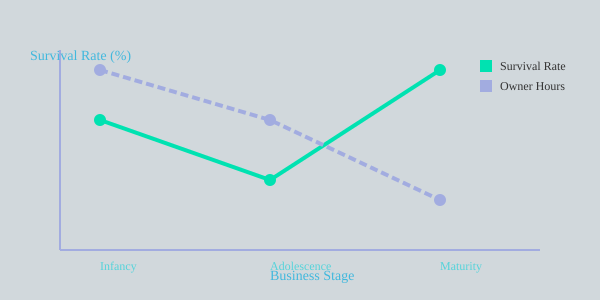
- Infancy: Owners average 12–14 hours/day. Failure rates spike as burnout sets in.
- Adolescence: Delegation without systems leads to chaos and loss of control, often causing business shrinkage or collapse.
- Maturity: Businesses that implement system-based management show a 1:1 correlation with long-term sustainability and owner satisfaction.
The data is clear: Overwork without systems leads to burnout and early failure. Early systematizing operations is the most reliable business growth strategy for boosting survival and satisfaction rates.
Wild Card: The Unspoken Emotional Pitfalls (and How to Stay Sane)
Let’s get real: building a small business isn’t just about systems, sales, or work culture. The emotional side can be just as brutal as the technical challenges. If you’ve ever felt overwhelmed by self-doubt, guilt for taking a break, or frustration when things don’t go as planned, you’re not alone—and you’re not broken. In fact, over 60% of first-year entrepreneurs report burnout, and persistent feelings of impostor syndrome are the norm, not the exception.
Michael E. Gerber’s The E-Myth Revisited nails it: “Everyone gets in the technician’s way.” That includes you. The constant tug-of-war between your inner Entrepreneur, Manager, and Technician isn’t just operational—it’s emotional. You might love the dream of financial freedom and time freedom, but the reality is often late nights, missed family moments, and the nagging sense you’re not doing enough. These hidden costs—burnout, guilt, and loneliness—are rarely discussed, but they can quietly sabotage your small business success.
Here’s the truth: mental and emotional self-care is as important as your business plan. Celebrate tiny wins, even if it’s just sending one email or making one sale. Schedule guilt-free downtime—your productivity can jump by up to 20% after a real mental health break. Don’t isolate yourself; connect with peers who understand the grind. I once took a ‘mental health’ Monday with zero apologies, and it made me a better leader the rest of the week.
Owning a business is a marathon, not a sprint. The journey to financial freedom and a healthy work culture starts with protecting your own well-being. Remember, the emotional pitfalls are part of the process, not proof you’re failing. Stay resilient, keep perspective, and give yourself permission to be human. That’s how you build a business—and a life—that truly works.
TL;DR: You can dodge the small business failure trap if you recognize the three personas in yourself—the Entrepreneur, the Manager, and the Technician—and design systems for sustainable growth instead of relying on passion alone. Systematize, stay curious, delegate wisely, and your business might just become the boss you’re happy to work for.
Post a Comment