

Let me tell you about the week I spilled coffee on my only suit right before a pitch meeting. Embarrassing? Sure. But it taught me that having nothing to lose is the ultimate underdog advantage. If you’re feeling invisible in the business world—no followers, tiny client list, a social media account dustier than your high school yearbook—consider this: your obscurity is actually your greatest asset. Buckle up, because you’re about to see why starting from nowhere can help you outsmart the household names.
Turning Failure Into Your Secret Growth Tool (Business Challenges Table)
Let’s get real: nobody starts at the top. If you’re feeling like a nobody in the business world, you’re actually in the perfect position to unlock the ultimate underdog business edge. Why? Because failure isn’t just common—it’s practically required. The road to success is paved with flops, false starts, and faceplants. But here’s the secret: every failed attempt is a lesson that sharpens your instincts, builds your resilience, and brings you one step closer to your breakthrough.
Embrace (and Expect) Setbacks: The Rite of Passage
Early failures aren’t a life sentence—they’re a rite of passage. Most entrepreneurs don’t get it right the first, second, or even third time. As one founder put it, “Most people fail the first time and the second and the third.” If you’re struggling with business challenges, know that you’re not alone. The startup lessons you gain from each stumble are what set you up for future wins.
Anecdotal Spiral: Fumbling Before Striking Gold
Take it from someone who’s been there: before building a successful portfolio, I had nine businesses that amounted to almost nothing. That’s right—nine. Unless you’re Mark Zuckerberg or Jeff Bezos (and let’s be honest, most of us aren’t), you’re going to fumble through several flops before you strike gold. The truth is, every entrepreneur you admire has a graveyard of failed ideas behind their success story.
Transparency Check: Even Giants Eat Glass
Don’t be fooled by highlight reels. Even the giants admit it’s tough. Elon Musk famously described entrepreneurship as “eating glass and staring into the abyss.” The reality is, most founders spend their first years building logos, launching websites, and waiting for someone—anyone—to buy. At first, nothing happens. Then, maybe you make a sale, but it doesn’t feel real. Eventually, you start making revenue, but profit is nowhere in sight. You’re taking on risk, maybe even debt, just to keep the dream alive. This is the grind that forges the entrepreneurial mindset—perseverance, grit, and relentless innovation.
Failure Actually Reduces Risk: Each Flop Is a Free Lesson
Here’s the twist: every failure actually makes you stronger and smarter. Each time you fall short, you’re collecting data, refining your approach, and learning what doesn’t work. These are cost-free lessons that reduce your risk the next time around. The more you fail, the more you know—and the closer you get to that breakthrough moment. This is the secret sauce of business scaling: learning fast, failing forward, and adapting relentlessly.
Industry Table: How Many Times Do Entrepreneurs Fail Before Success?
Think you’re failing too much? Think again. The average number of failed attempts before a real breakthrough is higher than most people realize. Check out the table below:
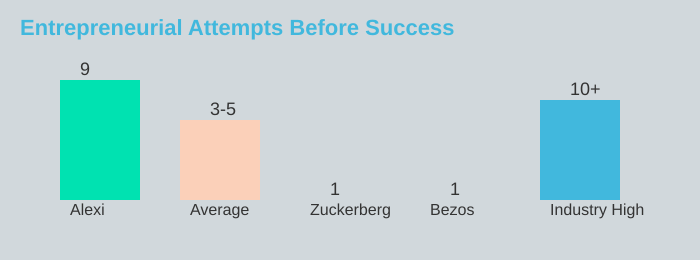
| Entrepreneur | Failed Attempts Before Success | Notes |
|---|---|---|
| Alexi (Anecdote) | 9 | Multiple flops before breakthrough |
| Industry Average | 3-5 | Most founders fail several times |
| Mark Zuckerberg | 1 | Exception, not the rule |
| Jeff Bezos | 1 | Exception, not the rule |
| Industry High | 10+ | Persistence pays off |
Encourage Persistence: Every Reset Is a New Scratch-Off Ticket
Every time you start over, you’re not back at zero—you’re back at zero with experience. Think of each new attempt as a scratch-off ticket with unlimited upside. The more you play, the better your odds. The underdog business advantage is real: you learn, adapt, and innovate faster than those who never face real business challenges. So, keep going. Your next attempt could be the one that changes everything.
Every Disadvantage Has a Competitive Edge If You Flip It (Competitive Edge Chart)
In the world of business, it’s easy to see being an underdog as a disadvantage. Maybe you’re not a household name. Maybe you don’t have a wall of case studies or a massive team. But here’s the secret: every disadvantage can become your ultimate competitive edge—if you flip it. The very things that make you a “nobody” can help you win in customer engagement, customer retention, and market competition. Let’s break down how you can turn your small size into a powerful asset, and why customers are craving exactly what you have to offer.
Personalized Service vs. Big Brand Impersonality
Big brands are safe. They have systems, scripts, and layers of support. But that safety comes at a cost: impersonality. When a client signs up with a market leader, they’re often just another account number. Their calls go to support tickets, and their emails are answered by whoever’s next in the queue. The truth is, customer engagement and customer retention are often higher in small businesses because you can offer something big brands can’t—personal connection.
- Direct owner access: You’re not passing clients off to a faceless account rep. You’re there, in the trenches, solving problems and celebrating wins.
- Real relationships: You know your clients’ names, their goals, and their struggles. That’s something no big brand can automate.
Unique Selling Point: You, Not a Rep
When a prospect says, “You’re not Gym Launch. Show me your track record,” it’s tempting to feel small. But here’s your edge: you’re not Gym Launch. You’re not a giant. You’re a real person who cares. That’s your unique selling point. As one agency owner put it:
For me, you’re going to have my cell phone number. If you need anything, you can call me whenever you want. It’s actually me.
This isn’t just a nice touch—it’s a competitive edge. When you offer your direct attention, you’re not just another vendor. You’re a partner. That’s what keeps customers coming back, and it’s what makes your business unforgettable.
Story: Winning Clients with Direct Access
Imagine this: A client is weighing their options. On one side, a giant brand with a polished pitch and endless testimonials. On the other, you—an underdog, but one who says, “Here’s my cell phone. If you need me, I’m here.” That’s not just a story; it’s a strategy. Time and again, small businesses win clients because they offer unparalleled attentiveness and direct owner access. You’re not competing with the whole colossus. You’re beating their entry-level gatekeeper.
Competitive Comparison: Safe vs. Invested
| Big Brand | Small Business (Underdog) |
|---|---|
| Account rep, support tickets | Direct owner access |
| Standardized process | Personalized solutions |
| Customer = number | Customer = name, story, relationship |
| Safe, proven, but distant | Invested, agile, and caring |
Compelling Marketing: Facts Over Claims
Don’t just say you care more—prove it. Compelling marketing comes from drilling down to facts, not just claims. Share real stories of how your hands-on approach made a difference. Show prospects the actual advantages of working with you. Use data, testimonials, and personal anecdotes to highlight your edge.
Competitive Edge Chart: Customer Engagement & Retention
Research shows that customer engagement rates and customer retention are consistently higher in small business settings, especially when clients have direct access to the owner. Here’s a visual comparison:
Being ‘small’ isn’t a weakness. It’s your competitive edge. When you lean into direct customer engagement and authentic relationships, you create loyalty that big brands can’t match. In the end, your greatest asset is being yourself—and caring more than anyone else in the market.
Volume Isn’t Luck: Why Your Reach is Smaller Than Your Potential (Market Takeover Table)
As an underdog business, it’s easy to look at your results and think, “I’m just unlucky.” Maybe you get one or two customers a month and wonder why growth feels so random. But here’s the truth: volume isn’t luck. The real reason your reach is smaller than your potential is because you’re not doing enough—yet.
The Size of the Pie Fallacy: Market Competition Isn’t What You Think
Most small business owners fall for the “size of the pie” fallacy. You start promoting on one channel—say, Instagram—and get a few customers. Then a competitor shows up, and suddenly it feels like your slice of the market pie is shrinking. More competitors? Now you fear there’s barely a crumb left for you.
But this is an illusion. The market isn’t a single pie, and you’re not fighting over the same slice. In reality, there are dozens of pies—untapped audiences, platforms, and strategies that most businesses never touch. You’re not stealing pie slices; you just keep forgetting there’s a second and third pie in the kitchen.
Most Businesses Only Tap a Tiny Sliver of Their Potential Audience
Here’s the hard truth: most small businesses only use one or two marketing methods. Maybe you post on Instagram, or run a few Facebook ads, or rely on word of mouth. But what about:
- Cold outreach (DMs, emails, calls)
- Warm outreach (existing network, referrals)
- Content marketing (blogs, videos, podcasts)
- Paid ads (Google, TikTok, LinkedIn, YouTube)
- Affiliate partnerships
- Referral programs
- Comment strategies (engaging on other people’s content)
Each of these is a new “pie” to taste. Most are untouched by your competitors. That means your real market is far bigger than you think—and your reach is only small because you haven’t tried enough ways to get noticed.
The Rule of 100: Your Secret Weapon for Market Takeover
So how do you break through? The answer is simple: volume. The more you do, the more consistent your results become. That’s why the Rule of 100 is a game-changer for small business growth and market takeover:
- 100 DMs or calls per day
- 100 minutes of content creation per day
- 100 minutes of paid ads per day
Can’t hit 100? Do as much as you can—but push your limits. The key is to multiply your exposure across as many channels as possible.
“The answer is you have to advertise more. You have to let more people know about your stuff.”
Why Volume Crushes the Illusion of Bad Luck
When you only do a little, results feel random—one customer here, two customers there. But when you increase your volume, you smooth out the volatility. Suddenly, you’re not waiting for luck; you’re creating predictable growth. This is the underdog business edge: outwork the competition, and you’ll outgrow them.
Market Takeover Table: Channel Diversity vs. Actual Reach & Revenue Growth
| Marketing Methods Used | Channels/Platforms | Average Monthly Reach | Revenue Growth Rate |
|---|---|---|---|
| 1-2 (e.g., Instagram, Facebook) | Social Only | 500-1,000 | 5% |
| 3-4 (add cold outreach, content marketing) | Social, Email, Blog | 2,000-5,000 | 15% |
| 5+ (add paid ads, affiliates, referrals) | Multi-channel | 10,000+ | 30%+ |
Startup strategies that focus on channel diversity and volume don’t just survive market competition—they dominate it. The more pies you discover, the more slices you get. Market entry strategies are about multiplying your exposure, not waiting for luck to strike.
How Constraints Spark Innovation (Resource Constraints & Necessity Table)
When you’re starting out as an underdog business, it’s easy to feel like your lack of resources is a disadvantage. But here’s the truth: resource constraints are often the very thing that gives you your edge. In fact, over 60% of disruptive startups cite resource constraints as a key driver of their innovation (facingdisruption.com). When you don’t have the luxury to spend freely, you’re forced to get creative, focus on what matters, and discover breakthrough solutions that established players overlook.
Innovation Out of Necessity: The Underdog’s Secret Weapon
Think about it—if you had unlimited money, you’d probably just throw cash at every problem. But when you’re working with a shoestring budget, every dollar counts. This is where innovation necessity comes in. You have to find new ways to reach customers, operate efficiently, and stand out. As one entrepreneur put it:
“Innovation from necessity: Underdog businesses often innovate due to financial constraints, leading to unique solutions.”
Whether you’re brand new or a seasoned business owner launching a new channel, you always start at zero. The difference is, underdogs learn to thrive in that zero-resource environment. They become masters of resourcefulness—turning what seems like a curse into their greatest asset.
Story: Building a Company with Zero Ad Budget
Let’s look at a real-world example. Imagine launching a company with no ad budget. Instead of running paid campaigns, you rely on pure hustle: email outreach, social media networking, and borrowed software tools. You barter for services, leverage free trials, and build partnerships with other small businesses. Every win feels earned, and every setback teaches you something new.
This is more common than you think. Many market disruptors—think Airbnb, Dropbox, and Mailchimp—began with almost nothing. They didn’t have big marketing budgets or fancy offices. What they did have was a relentless focus on solving problems creatively. Their startup strategies were born from necessity, not abundance.
Constraints Drive Focus, Creativity, and Scrappy Problem-Solving
When resources are limited, you’re forced to:
- Prioritize: Focus only on what moves the needle.
- Innovate: Find new, unorthodox ways to reach your goals.
- Partner: Collaborate with others to fill gaps in your capabilities.
- Bootstrap: Make the most of every tool, channel, and contact you have.
These constraints become your hidden asset. They drive you to develop scrappy problem-solving skills that bigger companies often lack. You learn to do more with less, and that mindset sticks with you as you grow.
Industry Insight: Disruptors Start Small
It’s no accident that many of today’s most successful companies began with minimal resources. They didn’t wait for the perfect moment or a big investment—they started with what they had and made it work. This is the ultimate underdog business advantage: constraints force you to innovate, adapt, and outsmart the competition.
Resource Constraints & Creative Business Strategies Table
| Resource Limitation | Creative Strategy | Outcome/Advantage |
|---|---|---|
| No Ad Budget | Email outreach, social media, referral programs | Direct customer connections, viral growth |
| Limited Tools/Software | Borrowing, bartering, using free trials | Cost savings, early partnerships |
| Small Team | Cross-functional roles, outsourcing, automation | Agility, rapid learning, lean operations |
| No Office Space | Remote work, co-working, virtual meetings | Lower overhead, global talent access |
| Minimal Inventory | Pre-orders, dropshipping, just-in-time delivery | Reduced risk, faster cash flow |
Remember, the next time you feel limited by your resources, you’re actually being handed the ultimate tool for innovation. Resource constraints don’t just make you survive—they help you thrive as an underdog business.
The Truth About Volatility, Consistency, and Scaling Up (Business Agility Chart)
When you’re building your business from scratch, it’s easy to believe that wild swings in your results are just part of the game—or worse, that you’re simply unlucky. But here’s the truth: volatility in your results is almost always a volume problem, not a luck problem. This is a core lesson in Business Agility and one of the most powerful Startup Strategies for any underdog business.
Why Volatility Feels Like Your Reality
Let’s break it down. Imagine you’re selling a service and you land one new client every three to five weeks. Sometimes you get two in a month, sometimes none. It feels random. But what’s really happening? You’re just not doing enough outreach, marketing, or advertising. The small number of attempts creates the illusion of unpredictability. In fact, volatility in new businesses is statistically normal—it’s a numbers game.
Consistency Isn’t Magic—It’s Engineered
Here’s the secret: consistency can be engineered through ramping up your outreach and marketing, not by wishing for luck. The first time I made a sale, I honestly didn’t believe it was real. Consistency felt impossible at first. But as I increased my marketing activity, the results smoothed out. The more people who know about your business, the more predictable your growth becomes.
“Volume increases negate luck and will give you consistency.”
Business Agility: Your Ultimate Underdog Edge
As a small business, you have a superpower that big companies envy: agility. You can test, fail, and pivot rapidly—while enterprise competitors move like the Titanic. Business Agility means you can try new channels, experiment with offers, and iterate your approach in days, not months. This adaptability is the heart of Small Business Growth and a key reason underdogs can outpace giants.
Scaling Up: The Rule of 100
So, how do you actually engineer consistency and scale up? Use the Rule of 100:
- Do 100 reachouts a day (cold or warm)
- Spend 100 minutes a day creating and posting content
- Spend 100 minutes a day on paid ads (research, creation, and spending)
Most people underestimate how much activity is required. If you’re not seeing steady results, you’re probably not doing enough. The more you put in, the less luck matters—and the more predictable your revenue becomes.
The Myth of Market Saturation
Many new entrepreneurs believe their market is shrinking as competitors appear. But most of the market is untouched. You’re likely using just one channel—maybe Instagram reels or LinkedIn posts—while dozens of other platforms and methods remain untapped. Business Scaling happens when you diversify your outreach and fill those empty circles with your presence.
Line Chart: Marketing Activity vs. Revenue Consistency
Picture a simple line chart: on the X-axis, you have Marketing Activity (Inputs); on the Y-axis, Revenue Consistency (Outputs). In the early stages, the line is jagged—high volatility. As you ramp up your outreach and diversify your channels, the line smooths out. That’s the power of volume and agility in action.
Table: The Impact of Volume on Revenue Consistency
| Activity Level | Revenue Volatility | Consistency | Notes |
|---|---|---|---|
| Low (1-2 reachouts/day) | High | Low | Results feel random, unpredictable |
| Medium (10-20 reachouts/day) | Moderate | Improving | Some steady growth, but still swings |
| High (Rule of 100) | Low | High | Steady, predictable revenue |
Key Takeaways for the Underdog Business
- Volatility is normal when you’re doing too little—ramp up your activity for smoother results.
- Consistency is engineered by increasing volume, not by hoping for luck.
- Business Agility lets you outmaneuver bigger, slower competitors—test, pivot, and scale faster.
- Diversify your channels to unlock new growth and avoid the “shrinking pie” fallacy.
Bringing It All Together: Your First Wild Move as an Underdog (Creative Analogy & Homework)
Let’s face it: in the world of business, there’s only one Nike. The rest of us? We’re the underdogs. But here’s the secret—being a “nobody” is your ultimate entrepreneurial mindset advantage. You don’t have to play by the rules of the giants. In fact, your difference is your superpower. The underdog business thrives not by copying the leader, but by finding the cracks in their armor and innovating where they can’t or won’t.
Stop Pretending to Be Nike (Unless You Are—Hi, Nike)
Most startups and small businesses fall into the trap of trying to look, sound, and act like the market leader. But remember: there’s only one leader, and statistically, you’re probably not it. That’s not a weakness—it’s an opportunity. Instead of mimicking the empire, focus on what makes you different. Your size, your story, your speed, your community—these are assets, not liabilities.
David vs. Goliath: Aim for the Kneecap
We all know the David vs. Goliath story. But here’s the twist: David didn’t win by fighting Goliath head-on. He aimed for the weak spot. In business, you don’t have to “defeat” the entire giant. You just need to outmaneuver the part of the giant that’s in your way. Maybe you’re not competing with Nike as a whole—you’re competing with the intern running their social media for a single product line. That’s a battle you can win.
“The way you beat the Roman Empire isn’t by taking it head on. It’s by tiny little nibbles on the edge of their perimeter.”
Think about the barbarians and Rome. The empire didn’t fall in a day. It was chipped away, bit by bit, by those who saw opportunity at the edges. That’s your playbook for startup strategies—find the overlooked corners, the underserved customers, the gaps in the giant’s attention. Innovate there. Build partnerships and ecosystems that help you scale, one nibble at a time.
Fact-Based Differentiation: The Honest Advantage
Here’s your wild move: build your brand and sales narrative around truth, not hype. Don’t claim you’re better than the leader in every way. Instead, highlight the fact-based differences that the leader can’t argue with. Maybe you respond faster. Maybe you customize. Maybe you care more about a specific niche. These are real, tangible advantages that cut through skepticism and make your marketing resonate.
- Constructive Competition: Don’t tear down the leader—just show where you shine.
- Honest Messaging: Customers trust facts over empty claims.
- Gradual Wins: Like the barbarians, take small, strategic bites out of the market.
Homework: Your First Wild Move
- Write down your unique underdog advantage. In your current situation, what do you have that the leader doesn’t? Be specific and honest. Don’t say “better”—say “different.”
- Stop pretending to be Nike. Unless you’re actually Nike, focus on your unique angle. This is your superpower.
- Personal Prompt: Comment (or write privately) how you contrast with the biggest name in your space, using facts the leader can’t dispute. For example: “We reply to customer emails within 2 hours. The leader takes 2 days.”
- Wild Card: Think like a barbarian. What’s one small, persistent action you can take to nibble at the edges of the market giant? Partnerships, new features, or a hyper-focused niche—pick one and start today.
Remember, most entrepreneurs are not market leaders. That means the odds—and the opportunities—are in your favor. Use your entrepreneurial mindset to find the cracks, innovate, and build your own path. The empire can’t stop you if it doesn’t see you coming.
FAQ: Underdog Business Power Moves (FAQ Table)
| Question | Answer |
|---|---|
| What’s the #1 underdog advantage most overlook? |
Your greatest advantage as an underdog is agility. Unlike industry giants, you’re not weighed down by layers of approval or slow-moving bureaucracy. You can pivot, test, and adapt faster than any big brand. This means you can spot opportunities, respond to customer feedback, and launch new ideas before the leaders even notice. Remember, 99.9% of all U.S. businesses are small businesses—you’re not alone, and your nimbleness is a superpower. |
| How do I survive repeated business failures? |
Persistence is the real secret sauce for small business growth. Every setback is a lesson, not a defeat. The most successful founders have failed—often more than once. What sets them apart is their willingness to learn, adapt, and try again. Think of each failure as a step closer to your breakthrough. As the saying goes, Every Goliath started as a David.Keep moving forward, and remember that creative outreach and knowing your unique edge matter most. |
| Is more marketing always better, or can you overdo it? |
More marketing isn’t always better. It’s about smart marketing. Flooding your channels with messages can actually turn people away. Instead, focus on clear, honest communication about what makes you different from the big players. Drill one level deeper—don’t just say you’re “not Nike.” Show how your product or service is uniquely suited to a specific need or audience. Quality and authenticity win over quantity every time. |
| How do I compete with brands everyone already knows? |
Don’t try to take on the giants head-to-head. Instead, focus on the “kneecap”—the small, overlooked segments where you can win. Big brands can’t move fast or personalize like you can. Engage with your customers directly, listen to their needs, and offer something the big guys can’t: a personal touch, flexibility, and real connection. This is the essence of customer engagement and the heart of underdog business success. |
| What’s a quick action I can take today to get noticed? |
Find a fact about your business that’s factually correct and unarguable—something the market leader can’t claim. Share it in your marketing and social channels. For example, maybe you respond to every customer message personally, or you offer a unique guarantee. Drop this in your content and comments. This kind of differentiation is what gets you noticed and remembered. |
| Does every great founder struggle at first? |
Absolutely. Every founder—no matter how successful—has faced struggles, doubts, and setbacks. The difference is, they kept going. They learned from each challenge and used it to get stronger. If you’re struggling, you’re in good company. The journey from “nobody” to “somebody” is paved with persistence and growth. Remember, small business dominance is built on resilience and the willingness to keep showing up. |
As you can see, being an underdog in business is less about fighting giants head-on and more about finding your unique edge, staying agile, and building real relationships with your customers. The data backs it up: 99.9% of U.S. businesses are led by underdogs just like you. Your persistence, creativity, and willingness to dig deeper are what will set you apart. So embrace your position, leverage your strengths, and remember—every Goliath started as a David. Your story is just beginning, and your next power move could be the one that changes everything.
TL;DR: You don’t need thousands of followers or a celebrity intro to build a winning business. Lean into your scrappy underdog DNA: turn constraints into superpowers, embrace failures as the price of real progress, and never forget that staying close to your customers is how you outmaneuver giants. Besides, every Goliath started as a David.
Post a Comment