

Picture this: It’s late at night in a dimly lit room, and you’re hunched over a battered graphing calculator, feverishly coding Snake for your friends. Fast-forward a couple decades; today, you ask GPT-5 to spin up the same game in seven seconds flat. Not only does it nail it, it adds new features on-the-fly with the casual flair of a digital virtuoso. Wild, right? We’re living through a historical moment—one where our memories of creative struggle merge with new realities that challenge everything we know about learning, making, and thinking. Let’s take an unconventional stroll through the world according to GPT-5, with a few detours into nostalgia, philosophy, and that sweet taste of bewilderment only the latest tech can bring.
Wait, Didn’t Coding Used to Hurt?
If you learned to code before AI, you probably remember the struggle. For many, it started with a simple game—like Snake—painstakingly programmed on a TI-83 calculator. As Sam Altman recalls, “When I was in junior high, I got a TI-83 and spent so long making Snake...” The process was slow, full of errors, and required hours of trial and error. Debugging was a rite of passage, and every small win felt hard-earned. This was cognitive time under tension—the mental equivalent of weightlifting, where the struggle itself built your creative muscles.
Now, GPT-5 coding changes everything. With a single prompt, you can ask GPT-5 to write (and rewrite) an entire game in seconds. Altman describes the experience: “On a whim with GPT-5, it did it in seven seconds.” Suddenly, what took hours—or days—can happen almost instantly. You can iterate, add features, and see your ideas come alive in real time. This is one of the most powerful GPT-5 features: on-demand creation, not just answers.
Speed vs. Creative Tension
But is something lost when coding no longer “hurts”? The old way forced you to wrestle with problems, building deep understanding through struggle. This is the essence of cognitive time under tension. Like lifting weights, the challenge made you stronger. With GPT-5, the friction is gone. Some worry that skipping the struggle means missing out on the growth that comes from it.
Yet, the creative process is evolving. Instead of spending hours on syntax errors, you can focus on higher-level ideas. Some users leverage GPT-5 for deeper thinking, using the AI as a creative partner to push boundaries. Others use it for shortcuts, quickly solving problems without digging in. The balance between speed and learning is shifting, and each user finds their own path.
GPT-5 Coding: By the Numbers
| Metric | With GPT-5 | Traditional Coding |
|---|---|---|
| Time to code simple game | ~7 seconds | Hours (child) |
| User engagement (top 5%) | Much higher productivity | Lower productivity |
| Coding ability | Outperforms 90% of humans | Varies widely |
As Altman notes, “It’s taken enormous cognitive time under tension to develop these tools.” Now, you get to decide how to use them—whether for rapid creation, deeper learning, or both.
Beyond Human: Superintelligence and the Long Road to True Discovery
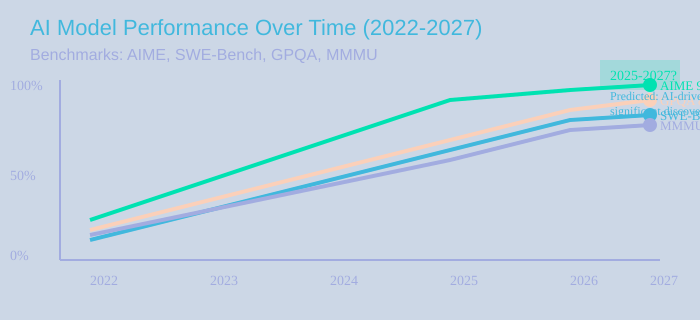
GPT-5’s benchmark scores are rewriting what’s possible for AI performance. On AIME 2025, it achieves 94.6%; on SWE-Bench, 74.9%; GPQA, 88.4%; and MMMU, 84.2%. These numbers show that GPT-5 is not just catching up to humans—it’s often outperforming them in high-level tasks. Yet, the leap from acing tests to making true scientific discoveries is a much longer journey.
OpenAI uses a striking metric: “We very recently got an IMO gold medal.” The International Math Olympiad is one of the toughest competitions in the world. For context, even top mathematicians may not solve a single problem in the allotted time. GPT-5’s ability to reach this level is a rare feat, but it highlights a key point: while AI can now solve problems that once took a professional minutes or hours, the “thousand-hour” creative leaps—like proving a new mathematical theorem—still belong to humans.
What’s missing? According to industry insiders, the gap is not just about skill, but about the kind of cognitive power needed for true discovery. Superintelligence isn’t just about solving problems faster. It’s about asking new questions, designing experiments, running labs, and even leading research teams or companies. As one expert put it, “I would bet by late 2027 most people agree there has been an AI-driven significant new discovery.” But today’s models, even at GPT-5’s level, still struggle with the long, open-ended research that defines major breakthroughs.
- GPT-5 benchmarks: Outperforming humans on structured tests
- Superintelligence: Defined by creative, long-horizon research and leadership
- AI scientific discovery: Predicted by late 2027, but not yet here
- Current weakness: AI excels at short tasks, but ‘thousand-hour’ projects remain a challenge
“We very recently got an IMO gold medal.”
“I would bet by late 2027 most people agree there has been an AI-driven significant new discovery.”
Whose Truth Is It Anyway? GPT-5 and the Fluid Boundaries of Knowledge
When you interact with GPT-5, you might notice how easily it delivers facts—dates, definitions, or scientific principles. But when you ask for advice, opinions, or cultural insights, things get more complex. This is at the heart of the question Nvidia CEO Jensen Huang posed: “Fact is what is. Truth is what it means. So facts are objective. Truths are personal. They depend on perspective, culture, values, beliefs, context.” This distinction is crucial for understanding GPT-5 explained and its role in shaping knowledge.
Facts vs. Truths: The AI Challenge
Facts are straightforward for AI. They are objective and verifiable—like the boiling point of water or the capital of France. Truths, on the other hand, are shaped by personal experience, culture, and context. As Huang notes, “Truths are personal. They depend on perspective, culture, values, beliefs, context.” This creates a challenge for AI and truth: how can a system trained on global data understand what is “true” for everyone?
How GPT-5 Navigates the Fluid Boundaries
GPT-5’s capabilities go beyond simple fact retrieval. It uses advanced context awareness to adapt its responses based on your background, language, and even cultural cues. For example, when asked about a holiday, GPT-5 can tailor its answer for someone in the United States versus someone in India. This surprising fluency is the result of training on diverse data and ongoing feedback from users worldwide.
- Objective facts: Consistent across cultures and contexts.
- Personal truths: Vary based on beliefs, values, and experiences.
- AI adaptation: GPT-5 can adjust tone and content to better fit the user’s context.
Facts are objective. Truths are personal. They depend on perspective, culture, values, beliefs, context.
This ability to adapt is impressive, but it also raises important AI ethics questions. How should GPT-5 balance respect for local truths with the need to provide accurate, unbiased information? As GPT-5 explained here, the boundaries between fact and truth are fluid, and AI must navigate them carefully for responsible global use.
Down to Earth: Risks, Routines, and Getting Creative With GPT-5
With GPT-5, the landscape of AI is shifting fast. The model sets new standards for safety and usability, but innovation is always a moving target. GPT-5’s writing feels more natural—“The writing quality of GPT-5 is much better. We still have a long way to go.” Yet even with major improvements, risks remain. Bias and AI hallucinations are down—GPT-5 reduces hallucinations by up to 80% compared to GPT-4—but they’re not gone. Safety and reliability are still works in progress, especially as more users rely on AI for mission-critical tasks.
GPT-5 in Your Daily Routine
GPT-5 powers agents across the enterprise: from Slack to Hubspot, Teams, and more. This means AI is at work, all day, helping with everything from customer support to research and workflow automation. The model’s multimodal AI capabilities—supporting text, images, video, and charts together—make it a flexible tool for both creative and business needs. Improvements in instruction following and context management mean GPT-5 is more reliable for real-time, high-stakes environments.
Access and Competition: Plus, Pro, and Enterprise
With new subscription tiers—Plus, Pro, and Enterprise—GPT-5 marks a new era in access and competition. Enterprise users get advanced features and deployment options, while individuals benefit from more creative and powerful tools than ever before. GPT-5’s enterprise features are designed for scale, security, and compliance, making it a trusted choice for organizations worldwide.
Natural Writing, Real-World Limits
GPT-5’s writing is less “AI slop” and more human, but there’s still room to grow. The model is better at following instructions and handling complex, long-form tasks, but some limitations persist—especially with tasks that require deep, long-term reasoning. As one user noted, “When you go back to GPT-4, it feels terrible.” GPT-5 raises the bar, but the journey to true superintelligence is ongoing.
| Feature | GPT-4 | GPT-5 |
|---|---|---|
| Hallucination Reduction | Baseline | Up to 80% lower |
| Modalities | Text, limited image | Text, image, video, charts |
| Instruction Following | Improved | Significantly improved |
| Enterprise Deployment | Limited | Slack, Hubspot, Teams, more |
Conclusion: From Fog to Focus—Your Role in the AI Era
As you stand at the edge of the AI era, tools like GPT-5 promise not just new speed, but new ambiguity. The creative process is changing, but it’s not disappearing. Instead, it’s evolving—pushed forward by the power and unpredictability of AI. In this GPT-5 guide, you’ve seen how the line between shortcut and deep work is becoming more blurred. The question is no longer whether you’ll use AI, but how you’ll adapt to it.
Sam Altman, CEO of OpenAI, put it simply:
“Society is a competitive place—expectations just go up.”As new tools arrive, the bar rises. Some people will use AI to do more, others may choose to do less. But for those who lean in, the possibilities are remarkable. The most engaged users are already stretching the limits of what’s possible, learning faster, building more, and exploring ideas in ways that were unthinkable just a few years ago.
Yet, the AI creative process is not a magic shortcut. GPT-5 can write code, draft essays, and even help solve complex problems, but it can’t replace the human drive to ask better questions or to persist through uncertainty. The creative struggle—once defined by hours of solitary work—is now shaped by your ability to collaborate with AI, to question its outputs, and to decide when to follow its lead or when to dig deeper yourself.
Living with tomorrow’s intelligence today means embracing both the clarity and the confusion that come with it. Resilience, curiosity, and a dash of skepticism are your best tools. Whether you’re young or old, a beginner or an expert, you have to choose: Will you let AI’s shortcuts define your work, or will you use its strengths to fuel a deeper journey?
Ultimately, adapting to AI is about more than mastering prompts or chasing productivity. It’s about co-evolving with technology, learning to expect more from yourself and your tools. The future remains open-ended. As the fog of uncertainty lifts, your choices will shape not just your own path, but the creative landscape for everyone.
TL;DR: GPT-5 is more than just new code—it’s a portal to a future that feels both exhilarating and unsettling. Understanding its quirks, powers, and limits may help you navigate a landscape where creative tension meets instant brilliance.
Post a Comment