
In 1993, when most saw video games as a kid’s hobby, few could imagine Nvidia would one day overshadow giants like Apple and Microsoft. If you’ve ever felt like the world was laughing at your weirdest idea, this story’s for you. Grab a coffee and brace for a corporate saga that feels more like a rebellious indie game than a Wall Street classic.
Life on Hard Mode: Nvidia’s Near-Game-Over Origins
The Nvidia company history is often celebrated for its groundbreaking innovations and industry dominance, but few remember just how close Nvidia came to disappearing before it ever truly began. In 1993, Jensen Huang, Chris Malachowsky, and Curtis Priem founded Nvidia with a bold vision: to create advanced graphics chips for the gaming industry—a market most of Silicon Valley dismissed as childish and unprofitable. Their journey, however, would be defined by a series of daunting setbacks that nearly ended the company before it found its footing.
Starting Up: Betting on Games When No One Else Would
At the time, the idea of building chips for video games was seen as almost laughable. The prevailing wisdom was that games were toys, not a serious business. Yet, Jensen Huang and his co-founders saw an opportunity where others saw a dead end. As Huang would later say:
A great entrepreneur is defined by the most non-obvious insight he has about the industry that nobody else believes in.
Nvidia’s first major project was the NV1 chip, an ambitious attempt to revolutionize 3D graphics for gaming. The company poured its limited resources into this product, hoping it would be the breakthrough needed to establish Nvidia as a leader in the field.
Disaster Strikes: The NV1 Flop and Industry Ridicule
Instead of a triumph, the NV1 launch became one of the most infamous product failures in Nvidia company history. Out of 250,000 units shipped, a staggering 249,000 were returned. Customers rejected the product, and the industry responded with skepticism and even ridicule. The market for consumer 3D graphics was so unproven that Nvidia was the only company daring enough to enter it at the time.
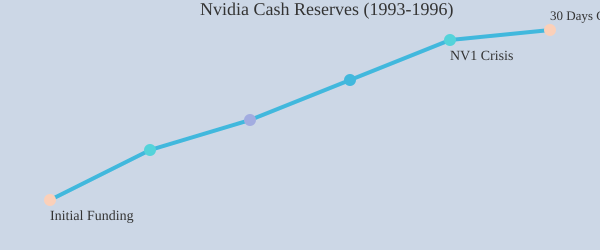
To make matters worse, Microsoft introduced DirectX, a new standard that rendered the NV1’s architecture obsolete almost overnight. Suddenly, Nvidia’s only product was not just unpopular—it was useless. The company’s cash reserves plummeted, and by 1996, Nvidia had only 30 days of cash left in the bank.
Survival Mode: Payroll Tricks and Personal Sacrifice
During this crisis, Jensen Huang leadership was put to the ultimate test. With the company on the brink, Huang resorted to extreme measures to keep Nvidia afloat. He skipped paying electricity bills so he could make payroll, and the office lights were dimmed to save every possible dollar. Employees worked in near darkness, a stark symbol of how close Nvidia was to shutting its doors.
The pressure was immense. While Nvidia struggled to survive, industry giants like Intel were reporting record profits—$5 billion every quarter. Silicon Valley insiders openly mocked Nvidia, and the company’s reputation was in tatters.
False Hope: The Sega Partnership and Crushing Setback
A glimmer of hope appeared when Nvidia secured a contract with Sega to develop the graphics chip for its next-generation game console. The deal brought much-needed funding and the promise of a future in the gaming industry. However, after a year of development, it became clear that Nvidia’s architecture was the wrong fit. Sega dropped Nvidia, and the partnership collapsed.
The fallout was devastating. Layoffs followed, and the company’s future looked bleaker than ever. Yet, it was precisely in these moments of adversity that Nvidia challenges resilience and Jensen Huang leadership emerged as defining forces. Instead of giving up, the founders doubled down, determined to learn from their failures and keep pushing forward.
- 1993: Nvidia founded by Jensen Huang, Chris Malachowsky, Curtis Priem
- NV1 product launch flops—249,000 of 250,000 units returned
- Only 30 days of cash left during crisis
- Sega partnership brings hope, then collapses after Microsoft’s DirectX launch
- Jensen Huang skips bills, dims office lights to pay employees
The early days of Nvidia were a masterclass in grit, resourcefulness, and the relentless pursuit of a vision that almost everyone else doubted. These formative struggles would ultimately shape the company’s DNA, setting the stage for its future as an innovation powerhouse.
The Turning Point: How a Chip Nobody Wanted Became Everyone’s Secret Weapon
The story of Nvidia’s rise is not just about innovation—it’s about resilience, adaptability, and learning from failure. In the mid-1990s, the Nvidia company history took a dramatic turn with the launch of the NV1 chip, a product that was supposed to revolutionize PC gaming but instead nearly ended Nvidia’s journey before it truly began.
From NV1 Failure to Industry Pivot
When Nvidia released the NV1 in November 1995, expectations were sky-high. The chip was a technical marvel, handling graphics, sound, and even game controls in one package. It was compatible with Sound Blaster audio systems and the Sega Saturn console, and Sega even bundled Nvidia’s chip with its new PC game controller. On paper, this looked like the perfect partnership between a Silicon Valley upstart and a Japanese gaming giant.
But the reality was harsh. Out of 250,000 NV1 units shipped, a staggering 249,000 were returned. The reason? Microsoft had just launched DirectX, a new set of rules for PC game development. DirectX required graphics chips to use triangle primitives for rendering, while the NV1 was built around quadratic curves. This technical mismatch left Nvidia’s chip obsolete almost overnight, as game developers flocked to the new standard.
The Rise of DirectX—and Nvidia’s Lightning-Fast Adaptation
DirectX, introduced in 1995, changed everything. It set a new industry standard for how graphics were rendered on Windows PCs, demanding that everything—from characters to environments—be built from triangles. Triangles became the digital building blocks of modern gaming, as seen in titles like Call of Duty, where every model is constructed from thousands of these simple shapes.
Jensen Huang and his team at Nvidia recognized that survival meant embracing this new standard. Instead of clinging to their original vision, they pivoted quickly, redesigning their next chip to align with DirectX and the triangle-based approach. This agility would become a defining trait in Nvidia company history.
RIVA 128: Nvidia’s Breakthrough Moment
In 1997, Nvidia launched the RIVA 128, a chip engineered from the ground up for triangle-based rendering and full DirectX compatibility. This was a radical departure from the NV1’s architecture. The RIVA 128 was fast, affordable, and—most importantly—aligned with what developers and gamers needed. It sold over 3 million units, finally putting Nvidia on the map and marking the company’s first major product success.
Quick Comparison: RIVA 128 vs. NV1—What Changed?
- NV1: Focused on curves, incompatible with DirectX, bundled with Sega hardware, commercial failure.
- RIVA 128: Focused on triangles, DirectX support, standalone PC graphics card, commercial hit.
GeForce 256: Nvidia Coins the Term ‘GPU’
The next leap came in 1999 with the launch of the GeForce 256 GPU. Nvidia didn’t just release another graphics card—they introduced the world’s first “Graphics Processing Unit.” The GeForce 256 was the first chip to include hardware transformation and lighting (T&L), offloading complex calculations from the CPU and enabling richer, more realistic 3D graphics. As one industry observer put it:
The GeForce 256, released in 1999, was the first product marketed as a GPU and introduced onboard transformation and lighting (T&L), significantly advancing 3D graphics technology.
This innovation set a new benchmark for the industry and forced competitors to rethink their own strategies.
Major Nvidia Chips and Their Impact
| Chip | Launch Year | Key Features | Commercial Impact |
|---|---|---|---|
| NV1 | 1995 | Curves-based rendering, Sega Saturn support | Commercial failure |
| RIVA 128 | 1997 | Triangle-based, DirectX support | 3 million units sold |
| RIVA TNT | 1998 | Multi-texturing, higher speed | Popular among gamers |
| GeForce 256 | 1999 | First GPU, hardware T&L | Industry game-changer |
All In on Gaming (When Everyone Else Wasn’t): The Unlikely Power of Play
In the mid-1990s, the tech world had a clear hierarchy: games were considered frivolous distractions, while “serious” companies focused on spreadsheets, servers, and business software. Most hardware makers chased enterprise contracts, dismissing the gaming industry as a niche for hobbyists. But Nvidia, under Jensen Huang’s leadership, saw something different. While others overlooked gaming, Nvidia went all in—betting that video games would become the ultimate stress test for computing technology.
Challenging the 1990s Wisdom
Back in 1995, few believed that gaming could drive technological innovation. Super Nintendo and Sega Genesis consoles dominated living rooms, powered by specialized chips designed for a handful of games. Meanwhile, personal computers lagged behind, struggling to keep up with the fast-paced graphics and physics that gamers craved. The prevailing wisdom was that real companies built hardware for business, not for play.
Jensen’s Contrarian Bet: Gaming as the Ultimate Stress Test
Jensen Huang, Nvidia’s co-founder, saw gaming differently. He recognized that games were not just entertainment—they were complex, ever-evolving simulations that pushed hardware to its limits. Every flicker of light, shifting shadow, and explosion required millions of calculations per second. As games grew more realistic, their computational demands exploded. Huang’s insight was simple but powerful: if Nvidia’s chips could survive the chaos of a video game, they could thrive in any field—from rockets to robotics, from medicine to movies.
If their chips could survive the chaos of a video game, they could thrive in any field from rockets to robotics, from medicine to movies.
Gaming’s Relentless Demands: The Data Behind the Revolution
Consider the evolution of computational demands in iconic video games:
| Game | Year | Calculations per Second |
|---|---|---|
| Mario 64 | 1996 | 100 million |
| Minecraft | 2011 | 100 billion |
| Modern Warfare 2 | 2022 | 36 trillion |
What does this mean in practice? In a modern game, the computer calculates how sunlight hits a helmet, how shadows fall on the wall, how a grenade spins and explodes, and how smoke reacts to gunfire—all in real time, 60 times per second. That’s millions of tiny calculations happening at lightning speed, frame by frame, to keep the experience smooth and lifelike. As the table above shows, the leap from Mario 64’s 100 million calculations per second to Modern Warfare 2’s 36 trillion is staggering. This relentless demand forged Nvidia gaming technology that would later power breakthroughs in AI, scientific research, and more.
Gaming Consoles vs. PC Graphics: Nvidia’s Unique Approach
While console makers built custom chips for closed systems, Nvidia focused on the open, ever-changing world of PC gaming. PC gamers demanded the best graphics, fastest frame rates, and most realistic effects. To meet these needs, Nvidia pioneered parallel computing and advanced chip design, allowing their GPUs to handle massive numbers of calculations simultaneously. This approach not only set Nvidia apart in the gaming industry but laid the groundwork for their dominance in fields like AI and data science.
Nvidia Chips: Sports Cars Built for Chaos
Think of Nvidia’s chips as sports cars—built not for smooth highways, but for the chaos of the racetrack. Gaming was the ultimate proving ground, where only the fastest, most reliable hardware could survive. Every new game became a tougher test, pushing Nvidia’s engineers to innovate faster and smarter. This “all in on gaming” strategy didn’t just establish Nvidia’s dominance in the gaming industry—it created technology robust enough for the world’s most demanding applications.
- Nvidia gaming technology became the gold standard for performance and reliability.
- Nvidia parallel computing enabled breakthroughs far beyond graphics.
- Nvidia chip design evolved to meet gaming’s chaos—and changed the world.
From Graphics Wizards to AI Overlords: Nvidia’s Unexpected Expansion
In the early days, Nvidia was known as a graphics company—a wizard behind the curtain powering immersive video games and dazzling digital worlds. But what set Nvidia apart was not just its technical skill, but a non-obvious insight held by co-founder Jensen Huang. While the world dismissed gaming as mere entertainment, Huang saw something deeper: the intense mathematical demands of rendering graphics in real time. Where others saw fun, he saw the future. This insight would become the foundation for Nvidia’s transformation from a graphics specialist to a titan of AI technology.
Nvidia’s First Leap: From NV1 to Gaming Powerhouse
Nvidia’s journey began with the launch of the NV1 chip in 1995. This ambitious chip was designed to handle everything from graphics to sound and even game controls. It was compatible with Sound Blaster audio systems, 15-pin joystick ports, and even the Sega Saturn console. Sega, a Japanese gaming giant, partnered with Nvidia to bundle the chip with their new PC game. The NV1 was ahead of its time, but it was just the start of Nvidia’s relentless drive to push boundaries.
The CUDA Revolution: Unlocking Parallel Computing
The real turning point came in 2006 with the introduction of the CUDA programming model. Suddenly, Nvidia chips weren’t just for pixels—they became engines for parallel computing. As Nvidia puts it:
Nvidia pioneered the CUDA programming model in 2006, enabling parallel computing on GPUs and expanding Nvidia’s role beyond graphics into general-purpose computing.
CUDA (Compute Unified Device Architecture) allowed developers to harness the massive parallel processing power of Nvidia GPUs for tasks far beyond graphics, including scientific simulations, financial modeling, and, most importantly, AI and deep learning. This move unlocked a new era for Nvidia technology, making it essential for researchers and innovators worldwide.
Nvidia GPUs: The Secret Engine of AI
As AI and deep learning exploded, Nvidia GPUs emerged as the secret engine behind the revolution. Training modern AI models, such as OpenAI’s ChatGPT and Google’s advanced neural networks, requires immense computational power—something traditional CPUs simply couldn’t provide. Nvidia’s deep learning technology, powered by CUDA, became the backbone of AI research and development.
For example, OpenAI’s GPT-3, one of the world’s most advanced language models, was trained on Nvidia GPUs. The ability to process vast amounts of data in parallel made Nvidia indispensable to the AI community. Today, Nvidia AI technology powers everything from self-driving cars to cloud computing platforms, making it a critical player in the digital age.
Partnerships That Changed the Game: Nvidia x OpenAI, Google, Microsoft
Nvidia’s expansion didn’t happen in isolation. Strategic partnerships with industry leaders like OpenAI, Google, and Microsoft accelerated progress. These collaborations ensured that Nvidia GPUs formed the backbone of modern AI research and cloud computing infrastructure. For instance, Microsoft’s Xbox leveraged Nvidia technology, while Google’s AI labs rely on Nvidia GPUs for training and inference.
Anecdote: From Paintbrush to Spaceship Controls
Imagine an art student whose paintbrush suddenly transforms into the controls of a spaceship. That’s what happened when Nvidia moved beyond graphics. The same hardware that once rendered lifelike dragons and racing cars now powers breakthroughs in medicine, robotics, and language understanding. This leap illustrates how a single, non-obvious insight—seeing the math behind the madness—can redefine an entire industry.
Chart: Nvidia’s Expansion Beyond Graphics
| Milestone | Year | Sector/Impact |
|---|---|---|
| CUDA Launch | 2006 | Parallel computing, scientific research |
| OpenAI GPT-3 Trained on Nvidia GPUs | 2020 | AI, deep learning, natural language processing |
| Nvidia Partnership with Microsoft Xbox | 2001 | Gaming, entertainment |
| AI Market Growth Rate (CAGR) | 2020s | ~40% (external reference) |
Nvidia’s journey from graphics wizards to AI overlords is a masterclass in spotting non-obvious opportunities and building the tools that power tomorrow’s breakthroughs. The company’s story is a reminder that innovation often starts with seeing what others overlook—and having the courage to bet on the future.
The Ridiculous Numbers: Tracking Nvidia’s Meteoric Financial Journey
Nvidia’s financial journey is nothing short of astonishing. From a scrappy underdog in the late 1990s to a $4.2 trillion titan in 2024, Nvidia’s rise has redefined what’s possible in the tech industry. The company’s valuation has not only surpassed industry giants like Apple and Microsoft, but it now exceeds the GDP of 185 countries. This explosive growth is a testament to Nvidia’s transformative impact on technology and markets, especially in the era of the AI revolution.
Nvidia’s Valuation: From Near-Zero to $4+ Trillion
In the late 1990s, the tech world was focused on business software, servers, and spreadsheets. Venture capitalists turned away from gaming companies, and engineers saw joining them as a waste of talent. Yet, Nvidia’s founder, Jensen Huang, saw what others missed: the future potential of gaming hardware. While competitors like Intel dominated the CPU market—powering 84% of the world’s computers in 1997—Nvidia quietly built the foundation for a new era.
Fast forward to 2024, and Nvidia’s market capitalization has soared to $4.2 trillion. As one analyst put it:
Today, Nvidia is worth $4.2 trillion, more than Apple, more than Microsoft, and more than the GDP of 185 countries in the world.
Timeline: Key Valuation Milestones
- 1993: Nvidia is founded, focused on graphics chips for gaming.
- 1999: Launch of the GeForce 256, the world’s first GPU.
- 2006: Introduction of CUDA, opening GPUs to AI and scientific computing.
- 2016: Nvidia’s market cap crosses $30 billion as deep learning takes off.
- 2020: Surpasses Intel in market value for the first time.
- 2023: AI revolution accelerates; Nvidia’s valuation rockets past $1 trillion.
- 2024: Nvidia’s market cap reaches $4.2 trillion, outpacing Apple and Microsoft.
Key Drivers of Nvidia’s Financial Success
- The Rise of Gaming: Nvidia’s early focus on high-performance graphics chips paid off as gaming exploded into a global industry.
- GPU Adoption in AI & Data Centers: Nvidia’s GPUs became the backbone of AI research and cloud computing, powering everything from autonomous vehicles to ChatGPT.
- Bold Partnerships: Strategic deals with tech giants and cloud providers cemented Nvidia’s dominance in the AI revolution.
Comparing Titans: Nvidia vs. Competitors
| Company | 2024 Valuation | Market Share (AI/Data Center) | Historic Milestone |
|---|---|---|---|
| Nvidia | $4.2 Trillion | 80%+ (AI GPUs) | First to $4T market cap in semiconductors |
| Apple | $3.3 Trillion | N/A | First to $1T market cap (2018) |
| Microsoft | $3.2 Trillion | Cloud leader | First to $2T market cap (2021) |
| Intel | $130 Billion | Legacy CPU leader | 84% CPU market share (1997) |
Nvidia’s Market Capitalization Growth Trajectory
The chart below illustrates Nvidia’s meteoric rise in market capitalization, especially after the AI revolution ignited demand for powerful GPUs:
Year    | Market Cap
--------|-----------------
1999    | $0.6 Billion
2010    | $7 Billion
2016    | $30 Billion
2020    | $250 Billion
2023    | $1 Trillion
2024    | $4.2 Trillion
Nvidia’s financial narrative is a record-breaking story of vision, risk-taking, and relentless innovation. The company’s valuation reflects not just product success, but its transformative impact on the world’s technology landscape.
Twists, Tangents & Tech Takeaways: Wild Lessons from Nvidia’s Unlikely Saga
Radical Lesson: Mocked Innovations Can Become Trillion-Dollar Staples
Nvidia’s company history is a masterclass in how the world’s most ridiculed ideas can become the backbone of tomorrow’s technology. In the mid-1990s, while most tech giants dismissed gaming as a niche distraction, Jensen Huang saw something no one else did. Where others saw “fun,” he saw a future built on speed, high-resolution graphics, and millions of calculations per second. This was not just about entertainment—it was about the math behind the madness. Huang’s leadership was defined by a willingness to bet on the weird, to pursue the non-obvious insight that others ignored.
As one wise entrepreneur put it, “A great entrepreneur is defined by the most non-obvious insight he has about the industry that nobody else believes in.” Jensen Huang’s leadership exemplifies this. While the world mocked games, he was quietly building the infrastructure for the AI revolution.
Failure Isn’t Fatal: The NV1 Flop Was a Crucial Step
Nvidia’s first product, the NV1, is legendary for all the wrong reasons. Out of 250,000 units shipped, 249,000 were returned. By any standard, this was a disaster. But this failure was not the end—it was the necessary beginning. Instead of folding, Nvidia doubled down on learning. The team dissected what went wrong, listened to feedback, and pivoted. This resilience is a core part of Nvidia’s challenges and resilience story.
Great products are often born from initial commercial embarrassment. The NV1’s flop forced Nvidia to rethink its approach, leading to the creation of the RIVA 128 and eventually the GeForce series—products that would define entire generations of gaming and, later, AI computing. In the world of innovation, failure plus resilience equals the possibility for revolutionary growth.
Jensen Huang’s “Bet on the Weird” Philosophy
Jensen Huang’s leadership is not about playing it safe. He is a risk-taker, not a conformist. Time and again, he bet against prevailing industry logic. When others saw dead ends, he saw opportunity. This “bet on the weird” philosophy is at the heart of Nvidia’s product success. Huang’s willingness to embrace the odd path, to “brave the odd path and not fear failure,” is a lesson for every innovator.
Embrace joy, brave the odd path, and don’t fear failure—it might just lead to the next technological revolution.
Random Tangent: What If Nvidia Had Stuck with Karaoke Chips?
It’s wild to imagine: what if Nvidia had stuck with its early experiments in audio chips for karaoke machines? The company might have become a footnote in tech history, known only to a handful of enthusiasts. Instead, Nvidia’s willingness to pivot, to abandon the safe and obvious, set it on a path to greatness. This tangent serves as a reminder that sometimes, the best move is to leave behind what’s comfortable and chase the opportunity that no one else sees.
Nvidia’s Journey: A Modern Myth of Tech
Nvidia’s company history reads like a modern myth—Odysseus, but with CPUs and venture capital. The journey was never straight. There were storms, monsters (in the form of market failures), and plenty of moments where giving up would have been the logical choice. But like any great hero, Nvidia pressed on, guided by non-obvious insights and a refusal to accept defeat.
Creative Takeaways: How to Spot Overlooked Opportunity
- Look for the math behind the madness: What seems like a toy or a fad today might be laying the groundwork for tomorrow’s breakthroughs.
- Don’t fear failure: Every flop is a chance to learn and pivot. The key is resilience.
- Bet on the weird: If your insight feels strange or unpopular, you might be onto something big.
- Challenge prevailing logic: Industry consensus is often wrong. Trust your unique perspective.
Nvidia’s path proves that strangeness isn’t a flaw in tech—it’s the engine of greatness if you double down on learning from it. For innovators, the lesson is clear: the next trillion-dollar idea might be hiding in the place everyone else is ignoring.
Appendix: Nuggets You Didn’t Know You Needed (Including ODO ERP & FAQ)
When examining how Nvidia transformed from an underdog to an AI titan, it’s easy to focus solely on hardware breakthroughs and visionary leadership. But sometimes, the secret sauce isn’t just in the chips—it’s in the systems that tie everything together. Enter the ODO ERP platform, a quirky yet instructive case study that shows how integrated business technology can accelerate growth for startups and established companies alike. Just as Nvidia’s unified architecture enabled it to leapfrog competitors, ODO’s seamless integration of business tools demonstrates the power of centralization and smart automation in scaling operations.
ODO ERP Platform: The Unsung Hero of Business Technology Integration
ODO ERP isn’t just another acronym in the alphabet soup of business software. It’s a platform built around the idea that every application should communicate effortlessly with the others, creating a truly unified system. Imagine your sales, inventory, and accounting data always in sync, giving you a real-time overview of your business performance. That’s not just convenient—it’s transformative. With over 45 integrated business applications, ODO ERP offers a comprehensive suite that covers everything from CRM to project management, all under one digital roof.
One of ODO’s most compelling features is its “free for life” offer on the first application, complete with unlimited hosting and support. This means startups can dip their toes into enterprise resource planning without the usual upfront costs, making it an accessible entry point for businesses at any stage. The platform’s user-friendly interface ensures that even non-technical founders can harness its power, breaking down barriers to digital transformation.
Centralized Tools and Automation: The Startup Scalability Advantage
What makes ODO ERP especially relevant to the Nvidia story is its emphasis on integration and automation. Just as Nvidia’s unified chip architecture allowed for rapid innovation and scalability, ODO’s centralized tools streamline repetitive tasks and free up time for what truly matters—growing your business. As one user put it,
Automation tools streamline repetitive tasks and give you more time to focus on what truly matters, which is scaling your business.
Effective integration tools don’t just save time; they amplify growth. For startups, knowing when to centralize systems for maximum efficiency is crucial. ODO ERP’s model shows that consolidating core business functions into a single, integrated platform can eliminate silos, reduce errors, and provide the data-driven insights needed for smart decision-making. However, as companies grow, there’s also a lesson in knowing when to specialize—adding targeted solutions for unique needs while maintaining a strong, integrated backbone.
Practical Lessons for Scaling Startups
The journey from scrappy startup to industry leader is rarely linear. One of the key takeaways from both Nvidia and ODO ERP is the importance of building scalable systems early. Centralization, when done right, creates a foundation for rapid growth and resilience. But flexibility matters too. Startups should periodically assess whether it’s time to consolidate more functions or introduce specialized tools as their needs evolve. The right balance between integration and specialization can be the difference between stagnation and explosive growth.
FAQ: Your Burning Questions on Nvidia, Tech, and Resilience
Q: How did Nvidia’s approach to integration help it outpace competitors?
A: Nvidia’s unified chip architecture allowed for faster innovation and easier scaling, much like how integrated business platforms help companies operate more efficiently.
Q: What makes ODO ERP different from other business management tools?
A: ODO ERP offers seamless integration across 45+ apps, a user-friendly interface, and a “free for life” first app, making it accessible and scalable for startups and growing businesses.
Q: When should startups centralize their systems?
A: Startups should centralize when manual processes start to slow growth or create errors. Centralization provides real-time insights and streamlines operations, but it’s important to remain flexible as needs change.
In the end, whether you’re building the next AI powerhouse or simply looking to scale your business, the lesson is clear: integrated systems—whether in chips or business platforms—are the hidden engines of innovation and growth. Don’t overlook the power of smart integration as you level up.
TL;DR: Nvidia’s $4T rise isn’t just a business victory—it’s proof that believing in the overlooked (and outnumbered) can change everything. If you take anything from their journey: Embrace joy, brave the odd path, and don’t fear failure—it might just lead to the next technological revolution.
Post a Comment