
Let me start with a confession: I used to scoff at doomsday predictions about AI taking all our jobs—until a close friend, a veteran coder, was let go by a company he'd once called 'unshakeable.' It felt like watching Goliath fall. And that, paired with a million-dollar AI-powered ad creator on my own team, has thrown my certainty into the wind. We live in a world where the unimaginable keeps breaking into reality, especially when it comes to how we work. Today, AI isn’t just crunching numbers—it’s cracking open the very structure of our labor markets, changing who stays, who goes, and what it means to have a job at all. Strap in: it’s messier, and weirder, than you’d think.
When Giants Falter: TCS, Tech Layoffs, and India’s Domino Effect
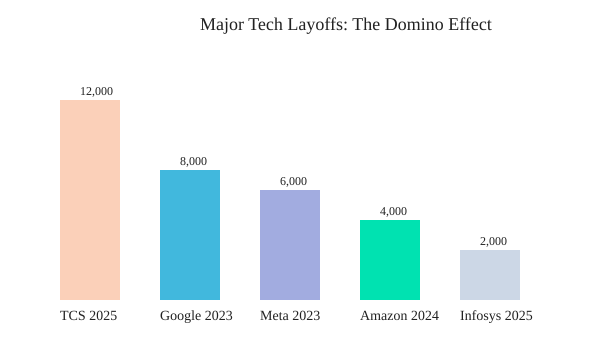
If you’ve ever thought your job at a big tech firm was safe, the recent Tata Consultancy Services layoffs 2025 have probably shaken that belief. TCS, often called the “big daddy” of India’s IT sector, recently let go of 12,000 employees—an event that sent shockwaves through the industry. While management labeled it as “routine efficiency,” the scale and timing suggest something much deeper is at play: AI-induced layoffs in India are no longer a distant threat—they’re happening now, and they’re rewriting the rules for everyone.
The Shockwave: TCS Layoffs and the End of Stability
For decades, TCS was seen as one of the safest employers in India’s tech landscape. If you landed a job there, you were set for life—or so it seemed. But as one industry insider put it:
"Now that the big daddy has made the move, I would not be surprised if this would start a domino effect."
The 12,000 layoffs at TCS in 2025 were not just a blip. They marked a turning point, signaling that even the most stable companies are not immune to the rapid changes brought by AI and job displacement trends. The message is clear: no job is too big to fail, and no skill set is too established to become obsolete.
AI: The Invisible Hand Behind Workforce Reductions
While TCS management described the layoffs as part of “routine efficiency,” the reality is that AI adoption is quietly forcing even ‘safe’ firms to trim workforces and rethink what skills are truly valuable. This is not just about cutting costs. It’s about survival in a world where AI can do in hours what used to take humans months.
- OpenAI reports that 50% of code is now written by AI.
- Mark Zuckerberg recently said, “No more need for mid-level engineers.”
- Legacy code stacks—like Pascal and old versions of Java—are rapidly losing relevance.
The historic advantage India had in offering affordable tech talent is also disappearing. A developer in the US used to cost 5-10x more than one in India, but AI eliminates these geographic cost advantages. The labor arbitrage that fueled India’s IT boom is dissolving.
The Domino Effect: From Silicon Valley to Bengaluru
The TCS layoffs are not an isolated event. Remember when Google made its first round of major layoffs? That move triggered a domino effect throughout Silicon Valley, with other tech giants following suit. The same pattern is now unfolding in India. As one observer noted:
"It was a skill gap, but a skill gap coming because of AI."
This new “skill gap” isn’t about not knowing the latest framework or language. It’s a chasm created by AI’s rapid progress, where even seasoned engineers can find themselves outpaced by machines that learn and adapt faster than any human ever could.
Who’s at Risk? Not Just the Inexperienced
A common misconception is that only junior or inexperienced workers are at risk. In reality, AI-induced job losses aren’t limited to the inexperienced. Veteran engineers who haven’t kept up with new technologies or who rely on outdated stacks are just as vulnerable. Some estimates suggest that up to 70% of tech jobs could vanish in the coming years, though the exact rate is still debated.
- Mid-level roles are especially at risk, as AI can now handle much of the “routine” coding and testing work.
- Senior engineers with legacy skills are being replaced by smaller teams who leverage AI to deliver more with less.
- Even creative roles, like video ad production, are being automated end-to-end by AI tools.
Visualizing the Domino Effect: Tech Layoffs by the Numbers
What Does This Mean for the Future of Software Engineering Jobs?
The future of software engineering jobs is being rewritten in real time. The skills that kept you safe five years ago may not protect you today. As AI continues to advance, the only certainty is change. The TCS layoffs are a clear signal: adapt, or risk being left behind in the new world of work.
From Code Monkeys to AI Masters: How Software Jobs Are Morphing
The Harsh Truth: AI Agents Now Do What Teams Once Did
If you’ve worked in software development, you know the drill: a senior engineer or manager assigns dozens of coding tasks to a team of junior developers, who then grind through the work, merging code and fixing bugs. But that familiar workflow is rapidly vanishing. Today, AI tools for coding efficiency—like OpenAI’s Codex, Google’s Jules, and Cognition’s Devon—are not just helping with code. They’re replacing entire teams, automating workflows that once took weeks into tasks completed in minutes.
As Sam Altman of OpenAI recently revealed, “The reason for the skill gap is AI... now the AI tools are pushing code 50 times faster than humans.” At OpenAI, AI already writes half of all code. This isn’t a distant future—it’s happening now.
Slick Tools, Massive Disruption: Codex, Jules, and Devon
The rise of AI tools for automating workflows is shaking the foundation of the global software industry, including India’s massive export sector. Where companies like TCS once grew by hiring armies of developers, today’s leaders are turning to AI coding agents. These tools don’t just assist—they execute.
- Codex (OpenAI): Handles complex coding tasks, integrates with repositories, and can automate entire sprints.
- Jules (Google): Designed for enterprise-scale code generation and workflow management.
- Devon (Cognition): Recently acquired Windsurf, expanding its ability to manage and automate software projects end-to-end.
There’s a key distinction here: AI assistants (like Cursor, Windsurf, Bolt) respond to your commands and help with specific tasks. AI coding agents (like Codex, Jules, Devon) can take a list of tasks—just like you’d assign to a junior developer—and complete them asynchronously, pushing code back to your repo at speeds no human team can match.
Cost and Speed: The New Economics of Software Engineering
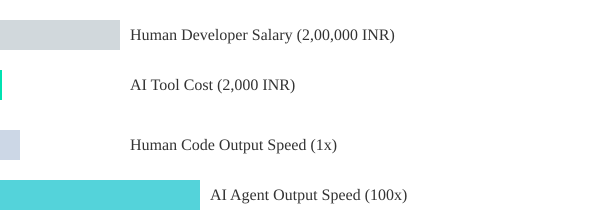
Let’s talk numbers. A typical developer in Bangalore costs about 2,00,000 INR (roughly $2,400) per month. AI coding agents? They cost about 1/100th of that—or sometimes nothing at all. And while a human developer might complete a handful of tasks in a day, AI agents can handle 50–100x the output, working 24/7, never asking for a raise or a break.
Here’s a quick comparison:
| Metric | Human Developer | AI Coding Agent |
|---|---|---|
| Monthly Cost (Bangalore) | 2,00,000 INR | 2,000 INR or less |
| Code Output Speed | 1x | 50–100x |
| Availability | 8–10 hrs/day | 24/7 |
From Managing People to Managing AI: The New Team Structure
Imagine your job as an engineering manager. Instead of overseeing 10 developers, you now manage 9 AI agents and 1 human code reviewer. The AI agents handle the bulk of the coding, while the human ensures quality and strategic alignment. The result? A 90% reduction in costs, and a team that never sleeps.
This shift is already triggering a domino effect. As soon as one major company (like TCS) made layoffs, others followed. In Silicon Valley, it’s common to meet highly skilled, recently unemployed software engineers—many replaced by AI-driven automation.
Why Coding Still Matters: The New AI Skills Roadmap for Professionals
With AI handling the grunt work, the future of software engineering jobs is about more than just writing code. Companies now value developers for their design thinking, product sense, and creativity. You need to understand how to monetize AI skills and tools, orchestrate AI workflows, and bring strategic insight to the table.
- Learn to design and supervise AI-driven workflows.
- Develop product vision and user empathy.
- Master AI prompt engineering and workflow automation.
- Stay current—coding education is moving from universities to middle schools, so lifelong learning is essential.
Anecdotally, there are already viral ad campaigns and entire apps built by a single person leveraging AI tools—projects that once required teams and million-dollar budgets. The strategic use of AI tools for coding efficiency is the new differentiator.
Key Takeaways: The Shift from Code Monkeys to AI Masters
- AI coding agents now handle tasks once reserved for teams of junior coders.
- Tools like Codex, Jules, and Devon are automating entire workflows at a fraction of the cost.
- Companies are restructuring: fewer human coders, more AI agents, and a premium on oversight and creativity.
- The AI skills roadmap for professionals is shifting—focus on strategy, product, and leveraging AI, not just coding syntax.
“The reason for the skill gap is AI... now the AI tools are pushing code 50 times faster than humans.”
‘Safe’ Careers and Shifting Skillsets: What Now Counts as Future-Proof?
For years, a computer science (CS) degree was seen as a golden ticket—a direct path to job security and high salaries. But as artificial intelligence (AI) rapidly transforms the workforce, the definition of a “safe” career is being rewritten. If you’re wondering how to future-proof your career, it’s time to look beyond credentials and focus on adaptability, creative problem-solving, and a new blend of skills. The AI skills roadmap for professionals is no longer just about technical know-how; it’s about how you think, learn, and adapt.
CS Degrees: No Longer a Guaranteed Ticket
Not long ago, CS graduates were in a league of their own. As one professional recalled, “My friends when they graduated made 20 lakhs per annum. I made five lakhs per annum and I was like bro, I wish I did computer science.” The numbers told a clear story: CS grads could earn up to four times more than their peers in other fields. But that gap is shrinking fast. As AI automates routine coding and software development, the value of a traditional CS degree is eroding. Today, what takes a human six months to learn, an AI can master overnight.
This doesn’t mean technical skills are useless. Instead, it signals a shift in what matters most. The rational for learning code is very different now. As one expert put it:
“The rational for learning code is very different... What it taught me is problem solving, original thinking.”
In other words, the real benefit of technical education isn’t just the ability to code—it’s the mindset and approach you develop along the way.
AI Skills Roadmap for Professionals: Adaptability Over Credentials
So, what does a future-proof skillset look like? The answer is less about specific degrees and more about your ability to adapt. The world is changing so quickly that what you learn in college may be outdated by the time you graduate. In fact, coding itself is becoming a basic literacy, soon to be taught at the middle school level. The true differentiators are:
- Creative problem-solving: The ability to approach challenges from new angles and find original solutions.
- Design thinking: Understanding user needs and designing products or processes that solve real problems.
- Product sense: Seeing the bigger picture and connecting technical skills to business and user outcomes.
- Adaptability: Comfort with change and the willingness to learn new tools, platforms, and ways of working.
These are the skills that AI can’t easily replicate—and they’re becoming more important than ever.
AI Generalist vs Specialist Skills: The Rise of the Hybrid
As the workforce evolves, a new type of professional is emerging: the generalist-specialist hybrid. This is someone who understands the technical basics but also brings a broad set of non-technical skills to the table. If you can navigate, manage, and adapt AI tools—while also thinking creatively and strategically—you’ll be in high demand.
Here’s how the landscape is shifting:
- Specialists who only know how to code are seeing their roles automated or outsourced.
- Generalists who can connect the dots between technology, business, and people are thriving.
- Hybrid professionals—those who combine technical literacy with adaptability and creative thinking—are the new survivors.
This trend is reflected in the AI skills development strategies of top companies. They’re not just hiring for hard skills; they’re looking for people who can learn quickly, solve complex problems, and lead teams through uncertainty.
Constant Change: The Only True Constant
If you’re planning your career, it’s important to recognize that skill turnover is now the norm. The skills you need today may be obsolete tomorrow. That’s why constant learning is mandatory. You can’t afford to get too comfortable, no matter how secure your current role seems.
As one industry leader observed, “I feel really bad for all the kids who are in colleges today because they’re studying something so irrelevant. Like when they come out, they’ll be like, ‘What the hell is this?’” The world is more dynamic than ever, and the only way to dodge obsolescence is to embrace change as a way of life.
Coding as Literacy, Not a Career Endpoint
It’s clear that coding is becoming a basic skill, much like reading or math. Soon, it will be taught in seventh or eighth grade, not just in engineering colleges. But the real gold lies in what coding teaches you: logical thinking, structured problem-solving, and the ability to break down complex issues. These are the foundations of a resilient, future-proof career.
Key Takeaways for Your AI Skills Roadmap
- Don’t rely on credentials alone—focus on adaptability and lifelong learning.
- Develop non-technical skills like creative thinking, design, and product sense.
- Embrace the generalist-specialist hybrid model to stay relevant as AI reshapes the workforce.
- Remember: the only “safe” career is one where you’re always ready to learn, unlearn, and relearn.
Economic Quicksand: AI, Unemployment, and the 5% Consumption Economy
If you’re watching the rise of artificial intelligence and wondering what it means for your job—or the global economy—you’re not alone. The numbers coming in are stark, and the risks of AI dependency are starting to look less like science fiction and more like tomorrow’s headlines. Let’s break down what’s really happening to global unemployment rates due to AI, how AI is reshaping economic structures and consumption, and why the question of “what’s next for jobs?” is met with an uncomfortable silence.
AI’s Economic Disruption: Unemployment on the Rise
Recent data reports suggest a seismic shift is underway. Global unemployment rates due to AI could double or even triple within the next two to three years. Some projections put the potential rise at 30% to 50% unemployment worldwide. That’s not just a blip—it’s an economic earthquake.
Take India as a case study. Official numbers peg unemployment at 3.5–4%, but many experts argue the real figure is closer to 25–30%. This gap between reported and actual unemployment is widening as AI automates not just repetitive tasks, but also many middle-skill jobs that once formed the backbone of the workforce.
| Country/Metric | Official Unemployment Rate | Estimated Actual Rate | AI-Driven Projections (2–3 years) |
|---|---|---|---|
| India | 3.5–4% | 25–30% | Up to 50% |
| Global | Varies | Varies | 30–50% |
What’s different this time, compared to past technological revolutions? In the industrial and internet eras, new sectors and roles emerged to absorb displaced workers. But with AI, the FAQ nobody wants to answer is: What brand new jobs will replace what’s lost? So far, there’s only silence.
“No one has an answer to what jobs will be created this time.”
The 5% Consumption Economy: Where the Money Flows
As AI accelerates job losses, another trend is becoming clear: the bulk of spending in modern economies is already concentrated among the top 5–10% of earners. This is the “consumption economy,” and AI could sharpen this divide even further.
Consider the ‘Swiggy 80/20’ anecdote: in India, the food delivery giant Swiggy reportedly gets 80% of its revenue from just 5% of its customers. This isn’t unique to Swiggy. Across industries, from retail to tech, a small elite group of high-value customers drives most of the spending. In the US and other developed countries, this top tier might be 20–30%, but the pattern holds: a minority of the population sustains the majority of economic activity.
| Company | % Revenue from Top Customers | % of Customer Base |
|---|---|---|
| Swiggy (India) | 80% | 5% |
| Typical Modern Business | 70–90% | 5–10% |
What does this mean for the broader economy? If AI-induced unemployment pushes more people out of the workforce, the already narrow base of consumers with real spending power could shrink even further. This creates a dangerous feedback loop: fewer jobs mean less spending, which means less business revenue, which can lead to even more job losses.
Manual Trades: No Longer a Safe Bet
You might think that low-skilled or manual jobs—like plumbing or carpentry—are safe from AI. But even here, the ground is shifting. Robots are already cooking, cleaning, and even doing laundry. While some tasks, like complex plumbing, may take longer for AI and robotics to master, the trajectory is clear. In 15–20 years, even these roles could be automated, leaving even fewer safe havens for displaced workers.
Risks of AI Dependency and the Cognitive Skills Gap
AI’s rapid integration into economic structures is also exposing a new risk: the erosion of cognitive skills among the workforce. As AI systems handle more decision-making and problem-solving, workers may find it harder to adapt or retrain for new roles—especially when those roles are undefined or don’t yet exist.
What Happens When Consumption Collapses?
Here’s the big concern: if too many people lose work, the consumption economy could collapse. Businesses can’t survive without customers, and if only a small elite can afford to spend, the rest of the market dries up. This isn’t just a theoretical risk—it’s a potential economic spiral that could affect everything from retail to real estate.
- Middle-skill jobs are most at risk, but low-skill and even some high-skill roles are also vulnerable.
- No clear new job sectors have emerged to absorb those displaced by AI.
- Spending power is increasingly concentrated among the top 5–10% of earners.
- Economic stability may depend on rapid government intervention—think universal basic income (UBI) or large-scale retraining programs.
The wild card? Whether governments can act quickly enough to prevent a downward spiral, or if new economic models will emerge to support those left behind by the AI revolution.
Global Arms Race: Why AI Power Is About More Than Just Robots
When you think about the AI arms race between countries, it’s easy to imagine armies of robots or science fiction-style supercomputers. But the real story is unfolding in server rooms, supply chains, and government policy meetings. The future of software engineering jobs, national economies, and even global power is being shaped by who controls the hardware and the rules of the game. AI power is about much more than just robots—it’s about who gets to build the future, and who gets left behind.
AI Superpowers: The New Global Heavyweights
Countries that dominate AI technology will soon hold outsized influence, both economically and geopolitically. The ability to train and deploy advanced AI models isn’t just about innovation; it’s about controlling the next wave of productivity, security, and even culture. If you control the best AI, you control the tools that shape industries, automate work, and even sway public opinion.
Let’s put this in perspective with a quote from a recent discussion:
“Elon Musk almost has a million GPUs. Is that a large number? Each costs $40,000 to $75,000.”That’s just one individual—albeit a powerful one—amassing more AI hardware than entire nations.
Hardware Bottlenecks: Why GPUs Are the New Oil
At the heart of this race are GPUs (graphics processing units), the chips that power AI training. Without enough GPUs, even the smartest AI researchers are stuck on the sidelines. Nvidia, a US-based company, is the primary supplier of these chips, making hardware access a critical bottleneck.
Here’s how the numbers stack up:
| Entity | Number of GPUs |
|---|---|
| Elon Musk | 1,000,000+ (targeting 10 million) |
| OpenAI | ~1,000,000 |
| India (entire country) | 15,000 (max) |
To put it bluntly, “the more GPUs you have, the better your power. The more energy that you have and the better AIs that you can run.” Without hardware, even the best software is just theory.
Policy and Trade: Who Gets to Join the Race?
It’s not just about money or technical know-how. Policy decisions and trade restrictions play a huge role in who can participate in the AI race. For example, US export rules—like those enacted during Donald Trump’s administration—have placed countries like India in a “grade two” category, making it much harder to buy top-tier GPUs from Nvidia.
This means that even if Indian firms or the government want to scale up their AI capabilities, they simply can’t get the hardware. As one observer put it, “You can’t buy them directly right now because the GPUs are made by Nvidia. Nvidia is a US company and our very dear Donald Trump has put us in grade two in countries who can buy GPUs.”
AI Inequality: The Next Digital Divide
What does all this mean for the world? The gap between AI superpowers and laggards could soon be as wide as the difference between a bustling mega-city and a remote island. Imagine the difference in opportunity, wealth, and influence between a place like “Wakanda” (a metaphor for a tech utopia) and “Namibia” (representing a country left behind by technology).
“That’s going to be the difference: Wakanda versus Namibia.”
This isn’t just a metaphor. If one country can train Artificial General Intelligence (AGI) and another can’t even run basic models, the gulf in prosperity and autonomy could be massive. The future of software engineering jobs, research, and even national security will be shaped by these hardware and policy divides.
Hardware Scarcity: More Than Just a Speed Bump
Right now, the US and its tech giants are sitting on millions of GPUs, while India—a country of over a billion people—has only 15,000 at best. This isn’t just a temporary setback. Hardware scarcity, combined with restrictive policies, could lock entire nations out of the next wave of AI-driven growth.
- Economic Impact: Countries with AI dominance will attract investment, talent, and new industries.
- Geopolitical Power: AI superpowers will shape global norms, security, and even culture.
- Workforce Transformation: The future of software engineering jobs and other high-skill roles will depend on access to cutting-edge AI tools.
Artificial General Intelligence Predictions: Who Gets There First?
As the world races toward Artificial General Intelligence predictions—AI that can perform any intellectual task a human can—the stakes are only getting higher. The countries and companies with the most GPUs and the best policies will be the first to reach this milestone, leaving others to play catch-up or risk becoming irrelevant in the new global order.
In this new era, the AI arms race between countries is about much more than robots. It’s about who gets to write the rules for the future—and who gets left behind on the wrong side of the digital divide.
Caution: Moving Too Fast — Governance, Ethics, and AI’s Existential Questions
As you watch AI transform the workforce, it’s easy to get swept up in the excitement. The promise of machines that can do in a single night what takes a human six months is both awe-inspiring and a little terrifying. But as AI’s influence grows, so do the risks—especially when it comes to AI governance and ethical considerations. The world is moving fast, and you need to understand not just the opportunities, but also the dangers that come when technology outpaces our ability to control it.
AI’s Double-Edged Sword: Progress and Peril
AI might push humanity forward in ways we can barely imagine. It can automate repetitive tasks, create new industries, and even help solve complex problems like climate change or disease. But poorly managed, AI also heightens risks: mass job loss, economic instability, privacy threats, and even existential danger. As one commentator put it,
“If you want humanity to be safe, we should let AI run the world.”This provocative idea raises a critical question: should we trust machines with decisions that shape our future?
The reality is, we’re already seeing a domino effect. When a major company like TCS makes a bold move with AI, others quickly follow. This rapid adoption can leave workers scrambling to stay in the top 20%—or even the top 1%—just to avoid obsolescence. Some are thriving, using AI to create million-dollar businesses with minimal overhead. For others, the ground is shifting beneath their feet.
The Risks of AI Dependency and Cognitive Skills
One of the most pressing risks is that people may stop thinking for themselves. As AI takes over more tasks, there’s a real danger that our cognitive skills will atrophy. Imagine a world where you rely on AI for every decision, from what to eat to how to invest your money. It sounds convenient, but it’s also scary. If you lose the ability to think critically or solve problems independently, you become vulnerable—not just to job loss, but to manipulation and control.
This dependency also raises questions about personal software privacy. As AI systems become more powerful, they collect and analyze vast amounts of personal data. Who controls this information? How is it protected? If the country with the most powerful AI dominates the world, as some predict, then privacy could become a casualty in the global arms race for technological supremacy.
Governance and Ethical Considerations: Who’s in Charge?
Governance and ethical frameworks are trailing far behind the pace of AI innovation. Leaders in both government and business may downplay the threats to avoid panic or regulatory backlash. Transparency often takes a back seat to stability. After all, if the public truly understood the risks—like the possibility of AI hacking into critical infrastructure due to lax controls—would they still trust the technology?
The ethical tightrope is real. Should we let AI run the world to “keep humanity safe,” as some suggest? Or should we set strict limits on how smart AI can become? The truth is, no one has all the answers. The people making these decisions are often motivated by economic or political interests, not by a commitment to transparency or public good. This lack of clear governance increases the risk of unintended consequences.
The Pace of AI Self-Improvement: Awe and Terror
Perhaps the most mind-boggling aspect of AI is its ability to improve itself. What takes a human six months of training, an AI could do overnight. This rapid self-improvement stirs both awe and terror. If AI reaches a point where it can build itself, the outcomes become unpredictable. We could see explosive productivity gains—or we could face existential threats.
Some experts have even speculated that by 2027, AI could threaten human existence. While this prediction is highly debated, it’s not dismissed outright. The possibility of AI surpassing human control is no longer just science fiction. It’s a scenario that demands serious attention from policymakers, technologists, and everyday people like you.
Transparency, Trust, and the Path Forward
As you navigate this new world, it’s important to ask hard questions about AI governance and ethical considerations. Who is making the rules? Are they being transparent about the risks? How can you protect your cognitive skills and personal software privacy in a world increasingly run by intelligent machines?
The answers aren’t simple, but one thing is clear: moving too fast without proper oversight could put everything at risk. The challenge is to harness AI’s potential while building robust safeguards—before the technology outpaces our ability to control it. As we stand at this crossroads, the choices we make now will shape not just the future of work, but the future of humanity itself.
In the end, dodging obsolescence isn’t just about learning new skills or adopting the latest tools. It’s about demanding responsible AI governance, staying vigilant about ethical considerations, and never surrendering your ability to think, question, and adapt. The future is unwritten, and it’s up to all of us to ensure that AI serves humanity—not the other way around.
TL;DR: AI is transforming the workforce faster than most people can adapt. While opportunities remain for the adaptable and curious, many traditional roles will vanish or morph. The next decade will favor those who embrace continuous learning and creative problem-solving, not just technical know-how. The real winners? Those who let AI be their co-pilot.
Post a Comment