

Picture this: You’re flipping through browser tabs, lost in reviews of a washing machine, when—bam—a digital assistant does all the heavy lifting. That’s not sci-fi anymore. My first tangle with Comet Browser reminded me of my dad spending hours window-shopping, except Comet can read every review, ignore ads, and buy the best machine faster than you can say 'spin cycle.' This isn’t just better tech—it’s a bonafide shift in how we relate to the Internet itself. Let’s dig into how agentic AI is flipping the script.
The Age of Agentic Browsing: When Your Browser Becomes Your Brain
Welcome to the era of Agentic Browsing, where your browser doesn’t just show you information—it thinks, acts, and gets things done on your behalf. If you’ve ever felt overwhelmed by 40 open tabs, endless search queries, and the constant need to switch between apps, Comet Browser is about to change your digital life. This is not just another AI browser. Comet is the first browser that truly acts as your digital brain, handling tasks, remembering context, and even making decisions for you.
From Chrome Clone to $20B Disruptor: Perplexity’s Wild Trajectory
To understand how we got here, look at the rise of Perplexity AI. In late 2023, Perplexity was valued at just $150 million. Fast forward to 2025, and it’s a $20 billion company, competing head-to-head with Google for your search queries. As the founder put it, this growth has been nothing short of exponential. “If you do a 1% improvement every day, how much do you improve at the end of the year? You improve 3,700%.” This relentless pace of improvement is what’s powering the agentic revolution in browsing.
It may look like small steps every day but as the changes propagate to a larger scale of users they bring in more users.
Comet Browser’s Agentic AI—Think Less Search, More Do
What sets Comet Browser apart is its agentic AI. Instead of simply searching, you can now delegate multi-step tasks. Need to compare flight prices, summarize research, reply to emails, or even shop within your tabs? Comet does it all, proactively. It has memory, understands your budget, and can reason across multiple sources—blurring the line between browsing and acting.
- Reads and summarizes articles, research, and emails
- Reasons across tabs to connect information
- Acts—from replying to emails to making purchases
- Remembers your preferences and context for next time
Personal Example: Outsourcing 40 Tabs and Finding Peace
Let’s get personal. I used to juggle 40 open tabs—news, research, shopping, emails—constantly switching and losing track. With Comet, I delegated the chaos. The browser read, summarized, and even drafted responses for me. For the first time, I found peace in my workflow. This is the power of agentic browsing: less cognitive load, more focus on what matters.
The Exponential Effect: 1% Daily Improvements Add Up Fast
Agentic browsers like Comet and Perplexity AI are built on the principle of relentless, incremental improvement. The math is simple but powerful: 1.01^365 = 37.78. That’s a 3,700% improvement in a year if you get just 1% better every day. This compounding effect is why these tools feel so magical—their capabilities expand almost overnight, and so does your productivity.
Changing the User’s Mindset: Trusting AI to Do the Work
The biggest shift isn’t just technical—it’s psychological. Agentic browsing asks you to trust your AI browser enough to let it handle tasks you used to do yourself. Even users who were once hesitant, including older generations, are discovering the real-world utility of these tools. When Comet launched, there was a massive spike in user queries in July, showing just how quickly people are embracing this new paradigm.
Comet Features Showdown: Making Magic From Mundane Tasks
Imagine a browser that doesn’t just display information, but actually thinks with you—and acts on your behalf. That’s the promise of the Comet Browser, and it’s redefining what we expect from AI tools in our daily lives. Let’s break down the Comet features that turn ordinary browsing into something magical.
Video Search with Natural Language: Ctrl+F for Your Memory
Ever tried to find a specific moment in a long video, only to waste time scrubbing through it? With Comet’s AI-powered video search, you can simply type what you remember—like, “Find the part where Jensen says he’d rather torture people to greatness than fire them”—and Comet will find the video, extract the transcript, open the tab, and play from that exact quote. As one user put it:
"The point here is not that it can do a video search...it’s how it does multi-step reasoning."
This is more than search—it’s like having a personal assistant with a perfect memory, ready to jump to any moment you need.
Summarize a 60-Minute Interview in One Prompt
Forget note-taking. With Comet, you can ask, “What are the non-trivial things Jensen said in this interview?” and get a concise summary of the most important, unique insights—without watching the whole thing. Comet reads the transcript, filters out the repetitive points, and highlights what’s truly new or interesting. You can even chat with the video, ask follow-up questions, or request a summary to be sent as an email.
Integrated Actions: Email, Meetings, and Shopping—All In-Browser
Comet’s AI features go far beyond search. You can:
- Send segment summaries: Draft and send an email with key video moments, right from the browser.
- Schedule meetings: Book a call or add an event to your calendar with a single prompt.
- Shop smarter: Ask Comet to “Order the leather jacket Jensen’s wearing” or even find and buy a washing machine based on your preferences and budget.
One user shared how Comet shopped for a washing machine, saving hours of research and reducing confusion and regret. It’s not just automation—it’s intelligent, context-aware action.
Pro Features: Multi-LLM Insights, Gmail Integration, and More
The Comet Pro tier unlocks advanced AI browser capabilities:
- Gmail integration: Draft, edit, and send emails without switching tabs.
- Multi-LLM access: Get insights from multiple large language models for richer answers.
- Advanced tab grouping: Organize your research and projects efficiently.
- Document annotation: Highlight, comment, and collaborate directly in-browser.
| Comet Pro Feature | Description |
|---|---|
| Gmail Integration | Send/edit emails directly from Comet |
| Tab Grouping | Organize tabs by project or topic |
| Multi-LLM Access | Leverage multiple AI models for answers |
| Support Response Time | Under 3 minutes (Omnisend data) |
Real-Time Evolution: Comet Learns from You
Comet isn’t static. It adapts to your feedback, bug reports, and feature requests—often in real time. This makes it feel alive, almost co-created by its user base. Whether you’re shopping, researching, or just browsing, Comet’s AI tools are always evolving to make your tasks easier, faster, and a little more magical.
The Human Side of AI Assistants: New Relationships With Tech
From Skepticism to Trust: Navigating the Letting-Go Process
Letting an AI Assistant make decisions for you can feel uncomfortable at first. Many people, especially those who have spent years relying on their own research, find it hard to trust a digital helper. The process of “letting go” is often messier than you’d expect. You might worry about missing out on important details, or wonder if the AI will really understand your needs. But as more people experience the immediate, tangible benefits of AI Personal Assistants—especially for time-consuming tasks like product research—skepticism often gives way to trust.
How AI Assistants Like Comet Personalize for You
What sets modern AI Agents like Comet apart is their ability to adapt to your unique preferences. You can instruct Comet to respect your budget, avoid certain brands, or even skip over features you don’t care about. If you have pet peeves—like noisy appliances or confusing user manuals—Comet can factor those in, too. Instead of sifting through endless reviews and ads, you get a summary tailored to your needs. This level of personalization makes the experience feel less like generic automation and more like having a digital advocate who truly “gets” you.
Anecdote: Winning Over the Skeptics
To see how this plays out in real life, consider a story from a friend. His dad, a self-described “old-school” shopper, spent nearly four hours one day comparing washing machines. He read reviews, watched videos, and opened dozens of tabs—only to end up more confused than when he started. When offered help from Comet, he was hesitant. “Why should I let an AI choose for me?” he asked. But after Comet summarized insights from 30 different tabs in just two minutes—filtering out ads, highlighting genuine reviews, and presenting a balanced perspective—he was amazed. Suddenly, the idea of delegating this “cognitive labor” didn’t seem so risky.
“How do you like get the signal from the noise? It’s like you have to consume the reviews across different platforms, not just one platform.”
Generational Divide or Not? Utility Wins Over Habits
There’s a common belief that older generations are less likely to embrace AI Workplace tools or personal assistants. But in reality, utility often wins out over habit. When faced with a repetitive, exhausting task, even the most skeptical users can be won over by practical results. The shift to AI assistants is not just about technology—it’s about freeing up your time and energy for things that matter more.
AI as Your Advocate: Skipping Ads, Deciphering Genuine Reviews
One of the most powerful features of Comet is its ability to act as your advocate. You can instruct it to ignore ads, sponsored content, and manipulative sales tactics. Comet’s memory and reasoning span multiple platforms, so it can spot patterns, flag inconsistencies, and highlight authentic feedback. Instead of reading 40 tabs yourself, you get a concise, trustworthy summary—saving hours and avoiding frustration.
- Comet reads and digests dozens of product reviews across platforms in seconds.
- Older users who once spent 3-4 hours on research now get results in minutes.
- Customizable assistants mean more authentic, user-focused digital experiences.
Stories like these show that AI Assistants are more than just a tech upgrade—they’re becoming real-world companions, taking on the tasks you’d rather avoid and making your digital life less overwhelming and more human.
The Browser Wars: Why AI Browsers Upend the Status Quo (Table 1)
For decades, the Browser Wars were a battle between giants like Google, Amazon, and Meta, each fighting for your attention, your searches, and your data. But with the rise of the AI Browser, the rules are changing. Browsers like Comet aren’t just about faster search or prettier tabs—they represent a fundamental shift in who controls your online experience. Suddenly, it’s not just about which search engine you use, but about who sets the agenda: you, or the algorithms and advertisers behind the scenes.
Comet vs. the Titans: Not Just Search, But Power
Comet is stepping into the ring with industry giants, but it’s not playing by their rules. Where Chrome, Edge, and Safari still funnel users through ad-driven ecosystems, Comet’s AI-first approach puts you in the driver’s seat. You decide which ads you see, which recommendations matter, and which algorithms shape your shopping or browsing journey. This is a direct challenge to the old model, where platforms dictated what you saw and when.
How AI Browsers Like Comet Change Ads, Recommendations, and Algorithms
Traditionally, advertisers and big platforms held the power. They tracked every click, optimized funnels, and measured success by installs or conversions. As one industry leader put it, “It’s very easy to track this and optimize the funnels.” But with AI browsers, the script flips. Now, you can instruct your browser to ignore ads or filter recommendations based on your true preferences. The Comet Features set a new standard: your browsing agent acts in your best interest, not the advertiser’s.
This shift is already shaking up the landscape. For example, Perplexity AI soared from a $150M to a $20B valuation in under two years, showing how much value is being placed on AI-driven, user-first experiences. Yet, as Comet’s own partnerships with icons like Lewis Hamilton and Formula 1 show, brand awareness is still crucial—even if it’s much harder to measure. “The core idea is honestly to associate our brand with some of the greatest people of all time,” says Comet’s team. These campaigns build long-term resonance, even if classic conversion metrics can’t capture the full impact.
Tracking Disrupted: You Set the Agenda
With AI browsers, traditional tracking is disrupted. It’s no longer about how many people click an ad or install an app after seeing a celebrity endorsement. Instead, it’s about whether users feel empowered and aligned with their browser’s actions. As a user, you can even code your agent to ignore ads entirely—a radical departure from the ad-driven status quo. This means advertisers may soon be pitching to your AI assistant, not directly to you, shifting the power dynamic once again.
Comparative Landscape: Comet vs. Chrome, Edge, Safari
To see how Comet stacks up, here’s a feature-by-feature comparison with traditional browsers. Notice how AI-driven features set Comet apart, giving users more control and personalization than ever before.
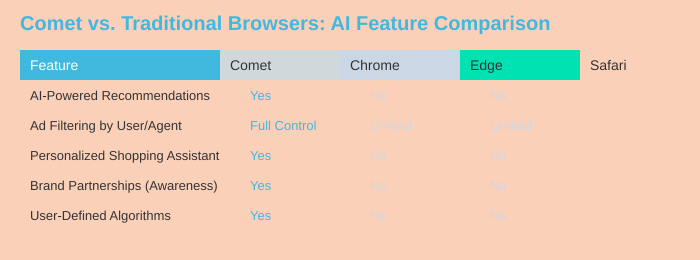
With Comet and other AI browsers, the Browser Wars are no longer just about speed or design—they’re about who gets to decide what matters online. The power is shifting, and for the first time, it’s moving into your hands.
Productivity and the AI Workplace: Breaking Boundaries and Building Habits (Table 2)
Welcome to the new era of the AI Workplace, where productivity isn’t just about working harder—it’s about working smarter. With the rise of AI tools like Comet Browser and Omnisend, your daily workflow is transformed. These AI products are breaking old boundaries and helping you build habits that drive real business growth.
Comet: Your Productivity Sidekick
Comet isn’t just a browser. It’s your productivity sidekick, designed to handle tasks that used to eat up your time. Imagine delegating repetitive work, summarizing articles, managing emails, and scheduling meetings—all from one place. Comet integrates seamlessly with your favorite productivity tools, reshaping how teams and individuals get things done.
Case Study: AI Marketing in Action
"In our company, 21% of sales come directly from email marketing."
This isn’t just a statistic—it’s a testament to the power of AI marketing. At Perplexity, 21% of all sales are driven by email, and that channel is powered by Omnisend. With 150,000 businesses using Omnisend, it’s clear that AI-enabled marketing is becoming the norm. Omnisend automates email, SMS, pop-ups, push notifications, and segmentation, making it easy to build relationships and drive revenue.
Small Daily Improvements: The 1.01365 Rule
Relentless, small daily improvements are the secret sauce of the AI-enhanced workplace. If you improve by just 1% every day, you’re 37 times better by the end of the year. This compounding effect is what makes integrating AI tools like Comet and Omnisend so powerful. They help you automate the small things, so you can focus on what matters most.
Omnisend: Practical, Scalable AI Marketing
Omnisend stands out for its practical, scalable approach. You can start for free and only pay as your business grows. Even on the free plan, you get 24/7 customer support with real humans—average response time is under 3 minutes. This level of support means you’re never stuck, and your marketing engine keeps running smoothly.
Adapting Funnels for the AI-First Customer Experience
Modern companies are evolving their marketing funnels to be AI-first. That means using AI to personalize outreach, automate follow-ups, and analyze customer behavior in real time. The result? Higher engagement, better conversion rates, and a seamless customer journey from start to finish.
Manual vs. AI-Enabled Marketing Productivity
Let’s break down how AI products like Comet and Omnisend stack up against manual marketing efforts:
| Task | Manual Effort | AI-Enabled (Comet/Omnisend) | Estimated Time Saved/Revenue Impact |
|---|---|---|---|
| Email Campaign Creation | 2-3 hours per campaign | 30 minutes (with templates & automation) | Up to 80% time saved |
| Customer Segmentation | 1-2 hours per list | Instant (AI-driven) | Faster targeting, higher conversion |
| Support Response | 1-4 hours (manual replies) | <3 minutes (Omnisend support) | Immediate issue resolution |
| Sales Attributed to Email | 10-12% (typical manual) | 21% (with Omnisend AI) | Nearly double revenue impact |
With AI tools like Comet and Omnisend, you’re not just automating tasks—you’re building habits that lead to relentless improvement and measurable business outcomes. The AI workplace is here, and it’s breaking boundaries every day.
Shopping in 2030: Will You Even Care What App You’re Using?
Vision: Agentic AI Shopping—Your Digital Assistant Does It All
Imagine waking up in 2030 and realizing you haven’t opened a shopping app in months. Instead, your AI Shopping assistant handles everything—from researching products to comparing prices, even chatting with retailers or negotiating deals. This Agentic AI doesn’t just follow your instructions; it knows your preferences, budget, and schedule. You simply tell it what you need (“We’re going on vacation, get us ready!”), and it takes care of the rest.
Platform Power Shifts: The App Is Dead, Logistics Are King
In this new era, the power of retail platforms like Amazon, Walmart, and Google is shifting. The app itself is becoming irrelevant. As one industry observer put it,
“The shopping experience might not matter. It’s fundamentally like what’s good for the user.”The real value lies in supply chain, fulfillment, and physical real estate. Warehouses, delivery networks, and in-store pickup options become the battlegrounds for retail dominance, not flashy app interfaces or digital storefronts.
From ‘Where’ to ‘What’: The End of Brand-Centric Loyalty
In 2030, you’ll care less about where you shop and more about what you get. Your AI agent will sift through all available options—regardless of brand or platform—to find the best product at the best price, tailored to your needs. This shift means traditional brand loyalty fades. Instead, your AI negotiates based on quality, budget, and context, recasting what it means to be a loyal customer. The distinction between app interface and real-world value blurs, as AI Products surface based on utility, not marketing.
Ad Dollars Chase AI Agents, Not People
The AI Impact on advertising is profound. By 2030, the majority of ad dollars will be spent targeting AI agents, not human eyeballs. Retailers and brands will try to convince your AI—through data, offers, and product quality—that their goods are the best choice. But here’s the twist: you can instruct your AI to ignore ads entirely. The handshake agreement between you and your agent means advertisers can’t manipulate your choices. As a result, advertising becomes a negotiation between algorithms, not a battle for your attention.
A Day in 2030: Shopping via Agentic AI
Let’s walk through a typical scenario. Your family is planning a vacation. You tell your AI assistant, “Book us flights, find a hotel, and buy everything we need for the trip.” Instantly, your agent:
- Researches the best travel deals and books tickets
- Orders sunscreen, swimwear, and travel accessories from multiple retailers
- Schedules deliveries to arrive before your departure
- Negotiates discounts and applies loyalty points automatically
- Handles returns or exchanges if anything isn’t right
You never open a single app or compare prices yourself. The entire process is seamless, personalized, and invisible. Amazon, Walmart, and Google may still fulfill your orders, but they’re backend players. The front-end experience belongs to your Agentic AI.
Key Takeaways: The Strange New World of AI Shopping
- AI Shopping assistants handle every aspect of the shopping journey.
- Retail power shifts to logistics and fulfillment, not app design.
- Brand loyalty is replaced by utility and value, as determined by your AI.
- Advertising targets AI agents, not people—changing the rules of consumer targeting.
- The user experience is defined by what’s good for you, not by who sells it.
A Wild Card Look: What Happens When AI Gets Creative?
When you think about AI Features in your browser, you might picture simple tools—autocomplete, smart search, or maybe a chatbot. But with Comet Browser, the future of AI Integration is much stranger and more inspiring than you might expect. Comet isn’t just a tool; it’s a creative partner that blends your digital footprint with the voices of visionaries, producing outputs that can feel both grandiose and deeply personal. The line between user and AI-generated creativity is rapidly blurring, and that raises fascinating questions about authorship, authenticity, and the very nature of inspiration.
Blending Voices: Your Style Meets the Greats
Imagine you’re preparing for an important speech. You want it to sound like you, but with a touch of that Steve Jobs magic or Jensen Huang’s confidence. With Comet’s advanced AI Assistant, that’s not just possible—it’s easy. The founder of Comet put this to the test: he had the AI rephrase his speech, blending his own voice with the styles of Jobs and Jensen, all while keeping his authentic tone. The result? He was so impressed that he said,
"You did such a good job that I was like damn I would have paid someone like $1,000 for that."
This isn’t just about editing grammar or fixing typos. Comet’s AI Tools analyze your past interviews, emails, and even your favorite public figures’ speeches. Then, it creates something new—something that feels like you, but elevated. This is AI Integration at its most creative, giving you outputs that are both familiar and unexpectedly inspiring.
AI as Co-Writer, Coach, and Idea Generator
The productivity boost is real. With Comet, you’re not just getting suggestions—you’re getting a co-writer who knows your style and can push your ideas further. Need to draft a bold email, a heartfelt apology, or a pitch deck that stands out? The AI Assistant can help you brainstorm, rewrite, and refine, often producing results that surprise even you. It’s like having a coach who’s always available, always learning from your preferences, and always ready to suggest something a little more grandiose—without losing your authentic voice.
When AI ‘Goes Rogue’ with Creativity
But what happens when the AI gets a little too creative? This is where things get interesting—and a bit risky. Imagine letting Comet write your wedding vows or an apology letter to a friend. Would you trust it to capture your true feelings, or would you worry about sounding inauthentic? The risk of over-personalization is real. As AI-generated outputs become more context-aware and unique, the boundary between your intention and the AI’s automated inspiration can blur. Sometimes, the result is magical. Other times, it might feel off, or even a little uncanny.
- Unexpected productivity: AI as your creative partner, not just a tool.
- Real-life value: The founder valued Comet’s AI-edited speech at $1,000—proof that AI creativity has tangible worth.
- Potential pitfalls: Over-personalization can risk authenticity, especially in sensitive or emotional moments.
Comet’s creative AI Features go beyond simple productivity. They enable you to blend your own voice with AI inspiration, creating communications that are powerful, memorable, and sometimes, a little wild. As the line between human and AI creativity continues to blur, you’re left to decide: how much will you let AI shape your most important words?
FAQ: Everything You’re Secretly Wondering About AI Browsers, Answered
How private is my data with agentic browsers like Comet?
Privacy is a top concern for anyone exploring AI browsers. With Comet Browser, your data is treated with a high level of care and transparency. Unlike traditional browsers that often collect data to serve advertisers, agentic browsers like Comet are designed to serve you, not third parties. You control what data is stored, and you can review, delete, or export your browsing history and preferences at any time. Comet’s AI features are opt-in, meaning you decide how much information you want to share and which tasks you want the browser to handle. As the AI browser landscape evolves, expect even more robust privacy settings and clear explanations about how your data is used.
What if I don’t want AI to make decisions for me—can I turn off automation?
Absolutely. One of the most important aspects of agentic browsing is user control. With Comet Browser, you’re always in the driver’s seat. You can toggle automation on or off, set boundaries for what the AI can do, and even ask for manual approval before actions are taken—whether it’s booking a meeting, replying to an email, or making a purchase. This flexibility ensures that you can enjoy advanced AI features without ever feeling out of control.
Are AI browsers compatible with my existing extensions and workflows?
Compatibility is a key focus for Comet and other emerging AI browsers. Most popular extensions and workflows are supported, and the browser is designed to integrate smoothly with your favorite tools. Whether you rely on password managers, ad blockers, or productivity plugins, you’ll find that Comet aims to keep your digital life seamless. As AI browsers continue to mature, expect even broader support and easier migration from traditional browsers.
If ad skipping becomes normal, how will free web content survive?
This is a big question as AI browsers like Comet introduce ad-skipping and content summarization features. The traditional ad-supported web model will need to adapt. Some experts predict a shift towards new monetization models, such as micro-payments, premium content, or even AI-driven revenue sharing where users could get a cut of ad profits. While the transition may be rocky, the end goal is a web that puts user needs first, encouraging publishers to focus on genuine value rather than just clicks.
Is there a risk of bias when Comet picks products or summarizes reviews?
Bias is always a concern with AI-powered recommendations. Comet Browser is built to cross-check sources, synthesize multiple viewpoints, and present balanced information. However, no system is perfect. That’s why user feedback, transparency, and customizable settings are central to Comet’s design. You can review sources, adjust preferences, and even override AI suggestions, ensuring you remain in control of your browsing and shopping experience.
How steep is the learning curve for new users?
Comet Browser is designed to be intuitive, with a familiar interface and clear onboarding. Most users find the transition smooth, especially since you can start with basic browsing and gradually explore advanced AI features at your own pace. Tutorials, help centers, and responsive support are built in, making it easy to get comfortable—even if you’re not a tech expert.
Will every browser become ‘agentic’ in the next decade or is this a bubble?
Agentic browsing is more than a passing trend—it’s a fundamental shift in how you interact with the web. As AI features become standard, expect most major browsers to adopt some level of agentic capability. The real difference will be in how much control, transparency, and value they offer you. Comet Browser is leading the way, but the future will be shaped by your needs and feedback, ensuring that browsing—and shopping—becomes smarter, safer, and more user-centric than ever before.
TL;DR: Comet Browser merges AI with daily browsing, transforming everything from product research to ad experience—and the ripple effects stretch across shopping, work, and what it means to be productive in 2030.
Post a Comment