

Let me take you back to my first attempt at selling homemade salsa at a weekend market. I nearly didn’t sign up—who wants to compete with 6 other salsa booths next to two guacamole stands and an actual taco truck? But here’s the twist: I sold out before noon, while a few booths with the fanciest signs packed up early. It made me question: was competition really my enemy? Or did it just push me to shout louder, offer samples with extra personality, and actually listen to what snackers wanted? Turns out, the so-called ‘market saturation’ boogeyman is often misunderstood. Let’s unpack what’s really happening in crowded industries—and why these “red oceans” are sometimes the absolute best place to start swimming.
Debunking the Myth: Why Market Saturation Is Rarely What You Think
When you look at your industry and see countless competitors, it’s easy to believe the market is “saturated.” This is one of the most common Market Saturation Myths—and it’s also one of the most damaging. As you try to grow your business, you may find yourself thinking, “There are too many people already doing this. The pond is full. The ocean is red.” But the reality is, most ‘saturated market’ claims are rooted in fear, ego, or a narrow view of what’s possible—not in fact.
“There’s a single reason why most people stay broke and most businesses stay small.”
Red Oceans Aren’t Always Bloody: The Reality Behind the Myth of Saturated Market
The typical entrepreneur sees a crowded space and assumes there’s no room left. But here’s what’s insane: 99% of people who say their market is saturated are completely wrong. Unless you’re literally selling to 140 people in a rural desert town, your market is probably a hundred—or even a thousand—times bigger than you think.
Let’s put this in perspective. In a typical city of 400,000 to 1,000,000 people, most businesses barely scratch the surface of their potential customer base. The average entrepreneur has tapped into less than 1% of the actual market. That’s not a typo—less than 1%.
“The average entrepreneur has tapped into less than 1% of the actual market.”
Why Market Saturation Fears Are Usually Self-Limiting Beliefs
So, why does the Myth Of Saturated Market persist? It comes down to visibility and perception. You see your competitors everywhere—on social media, in ads, maybe even in your own neighborhood. It feels like everyone is fighting over the same tiny slice of pie. But here’s the wild card: if everyone’s fighting over a slice, who’s looking for the whole bakery?
- Visibility ≠ Saturation: Just because you see competitors doesn’t mean the market is full. Most people in your area or niche haven’t even heard of you—or your competitors.
- Local Exceptions Are Rare: The only true “saturated” markets are tiny, isolated ones (think: 140 people in a desert town). For everyone else, the total addressable market is vastly larger than assumed.
- Keyhole vs. Open Door: Most entrepreneurs look through a keyhole and assume that’s all there is. In reality, the door is wide open, and the room is much bigger.
Growth Ceiling Causes: It’s Not the Market, It’s the Method
Let’s talk about Growth Ceiling Causes. The real reason most businesses stay small isn’t market saturation—it’s underutilized channels, poor advertising, or lack of innovation. If you’re not reaching more people, it’s usually because you don’t know how to advertise effectively, or you haven’t differentiated your offer. Innovation and differentiation create opportunity, even in crowded spaces.
- Underutilized Channels: Are you leveraging every platform—social, search, local partnerships, events?
- Advertising Know-How: If you’re unable to reach more leads, it’s not the market’s fault. It’s a skill gap.
- Innovation: New angles, offers, and customer experiences can open up “hidden” segments of the market.
Data Snapshot: Perceived Market vs. Reality
To visualize this, consider the following donut chart:
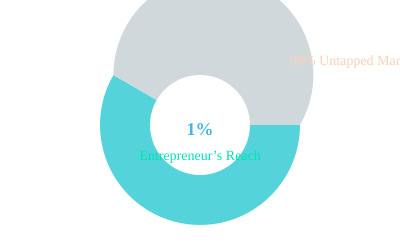
This chart shows the tiny sliver most entrepreneurs access (1%) versus the vast, untapped market (99%). The next time you hear someone say, “My market is saturated,” remember: the real limitation is rarely the market—it’s how you approach it.
What You’re Missing: The Overlooked Channels (and Competitors Aren’t the Real Problem)
When you think about market expansion techniques and customer acquisition, it’s easy to feel boxed in by what looks like a crowded space. Maybe you’ve noticed two more competitors pop up, and suddenly it feels like your share of the pie is shrinking. You might even catch yourself thinking, “I used to have this whole pie. Now I only have a quarter.”
But here’s the truth: this belief will keep you stuck in sales marketing stagnation. The real problem isn’t your competitors—it’s that you’re only seeing a tiny sliver of the market. Most entrepreneurs stick to one familiar channel, limiting their reach dramatically. You’re this tiny little sliver of this one way that you get customers on this one tiny platform.
The ‘Crowded’ Space Is Just One Slice
Imagine your current marketing efforts as a small red dot in a massive pie chart. That dot represents your ads on one platform, in one format. Maybe it’s Facebook ads, or Instagram stories, or Google search. But what about the rest of the pie? Your potential audience is scattered across countless platforms and formats you may never have tried.
Here’s a quick reality check: even if you’re running Facebook ads, you’re only reaching people who use Facebook, in the way that you’re advertising. What about those who prefer TikTok, YouTube, or even email? What about people who respond to direct mail, or who listen to the radio on their morning commute?
Examples of Overlooked Channels
- TikTok
- YouTube
- X (formerly Twitter)
- Radio
- TV
- Taboola (native ads)
- Google Search
- Direct Mail
- School and community spaces
- Phone calls and DMs
- In-person outreach
Most businesses only advertise in one channel and one format per channel. But your audience is everywhere. As one expert puts it,
'You only know how to advertise to an avatar that understands the solution and product that you're selling.'This means you’re missing out on all the people who don’t fit that narrow profile—or who simply aren’t on your chosen platform.
Visualizing the Opportunity
Picture your current ad spend as a tiny red slice in a pie chart of aggregate attention. When you zoom out, you realize that slice is almost invisible compared to the total market. The rest of the chart is made up of all the other channels and formats you’re currently doing nothing with. The opportunity for business differentiation is massive.

Bar chart: Most small businesses heavily use Facebook and Instagram, while channels like direct mail and radio/TV are rarely touched.
Comparing Channels: ROI and Effort
| Channel | ROI Potential | Effort Required |
|---|---|---|
| Facebook Ads | High (if targeted) | Medium |
| Email Marketing | Very High | Low |
| Direct Mail | Medium | High |
| Radio/TV | Varies | High |
| TikTok/YouTube | High (for younger demos) | Medium |
Wild Card: Stand Out with the Unexpected
What if you ran old-school radio ads just to stand out? Or sent handwritten letters to your top prospects? Sometimes, the least crowded channels offer the most attention. Omnipresence—being everywhere—multiplies your results and breaks you out of the “red ocean” mindset.
Remember, the space you think is saturated is just a tiny sliver. The real opportunity for market expansion techniques lies in the overlooked channels you haven’t even tried yet.
Crowded Waters, Fat Fish: Why Fierce Competition Means Massive Opportunity
When you look at a crowded market, it’s easy to see only the “blood in the water.” You might wonder, “Why enter a space with so many sharks already circling?” But here’s the counterintuitive truth: the more competitive the (red) ocean, the greater the rewards can be. If you’re asking yourself, “Why Saturated Markets?”—the answer is simple. Where there’s fierce competition, there’s also massive opportunity for entrepreneurial growth.
Competition Signals Demand, Not Defeat
Think about the business advice niche. Is it populated? Absolutely. Is it a red ocean? Without a doubt. But should you avoid it? Not necessarily. The presence of many competitors means there’s a healthy demand—customers are already there, looking for solutions. As one wise entrepreneur put it:
“The bloodier the water, it means the more fish are there.”
In other words, the ‘redder’ the ocean, the more fish (customers) are swimming around. Sometimes, blood in the water means there’s plenty to eat. Fierce competition is usually a sign of a thriving market, not a closed door.
Industry Examples: Winning in Crowded Spaces
Let’s look at some real-world examples. Warby Parker entered the eyewear industry, which was already packed with established giants. Canva launched into the design software market, competing with well-known brands. Both companies didn’t just survive—they thrived. Their secret? They focused on their unique value proposition and innovated within their industries. Warby Parker made eyewear affordable and stylish online. Canva made design accessible to everyone, not just professionals.
Data Snapshot: Outbound Success in a Red Ocean
| Company | Monthly Revenue | Competitive Edge |
|---|---|---|
| Example Software Company | $10 million/month | Outbound sales methods |
| Top Competitor | 5x larger | Different strategy, same market |
Even with a competitor five times bigger, the software company found a path to $10 million per month by using a different approach. This is proof that overcoming industry competition is possible—even in the most saturated markets.
Personal Anecdote: Salsa in a Sea of Salsas
Let me share a quick story. Years ago, I almost didn’t start selling my homemade salsa. The grocery shelves were already packed with dozens of brands. I thought, “Who needs another salsa?” But I decided to try anyway. I focused on what made my salsa unique—fresh ingredients, bold flavors, and a story customers could connect with. To my surprise, people loved it. Action and creativity made the difference, not the absence of competition.
Why Saturated Markets Are Fertile Ground
- Competition validates market demand. If others are doing well, there’s a reason.
- Customers are already educated. You don’t have to explain the need for your product.
- Room for differentiation. Standing out is more important than being first.
- Potential for breakout success. Industry examples show that even the busiest markets allow for transformative growth.
Sharks Aren’t Your Enemies—They’re Proof the Pond Is Worth Swimming In
It’s tempting to see competitors as threats, but in reality, they’re a sign you’re in the right place. Sharks don’t gather where there’s nothing to eat. Their presence means the pond is full of opportunity. Your job is to swim smarter, not just harder. Focus on your unique value proposition and look for ways to innovate. Remember, creative differentiation within saturated spaces is where entrepreneurial growth happens.
So, next time you see a crowded market, don’t turn away. Instead, ask yourself: “How can I stand out and claim my share of the fat fish?”
When to Niche Down (and When to Swim Upstream)
There’s a reason you hear the phrase, “the riches are in the niches.” When you’re just starting out, the smartest move is often to Find Your Niche and focus tightly. Think of it like this: it’s easier to become the biggest guy in a puddle than to make a splash in the open sea right away. By narrowing your focus, you’re competing against fewer people, which means you can gain traction, build your reputation, and even command higher prices. This is the essence of Niche Market Focus.
But here’s the catch: while the upside in a niche is capped, so is the risk. You get to learn, profit, and refine your skills without being overwhelmed by the competition of a massive market. As your skills and experience grow, you earn the right to move from that puddle to a pond, then to a lake, and eventually, as your confidence and capabilities expand, you can fight in the ocean.
Stage-Based Growth: Dominate, Then Expand
Business growth isn’t a single leap—it’s a journey through stages. At first, a tight niche gives you pricing power and clarity. You’re the go-to expert, not just another face in the crowd. Over time, as you master your craft and your audience grows, you’ll feel the urge (and have the ability) to expand. This is where Business Scaling Steps and Market Expansion Techniques come into play.
Let’s break down the analogy: you start as the biggest fish in a puddle. Once you’ve outgrown that, you move to a pond, then a lake, and finally, the ocean. Each step up represents a broader market, more competition, and greater opportunity—but only if you’re ready for it.
Five Directions for Business Evolution
When you’re ready to evolve, you have five main options for scaling or shifting your business. Each comes with its own risks and rewards:
| Strategy | Description | When to Use | Potential Upside | Potential Risk |
|---|---|---|---|---|
| Upmarket | Target higher-end clients or premium offerings | When you’ve mastered your current market and want higher margins | Higher profits, prestige | More demanding customers, higher expectations |
| Downmarket | Offer more affordable options to reach a broader base | When you want volume over margin | Larger customer base | Lower margins, potential brand dilution |
| Adjacent | Expand into related products or services | When your audience has additional needs you can meet | Cross-selling, deeper loyalty | Complexity, distraction from core |
| Broader | Widen your target audience or market segment | When you’ve saturated your current niche | More growth potential | More competition, less focus |
| Narrower | Double down on a specific sub-niche | When competition increases or you want to specialize further | Higher expertise, loyal following | Smaller market, limited scale |
Niche Pricing = More Profit Early; Scale Comes with Expansion
When you start niche, you can often charge more because you’re solving a specific problem for a specific group. As you grow and move upstream, you may need to adjust your pricing and offerings, but your early profits and reputation will fuel your expansion.
Tangential Musing: The Danger of Going Too Broad, Too Soon
It’s tempting to try to be everything to everyone, but that usually lands you nowhere. If you spread yourself too thin, your message gets lost, your brand becomes forgettable, and you end up fighting an uphill battle. Focus first, then expand—don’t skip the steps.
Eventually you get to the point where... fight in the ocean.
Remember, Find Your Niche first. Master your pond before you swim upstream. That’s how real business growth happens—one stage at a time.
It’s (Usually) Not the Market—It’s Your Strategy: How Skill, Messaging, and Consistency Win
When business growth stalls, the first instinct is often to blame the market. Maybe you’ve thought, “There just aren’t enough leads,” or “My city is too small.” But the truth is, Growth Ceiling Causes are rarely about market demand. More often, the real obstacles are skill gaps, unclear messaging, and inconsistent execution. If you want to break through, it’s time to look inward—because the market is almost never as saturated as it seems.
The Real Growth Ceiling: Skill, Messaging, and Consistency
Let’s get honest: Most businesses barely scratch the surface of their potential audience. Studies show that 0-1% market penetration is common, even in crowded industries. For example, a local service business in a city of 400,000 people may only need 200 loyal customers to thrive. That’s just 0.05% of the population. So why do so many entrepreneurs feel stuck?
- Skill: Are you truly mastering your craft—whether it’s sales, marketing, or operations? As one expert put it,
'You are just too unskilled to capture the significantly larger percentage of the pie.'
Skill gaps, not market size, are often the real Entrepreneurship Challenges Solutions need to address. - Messaging: If your message doesn’t resonate, even the best product won’t sell. Unclear or generic messaging confuses customers and limits your reach.
- Consistency: Half-hearted, scattershot tactics rarely win. Consistent execution—showing up daily, refining your approach, and delivering value—beats sporadic efforts every time.
Case Study: It’s Not the Leads—It’s the Outreach
Consider the entrepreneur who complains about a lack of leads. They run the same ad for months, post sporadically on social media, and rarely follow up with prospects. The problem isn’t market saturation—it’s stale ads and stagnant outreach. When they finally update their messaging, diversify their channels, and commit to daily outreach, leads start flowing again. This is a classic example of how Business Growth Mindset and operational improvements can shatter perceived ceilings.
Creative Wild Card: Rethink the Recipe, Not the Pie
Imagine blaming a pie for tasting bland, when the real issue is the recipe or the oven. Markets are similar. Instead of blaming the “pie” (market), ask yourself:
- Is my offer truly differentiated?
- Have I tested new channels or creative angles?
- Am I pairing ads with direct outreach for omnipresence?
Often, you don’t need a bigger market—you need a better approach. Consistent innovation and omnipresence unlock new slices of the pie, even in so-called “red oceans.”
Tangible Solutions: Fixing Operational Inefficiencies and Messaging
Most Growth Ceiling Causes are operational, not external. Here’s how to address them:
- Improve Content: Regularly update your messaging. Test headlines, visuals, and offers to see what resonates.
- Expand Channels: Don’t rely on a single platform. Use email, social media, ads, and partnerships to reach more people.
- Pair Ads with Outreach: Combine paid ads with personal outreach for maximum visibility and trust-building.
- Streamline Operations: Fix bottlenecks in your sales or fulfillment process. Operational inefficiencies can quietly cap your growth.
Consistent Execution Beats Scattershot Tactics
It’s easy to try a tactic once and give up. But the businesses that win are those that show up, refine, and repeat. Consistent, better execution always outperforms half-hearted efforts. If you’re facing a plateau, look at your habits and systems before blaming the market.
Operational Inefficiencies and Unclear Messaging: Silent Growth Killers
Finally, remember that operational inefficiencies and unclear messaging are two of the biggest Entrepreneurship Challenges Solutions you can control. They confuse customers, slow down your team, and limit your reach—regardless of how big the market is.
The market isn’t static. With the right skills, clear messaging, and relentless consistency, you can always find new opportunities for growth—even in the most crowded ponds.
Conclusion: From Myth to Mindset—Choosing Your Ocean (and Why There’s Room for More Boats)
It’s easy to look at a crowded market and feel like there’s no space left for you. The idea of “market saturation” is a common story in business circles. But if you look closer, you’ll see that this belief often acts as a comforting myth—a way to avoid the tough work of improving, adapting, and growing. The real limits to your business growth mindset are rarely set by the market itself. More often, they’re internal, shaped by how you think about competition and opportunity. When you shift from seeing the world as a zero-sum game to embracing abundance, you unlock new ways to overcome industry competition and maximize market potential.
Market Saturation: The Myth That Holds You Back
Many entrepreneurs and business owners use market saturation as a reason to stand still. It’s a tempting excuse: “There are already too many players,” or “The big guys have it all sewn up.” But in reality, most markets are not as closed as they seem. What looks like a “red ocean” full of sharks is often just a busy harbor—one where new boats can still set sail if they’re willing to learn, adapt, and persist.
- Comfort vs. Growth: It’s comfortable to blame the crowd. It’s harder to ask, “How can I improve my offer, my skills, or my approach?”
- Internal Barriers: The biggest limits are often your own fears, habits, or lack of action—not the number of competitors.
Business Growth Mindset: Your Most Valuable Asset
Adopting a business growth mindset means seeing every challenge as a chance to learn. Instead of shrinking from competition, you look for ways to stand out. This might mean improving your product, finding new channels, or simply showing up more consistently than others. Overcoming industry competition isn’t about fighting for scraps—it’s about creating your own space and making your presence felt.
Remember, omnipresence—being visible and available across multiple channels—can transform how you approach competition. When you stop worrying about the “red ocean” and start focusing on being everywhere your customers are, you realize there’s plenty of room for more boats.
Personal Story: The Salsa That Sold Out
Let’s go back to that moment when the salsa sold out. It didn’t happen because the market was empty or because there was no competition. It happened because you stayed in the game, kept improving, and didn’t let early setbacks push you out. You adapted your recipe, listened to feedback, and showed up week after week. Eventually, the crowd noticed. That’s the power of persistence and a growth mindset in action.
It’s a Journey—Not a Race
Business growth is a journey, not a sprint. You don’t have to dominate your industry overnight. Sometimes, you stay in the “small pond” for a while, learning and refining your skills. As you get better, you can expand your reach, try new channels, and take bigger risks. The important thing is to keep moving, keep learning, and never let fear of the crowd shrink your ambition.
- Opportunity Mindset: There’s more pie left, and always new flavors waiting to be discovered.
- Practical Expansion: Try new platforms, test new messages, and keep your eyes open for untapped niches.
- Skill Development: Invest in yourself and your team—better skills mean better results, no matter how crowded the market.
- Staged Growth: It’s okay to start small. As you improve, your market will grow with you.
"Choose action over excuses, and you might just find there’s more pie than meets the eye."
So next time you hear someone say the market is too crowded, remember: most limitations are internal. With the right mindset and consistent action, there’s always room for one more boat—especially if it’s yours.
FAQs: Unpacking Burning Questions About Market Saturation and Growth
Is my market really saturated, or am I just seeing more competitors?
It’s easy to mistake a rise in competitors for true market saturation, but the Market Saturation Myth is just that—a myth for most entrepreneurs. Unless you’re serving a tiny, isolated community, your market is likely 100 to 1,000 times larger than you realize. Most businesses have accessed less than 1% of their total addressable market. What you’re actually seeing is a small slice of potential demand, often limited by your current advertising skills or the platforms you’re using. Instead of blaming the market, look at how you can improve your outreach and messaging to reach new segments. The reality is, there are always next steps beyond so-called ‘saturation’ if you’re willing to learn and adapt.
What are five ways I can expand my business beyond its current niche?
If you want to move past your current limits, there are proven Market Expansion Techniques you can use. First, go upmarket—target bigger clients or organizations. Second, go downmarket—serve a larger, less affluent group. Third, move into adjacent industries that share similar needs. Fourth, broaden your focus to related sectors, like expanding from fitness to overall health and wellness. Fifth, narrow your focus even further to Find Your Niche and dominate a specific sub-segment. Most businesses haven’t even defined their ideal customer, so start by clarifying who you serve best and then choose your next move strategically.
Can I succeed without a unique value proposition?
While a unique value proposition helps, it’s not the only path to success in a so-called Saturated Market. Many thriving businesses offer similar products or services but win by executing better—through superior service, omnipresence, or relentless follow-up. In crowded markets, the “bloodier the water, the more fish there are.” Your edge could be your consistency, your ability to reach customers in more places, or your willingness to outwork competitors. The key is to stop waiting for a perfect, one-of-a-kind idea and instead focus on serving your market more effectively than others.
Should I focus on more platforms or better content first?
Both matter, but if you’re just starting, prioritize quality content that resonates with your audience. Once you have messaging that works, expand to more platforms to increase your reach. The biggest mistake is relying on a single channel—true Saturated Market Solutions come from omnipresence. Use every tool available: Instagram, Facebook, TikTok, YouTube, X, direct mail, and more. Each platform is a new opportunity to connect with untapped customers. As you grow, distribute your best content everywhere to maximize your impact.
How do I measure if I’ve truly ‘saturated’ my market?
Actual market saturation is rare. You’ll know you’re close when you’ve maximized every available channel, tested every platform, and still can’t grow despite improving your skills and offers. For most, the real limit is not market size but skill in marketing, sales, and execution. If you’re only reaching a few hundred customers in a city of hundreds of thousands, you’re far from saturation. Keep pushing—expand your reach, improve your ads, and try new strategies before concluding you’ve hit the ceiling.
Are saturated markets riskier or more profitable in the long run?
Saturated markets often seem risky, but they can be the most profitable. High competition signals high demand. If you can carve out your space and deliver consistent value, you’ll find more opportunity—and more reward—than in “blue ocean” markets with little demand. The real risk is in underestimating your market or giving up too soon. Stick with your business, keep learning, and use every Market Expansion Technique available. Over time, your persistence and skill will pay off.
In conclusion, the belief in market saturation is more limiting than the market itself. The next level of growth is always within reach if you shift your mindset, take responsibility, and commit to mastering your craft. Don’t let the myth of saturation hold you back—there are always new ways to expand, serve, and win.
TL;DR: Market saturation isn’t your enemy; it’s your opportunity—if you’re willing to innovate, differentiate, and reach farther than you think. Choose action over excuses, and you might just find there’s more pie than meets the eye.
Post a Comment