

Few people read 600+ page biographies cover to cover—fewer still return to highlight passages and obsess over patterns. But that's exactly what this blog's author did with Walter Isaacson’s deep-dive into Elon Musk. The result? Not a tabloid parade of controversies, but a hard look at the raw principles powering Musk’s career—from slumbering at the office to erasing every non-essential keystroke in user interfaces. And to keep it honest: along the way, some lessons sting, some dazzle, and one or two are just plain odd.
Strategy Games, War Mode, and Relentless Boardroom Battles (Elon Musk biography insights)
In the Elon Musk biography, one theme echoes from Musk’s earliest days: his obsession with strategy and relentless competition. Before he was an entrepreneur, Musk was a college student who spent countless hours immersed in the classic board game Diplomacy. This wasn’t just a pastime—it was a training ground. Musk’s love for strategy games, whether board or video, became the crucible where he honed the tactical thinking that would define his leadership style for decades.
Musk himself put it simply:
“I am wired for war.”This phrase, repeated throughout his life, is more than bravado. It’s a guiding principle. Musk’s approach to business, as revealed in every stage of his career, is shaped by this mindset. He doesn’t just play to win—he plays to dominate, to outthink, and to outmaneuver.
Musk’s Early Obsession: Strategy as Relaxation and Preparation
In college, Musk’s way of unwinding was to dive deep into Diplomacy. He would play for hours, escaping stress while sharpening his ability to see several moves ahead. This habit, highlighted in many Elon Musk biography insights, laid the groundwork for his later business philosophies. Musk’s competitive edge was not accidental; it was cultivated through relentless practice and a genuine love of strategic challenge.
Hardcore Work Ethic: War Mode at Zip2
When Musk launched his first company, Zip2, his management style was already set. He and his team slept in the office and showered at the YMCA. Musk demanded the same intensity from others that he demanded from himself. He was openly contemptuous of work-life balance, believing that only total commitment could build something great. As he put it,
“It’s not your job to make people on your team love you ... that’s counterproductive.”
Showmanship as Salesmanship
Musk’s business philosophies included a keen sense of showmanship. At Zip2, he and his brother staged a dramatic demonstration for investors: they bought a large computer rack, placed a small computer inside, and made it look like a massive, powerful server. This creative persuasion was a form of strategic storytelling—convincing others of Zip2’s potential through a single, memorable image. This tactic would become a hallmark of Elon Musk’s leadership style in later ventures.
Directness and Mission-First Culture
Another core aspect of Musk’s approach was his aversion to middlemen. He insisted on selling directly to consumers, a philosophy that started with Zip2 and persisted through Tesla and SpaceX. Musk also rejected the idea of workplace camaraderie if it distracted from the mission. He believed that being overly collegial was “counterproductive and dangerous,” prioritizing results over comfort—even if it meant offending or intimidating his team.
| Key Data Point | Details |
|---|---|
| Board game Diplomacy | Musk played for hours in college (early 1990s) |
| First company: Zip2 | Founded before Musk turned 27 |
| Sale of Zip2 | $37 million (Musk’s share: $22 million, age 27) |
These early habits—strategic thinking, relentless work, direct sales, and a mission-first mindset—are the foundation of leadership lessons Elon Musk offers. They reveal a leader who chips away everything that’s not essential, leaving only the raw, unyielding pursuit of greatness.
The Cycle of Wealth: Building, Cashing Out, and Betting Even Bigger (Musk's risk tolerance)
Elon Musk’s journey is a masterclass in Musk's risk tolerance and investment strategies. At just 27, after selling Zip2, Musk found himself with a staggering $22 million. For most, this would be a ticket to a life of luxury—perhaps an island, fast cars, or early retirement. But Musk’s mindset was radically different. As he explained in interviews at the time, “I could go buy an island, but I’m much more interested in trying to build and create a new company.” The money, for Musk, was never the end goal. It was simply fuel for the next big leap.
This approach—making money and immediately putting it back into another company—has defined Musk’s career for decades and is a cornerstone of Elon Musk leadership style. He has an extreme, almost binary, risk profile. There is no middle ground. As Musk himself put it:
"I'm either going to be wealthy or broke, but it's not going to be anything in between."
After the Zip2 windfall, Musk didn’t hedge his bets. He poured nearly all his winnings into X.com, which later became PayPal. When PayPal was sold, he repeated the cycle, investing heavily in SpaceX and Tesla—ventures that many experts at the time considered impossibly risky. Even decades later, after Tesla’s success made him one of the world’s richest people, Musk sold large amounts of Tesla stock to fund the purchase of Twitter (now X), once again risking his fortune on a bold new vision.
| Year | Event | Amount |
|---|---|---|
| 1999 | Zip2 Sale | $22 million |
| 2022 | Tesla Stock Sold for Twitter Purchase | Undisclosed (billions) |
This cycle of building, cashing out, and betting even bigger is not just a financial strategy—it’s a reflection of Musk’s core motivation. As he’s said, “The real payoff is the sense of satisfaction in having created a company.” For Musk, satisfaction comes from achievement, not from accumulated wealth. Money is a tool to solve problems, not a trophy to be displayed.
Musk’s risk tolerance is legendary, even among tech entrepreneurs. Where others might diversify or seek security, Musk throws everything into the next mission. This “all-in or bust” mentality is rare and infectious. His belief in his missions—whether colonizing Mars, electrifying transportation, or reinventing social media—pulls others into his orbit, inspiring teams to tackle challenges that seem impossible.
- After Zip2: Invested almost all proceeds into new ventures, not personal luxury.
- Extreme risk tolerance: No hedging, no safety net—just bold bets on the future.
- Cycle repeats: Tesla stock earnings funneled into Twitter, SpaceX, and more.
- Belief as a force: Musk’s conviction draws others into ambitious missions.
- Motivation: True satisfaction is in building, not accumulating.
- Binary mentality: “Win or broke”—no middle ground.
These patterns, visible throughout Elon Musk biography insights, reveal a leader who draws power from risk, thrives on challenge, and measures success by the scale of problems solved—not by the size of his bank account.
Simplify, Delete, Repeat: The Radical Art of Making Things Less Complicated
If there’s one commandment that defines Elon Musk’s approach to product development, it’s this: simplify, delete, repeat. In Walter Isaacson’s biography, Musk’s obsession with simplification and deletion is so relentless that, as the author notes, “half the book is him just yelling at people to delete, to edit, and to simplify.” This is not just a quirk—it’s a radical management philosophy that underpins everything Musk builds, from PayPal to SpaceX and Tesla.
Simplification and Deletion: Musk’s Signature Management Move
Musk’s first principles thinking in business always starts with the question: What can we remove? He believes that every extra feature, every unnecessary step, and every layer of bureaucracy is a drag on progress. In product design and user interface, Musk is famously ruthless. “He does this relentlessly. He had a passion for simplicity when it came to designing user interfaces,” Isaacson writes. At PayPal, Musk personally honed the UI to minimize the number of keystrokes required to open an account, cutting away anything that didn’t serve the core function.
Hostility to Unnecessary Features
Musk’s hostility to bloat is legendary. He is known for walking into meetings and demanding that teams delete features, merge roles, and trim processes. His philosophy: if you’re not actively making the product simpler, you’re making it worse. This drive for simplification and deletion in product development is not just about aesthetics—it’s about efficiency, cost control strategies, and scalability.
Engineers Lead, Not Product Managers
To maximize function-focused simplicity, Musk upended traditional company structures. He merged engineering with project management, insisting that engineers—not product managers—should lead teams. “Separating the design of a product from its engineering was a recipe for dysfunction,” he believed. Designers had to feel the pain if their ideas were hard to build. This integration ensures that every decision is grounded in technical reality and that simplification and deletion are embedded in every layer of the process.
Beyond Niche: Ambition to Reshape Industries
Musk criticizes niche-thinking, refusing to settle for incremental improvements or small market segments. His ambition is to remake entire industries. This requires products that are not only innovative but radically simple and scalable—a feat only possible through relentless simplification and deletion.
The 'Idiot Index': Quantifying Inefficiency
Perhaps Musk’s most famous cost control strategy is the creation of the “idiot index”—a blunt metric that measures how much more expensive a finished product is compared to its raw materials. If a rocket cost 50 times more than its parts, the idiot index was 50. Musk’s goal: drive this number down through simplification, deletion, and first principles thinking in business. This quantitative approach to slashing inefficiencies became a cornerstone of SpaceX’s success.
“He does this relentlessly. He had a passion for simplicity when it came to designing user interfaces.”
SVG Chart: The Decline of the 'Idiot Index' at SpaceX
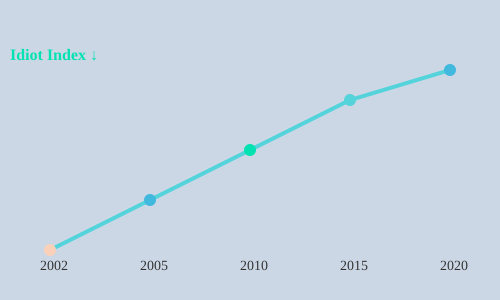
Musk’s radical art of making things less complicated is more than a management style—it’s a blueprint for building world-changing companies. By simplifying, deleting, and repeating, he transforms not just products, but entire industries.
Company-Building by the Numbers: Timeline of Musk's Major Ventures (Elon Musk Career Milestones Table)
To truly understand the Elon Musk management style and the enduring lessons from Elon Musk’s career, it’s essential to look at his journey in chronological order. Each company Musk has built—Zip2, PayPal, SpaceX, Tesla, and Twitter—serves as a new testing ground for his evolving philosophy. The timeline below reveals how his core principles, such as relentless simplification, aggressive deadlines, and bold financial bets, have not only survived but intensified over decades. This approach demonstrates how a single founder can leave a multi-decade mark on entire industries by iterating and refining strategies across companies.
Chronological Evolution of Musk’s Company-Building Principles
- Zip2 (1996–1999): Musk’s first company, built with his brother, set the tone for his career. He worked every waking hour, slept in the office, and obsessed over both product and presentation. Showmanship became salesmanship—he famously showcased a “giant server” to impress investors, even if it was just a small computer in a large frame.
- PayPal (1999–2002): After selling Zip2, Musk rolled nearly all his winnings into X.com, which became PayPal. Here, he doubled down on simplification—streamlining user interfaces and pushing for direct sales to customers. He merged design and engineering teams, a decision that would echo throughout his later ventures. Even after being ousted as CEO, Musk’s belief in his vision was unshaken:
'If I had stayed, PayPal would be a trillion dollar company.'
- SpaceX (2002–present): Musk’s ambition exploded. He devoured books on rocket science, moved to Los Angeles to be near aerospace talent, and invested his own fortune. SpaceX is where his obsession with cost reduction (the “idiot index”) and first-principles thinking became legendary. He set impossible deadlines and was on the front lines of every crisis, reinforcing his “wired for war” approach.
- Tesla (2004–present): Musk joined Tesla as a major investor and soon took the helm. He brought his signature management style: merging engineering and design, setting audacious goals, and pushing for radical simplification. Executive disputes and near-bankruptcy moments tested his resolve, but his willingness to risk everything for the mission never wavered.
- Twitter/X (2022–present): Musk’s acquisition of Twitter marked a new chapter. He immediately focused on cost reduction, server efficiency, and cultural overhaul—once again applying lessons learned from decades of company-building. His hands-on, detail-obsessed leadership style was as intense as ever.
Elon Musk Career Milestones Table
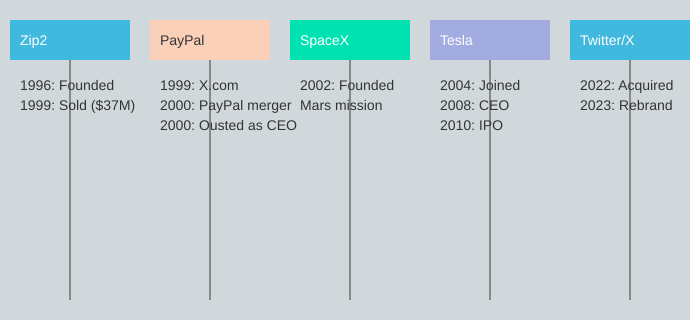
| Company | Year Founded/Joined | Headline Events | Musk’s Role |
|---|---|---|---|
| Zip2 | 1996 | Sold to Compaq (1999, $37M) | Co-founder, CTO |
| PayPal (X.com) | 1999 | Merger, Ousted as CEO (2000), IPO (2002) | Founder, CEO |
| SpaceX | 2002 | First private orbital launch (2008), NASA contracts | Founder, CEO, Chief Engineer |
| Tesla | 2004 | CEO (2008), IPO (2010), Model S/X/3/Y launches | Investor, CEO, Product Architect |
| Twitter/X | 2022 | Acquisition, Rebrand, Cost Overhaul | Owner, CEO |
Across every milestone, Musk’s leadership principles—from radical simplification to betting everything on the mission—are visible. Each new venture is not just a company, but a laboratory for refining the same core strategies, often in the face of extreme challenges and failures. This relentless iteration is the throughline of the Elon Musk biography—and the source of lessons for anyone seeking to build something truly enduring.
Making Belief Irresistible: Infectious Vision, Mission-Driven Cultures, and the 'Mandate from Heaven' (leadership lessons from Elon Musk)
One of the most powerful leadership lessons from Elon Musk is his ability to make belief irresistible. Musk’s personal conviction is so authentic and outsized that it shapes the very trajectory of his companies and teams. Over and over, people who work with Musk describe how his sheer certainty and intensity pull them into pursuing wild, world-changing goals—no matter how improbable they seem at first.
Musk’s Contagious Conviction: Drawing Others Into the Impossible
Musk’s leadership and operational tactics are rooted in a deep, almost obsessive belief in his mission. Whether it was building rockets to colonize Mars, disrupting the auto industry with Tesla, or acquiring Twitter to champion free speech, Musk’s vision is always front and center. He doesn’t just talk about changing the world—he acts as though it’s inevitable, and this certainty is contagious. As one observer put it, “Even when it seemed like crazy talk, you would believe him because he believed it.”
The Public Face: CEO as Chief Evangelist
Throughout his career, Elon Musk leadership style has included positioning himself as the public face and chief spokesperson for his companies. He believes the founder should be the best advocate for the mission, making himself visible not only to employees but also to customers, investors, and the wider public. This visibility is not just for show—it’s a strategic move that fuses product and culture, motivating teams and signaling to the world that the company is led by someone with unwavering commitment.
Mission-First, Money-Second: Inspiring Belief Beyond Logic
Musk’s approach to leadership is “mission-first, money-second.” He starts with a bold mission—like making humanity a multiplanetary species—and only later figures out how to make the business work. This approach inspires belief even when plans seem irrational. As Musk famously said:
“To have a base on Mars would be incredibly difficult ... but it will be incredibly inspiring and we must have inspiring things in the world.”
This framing of his ambitions as a “mandate from heaven” elevates the work to something epochal, making it easier for people to dedicate themselves fully.
Company Culture: Amplifying Risk and Burning the Boats
Inside Musk’s companies, the culture is built around amplifying risk and never retreating. He sets insane deadlines, pushes teams to the brink, and leads by example—often sleeping under his desk. Musk’s influence on culture is about burning the boats, making retreat impossible, and ensuring everyone is all-in. This intensity attracts those who want to be part of something bigger than themselves and weeds out those who don’t share the vision.
Vision as a Recruitment Tool and Market Differentiator
Musk leverages his vision not just to motivate his teams, but also as a powerful recruitment tool and market differentiator. The promise of working on epoch-level challenges—like colonizing Mars or accelerating the world’s transition to sustainable energy—draws top talent and sets his companies apart in crowded industries. Authentic, mission-driven belief becomes the ultimate lever for ambition and aggressive recruiting.
- Key Insight: Musk’s personal conviction routinely draws others into pursuing wild, world-changing goals.
- CEO Visibility: Musk’s presence is integral to motivating teams and shaping public perception.
- Culture of Risk: Amplifying risk and never retreating are core to Musk’s leadership style.
- Vision as Differentiator: Mission-driven belief is both a recruitment tool and a market edge.
First Principles Thinking: Physics, 'Idiot Index,' and Deconstructing the Impossible (first principles thinking in business table)
Elon Musk’s approach to business is famously unconventional, but at its core lies a simple, powerful method: first principles thinking. As highlighted in Walter Isaacson’s Elon Musk analysis, Musk doesn’t just accept how things are done—he breaks every problem down to the most basic truths, often rooted in physics, and then rebuilds solutions from scratch. This rare approach among CEOs is what sets Musk’s business philosophies and principles apart, enabling breakthrough innovations that others might miss or ignore.
Breaking Problems Down to Physics
Most leaders rely on analogy—copying what works elsewhere. Musk, however, insists on drilling down to the raw materials and fundamental science. As Isaacson notes,
“Elon employed first principles thinking, drilling down to the basic physics of the situation and building up from there.”This means ignoring assumptions, questioning every step, and refusing to be limited by “the way it’s always been done.”
The 'Idiot Index': Quantifying Waste
One of Musk’s most original contributions is what he calls the ‘idiot index’. This metric calculates how much more expensive a finished product is compared to the cost of its basic materials. If a product’s price is many times higher than its raw components, the ‘idiot index’ is high—signaling inefficiency and waste. Musk used this insight to slash costs at SpaceX, famously reading every available book on rocket engineering before starting the company. By applying first principles thinking in business, he exposed and eliminated unnecessary markups that had long been accepted as industry norms.
| Step | Description | Example (SpaceX) |
|---|---|---|
| 1. Identify Assumptions | List what everyone believes about the problem. | “Rockets are expensive because they always have been.” |
| 2. Break Down to First Principles | Reduce the problem to basic physics or raw materials. | “What are the materials and physics needed to build a rocket?” |
| 3. Calculate 'Idiot Index' | Compare finished product cost to raw material cost. | “Why does a $60 million rocket only have $2 million in materials?” |
| 4. Rebuild from Scratch | Design new solutions unconstrained by tradition. | “Let’s build rockets in-house, reusing parts and cutting costs.” |
Iterative Self-Education and Creative Solutions
Musk’s process isn’t just technical; it’s deeply personal. He devours every book, paper, and manual on the topic at hand, echoing the self-education habits of Edison and Churchill. This relentless learning, combined with radical questioning, leads to creative—and sometimes unorthodox—solutions. Whether it’s rockets, electric cars, or software, Musk’s first principles thinking in business is a scalable, transferable method that exposes hidden opportunities for disruption.
- Physics as Foundation: Every solution starts with the laws of nature, not industry dogma.
- ‘Idiot Index’ as Compass: Quantifies waste and sets targets for efficiency.
- Universal Application: From rockets to cars to AI, the method applies everywhere.
- Breakthrough Results: SpaceX’s dramatic cost reductions are just one example.
The Cost of Genius: Work-Life Imbalance, Burnout Risks, and Collateral Damage (Musk's influence on company culture)
Elon Musk’s management style is legendary for its intensity and relentless drive. His work ethic and dedication have shaped not only his own life but also the very DNA of the companies he leads. Yet, this wild blueprint for company-building comes at a steep personal and organizational cost. Musk’s influence on company culture is unmistakable—he sets the bar sky-high, but the pressure can be overwhelming for many.
Musk’s Obsessive Work Ethic: The Personal Price
From the early days of Zip2 to the launch of SpaceX, Musk’s approach has been simple: work comes first, always. He is known to work almost nonstop, taking minimal vacations and rarely stepping away from his projects. This ‘obsessive compulsive’ work ethic is both his superpower and his Achilles’ heel. As one observer put it:
"You cannot work as much as Elon works ... and expect to have relationships."
This reality played out in his first marriage to Justine Musk. When Elon decided to move to Los Angeles to start SpaceX, he did so abruptly, without even explaining the move to Justine. This pattern—work before family—would repeat throughout his life. Domestic tranquility is virtually non-existent in Musk’s world; the demands of his ventures always take precedence.
Company Culture: Relentless Hours and Sky-High Expectations
Musk’s influence on company culture is profound. Employees at Tesla, SpaceX, and his other ventures are expected to match his pace. The culture is built around relentless hours, intense productivity streaks, and a shared sense of mission. Breaks are rare, and even when they happen, they are intense—Musk is known to allow brief, all-consuming video game binges as the only real downtime.
- Relentless hours: Employees often work late into the night, mirroring Musk’s own schedule.
- Sky-high expectations: The bar for performance is set at the level of Musk’s own ambition.
- Intense productivity: Teams are pushed to deliver results at breakneck speed.
Not for Everyone: Burnout and Retention Challenges
Musk’s work ethic and dedication produce spectacular outcomes, but not everyone can—or should—emulate his extremes. The risk of burnout is high, and employee retention can be problematic. The environment favors those who thrive under pressure and are willing to sacrifice work-life balance for the chance to be part of something extraordinary.
For many, the cost of genius is simply too high. Relationships strain, personal health suffers, and downtime becomes a rare luxury. Even Musk’s own breaks are brief and intense, reflecting his all-or-nothing approach to both work and play.
Collateral Damage: The Downside of Musk’s Management Style
The collateral damage of Musk’s influence on company culture is real. While some team members rise to the challenge and help achieve legendary results, others struggle with the relentless demands. The high-pressure environment can lead to rapid burnout, and only a select few are able to sustain the pace for the long haul.
Ultimately, the challenges and failures in Musk’s ventures are often as much about human limits as technological ones. His blueprint for company-building chips away at everything that’s not genius—but sometimes, what’s left behind is just as important as what’s achieved.
Wild Card Corner: Hypothetical Spin—If Musk Ran Your Local Library and Two Curious Scenarios
Elon Musk’s first principles thinking and radical management style have transformed industries from rockets to electric cars. But what if these Musk business philosophies were unleashed in the most unexpected places? Let’s play out three wild scenarios—each a creative lens on how Musk’s relentless approach could shake up even the most traditional institutions.
If Musk Ran Your Local Library
Picture Musk as the new director of your neighborhood library. The first order of business: delete, edit, and simplify. Forget the Dewey Decimal System—Musk would reclassify every book by a ruthless cost-benefit analysis and real-time foot traffic data. Shelves gathering dust? Gone. Only high-impact, high-circulation titles survive. The “idiot index” would be applied to every process: if the cost of lending a book exceeds its value to the community, it’s out. Expect dramatic showmanship too—perhaps a live demo of a robotic librarian or a VR reading room to attract investors and press.
- Books as Inventory: Each title’s shelf life is tracked like a Tesla part. If it doesn’t move, it’s deleted.
- Staff as Engineers: Librarians become “mission engineers,” tasked with optimizing the flow of knowledge, not just shelving books.
- Mission-First Culture: The library’s new goal? “Accelerate human learning locally.” Camaraderie is secondary to results.
Some patrons might revolt at the loss of beloved but rarely borrowed books. Yet, the library would likely become a lean, high-velocity engine for community learning—if you can keep up.
Scenario 2: The Musk Pizza Shop—Applying the ‘Idiot Index’
What if Musk took over your favorite pizza shop? Every ingredient, every step, every expense is broken down to raw materials. The “idiot index” exposes inefficiencies: Why does dough cost so much more than flour, water, and yeast? Musk would automate dough kneading, optimize oven layouts, and possibly design a robotic pizza assembler. The goal: perfect margin and speed, not tradition.
- Menu Simplification: Only bestsellers survive. Custom orders? Only if they scale.
- Vertical Integration: Musk might even buy a wheat farm to control flour costs.
- Showmanship: Expect a viral launch event—maybe a pizza delivered by drone.
Some regulars might miss the old-school charm, but the shop would become a case study in first principles thinking applied to food service.
Scenario 3: Sports Teams—Mission-First, Camaraderie-Last
Imagine a sports team run on Musk’s “mission-first, camaraderie-last” mantra. Every player’s contribution is measured by data and impact. Team bonding activities? Only if they improve performance. Underperformers are swiftly replaced, and the coach is a “frontline general,” always present, always pushing for more. The mission—winning championships—trumps all else.
- Radical Accountability: Every play, every mistake is analyzed and iterated.
- Continuous Learning: Players study not just their sport, but also other fields for cross-pollination of tactics.
- Staff Turnover: Complacency is purged; only the hungry survive.
Such a team might dominate the league—or implode from burnout and mutiny. Either way, entrenched habits would be shattered, and the results would be unforgettable.
These playful scenarios show that Elon Musk management style and first principles thinking can be brilliantly—or dangerously—applied anywhere. The lesson: challenge every assumption, delete what doesn’t serve the mission, and never settle for “the way it’s always been done.”
Frequently Asked Questions: Musk’s Company-Building Playbook, Simplified
What is Musk’s 'idiot index' and how can I use it?
The “idiot index” is one of the most practical leadership lessons Elon Musk offers. Simply put, it’s the ratio of the cost of a finished product to the sum of its raw materials. If the number is high, Musk sees it as a sign that inefficiency, unnecessary complexity, or supplier markups are inflating costs. He urges teams to break down every product and process to its basics, asking: “Why can’t we do this cheaper or smarter?” Anyone, in any industry, can use this principle by regularly questioning expenses and processes, seeking out the simplest, most direct path to value. It’s a call to challenge assumptions and relentlessly pursue efficiency—a core part of Musk’s business philosophies and principles.
Is Musk’s work ethic realistic for most people?
Elon Musk’s work ethic is legendary—and extreme. He’s known for sleeping on factory floors, working 100-hour weeks, and expecting similar dedication from his teams. While this level of intensity is not realistic or healthy for most people, the underlying lesson is about commitment to mission and leading by example. Musk’s leadership principles suggest that while not everyone needs to match his hours, adopting a mindset of urgency, focus, and personal accountability can drive extraordinary results. The key is to find your own sustainable version of intensity, inspired by Musk’s example, without burning out.
Does he really reject all forms of work-life balance?
Musk is candid: he has little interest in traditional work-life balance. For him, the mission always comes first, and he’s willing to sacrifice comfort, routine, and even relationships for it. However, this doesn’t mean everyone should follow suit. The deeper insight is about prioritization and clarity of purpose. Musk’s business philosophies and principles are about aligning your time and energy with what matters most to you. For some, that’s a world-changing company; for others, it’s a different kind of legacy. The lesson is to be honest about your own priorities and make conscious choices accordingly.
How much does simplification matter if you’re not building rockets?
Simplification is at the heart of Elon Musk’s leadership principles, and it applies far beyond rockets or electric cars. Whether you’re running a bakery or a tech startup, complexity is the enemy of progress. Musk’s insistence on deleting unnecessary steps, merging roles, and questioning every requirement is a universal tool for innovation and growth. By constantly asking, “What can we remove or streamline?” you create space for creativity, speed, and resilience—no matter your field.
What’s the most transferable lesson from Musk’s career?
The most transferable lesson is the power of first principles thinking: breaking problems down to their fundamental truths and rebuilding from there. This approach, central to Musk’s business philosophies and principles, encourages you to ignore “the way things have always been done” and instead invent new solutions from scratch. It’s a mindset that anyone can adopt, regardless of industry or background, to challenge limits and drive breakthrough results.
Can you really learn to inspire belief, or is it innate?
Musk’s ability to inspire belief is legendary, but it’s not just an inborn trait—it’s a skill honed by conviction, clarity, and relentless communication. He embodies his mission so completely that others can’t help but be swept up by it. The lesson: if you want to inspire others, start by believing deeply in your own mission, communicate it with passion, and back it up with action. Over time, this authenticity becomes contagious, rallying teams and investors to your cause.
In the end, Musk’s company-building playbook is not just for tech titans—it’s a set of timeless leadership lessons for anyone who wants to push boundaries, simplify relentlessly, and lead with conviction. By demystifying his approach, Isaacson’s biography makes clear that while few can match Musk’s intensity, anyone can apply his principles to build something extraordinary.
TL;DR: Elon Musk’s company-building magic isn’t just about ambition or controversy; it’s a finely-honed system of principles: relentless dedication, risk obsession, simplification, and belief-inspiring leadership. Anyone can adapt these (with a little courage).
Post a Comment