

Let me be candid—I once posted a YouTube Short that soared to 34 million views. A week later? Another one cratered at just 30,000. Ouch. At first, I thought it was luck. But after obsessively breaking down what went right (and wrong), I realized: it’s all about the first few seconds. Whether you’re a seasoned creator or have barely posted, the difference between viral gold and digital oblivion starts with your hook. Ready to figure out why? Let’s get honest and gritty about real, algorithm-tested strategies—complete with a few confessions and curveballs from my own uploads.
Why the First Seconds Decide Everything: Hooks, Curiosity, and Scrolling Thumbs
Imagine uploading two YouTube Shorts in the same niche—one explodes to 34 million views, the other barely scrapes 30,000. The difference? It all comes down to the first few seconds. If you want to master the YouTube Shorts Algorithm and create Viral YouTube Shorts, you must understand the science of the hook.
"Your hook is by far the most important part of any YouTube short."
The Thumb Test: One Second to Win Attention
Every viewer’s thumb hovers for about a second before deciding to stay or scroll. In that blink, you’re not just competing with other creators—you’re fighting for survival in a feed that never stops. The first 3 seconds are the golden window. If you don’t grab attention instantly, your video is dead in the water, no matter how good the rest is.
Real Data: 34 Million vs. 30,000 Views—The Power of the Hook
Here’s a real-world example: I uploaded two Shorts with nearly identical content. One started with a direct, controversial question. The other eased in slowly. The result? The first video hit 34,000,000 views. The second, just 30,000 views. The only real difference was the intro structure.
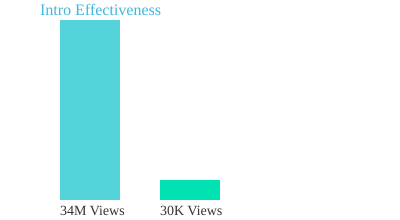
| Video | Views | Intro Strategy | Key Example |
|---|---|---|---|
| Short A | 34,000,000 | Direct, Controversial Hook | “Have you ever wondered why Asian people have such small eyes?” |
| Short B | 30,000 | Slow, Generic Start | Standard intro, no immediate intrigue |
| Mr. Beast Example | N/A | Familiar Face, High Stakes | Turned down $1B offer in first 3 seconds |
| Best Practice | N/A | 3-Second Hook | Immediate, bold statement or visual |
Three Must-Haves for Effective Video Hooks
- Immediacy: Get straight to the point. Don’t waste a millisecond. “You are literally fighting for attention every time you start a YouTube short.”
- Intrigue: Spark curiosity or controversy. Ask a question or show something unexpected. This is a powerful psychological trigger that boosts viewer retention and sharing.
- Zero Fluff: Cut all filler. Every second must earn its place. The YouTube Shorts Algorithm rewards videos that keep people watching, not those with flashy but empty intros.
Controversy, Familiar Faces, and Curiosity: Psychological Triggers That Work
Look at Mr. Beast’s viral success. He often starts with a jaw-dropping statement—like turning down a $1B offer—or a familiar face. These triggers instantly create questions in the viewer’s mind: “Why would someone do that?” or “What happens next?” The same goes for controversial questions. In one viral Short, the opening line—“Have you ever wondered why Asian people have such small eyes?”—is shocking, but it taps into a universal curiosity. It’s bold, direct, and impossible to ignore.
When you combine these triggers with a clear, compelling visual, you maximize the chance of algorithm promotion. The YouTube Shorts Algorithm cares about viewer retention and engagement. If your intro makes people pause, watch, and comment, your video will be pushed to millions more.
Every Second Counts: Break Down Your Script
To master Effective Video Hooks, analyze every sentence. Ask: Does this line grab attention? Does it spark curiosity or emotion? If not, cut it. Remember: Viewer attention dips sharply after a weak intro. The first three seconds are your only chance to win the scrolling thumb—and the viral jackpot.
Script Surgery: Breaking Down Every Word (and Why 'Fluff' Kills Your Views)
Every Word Counts: The Anatomy of a Viral Script
When it comes to Scripting Techniques for YouTube Shorts, every single word is a calculated move. As one top creator puts it:
"Every single word I write in my scripts is so calculated to the point that I know what's going to happen in the next 30 seconds, so I can lead them perfectly into it."This is the core of Crafting Engaging Scripts—no line is wasted, and every sentence pushes the viewer toward your payoff. If you wander or add unnecessary details, you lose attention. In fact, data shows that scripts lose 20-50% of viewers immediately after fluff or weak explanations.
Skip the Fluff: Every Line Drives to the Payoff
Your script is a race against the scroll. The moment you start a YouTube Short, you’re fighting for attention. Unlike long-form content, Shorts don’t require commitment—viewers can swipe away in a split second. That’s why your intro must get straight to the point.
- Every line should drive toward the ultimate payoff. If it doesn’t, cut it.
- Skip digressions and side stories. Viewers want the main event, not the warm-up.
- Optimum intro length: Under 15 seconds before you hit the main content.
Tease, Don’t Reveal: Build Curiosity with Micro-Storytelling
Building Curiosity is the secret sauce of Micro-storytelling. Instead of dumping all the information upfront, tease the outcome. Make viewers want to stick around to see if their guess is right. For example, in a viral Mr. Beast Short, the script didn’t just say, “He got a billion-dollar offer.” It teased the context, then layered in details:
- “He went on a podcast and admitted he received a billion dollar offer…”
- Quickly add, “It included all 18 of his channels and all of his companies.”
Notice how the script doesn’t over-explain. It gives just enough for the audience to fill in the blanks, empowering them to feel smart. As another expert tip says:
"Don't insult your audience's intelligence by overexplaining really simple things."
Supporting Hooks vs. Story-Driven Intros: When to Use Which
There are two main ways to open your Short:
- Supporting Hook: A bold fact, question, or statement that instantly grabs attention. Use this when your content is about a surprising stat or a quick reveal.
- Story-Driven Intro: Start with a scene, timeline, or location, then develop context. This works for Shorts that need a bit of setup before the payoff.
Quick Context, Zero Over-Explaining
Viewers want to feel smart. Give them enough context to understand, but let them connect the dots. If you spend too long explaining, you risk losing their interest. Remember, the majority of YouTube Shorts are under 60 seconds. Brevity isn’t just a style—it’s a necessity.
Script Like Sherlock Holmes: Every Line Is a Clue
Imagine if Sherlock Holmes wrote YouTube scripts. Every sentence would be a clue, building a puzzle that the audience wants to solve. That’s how you should approach Crafting Engaging Scripts for Shorts. Each line should either:
- Advance the story
- Build curiosity
- Lead to the next key moment
SVG Chart: Viewer Retention vs. Fluff
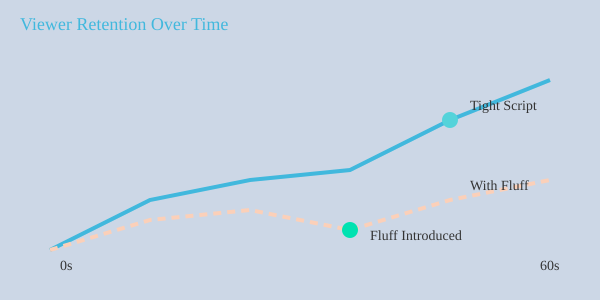
Key: Tight Script | With Fluff
Remember: Every word matters. Fluff is your enemy. Script like Sherlock, and your Shorts will keep viewers glued until the very end.
Payoffs, CTAs, and the Bitter Truth About the Algorithm's Attention Span
If you want to master YouTube Shorts, you need to understand one hard truth: the algorithm’s attention span is brutally short. The moment you deliver the answer, the twist, or the “aha!” moment, viewers vanish. The YouTube Shorts algorithm knows this. It tracks sharp engagement drops right after the main payoff, and if your audience bails, your view count and reach can stall. That’s why the timing and style of your call to action (CTA) are more important than ever.
Let’s break down the science of attention. Viewers arrive for a promise—maybe a shocking reveal, a clever hack, or a quick laugh. If you drag out the payoff, you risk losing them before you deliver. If you overpromise and underdeliver, you frustrate them and kill your channel’s trust. The best practice? Deliver the payoff quickly and directly. Don’t make your audience wait. The second they get what they came for, they’re ready to swipe away. Your window for engagement is just a few seconds wide.
This is where the CTA comes in. As one Shorts expert put it,
"Call to action is quite literally the only time you should ever go off topic in a video, but even then, tie it in."The CTA isn’t just a formality—it’s your last, best shot at converting a passive viewer into an active subscriber, commenter, or sharer. But here’s the catch: the CTA must feel organic, not forced. The YouTube Shorts algorithm favors engagement, but viewers can spot a generic “please subscribe” from a mile away. Instead, weave your CTA into the story. For example, in MrBeast’s viral Shorts, you’ll hear lines like, “Subscribe if you love Chandler,” or “Subscribe if you knew who it was the entire time.” These CTAs are contextually relevant, playful, and directly tied to the viewer’s experience.
Why does this matter? Because the data is clear: Shorts experts report that organic, story-driven CTAs placed near the very end of a video can boost engagement rates by 15-25%. Top Shorts creators, many earning over $20,000-$30,000 per month, rely on attention-savvy scripts that deliver the payoff, then instantly transition to a CTA that feels like a natural next step. If you wait too long or break the flow with a clunky request, you’ll see your dropoff rate spike—and the algorithm will notice.
To illustrate the difference, here’s a comparison of CTAs and their impact on engagement:
| CTA Style | Example | Engagement Result |
|---|---|---|
| Organic (Story-Driven) | “Subscribe if you love Chandler.” | 15-25% higher engagement, more shares, better retention |
| Forced (Generic) | “Please subscribe to my channel.” | Lower engagement, higher dropoff, less algorithmic push |
The takeaway? The best CTAs are woven seamlessly into the narrative. They feel like a reward, not a demand. They’re timely—coming right after the payoff, when attention is highest but before viewers swipe away. And they never overpromise. Leave your audience satisfied, maybe even a little excited for what’s next, but never frustrated or misled.
In the end, the bitter truth about the YouTube Shorts algorithm is that it’s ruthless with attention. Your job is to deliver value fast, transition to a relevant CTA, and make every second count. If you can master the art of the timely payoff and the organic call to action, you’ll not only boost your YouTube Shorts view count, but you’ll also build a loyal, engaged audience—and maybe even join the ranks of creators earning tens of thousands each month. That’s the real secret behind viral YouTube Shorts: understanding the fleeting nature of attention, and using every moment wisely.
TL;DR: Sharpen your YouTube Shorts by nailing the hook, keeping viewers curious, and delivering a satisfying payoff. Blend psychology with smart scripting, and let the algorithm work for you.
Post a Comment