

Let's be honest: It's easy to have the patience of a saint when the WiFi is strong, your coffee is hot, and no one's telling you the same story... AGAIN. But life doesn't work that way. This isn't a confession booth, but here's a story: Last week, I found myself internally bellowing while my partner recounted (for the third time!) the tale of the Great Sandwich Mix-Up of 2014. I managed not to interrupt, but the mental effort left me as drained as my phone on 3%. If patience ever felt just out of reach—especially with ADHD—you are definitely not alone. Today, we ditch the guilt and discover why our brains work this way, plus an alternative path out of the impatience trap (with a few quirks and plenty of practical strategies).
The ADHD Patience Paradox: When Love Meets Impulse
You want to be patient—you really, truly do. Especially with the people you love most. But if you live with ADHD, you know that managing emotions with ADHD isn’t as simple as just deciding to be calm. You might promise yourself you’ll listen patiently to your partner’s stories, or keep your cool when your kids are dragging their feet. Yet, in the moment, your patience can feel like a leaky balloon—no matter how much you want to hold onto it, it slips away.
Why Wanting to Be Patient Isn’t Enough for ADHD Brains
ADHD emotional regulation is a real challenge. Your brain knows what you should do: pause, breathe, let your loved one finish their story. But when you’re activated—when your partner is telling that same long story for the third time, or your kids are moving at a glacial pace while you’re already late—your impulse to interrupt or rush them can feel overwhelming. This isn’t just a minor annoyance. It’s a core part of emotional dysregulation in ADHD.
Everyday Triggers: Slow Talkers, Dragged Feet, and Endless Kid Chaos
Let’s be honest: the world isn’t built for ADHD brains. Everyday situations can become emotional landmines:
- Your partner’s detailed, meandering stories (again).
- Your child’s endless search for their shoes when you’re late.
- Long lines, slow drivers, or repetitive routines.
Each of these moments can trigger impatience, frustration, and even anger. And because you love these people, the urge to “just be patient” can make you feel even worse when you can’t pull it off.
The Inner Tug-of-War: Knowing You Should Pause, But Can’t Quite Do It
Inside, you’re fighting a battle. One part of your brain is whispering, “Just be patient, take a breath, you’re fine.” But the other part is screaming, “I can’t take this anymore!” This tug-of-war is exhausting. And when you lose your cool, the fallout isn’t just external—it’s internal, too.
How Impatience Spirals Into Guilt, Relationship Tension, and Exhaustion
Impatience with loved ones is more than a fleeting frustration. It can spiral into:
- Guilt: You feel bad for snapping or interrupting.
- Relationship tension: Your partner or kids may feel unheard or rushed.
- Exhaustion: The emotional effort of trying (and failing) to regulate your reactions wears you down.
As one community member put it,
“For a lot of us with ADHD, impatience can chip away at our self-esteem, it can strain relationships, it can leave us thinking that we're letting down the people who matter most to us.”
Personal Anecdote: The Saga of the Recycled Story and the Eye Twitch
Picture this: Your partner starts telling that story about their coworker—again. You love them, but you feel your eye start to twitch. You try to listen, but every cell in your body wants to finish their sentences or change the subject. You know you should be patient. But your impulse wins, and you interrupt. The look on their face? It stings. The guilt? It lingers.
Impatience: A Real Emotional Hurdle, Not Just a Character Flaw
It’s important to recognize that relationship conflict and ADHD often go hand-in-hand, not because you don’t care, but because emotional regulation is a genuine hurdle. According to Additude data, 37% of adults with ADHD say impulse control is their biggest daily challenge. Community feedback and lived experience also show higher rates of relationship conflict due to impatience.
| Challenge | Reported Rate | Source |
|---|---|---|
| Impulse control as biggest daily challenge | 37% | Additude Magazine |
| Higher relationship conflict due to impatience | Significant | Lived experience, community feedback |
Remember, impatience isn’t a character flaw—it’s a real emotional challenge that deserves understanding and support.
Inside the ADHD Brain: Why Forcing Patience Backfires
The ADHD ‘Operating System’: How Emotional Regulation Gets Short-Circuited
Think of your ADHD brain as running its own unique operating system. While a neurotypical brain processes impulses and emotions with a reliable set of controls, the ADHD brain’s system is wired differently—especially when it comes to executive function and emotional regulation. This difference is at the root of why emotional dysregulation and impatience can feel so intense and hard to manage.
The Unreliable Control Center: The Faulty Prefrontal Cortex Gate
Your prefrontal cortex acts like a control tower, managing planning, impulse control, and emotional regulation. In ADHD, this “security checkpoint” is often unreliable. When impatience or frustration arises, a neurotypical brain’s control gate can pause, assess, and decide whether to let that impulse through. For ADHD brains, that gate is leaky—impulses often burst through before you even realize it. This is why you might find yourself reacting—interrupting, sighing, or abandoning a task—before you can stop yourself.
Why Forced Self-Control Drains Your Mental ‘Battery’ Fast
Trying to force patience through sheer willpower is like running a demanding app on a phone with low battery. Here’s the reality:
- ADHD brains start the day at 60% battery, while neurotypical brains begin at 100%.
- Every effort to suppress impatience—clenching your jaw, repeating “don’t interrupt”—uses up precious executive function energy.
- By mid-morning, you might be running on 20%, with little left for what actually matters.
“As an ADHD brain, maybe we start the day at 60% battery, while a neurotypical brain starts at 100% battery. And then when we're using all of that energy to try and force patience... we're running with 20% and no energy left for what actually matters.”
The Performance Paradox: Looking Calm Outside, Volcanic Inside
Many with ADHD become experts at emotional masking—appearing patient on the outside while feeling like a volcano inside. This act is exhausting. Suppressing your true feelings doesn’t make them go away; it just builds internal pressure. The more you force yourself to “just be patient,” the more your executive function battery drains, and the more likely you are to experience an emotional outburst later.
How Suppression Triggers Inner Battles and More Impatience
Suppressing impatience doesn’t solve the problem. Instead, it creates an inner battle. You might:
- Feel your heart race or your body tense up
- Become restless or desperate to escape the situation
- Experience a quick burst of relief after reacting impulsively, followed by guilt and self-criticism
This cycle—trigger, frustration, impulsive reaction, shame—repeats, leaving you with even less emotional capacity for the next challenge. The inner critic gets louder, asking, “Why can’t I just be more patient?” This self-blame only worsens emotional exhaustion and dysregulation.
Analogy: Emotional Energy Like a Smartphone Battery
Imagine your executive function as a battery:
- Neurotypical brain: Starts at 100%, can handle emotional regulation with ease.
- ADHD brain: Starts at 60%, and every act of forced patience drains it faster.
By noon, after several rounds of suppressing impatience, your battery might be nearly empty—leaving you vulnerable to emotional dysregulation and burnout.
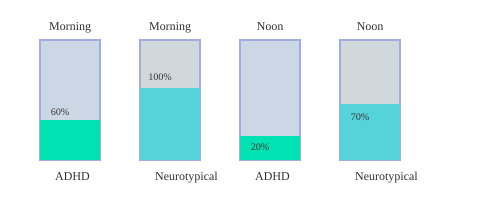
Executive function 'battery' levels: ADHD vs. neurotypical brains across morning and noon, given emotional suppression efforts.
The Mindset Shift: Making Peace with Impatience (Yes, Really)
Let’s start with a radical idea: Patience begins with self-patience. If you’re living with ADHD, you already know how quickly impatience can bubble up—waiting in line, listening to a slow explanation, or even trying to focus on a task that just feels impossible. Most emotional regulation strategies tell you to “calm down” or “push through.” But what if the real path to patience is not about suppressing impatience, but about accepting it?
Impatience as a Messenger, Not an Enemy
Here’s the truth: impatience isn’t a flaw to crush. It’s a message from your nervous system. When you feel that familiar surge of frustration, your brain is trying to tell you something—maybe you’re bored, overwhelmed, or your dopamine levels have taken a nosedive. Instead of treating impatience as an enemy, what if you saw it as data?
| Impatience Signal | Possible Message | Adaptive Response |
|---|---|---|
| Under-stimulation | This is boring, I need more engagement | Add novelty or movement |
| Overwhelm | This is too much, I feel lost | Break tasks into smaller steps |
| Dopamine drop | This feels flat, motivation is low | Use rewards or change environment |
Treating impatience as a signal, not a defect, is a powerful mindfulness technique for ADHD. It helps you respond with curiosity instead of judgment, which is the foundation of self-compassion and emotional clarity with ADHD.
How Reframing Your Response Reduces Inner Battles
Most of us try to silence impatience—shaming ourselves or pushing it away. But research shows that acceptance of emotions, rather than suppression, leads to better long-term emotional regulation. When you allow yourself to feel impatient without judgment, you quiet the exhausting inner battle. This opens up space for creative solutions and self-understanding.
"The first and most important step to developing greater patience is practicing patience with your own impatience."
Practical Script: Gentle Self-Narration During an Impatience Surge
Next time you feel that wave of impatience, try this gentle self-talk:
- Notice: “I’m feeling really impatient right now.”
- Name: “That’s okay. Impatience is just a signal—maybe I’m bored or overwhelmed.”
- Normalize: “Everyone feels this way sometimes. I don’t have to fix it right now.”
- Nurture: “What do I need? Can I make this task more interesting, or give myself a short break?”
This script is a simple emotional regulation strategy that helps you pause, observe, and respond with kindness. Remember, imperfection is expected. The goal is not to eliminate impatience, but to make peace with it.
Embracing Curiosity Over Judgment
When impatience strikes, ask yourself: What if I paused and let this discomfort just ‘be’ for a second? Self-observation is the foundation for behavioral change. By treating impatience as valuable data, you break the shame-impulse cycle and open the door to adaptive responses. This is how you build true emotional clarity with ADHD—one moment of self-compassion at a time.
Science-Backed Emotional Regulation Strategies (with a Side of Real Life)
Mindfulness Meditation and Deep Breathing: Evidence and Quick Tips
Let’s start with a strategy that’s both simple and powerful: mindfulness meditation. Research shows that mindfulness techniques such as meditation and deep breathing exercises are effective for improving emotional regulation and reducing impulsivity in individuals with ADHD. These practices help you notice your emotions without letting them take over. Even just a few minutes a day can make a difference.
- Quick tip: Try “box breathing”—inhale for 4 seconds, hold for 4, exhale for 4, hold for 4. Repeat 3-5 times when you feel impatience rising.
- Real life: When you’re stuck in traffic or waiting in line, use this time for a quick breathing reset instead of letting frustration build.
Cognitive Behavioral Therapy (CBT) vs. Dialectical Behavior Therapy (DBT): Which Fits ADHD Challenges?
Both cognitive behavioral therapy (CBT) and dialectical behavior therapy (DBT) are clinically validated for ADHD-related emotional regulation. CBT focuses on identifying and changing unhelpful thought patterns, while DBT adds skills for tolerating distress and managing intense emotions.
- CBT: Great for challenging negative self-talk and building problem-solving skills.
- DBT: Excellent for learning emotion tolerance, mindfulness, and practical coping techniques.
- Real life: If you find yourself spiraling after a mistake, CBT can help you reframe the situation. If you feel overwhelmed by emotion, DBT skills like “self-soothing” can help you ride the wave.
Why Consistent Routines and Daily Structure Help Minimize Triggers
ADHD brains thrive on structure. Consistent routines and daily organization lower the frequency of emotional surges by reducing surprises and decision fatigue. When you know what’s coming next, you’re less likely to get thrown off balance.
- Set up visual schedules or reminders for daily tasks.
- Anchor your day with predictable routines—like a morning checklist or a set bedtime ritual.
- Real life: Even a simple “keys-in-the-bowl” habit can prevent a frantic, emotional scramble before you leave the house.
The Overlooked Power of Creative Outlets and Movement
Physical activity and creative outlets are more than hobbies—they’re proven emotional regulation strategies. Movement helps release pent-up frustration, while creative activities like drawing, music, or journaling give your feelings a safe place to land.
- Take a brisk walk or dance to your favorite song when you feel overwhelmed.
- Try doodling, painting, or playing an instrument to express emotions non-verbally.
Tracking Progress: Using a Frustration Log or Emotional Vocabulary Journal
Journaling is a science-backed way to build emotional clarity and resilience. Try keeping a frustration log or an emotional vocabulary journal to track triggers, reactions, and what helps you recover. Over time, you’ll spot patterns and celebrate progress.
- Write down what happened, how you felt, and what you tried to cope.
- Review weekly to notice improvements and adjust your strategies.
Quick Chart: ADHD Emotional Regulation Strategies Comparison
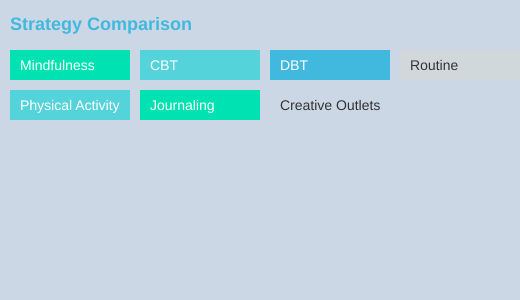
| Strategy | Strengths | Target Symptoms | Practical Example |
|---|---|---|---|
| Mindfulness | Reduces impulsivity, increases awareness | Emotional swings, impatience | Box breathing in stressful moments |
| CBT | Reframes negative thoughts | Self-criticism, frustration | Challenging “I can’t” thoughts |
| DBT | Builds emotion tolerance, coping skills | Overwhelm, emotional surges | Self-soothing with sensory tools |
| Routine | Minimizes triggers, adds predictability | Disorganization, stress | Morning and evening checklists |
| Physical Activity | Releases tension, boosts mood | Restlessness, irritability | Quick walk or dance break |
| Journaling | Clarifies emotions, tracks progress | Confusion, overwhelm | Frustration log or mood journal |
| Creative Outlets | Expresses feelings safely | Anger, sadness | Doodling, music, crafts |
Building Self-Compassion: Your Secret Superpower for Calm
When it comes to emotional regulation strategies for ADHD, self-compassion is a game-changer. Dr. Kristen Neff, a pioneer in self-compassion research, describes it as having three main components: self-kindness, common humanity, and mindfulness. As she puts it,
"Self-compassion has three main components, and I think they fit really beautifully with managing and working with our impatience."Let’s break down how these pillars can transform your ability to stay calm and patient, even when your patience feels like a leaky balloon.
1. Self-Kindness: Talk to Yourself Like a Friend
ADHD brains are often quick to self-criticize. When you snap at someone or lose your cool, your inner voice might say, “What is wrong with me? Why can’t I just be more patient?” Dr. Neff’s first pillar, self-kindness, invites you to pause and treat yourself with the same warmth you’d offer a friend. Instead of harsh judgment, try saying, “This is really hard for me right now, and that’s okay. What do I need?”
- Practical example: If you miss a deadline or get frustrated waiting in line, notice your self-talk. Would you shame a friend for the same thing? Probably not. Offer yourself understanding instead.
- Self-kindness interrupts the shame spiral that often fuels emotional outbursts in ADHD.
2. Common Humanity: You’re Not Alone in This
The second pillar, common humanity, is a powerful reminder that your struggles are not unique or isolating. Millions of people with ADHD experience impatience, restlessness, and frustration—sometimes all in one morning! Recognizing this shared experience reduces self-blame and isolation. You’re not broken, and you’re certainly not alone.
- When you catch yourself thinking, “No one else has this problem,” remember: ADHD brains everywhere are navigating similar challenges every day.
- Knowing this helps build emotional resilience and stops you from stacking shame on top of frustration.
3. Mindfulness: Noticing Impatience, Not Becoming It
The third pillar, mindfulness, means observing your thoughts and feelings without getting swept away by them. Instead of over-identifying (“I am impatient”), you can step back and notice (“I’m feeling impatience right now”). This subtle shift creates space between your trigger and your reaction, making it easier to choose a calmer response.
- Try saying, “I notice I’m feeling really restless,” instead of, “I can’t deal with this!”
- This mindful awareness is one of the most effective mindfulness techniques for emotional regulation in ADHD.
Personal Tangent: The Day Self-Compassion Saved My Last Bit of Patience
There was a day when everything seemed to go wrong—missed appointments, lost keys, and a mountain of unfinished tasks. My old habit was to spiral into self-criticism and frustration. But that day, I paused and tried self-kindness: “This is tough, but I’m doing my best.” I remembered I wasn’t alone, and I simply noticed the impatience instead of letting it take over. The result? My patience didn’t leak away completely. Self-compassion gave me just enough calm to get through.
Research shows that self-compassion training significantly improves emotional resilience and reduces shame-driven reactivity in ADHD. By practicing self-kindness, embracing common humanity, and using mindfulness techniques, you build a foundation for true emotional regulation—one that supports you, even on the hardest days.
Tracking Triggers and Progress: Your Personalized Toolkit
When it comes to mastering emotional regulation with ADHD, tracking your triggers and progress is like giving yourself a roadmap through the chaos. Instead of letting frustration sweep you away, you can use simple tools—like a frustration log—to turn every emotional flare-up into data you can learn from. This is your emotional regulation toolkit in action: practical, personal, and surprisingly empowering.
Why Keeping a Frustration Log Can Reveal Hidden Patterns
Recording your moments of impatience or frustration isn’t about judging yourself. It’s about treating each episode as a message. When you log what happened, how you felt, and what triggered you, you start to see patterns that were invisible before. Research shows that simple tracking tools like these help you build long-term emotional control and resilience by identifying recurring stressors.
Sample Chart: Daily Log Entries and Mood Correlation
Try using a basic chart or table to make your tracking easy and visual. Here’s a simple example:
| Date | Trigger | Reaction | Mood (1-5) | Notes |
|---|---|---|---|---|
| Thursday | Lunchtime noise | Snapped at coworker | 2 | Skipped breakfast, felt rushed |
| Friday | Slow traffic | Leg bouncing, irritable | 3 | Listened to calming music |
Logging just 7-14 entries per week can quickly highlight when and where your patience feels thinnest—maybe it’s always around 2 p.m. after meetings, or during the morning rush. This data helps you respond with curiosity instead of criticism.
Customizing Your Emotional Vocabulary to Notice Nuance
One of the most powerful coping skills is expanding your emotional vocabulary. Instead of just “mad” or “frustrated,” try words like “restless,” “overwhelmed,” or “irritated.” The more specific you get, the more you can pinpoint what’s really going on. As one expert puts it:
"Developing an emotional vocabulary helps children with ADHD articulate their feelings, leading to better emotional management and resilience."
This is just as true for adults. Use your log to practice naming your feelings. Over time, you’ll notice subtle shifts and patterns you might have missed before.
Using Data (Not Judgment) to Make Changes
When you review your frustration log, approach it like a scientist, not a critic. Instead of thinking, “Why can’t I just chill out?” try gentle narration: “Here it is. I know this feeling. I notice my leg wanting to bounce. I’m feeling really restless. It makes sense, given the situation.” This mindset helps you step out of autopilot and into gentle self-correction, building your emotional awareness and regulation skills.
Example: Thursday’s Log Uncovers a Hidden Lunchtime Trigger
Maybe you notice that every Thursday, your mood dips at lunchtime and you get snappy. Looking at your log, you realize you often skip breakfast and feel rushed. Now, you have a clear, actionable insight—and a chance to experiment with new coping skills, like eating earlier or taking a five-minute break.
Wild Card: Gamify Progress for Motivation
Tracking doesn’t have to be boring. Turn it into a game by adding a reward system, progress bar, or sticker chart. Each day you log or use a new coping skill, give yourself a point or a sticker. Watch your progress grow—and celebrate every small win. Tools like these transform self-observation from dull homework into a useful, even enjoyable process.
Common Pitfalls and How to Move Past Them (Progress, Not Perfection)
When it comes to emotional regulation with ADHD, it’s easy to wish for a magic switch—a quick fix that makes frustration and overwhelm disappear. But the truth is, emotional resilience with ADHD is a practice, not a one-time event. As one expert puts it,
"It is an ongoing practice, for many of us, it's frankly a totally new way of relating to ourselves."
Let’s break down the most common pitfalls, why they happen, and how you can use proactive strategies, community support, and positive reinforcement to keep moving forward—even when progress feels slow.
Why Emotional Regulation Is a Practice, Not a Switch
Building emotional resilience with ADHD is like learning a new language. If you’ve never been taught to practice self-compassion or regulate your emotions, it’s normal for these skills to feel awkward or even fake at first. Consistency and perseverance matter far more than perfection. Every time you try—even if you stumble—you’re rewiring your brain and building new habits.
When Self-Kindness Feels Awkward (And Why That’s Normal)
Many of us were never taught to be gentle with ourselves. So, when you start practicing self-kindness, it might feel uncomfortable or even silly. That’s not a sign you’re doing it wrong—it’s a sign you’re doing something new. Remember: feeling awkward is part of the process. Over time, these new ways of relating to yourself will feel more natural.
Mistakes, Setbacks, and ‘Volcanic’ Days Happen—Here’s What to Do Next
Everyone slips up, even with the best tools. You might have days where your patience feels like a leaky balloon and you lose your cool. This isn’t failure; it’s just part of the journey. Instead of beating yourself up, try these steps:
- Pause and notice: Recognize what happened without judgment.
- Reflect: Ask yourself what triggered the reaction and what you might try next time.
- Reset: Use positive reinforcement—remind yourself that every attempt counts as progress.
Proactive Strategies: Set Reminders, Enlist Community Support, Script Responses
Staying on track with emotional regulation takes more than willpower. Here are some proactive strategies that make a real difference:
- Set reminders: Use alarms or sticky notes to prompt check-ins with yourself throughout the day.
- Enlist community support: Share your goals with friends, family, or ADHD support groups. Community support boosts success rates and helps you feel less alone.
- Script responses: Prepare simple phrases for tough moments, like “I need a minute,” or “Let’s take a break.”
Tangent: That Time I Set a Reminder and Ignored It (And What I Learned)
Here’s a real-life example: I once set a reminder to pause and breathe during stressful meetings. The alarm went off—and I ignored it. At first, I felt like I’d failed. But then I realized: the reminder still planted a seed. The next day, I paused without the alarm. Progress, not perfection, is what counts.
Key: Progress Over Perfection, Always
Frustration is part of the journey—not a sign to give up. Ongoing practice, community support, and positive reinforcement are your best tools for building emotional resilience with ADHD. Embrace mistakes as learning opportunities, adjust your strategies as needed, and remember: real change happens by practicing and adapting over time.
FAQ: ADHD, Patience, and Emotional Regulation (Real Answers)
How do I know if I’m struggling with emotional regulation or just ‘normal’ impatience?
Everyone feels impatient sometimes, but with ADHD, emotional regulation challenges often go deeper. If you notice your reactions feel bigger, last longer, or are harder to control than those around you, it’s likely more than just everyday impatience. Emotional regulation ADHD struggles can look like sudden anger, tears, or frustration that seem to come out of nowhere and linger. If you’re often hard on yourself afterward, that’s another sign. Remember, recognizing this is the first step toward change.
What’s the fastest way to calm down when I feel the urge to snap?
When you feel that urge rising, try a simple mindfulness technique: pause and take three slow, deep breaths. Name what you’re feeling—out loud or in your head. This quick check-in interrupts the automatic reaction and gives you a moment to choose your next step. Over time, these coping skills become easier and more natural.
Can kids with ADHD use these strategies too?
Absolutely! Kids can learn emotional regulation ADHD skills, too. The key is to keep things simple and practice together. For example, use a “feelings thermometer” or a favorite calming activity. Community support, like ADHD groups or family check-ins, can help kids feel less alone and more understood.
I tried mindfulness before and quit. Any tips for sticking with it?
You’re not alone—many people with ADHD find mindfulness tough at first. Try shorter sessions (even one minute counts) and pick activities you enjoy, like mindful coloring or listening to music. Remember, progress is about consistency, not perfection. If you miss a day, just start again. Community support or an accountability buddy can make a big difference.
How do I explain emotional cycles to my partner or family?
Start by sharing that emotional regulation ADHD means your feelings can be intense and quick to change. Use simple examples from your day. Let them know you’re working on coping skills and appreciate their patience. Honest conversations build understanding and help everyone support each other better.
Is medication necessary for emotional regulation ADHD?
Medication can help some people, but it’s not the only answer. Many find a mix of coping skills, mindfulness techniques, and therapy works well. If you’re unsure, talk to your doctor about your options. What matters most is finding what helps you feel more in control.
What’s a frustration log, and how do I start one?
A frustration log is a simple tool to track what triggers your emotions and how you respond. Just jot down the situation, your feelings, and what you did next. Over time, you’ll spot patterns and discover which coping skills work best for you. This is a powerful way to build self-compassion and patience.
Can these tools be combined with therapy?
Yes! Many people use mindfulness, frustration logs, and other coping skills alongside therapy. In fact, therapists often encourage this approach. Combining strategies gives you more ways to manage emotional regulation ADHD and build lasting change.
How do I bounce back after an impulsive ‘oops’?
Everyone slips up. When it happens, pause and practice self-compassion. Remind yourself that learning new skills takes time. Reflect on what happened, use your frustration log, and plan a different response for next time. Every ‘oops’ is a chance to grow.
Where can I find community or coaching for ongoing support?
Look for ADHD support groups online or in your area. Many communities offer coaching, workshops, and forums where you can share experiences and learn new coping skills. Connecting with others makes the journey less lonely and helps you stay motivated. Remember, you’re not alone—and with the right support, patience really can become your superpower.
TL;DR: Becoming more patient with ADHD isn't about forcing willpower—it's about understanding how your brain works, embracing self-compassion, and using realistic strategies (like mindfulness and self-kindness) to shift your response. Ditch the shame, welcome greater calm, and reclaim your emotional energy—with science-backed techniques, not superhuman self-denial.
Post a Comment