

Picture this: It’s 1:30 a.m., you’re knee-deep in workflow nodes, and your bed is just a distant fantasy. You’ve wrangled APIs, tamed webhooks, and set up error handlers like a true N8N wizard. You can almost hear the applause. Except, when your big reveal comes, the client looks… utterly lost. I’ve been there. This isn’t just another automation story—it's about the very real chasm between technical brilliance and what actually delights clients. Whether you’re new to N8N automation techniques or a Go High Level pricing skeptic, this post will shake your approach to client automation forever.
From Sleepless Nights to Silent Clients: The Trap of Technical Brilliance in Automation
Let’s set the scene: It’s 1:30 AM. You’re hunched over your laptop, eyes burning, meticulously crafting a 47-node N8N workflow. Every API is connected, every webhook is firing, and error-handling is flawless. You’ve spent three or four days perfecting this automation, convinced that this is the ultimate demonstration of your N8N automation techniques and commitment to business efficiency. But when you finally present your masterpiece to the client, all you get is silence.
‘The client looked at the workflow but had no reaction at all.’
Story Time: When Technical Brilliance Meets Client Confusion
This is not just a hypothetical. It’s a common story in the world of automation and freelance tech work. You pour your heart into building something robust and technically impressive. You expect the client to be amazed. Instead, they look confused—or worse, overwhelmed. One client even said, “This is too complicated. Can you show me something simpler?”
- 47 workflow nodes—each one tested and optimized
- Multiple API integrations—all working seamlessly
- 3-4 days of effort—and countless sleepless hours
- 0 positive client reactions—after the technical demo
It’s a harsh reality: Technical excellence in N8N automation techniques does not automatically translate to client satisfaction or business efficiency. In fact, it can sometimes have the opposite effect.
The Anticlimax: When Clients Don’t Celebrate Your Masterpiece
After all those hours, you expect at least a nod of appreciation. But clients aren’t interested in the backend magic. They don’t care about webhook URLs, JSON responses, or how many nodes you’ve used. What they want is a visible, frictionless solution—something that makes their business run smoother without them needing to understand the technical details.
This disconnect is a trap many automation professionals fall into. You’re proud of your skills, and rightfully so. But if your client engagement strategies focus on showing off technical depth rather than delivering clear, user-friendly results, you risk losing your audience—and your clients.
Revelation: Mastery Means Delivering Value, Not Just Complexity
The real turning point comes when you realize that mastery isn’t about showing off your workflow kitchen; it’s about serving up results in the dining room. Clients want to see how automation improves their daily operations, not how intricate your N8N workflow is. If your solution is invisible or incomprehensible to them, it’s as if it doesn’t exist at all.
After a no-reaction client meeting and a sleepless night, you start to question your approach. Why didn’t the client appreciate your work? The answer is simple: You built what was cool for you, not what was helpful for them. You focused on technical achievement instead of client experience.
The Flawed Focus: Building for Yourself, Not the Client
This is a classic freelancer misstep. You get caught up in the backend world, optimizing for technical perfection, while forgetting that your client lives in the frontend. They crave business efficiency N8N can provide, but only if it’s presented in a way they can see and understand—think professional CRM dashboards, not lines of code or workflow diagrams.
Even the best automations can be invisible and unvalued to those not living in the backend world. Your job isn’t just to automate; it’s to translate that automation into tangible benefits the client can recognize and appreciate.
Visual Insight: Developer Effort vs. Client Engagement
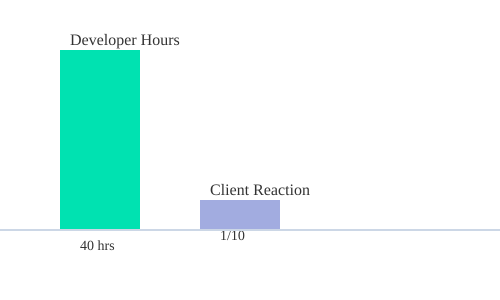
This chart shows a common pattern: massive developer effort, minimal client engagement. The lesson? Shift your focus from technical brilliance to client-centric solutions. That’s where true business efficiency—and client loyalty—are built.
The Restaurant Analogy: Don’t Leave Clients in the Kitchen—Give Them the Dining Experience
Imagine you’re a chef in a high-end restaurant. You’ve spent years perfecting your craft, mastering recipes, and building a kitchen that runs like a well-oiled machine. But when guests arrive, do you invite them into the kitchen to watch the chaos, or do you seat them in a beautifully arranged dining room, hand them a menu, and let them enjoy the experience? This is the core of client-centric automation—your clients want the results and the experience, not the behind-the-scenes complexity.
Why Exposing Backend Complexity Is a Rookie Move in Automation Consulting
Many automation experts, especially those new to client work, fall into the trap of showing off their technical brilliance. You might be tempted to walk your clients through every workflow, every node, and every integration you’ve built in N8N. But here’s the truth: clients don’t want to see your kitchen. They don’t care about the step-by-step cooking process; they want the finished dish, served perfectly every time.
When you expose backend complexity, you risk overwhelming your clients and making your solution seem more complicated than it needs to be. This can actually reduce perceived value—clients pay more for systems they understand and can showcase, not for technical wizardry they can’t explain to their team or boss.
Drawing the Parallel: Would You Let Diners See Your Kitchen Chaos?
Think about your last fine-dining experience. You sat in a comfortable dining room, interacted with a professional waiter, browsed a clear menu, and enjoyed your meal without ever worrying about what was happening in the kitchen. The chef’s brilliance was never in doubt, but it was the service and presentation that made the experience memorable.
In automation consulting, your backend—built with tools like N8N—is the kitchen. It’s where the magic happens, but it’s not where your clients belong. Your clients want:
- A clear menu of features and options
- Results they can see and measure
- Smooth, professional service
- A system they can use, discuss, and showcase
They don’t want a tour of your workflow kitchen. They want the dining experience.
Translating Backend Logic into Front-End Delight: N8N Meets Go High Level
This is where the distinction between backend and frontend becomes crucial. N8N empowers you to build powerful automations, but it’s Go High Level that provides the professional CRM solutions automation interface your clients crave. Go High Level dashboards are the dining room: clean, organized, and designed for client interaction.
When you present your solution through a Go High Level dashboard, you’re giving your client a system they can actually use. They can tag leads in real time, view analytics, and manage their business—all without ever seeing the complex workflows running in the background.
‘Go High Level is your dining room; N8N is the chef’s kitchen running the show behind the scenes.’
The ‘Stack’ Revelation: Combining N8N Power with a Client-Facing Go High Level Interface
The real value—and higher pricing potential—comes from combining the technical power of N8N with the client-centric experience of Go High Level. This “stack” lets you deliver robust automation while presenting a polished, professional front end. Clients are willing to pay premium Go High Level pricing for solutions they understand, trust, and can demonstrate to their teams.
| Feature | Backend (N8N) | Frontend (Go High Level) |
|---|---|---|
| Role | Automation Engine | Client Dashboard & CRM |
| Client Interaction | None (hidden) | Direct (menu, analytics, lead tagging) |
| Pricing Example | Included in stack | ₹75,000–₹150,000 per implementation |
| Ongoing Service | Workflow maintenance | Monthly retainer for dashboard management |
Opinion: If Your Automation Isn’t Turning Heads at the Client’s Side, You’re Missing the Restaurant Point
Client communication and solution presentation matter as much as technical design. If your automation isn’t impressing your client’s team, helping them make decisions, or giving them something to showcase, you’re missing the essence of client-centric automation. Remember: your technical brilliance belongs in the kitchen. The dining room is where your clients fall in love with your solution—and where your business grows.
Making Lead Qualification Actually Automatic: The Real Power of N8N and Go High Level Integration
Case Study: Rahul’s Lead Management Nightmare
Meet Rahul, a freelancer specializing in automation. Every month, he receives around 50-60 leads. At first glance, this sounds like a dream for any service provider. But here’s the catch: 80% of these leads are unqualified. Most are just curious, lack the budget, or aren’t serious about buying. Rahul spends 2-3 hours daily—sometimes up to 90% of his monthly work hours—just calling and sorting through these leads. The result? Qualified leads get late responses, and Rahul loses business opportunities. This is a classic case of manual lead management inefficiency.
Smart Forms: The First Step in Lead Qualification Automation
To tackle this, Rahul implemented a smart solution using Go High Level landing pages. Instead of a generic contact form, he created a Free Automation Assessment form packed with intelligent questions. These forms automatically capture:
- Basic details (company name, contact info)
- Company size
- Monthly revenue
- Current tools and processes
- Primary pain points (via dropdown selection)
- Project urgency and timeline
- Budget range
This approach ensures that every lead provides enough information for instant, automated pre-qualification—no more guessing or endless calls.
Intelligent Filtering: AI-Powered Lead Scoring with N8N
The real magic happens in the backend with N8N and Go High Level integration. As soon as a lead submits the form, AI-driven automation in N8N analyzes the responses. Using custom prompts, N8N instantly scores each lead based on:
- Budget fit
- Urgency of need
- Company size and revenue
- Specific pain points
- Current tool usage
This lead qualification automation process is not only fast but also highly reliable. For example, if a lead scores above 70 out of 100, it’s tagged as “hot.” Lower scores are marked as “warm” or “cold.”
“30 seconds after form submission, hot leads are tagged in Go High Level and personalized outreach begins.”
Automated Outreach: Nurturing Leads Without Lifting a Finger
Once leads are scored, the system triggers tailored workflows:
- Hot leads (score 70+): Receive an instant WhatsApp message, a custom proposal, and a new task for Rahul—all within 3.5 minutes of form submission.
- Warm/cold leads: Enter nurturing sequences with educational content and scheduled follow-ups, ensuring no opportunity is left behind.
This lead management automation means Rahul spends zero time on manual triage, and every qualified lead gets immediate attention.
What If Rahul Ignored Automation?
Imagine if Rahul stuck to his old ways. He’d continue wasting hours daily, burning out before ever scaling his business. Qualified leads would slip through the cracks, and his reputation would suffer from delayed responses. In contrast, with N8N and Go High Level integration, Rahul’s workflow is streamlined, efficient, and scalable.
SVG Chart: Manual vs. Automated Lead Management
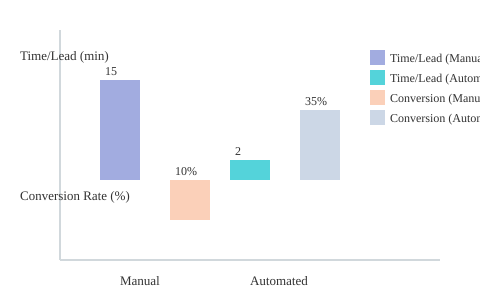
By leveraging lead qualification automation with N8N and Go High Level, Rahul’s business is now driven by data, speed, and efficiency—unlocking the true power of AI-powered automation for lead management.
Behind the Scenes: What Actually Happens in an AI-Driven Automation Workflow?
When you hear about AI-driven automation workflows, it’s easy to imagine a black box where magic just happens. But the reality is both more structured and more impressive. Let’s break down exactly what occurs when you integrate Go High Level with N8N, and how AI-powered smart actions transform a simple form fill into a full-blown, personalized client journey—often in under four minutes.
Step-by-Step: From Form Fill to Full Automation
- Contact Form Submission: It all starts when a lead fills out a form on your Go High Level landing page. Instantly, their details are captured and sent to your automation workflow.
- AI Analyst Node Activation: In N8N, the first node acts as your virtual business analyst. This “AI analyst” reviews the lead’s details using a detailed prompt that includes task type, lead score, category, buying readiness, recommended packages, estimated deal value, and even potential objections.
- AI-Powered Scoring & Categorization: The AI assigns scores based on factors like budget, urgency, company size, and lead type. For example, a tech startup with a ₹2 lakh budget and urgent timeline might score 95/100, instantly qualifying as a hot lead. As one user put it:
‘The AI analyst scores, categorizes, and personalizes responses in both Hindi and English.’
- Branching Logic: Hot, Warm, and Cold Leads: Within seconds, the workflow splits into three branches:
- Hot Leads (Score 70+): Immediate, high-touch actions.
- Warm Leads (Score 40–69): Nurturing and educational sequences.
- Cold Leads (Score <40): Minimal engagement, tagged for future campaigns.
Visualization: How Each Lead Type Gets a Unique Journey
- Hot Leads: The system springs into action. Within 3.5 minutes, the lead receives a personalized WhatsApp message, a custom proposal is generated and stored in Google Drive, an email with a calendar link is sent, and a call task is created for your sales rep. Simultaneously, your team is notified on Slack, and the lead is tagged as “Hot” in Go High Level. The entire cycle is seamless, automated, and feels personal thanks to smart AI prompts.
- Warm Leads: These leads enter a 7-day nurture sequence. Day one: a WhatsApp message and a detailed case study via email. Day three: an ROI calculator and educational content tailored to their industry. All actions are staged and tracked in Go High Level, ensuring no lead is left behind.
- Cold Leads: Automatically tagged for newsletters and occasional check-ins, ensuring your brand stays top-of-mind without wasting resources.
Workflow Timelines: Speed Meets Personalization
| Lead Type | Workflow Timeline |
|---|---|
| Hot Leads | 3.5 minutes from form to all outreach steps |
| Medium (Warm) Leads | 7-day nurturing email and WhatsApp sequence |
| Cold Leads | Automated newsletter and occasional check-ins |
Why It Feels Human—Even When It’s Automated
Here’s the surprise: even though every step is automated, the process feels remarkably human. That’s because the AI is not just following a script—it’s adapting, personalizing, and responding to each lead’s unique context. Whether it’s crafting messages in Hindi or English, recommending the right package, or anticipating objections, AI-powered smart actions make personalization at speed and scale a reality.
Resource Optimization: Branched Workflows Save Time and Effort
By splitting leads into hot, warm, and cold branches, you ensure your team focuses on the most promising opportunities. Hot leads get immediate attention, warm leads are nurtured over time, and cold leads are efficiently managed for future potential. This time-saving automation workflow not only boosts efficiency but also mimics human decision-making at scale—something that’s nearly impossible to achieve manually.
In short, what happens behind the scenes in an AI-driven automation workflow is a blend of speed, intelligence, and personalization that can impress clients and optimize your business—if you know how to set it up right.
Pricing Realities: How Client-Centric Presentation Changes What You Can Charge
When it comes to automation services, how you present your work can completely transform your pricing strategy. Many professionals still rely on showing clients technical dashboards, webhook URLs, and backend JSON logs. While these demonstrate your technical skills, they often leave clients confused, anxious, and feeling dependent on you for every small change. This approach limits your pricing power and keeps your services stuck in the one-time fee bracket. Let’s break down how a client-centric presentation—especially using tools like Go High Level—can unlock higher fees, recurring revenue, and better client relationships.
Old Way: Technical Backend Demos Limit Your Pricing
In the traditional approach, you might walk a client through the backend of an automation platform like N8N. You show them webhooks, raw data, and technical dashboards. Here’s what typically happens:
- Client Experience: Clients see complex interfaces they don’t understand.
- Emotional Response: They feel confused and worried, thinking they’ll always need you for support.
- Pricing Reality: Most clients are only willing to pay a one-time fee, usually between ₹20,000 and ₹50,000, for workflow setup.
- Retention: Once the workflow is delivered, the relationship often ends—no ongoing retainer, no long-term engagement.
Clients frequently ask, “How does this actually work?” or even express fear: “What is all this?” The perceived value is low because the solution feels abstract and inaccessible.
New Way: Client-Facing Dashboards Justify Premium Pricing
Now, let’s look at the modern approach using a professional stack like Go High Level plus N8N integration. Instead of showing backend complexity, you present a polished, branded CRM dashboard with automated messaging and clear, interactive workflows. Here’s the difference:
- Client Experience: Clients see a professional CRM, branded dashboards, and automated messages—all tailored to their business.
- Emotional Response: They feel empowered, in control, and impressed. Everything is visible and easy to understand.
- Pricing Reality: Clients are willing to pay ₹75,000 to ₹150,000 for implementation, plus a monthly retainer to keep their dashboard active and supported.
- Retention: Ongoing engagement is built in. Clients happily pay for continued support and improvements.
‘Thank you, Abhijeet, this was much needed. Exactly what I was looking for.’
Pricing Strategies for Automation Services: A Comparative Table
| Approach | Client Experience | Pricing | Retention |
|---|---|---|---|
| Backend Only (Technical Demo) | Confusing, dependent, abstract | ₹20,000–₹50,000 (one-time) | Low (project ends after delivery) |
| Client-Facing Stack (Go High Level + N8N) | Empowered, in control, impressed | ₹75,000–₹150,000 (setup) + monthly retainer | High (ongoing support and upgrades) |
Why Does This Shift Work?
The answer is simple: perceived value skyrockets when clients interact with tangible, branded tools that directly impact their workflow. Instead of paying for invisible backend magic, they invest in a solution they can see, use, and show off to their own team. This is why Go High Level pricing features are so effective—they focus on the client’s experience, not just technical achievement.
Monetizing Ongoing Value with Monthly Retainers
With a client-facing stack, you’re no longer just selling a workflow—you’re selling ongoing business value. Clients are happy to pay a monthly retainer for:
- Continuous dashboard access and updates
- Proactive support and troubleshooting
- New feature rollouts and integrations
This transforms your automation service from a one-time project into a recurring revenue stream. Clients appreciate the ongoing partnership, often leading to testimonials and referrals. As one client put it:
‘Thank you, Abhijeet, this was much needed. Exactly what I was looking for.’
In summary, shifting from backend demos to client-centric dashboards—powered by Go High Level and N8N—lets you command premium pricing, secure monthly retainers, and build lasting client relationships.
Quirky Learnings and Left Turns: Automation Success Is About People, Not Just Processes
Let’s get honest: If you’re deep into automation—whether with N8N, Go High Level, or any other tool—you’ve probably spent years perfecting your technical skills. But here’s the unexpected insight: Most automation experts (myself included) spend years ‘showing off’ the wrong thing! We get caught up in the thrill of building clever workflows, chaining together triggers, and making dashboards that dazzle… but for whom? The truth is, client-centric automation solutions are less about the “how” and more about the “why.”
The Temptation to ‘Flex’ and Why It Backfires
It’s easy to fall into the trap of flexing your workflow knowledge. You want to impress, so you showcase intricate automations, explain every step, and maybe even demo your backend setup. But here’s the tangent: This approach often leads to burnout and lost sales opportunities. Why? Because clients don’t care about your scripts or your triggers—they care about outcomes. They want their headaches solved, not a tour of your technical kitchen.
Clients don’t want your kitchen, they want your delicacy. Automate accordingly.
Analogy Recap: You’re Not Paid to Cook; You’re Paid to Cater a Memorable Experience
Think about it: When someone hires a caterer, they’re not asking for a lesson in knife skills or a breakdown of the oven’s temperature settings. They want a delicious meal, served seamlessly, that makes their event unforgettable. In automation, your job isn’t to show off your code—it’s to deliver a solution that feels effortless and impactful. Transforming technical skills into business solutions is what separates a technical supplier from an indispensable advisor.
Personal Reflection: The Invisible Automation
Early in my journey, I realized I was trying to flaunt my skills instead of selling a solution. I built a workflow that looked great on my system, but it didn’t translate to what the client actually needed. The client didn’t want to see the workflow—they wanted a system that just worked. The best automations are invisible; the client is wowed by the outcome, not the code.
Checklist: Are You Building for Yourself or for the Client?
- Does the client understand the value of your automation without seeing the backend?
- Are you solving a real pain point, or just adding features you find impressive?
- Is your workflow easy for the client to use and maintain?
- Have you asked the client what success looks like for them?
- Would the client pay for your workflow if they never saw the code?
(Hint: The wallet votes.)
Client Engagement Strategies in Automation: Speak Their Language
Professional growth in automation means learning the language of results, not just scripts. Clients want to know: How will this save me time? How will this help me close more leads? For example, with Go High Level integrations, it’s not about the tagging system itself—it’s about how leads are automatically sorted and nurtured, so no opportunity slips through the cracks. If a lead scores low, maybe they get a welcome email. If they’re hot, they’re tagged for immediate follow-up. The client doesn’t care about the logic tree; they care about more sales and fewer headaches.
Shifting from Backend Tunnel Vision to Outcomes-Focused Consulting
Moving from a solo technical focus to truly collaborative, client-centric automation solutions takes time and humility. It’s not just about time saved; it’s about trust built and headaches avoided. Embracing the client’s perspective is what transforms you from a technical supplier to an indispensable advisor. When you design automations that are seamless and outcome-driven, clients don’t just appreciate your work—they rely on it.
So, next time you’re tempted to show off your latest workflow, remember: Clients don’t want your kitchen, they want your delicacy. Automate accordingly.
Your N8N and Go High Level Integration Toolkit: Next Steps and Pro Tips for 2025
As you look to master N8N automation techniques in 2025 and deliver real value to your clients, it’s essential to build a toolkit that’s both powerful and practical. The right integration stack can save you hours every week, streamline your client communications, and help you stand out in a crowded market. But with new features and trends emerging rapidly, how do you ensure your automation workflows are both future-proof and client-friendly?
Checklist: Building Your Effective Automation Stack
Start with the basics. A working N8N backend is your engine for time-saving automation workflows. N8N’s flexibility means you can connect almost anything—CRMs, social media, IoT devices, and more. Pair this with Go High Level’s robust CRM, which offers campaign management, calendar scheduling, WhatsApp and email integration, and newsletter tools, all at an affordable monthly price. To maximize lead capture and qualification, integrate smart forms and AI scoring prompts. These components together allow you to automate everything from sending emails and WhatsApp messages to managing social media connections and running multi-channel campaigns.
Don’t DIY Everything: Leverage Templates and Community Wisdom
One of the biggest mistakes automation specialists make is trying to build every workflow from scratch. In 2025, the most effective N8N and Go High Level integration benefits come from using built-in templates and community best practices. The N8N community offers a wealth of pre-built automations, while Go High Level’s templates cover everything from client onboarding to campaign launches. By adopting proven patterns, you reduce errors, speed up deployment, and ensure your automations are reliable and scalable.
Pitfalls to Dodge: SSL Failures, Complexity, and Client Confusion
Even the best automation stack can be derailed by common pitfalls. SSL failures can break integrations and erode client trust, so always ensure your connections are secure and up to date. Avoid overcomplicating the client side—clients want results, not a maze of dashboards and settings. Most importantly, never neglect client education. Take time to explain how your automations work and how they benefit the client. This transparency builds confidence and helps you close more deals.
2025 Predictions: Zero-Code, Real-Time, and Human Oversight
Looking ahead, the future of time-saving automation workflows lies in zero-code data aggregation, real-time triggers, and human-in-the-loop oversight. Cross-platform integration will be the norm, not the exception. As one industry expert put it:
‘With N8N, zero-code and AI are not just buzzwords—they’re necessities for speed and scale in 2025.’
Clients will expect seamless experiences across platforms, with automations that adapt in real time and keep them in the loop when needed. Your ability to blend these elements will set you apart as an automation specialist.
Pro Tip: Treat the Dashboard Like a Showroom
When presenting your work, remember: your client’s dashboard should feel like a showroom, not a server room. Focus on clarity, ease of use, and visual appeal. Working demos and client-facing documentation are proven to increase close rates. Show clients exactly how your N8N and Go High Level integration benefits their business—don’t just tell them. This approach not only builds trust but also positions you as a partner in their success, not just a tech provider.
Stay Ahead: Trendwatching and Continuous Learning
N8N and Go High Level are evolving fast. Make it a habit to review 2025 feature releases, trend reports, and community forums. The most successful automation specialists are those who adapt quickly, experiment with new tools, and share their findings. By staying informed, you’ll be ready to offer the latest solutions and keep your clients ahead of the curve.
In conclusion, your N8N and Go High Level integration toolkit is more than just a set of tools—it’s your competitive edge. By building a smart stack, leveraging community wisdom, avoiding common pitfalls, and focusing on client experience, you’ll unlock the full potential of automation in 2025. Remember, in the world of automation, showing off your skills is good—but delivering real, visible value is what wins clients and keeps them coming back.
TL;DR: Don’t just show clients your technical toolkit—craft them an experience. Shifting from backend bravado (N8N wizardry) to polished, client-facing dashboards (Go High Level integration) isn’t a nice-to-have, it’s how you win hearts, wallet-share, and the future of automation. Learn this, and your nights might just get a bit more restful.
Post a Comment