

Have you ever been the 'smartest person in the room'—yet watched others execute messy plans, stumble, and then succeed while you’re still perfecting your blueprint? I’ve been there—jotting endless notes, researching every angle, and still stuck at the starting block. Today, we’re diving into the murky world where being highly intelligent actually makes execution harder, not easier. I’ll share the science, a dash of personal embarrassment, a quirky experiment involving YouTube makeup tutorials, and why sometimes raw delusion beats informed hesitation. Buckle up: It’s time to stop letting your big brain keep you small.
Brains vs. Boldness: Why Intelligence Backfires in Real Life Moves
Have you ever wondered why the smartest person in the room isn’t always the most successful? You might know exactly what you should be doing, have researched every angle, and planned for every scenario—yet when it comes time to act, your brain just won’t let you move forward. Meanwhile, people with less knowledge or fewer qualifications are out there succeeding, making money, and achieving their goals. If this sounds familiar, you’re not alone. This is the paradox of analysis paralysis—and it’s especially common among highly intelligent, self-aware individuals.
Intelligence: A Double-Edged Sword in Decision-Making
Intelligence often brings with it critical thinking, deep awareness, and the ability to see multiple outcomes. But these strengths can quickly turn into weaknesses. The more you know, the more you realize what you don’t know. This leads to second-guessing, self-doubt, and endless overthinking in decision-making. Instead of acting, you get stuck analyzing every possible risk and outcome, trying to prevent every potential problem before it even happens.
‘Socrates Syndrome’: Knowing You Know Nothing
This phenomenon is sometimes called the ‘Socrates Syndrome’—named after the ancient philosopher who famously said,
“The only thing I know is that I know nothing.” – Socrates
When you’re highly aware of your own knowledge gaps, it can be paralyzing. You see all the things that could go wrong, all the skills you haven’t mastered, and all the ways you might fail. This self-awareness, while intellectually honest, often leads to analysis paralysis rather than action.
The Dunning-Kruger Effect: Confidence vs. Competence
The Dunning-Kruger effect is a psychological principle that explains why people with low competence in a domain tend to overestimate their abilities, while experts tend to underestimate theirs. If you’re highly intelligent or skilled, you’re more likely to see the complexity of a situation—and doubt yourself. On the other hand, those with less experience or knowledge often don’t recognize what they don’t know. This “blissful ignorance” gives them the confidence to act, even if they aren’t fully prepared.
- Experts: High self-awareness, low confidence, slow to act
- Novices: Low self-awareness, high confidence, quick to act
Stories of Bold Novices: Learning by Doing
Sometimes, success comes not from knowing everything, but from being bold enough to start. Many entrepreneurs, creators, and leaders began with little knowledge but a lot of action. They learned by doing, not by waiting until they felt “ready.” Their lack of awareness about potential pitfalls actually worked in their favor—they didn’t overthink, they just moved.
Personal Experience: My Embarrassing YouTube Origin
When I started my YouTube channel at age 15, I had zero expertise and no clue what I was doing. I didn’t overthink, I just uploaded videos. Looking back, my early content was embarrassing—but that bold action paid off. Today, the channel has over 1.4 million subscribers. If I had waited until I felt “ready” or knew everything, I never would have started.
Why Intelligence Leads to Analysis Paralysis
Intelligent people tend to:
- See all possible risks and outcomes
- Overanalyze and strategize endlessly
- Experience decision fatigue and self-doubt
- Delay action in pursuit of the “perfect” plan
This is the heart of analysis paralysis. The more you know, the harder it is to act. Meanwhile, those with less information or experience often succeed simply because they act first and learn as they go.
Comparison: High Intelligence vs. Bold Action
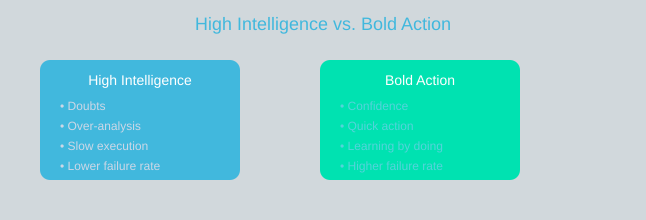
In the end, intelligence enables complex planning, but it can also hinder spontaneous action. Sometimes, the boldest move is simply to start—before you feel ready.
The Invisible Wall: Fear, Failure, and Evolutionary Brain Traps
Have you ever found yourself stuck in a cycle of reading, researching, and learning—yet never actually starting? If you’re caught in analysis paralysis, you’re not alone. This invisible wall between knowing and doing is built from a mix of fear of failure, perfectionism, and the way our brains evolved to keep us safe. Understanding these traps is the first step to breaking free.
Why Constant Learning Feels Safe: No Risk, No Rejection
It’s easy to convince yourself that you just need one more book, one more online course, or one more expert opinion before you begin. This endless preparation feels productive, but it’s actually a clever way to avoid risk. When you’re learning, you’re not exposing yourself to criticism, rejection, or failure. There’s no chance of making a mistake if you never take the leap.
Many high achievers fall into this trap. The more you learn, the more you realize how much you don’t know. This can lead to a never-ending cycle of preparation, where the act of learning becomes a shield against the fear of failing.
Evolutionary Roots: Our Brains Are Wired for Caution, Not Modern Results
From an evolutionary psychology perspective, our ancestors survived by being cautious. Those who hesitated before exploring new territory or trying something risky were more likely to avoid danger—like a lurking predator. This cautiousness was a survival trait, and it’s still hardwired into our brains today.
But in the modern world, the dangers are different. The “lions” we face are not physical threats, but the fear of embarrassment, failure, or regret. Our brains still respond with the same risk-averse instincts, making us overthink and hesitate. As a result, analysis paralysis is a modern outcome of ancient survival instincts—knowing more equals more reasons to avoid action.
The Gap Between Knowing and Doing: Not Laziness, But Self-Protection
It’s easy to blame yourself for not starting, but the gap between knowledge and execution isn’t just laziness. It’s your brain trying to protect you. When you set high goals or expect perfection, the fear of not measuring up can become overwhelming. This activates the “freeze” response—where you stay safe by doing nothing.
Common signs of this trap include:
- Perpetually signing up for new courses or webinars
- Collecting books and resources but never applying them
- Hesitating to share your work or ideas publicly
- Waiting for the “perfect” moment to start
Perfectionism and goal-centric thinking often make the fear of failure loom even larger. The more you focus on getting everything right, the more paralyzed you become. As one creator put it,
“Confidence comes from delusion, because I had low awareness towards how hard it is.”Sometimes, a little naivety—or even “delusion”—can be the push you need to start.
Perfectionism: The Enemy of Progress
Perfectionism is a major driver of analysis paralysis. It convinces you that you’re never ready, that you need more information, or that your first attempt must be flawless. But in reality, the modern world rewards what you do—not just what you know. Constant learning without action leads to information overload and missed opportunities.
Therapy can help address the underlying fears of failure, judgment, and regret that fuel analysis paralysis. Setting deadlines and time limits for decisions can also counteract fear-based hesitation, forcing you to move from learning to doing.
Time Spent: Learning vs. Executing
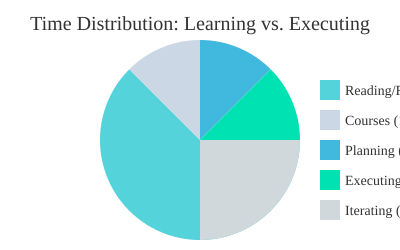
This chart illustrates how knowledge workers often spend the majority of their time on learning activities, with far less devoted to actual execution and iteration. Recognizing this imbalance is the first step toward shifting from endless preparation to meaningful action.
Messy Action Over Perfect Plans: Real-life Stories, Small Wins, and the Power of Delusion
When it comes to actionable strategies for success, most people believe they need the perfect plan before starting. But the truth is, what matters most is what you actually build, ship, and create. People pay for what you do and what you can offer, not for your intentions or your perfectly crafted plans that never see the light of day. This is the paradox of analysis paralysis: the more you try to perfect your approach, the less likely you are to actually do anything at all.
Confidence Doesn’t Always Come from Competence
It might surprise you, but confidence often comes from action, not from knowing everything. Sometimes, it’s a bit of delusion that gets things moving. Many successful entrepreneurs admit that their first steps were taken not because they were sure, but because they were naive enough to try. As one creator put it, “I thought if only I post more videos, I’ll just succeed.” This wasn’t a calculated strategy—it was a leap of faith. The result? Over 1.4 million YouTube subscribers, achieved not through perfect planning, but through relentless, messy action.
Stories from Entrepreneurship: Silly Experiments Win
Real-life stories show that iterative improvement in personal projects is more valuable than endless theory. The ‘My First Million’ podcast and the ‘How to Get Your First 100 Customers’ guide highlight entrepreneurs who succeeded by running small, sometimes silly, experiments:
- Festival-Costume Test: One founder tested product demand by wearing a homemade costume to a local festival. The feedback and attention gained were far more valuable than months of market research.
- Casual Party ‘Market Research’: Another entrepreneur hosted a casual party, using it as an informal focus group to gauge interest in a new service. The event provided honest feedback and the first paying customers.
These stories prove that messy execution often trumps perfect but unexecuted plans. The willingness to try, fail, and adjust is what sets successful creators apart.
Iterative Improvement: Learning by Doing
Learning accelerates with action. You don’t need to be the smartest person in the room or have the best plan. In fact, executing on a mediocre plan is always better than never executing on a perfect plan:
“Executing on a mediocre plan is always better than never executing on a perfect plan.”
When you take action, you get real feedback. You can look at the results, tweak your approach, and try again. This cycle of experimentation and iterative improvement is the fastest way to learn and build confidence through action. Community sharing of these experiments—whether through blog posts, social media, or meetups—provides social proof and inspiration for others to try their own ideas.
Numbers Talk: 1.4 Million Subscribers from Imperfect Beginnings
The story of a YouTube creator who reached 1.4 million subscribers is a perfect example. In the beginning, there was no grand strategy—just a belief that posting videos consistently would eventually work. Even when others doubted or made fun, the creator kept going. Now, with more experience, the temptation to overanalyze every move is strong, but the lesson remains: action beats analysis.
Wild Card: Try Something Ridiculous
Sometimes, the biggest breakthroughs come from trying something that seems a little ridiculous. Whether it’s launching a product at a festival or turning a party into a market research event, these wild cards can lead to unexpected results. The key is to experiment boldly and learn quickly.
| Resource | Key Data |
|---|---|
| How to Get Your First 100 Customers Guide | Features 7 real-life stories of messy action |
| YouTube Channel Case Study | 1.4 million subscribers reached by executing, not overplanning |
Remember, the world rewards what you do, not what you plan. Take messy action, celebrate small wins, and let a little delusion push you forward. That’s how real progress—and confidence—are built.
Tiny Experiments: How to Outsmart Your Brain and Trick Yourself Into Action
If you’ve ever found yourself stuck in the loop of endless planning, research, or overthinking, you’re not alone. Many people believe that success comes from having the perfect plan or learning everything before starting. But here’s the truth: real progress comes from action, not just knowledge. This is where the tiny experiments framework comes in—a practical way to break free from analysis paralysis and start moving forward.
Forget Goals—Run Experiments
Traditional goal-setting often sets you up for a win-or-fail mindset. You either hit your target or you don’t, and that can be paralyzing. Instead, try reframing your approach: forget about big, intimidating goals for now—run tiny experiments instead. When you treat life as a series of experiments, you shift from worrying about failure to gathering useful data. As neuroscientist Anning Anlor Lacunf puts it:
“When you treat life as an experiment, failure actually doesn’t exist.”
This shift dissolves the fear of making mistakes. Every outcome becomes feedback, not a verdict on your abilities.
The P.A.C.T. System: A Framework for Tiny Experiments
The P.A.C.T. system—Purposeful, Actionable, Continuous, Trackable—offers a simple structure for running effective tiny experiments. Here’s how it works:
| P.A.C.T. Step | Description | Example |
|---|---|---|
| Purposeful | Define a clear intention or curiosity | “Can I build an audience by writing a weekly newsletter?” |
| Actionable | Break it into a small, specific action | Send one newsletter each week |
| Continuous | Repeat the action over a set period | Commit to 6 weeks |
| Trackable | Measure what happens and gather feedback | Track open rates and replies |
How to Start: Steps for Tiny Experiments
- Observe Your Curiosities: Notice what you’re interested in or want to improve.
- Form a Hypothesis: Ask, “What might happen if I try X for a short time?”
- Design an Experiment: Choose a small, low-stakes action you can repeat (e.g., daily, weekly).
- Gather Feedback: Track what happens—don’t judge, just collect data.
- Iterate: Adjust your experiment based on what you learn. Keep what works, tweak what doesn’t.
Examples Across Fields
- Business: Post a short video on YouTube daily for 8 weeks and see what resonates.
- Writing: Launch a weekly newsletter for 6 weeks and track subscriber growth.
- Productivity: Try 3-day work sprints, then review your energy and output.
- Health: Walk 10 minutes after lunch every day for two weeks and note your mood.
Why Tiny Experiments Work
The beauty of the tiny experiments framework is that it lowers the stakes. You don’t have to overhaul your life or commit to a huge change. You simply try something small, observe what happens, and use that information to guide your next step. This approach is rooted in learning by doing—one of the most effective goal-setting techniques for real-world progress.
By running tiny experiments, you collect real data about what works for you, not just what worked for someone else. You’ll quickly see that there’s no single path to success. Instead, you create your own, step by step, experiment by experiment.
Remember: Failure disappears—it’s all feedback and data. You don’t need to wait until you’re “ready.” Start tiny, and go big later.
Wild Card: Energy Sprints, Creative Burnout, and Unorthodox Work Rhythms
When it comes to productivity hacks for creators, most advice centers on building routines and sticking to them. But what if your mind simply doesn’t work that way? If you’ve ever found yourself staring at a blank screen, unable to muster the energy for even a simple email, you’re not alone. Many creative professionals experience wild fluctuations in energy and focus—sometimes feeling unstoppable, other times barely able to start. This isn’t laziness; it’s a natural part of the creative process, and fighting it can actually lead to cognitive overload stress and mental exhaustion indecision.
Not Everyone Thrives on Routine
Traditional work schedules—like the classic nine-to-five, Monday through Friday—assume that productivity is a steady, predictable output. But for many in creative or non-linear fields, energy and focus come in unpredictable waves. Some days, you might feel like you’re operating at 120%, with ideas and motivation overflowing. Other days, it might take you hours just to reply to a single message. Forcing yourself to maintain the same level of output every day can quickly lead to burnout and frustration.
My Experiment: 3 Days of Deep Work, 4 Days Off
To break free from the cycle of cognitive overload stress and mental exhaustion indecision, I decided to run a personal experiment. Instead of pushing for consistency, I leaned into my natural rhythms. Here’s what I tried:
- Three days of intense work sprints: During these days, I would immerse myself in deep work for 12-14 hours, often at a library or quiet space. I focused on high-impact tasks and let myself ride the wave of creative energy.
- Four days completely off: No work, no emails, no pressure. These days were for rest, hobbies, and recharging.
I tracked my flow state, burnout levels, and creative output throughout the process. The goal was to see if tuning my work cycle to my personal tendencies—not productivity dogma—could actually improve my results.
Results: Fewer Crashes, Better Mental Health, More Consistent Content Creation
The results were eye-opening. By allowing myself to work intensely when I was “in the flow”—as I often felt,
“When I’m in the flow, nobody can stop me.”—and then truly rest when my energy dipped, I noticed several key benefits:
- Fewer crashes: I experienced less burnout and fewer days lost to total exhaustion.
- Better mental health: The guilt of “not doing enough” on low-energy days disappeared, replaced by a sense of balance and self-acceptance.
- More consistent content creation: My creative output became more reliable, even if my schedule looked unconventional on paper.
These findings echo research suggesting that alternative work schedules can decrease burnout without harming productivity, especially for those in creative fields. By respecting your natural ups and downs, you can prevent the kind of overload that leads to indecision and mental fatigue.
Customizing Work Habits: Productivity Hacks for Creators
Instead of forcing yourself into a mold that doesn’t fit, consider experimenting with your own work rhythms. Here are some ways to start:
- Track your energy: Notice when you feel most creative and focused. Are there certain days or times when you’re “on fire”?
- Test work sprints: Try periods of deep work followed by real downtime. Adjust the length and intensity to suit your lifestyle.
- Observe outcomes: Monitor your output, stress, and satisfaction. Are you creating more? Feeling less burnt out?
Whether you’re a creator, manager, or parent, tuning your work cycles to your own tendencies can lead to higher output and greater satisfaction. Remember, embracing your natural ups and downs isn’t a weakness—it’s a powerful productivity hack that can help you avoid cognitive overload stress and mental exhaustion indecision for the long haul.
Break Free: Concrete Steps Beyond Overthinking and Inaction
If you’re stuck in the loop of overthinking, you’re not alone. Many people—especially those who crave certainty—find themselves paralyzed by endless analysis. The good news? You can break free. Here are practical, research-backed steps to help you stop overthinking and move from analysis paralysis to meaningful action.
Limit Your Options: Escape the Paradox of Choice
One of the main drivers of analysis paralysis is having too many choices. The more options you have, the harder it becomes to decide. This is known as the “paradox of choice.” To stop overthinking, limit your options whenever possible. For example, if you’re creating content, don’t brainstorm 20 topics—pick your top three and choose from those. This simple reduction makes decisions faster and less stressful.
- Pick 2-3 options, not 10.
- Set rules: “I’ll only consider X or Y.”
- Batch similar tasks to avoid switching contexts.
Set Time Constraints: Use Parkinson’s Law to Your Advantage
Parkinson’s Law states that “work expands to fill the time available for its completion.” If you give yourself a week to write a blog post, it’ll take a week. If you give yourself two hours, you’ll finish in two hours. Setting time limits is one of the most effective analysis paralysis tips out there.
- Timeboxing: Allocate a fixed amount of time for each task. For example, “I’ll spend 30 minutes outlining, then start writing—no matter what.”
- Deadlines: Even self-imposed deadlines create urgency and focus.
- Timers: Use a timer to keep yourself accountable. When the timer goes off, move to the next step.
Reward Action, Not Just Planning
Overthinkers often get stuck in the planning phase, treating every project like a high-stakes goal. This triggers fear of failure—because goals feel binary: you either win or lose. Instead, focus on learning by doing. Create an environment where quick starts and messy progress are celebrated.
- Track “starts” instead of “finishes.”
- Share rough drafts or prototypes, not just polished work.
- Remind yourself: “You just need to be doing while everyone else is preparing.”
Leverage Social Proof and Accountability
It’s easier to take action when others are watching or cheering you on. Use accountability partners or join groups where progress is shared. Social support helps maintain forward motion and reduces the urge to overthink every step.
- Join a mastermind or accountability group.
- Share your goals publicly—even a simple tweet can help.
- Ask a friend to check in on your progress.
Simple Decision-Making Tools: Pros/Cons Lists and Coin Flips
Sometimes, the simplest tools are the most effective. If you’re stuck, make a pros and cons list. It’s basic, but it forces you to clarify your thoughts and move forward. If you still can’t decide, try the “coin flip” method: assign each option to heads or tails, flip the coin, and notice your gut reaction as it lands. Often, you’ll realize which outcome you truly want.
- Write a quick pros/cons list for your next step.
- If you’re still undecided, flip a coin—your instinct will guide you.
Summary Table: Concrete Analysis Paralysis Tips
| Technique | How It Helps |
|---|---|
| Limit Options | Reduces overwhelm and speeds up decisions |
| Set Time Limits | Creates urgency and prevents endless planning |
| Accountability | Social support encourages action |
| Pros/Cons List | Clarifies choices and prompts movement |
| Coin Flip | Reveals your true preference and breaks deadlock |
Remember, the key to overcoming analysis paralysis is to act—even imperfectly. Each small step chips away at the wall of overthinking and builds momentum for real progress.
FAQ: Your Real (and Slightly Awkward) Analysis Paralysis Questions Answered
Analysis paralysis is one of those things that seems to strike hardest when you care most about the outcome. If you’ve ever found yourself stuck in a loop of overthinking and decision-making, you’re not alone. Here are honest answers to the most common—and sometimes awkward—questions people ask about analysis paralysis, overthinking, and how to actually move forward.
Why do smart people get stuck in indecision?
It’s a myth that intelligence always leads to action. In fact, the more you know, the more possibilities you see—and the more you might worry about picking the “wrong” one. Overthinkers often want to optimize every choice, but this can lead to endless weighing of pros and cons. Remember, there’s no one way to succeed. Sometimes, good enough is better than perfect.
What’s the simplest way to start executing?
If you don’t have a clear goal, it’s easy to feel lost. But you don’t need a grand plan to begin. Neuroscientist Anning Anlor Lacunf’s book, Tiny Experiments, suggests starting with simple observations. Just notice what you’re curious about or what keeps coming up in your mind. Write it down. Then, form a hypothesis—basically, a guess about what might happen if you try something small. This approach lets you take action without the pressure of big, intimidating goals.
How do I handle the fear of failing in public?
Fear of embarrassment is real, especially in creative or entrepreneurial work. The truth? Most people are too busy worrying about themselves to notice your mistakes. If you treat each attempt as a “tiny experiment,” failure becomes just another data point—not a disaster. The more you try, the less scary it gets.
Can I really learn by doing? (Isn’t that risky?)
Absolutely. While it feels safer to plan and research, real learning happens through action. Trying things out—especially in small, low-stakes ways—gives you feedback you can’t get from thinking alone. It’s not about being reckless; it’s about embracing the idea that progress comes from iteration, not perfection.
How do I know if I’m overanalyzing?
If you find yourself thinking about the same decision for days, or if you’re waiting for “just one more” piece of information, you’re probably overanalyzing. Ask yourself: Am I learning anything new, or just looping through the same thoughts? If it’s the latter, it’s time to act.
Are tiny experiments better than big goals?
For many overthinkers, yes. Big goals can feel overwhelming and trigger more analysis paralysis. Tiny experiments, on the other hand, lower the stakes and help you build momentum. You don’t need to map out your entire future—just try something small and see what happens.
What if I work best outside routines?
Not everyone thrives on strict schedules. If you’re more of a “follow your curiosity” type, tiny experiments fit perfectly. Let your interests guide you, and use observation and hypothesis as your framework. There’s no single formula for productivity.
How do I handle information overload?
Set boundaries for research. Give yourself a time or resource limit, then act on what you know. Remember: More information doesn’t always mean better decisions. Sometimes, it just means more confusion.
How do I stop comparing myself to people who are taking action?
Comparison is normal, but it’s rarely helpful. Focus on your own experiments and progress. Everyone’s journey is unique, and what works for someone else might not work for you. Celebrate your own small wins—they matter.
Any book or podcast recommendations for busting analysis paralysis?
Definitely check out Tiny Experiments by Anning Anlor Lacunf for a science-backed, low-pressure approach to action. For inspiration and practical tips content creation, podcasts like My First Million share real stories of people who started before they felt ready. Remember, the best advice is the one that helps you take your next step.
In the end, analysis paralysis is just a sign that you care. The trick is to channel that energy into action—one tiny experiment at a time. Progress isn’t about being fearless or perfect; it’s about being willing to try, learn, and keep moving forward.
TL;DR: Analysis paralysis feeds on endless preparation. The only way out? Start before you’re ready, learn by doing, and treat life like an experiment—not an exam.
Post a Comment