

Picture this: You arrive at work and instead of scrambling to keep pace with AI, you’re confidently partnering with it, turning what feels like a challenge into an unprecedented opportunity. I remember when I first hesitated to trust AI for critical tasks — like fact-checking important info or drafting official emails. Fast forward, I realized the secret isn't fearing AI’s rise but becoming the professional AI cannot replace. This post shares actionable skills and insider tips gathered from leaders in Silicon Valley and AI pioneers, helping you stay indispensable in the AI age.
Rethinking AI Disruption: Becoming the Professional AI Can't Replace
When most people hear about artificial intelligence, their first thought is, “Will AI replace my job?” But that’s not the right question. The real challenge is to ask: How do you become the professional AI cannot replace? The answer lies not in resisting change, but in adapting and mastering the skills that AI can’t easily replicate.
AI Job Growth: The Real Opportunity
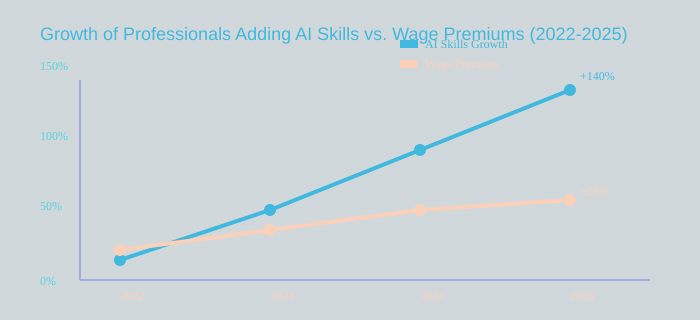
Right now, we’re seeing a dramatic shift in the job market. According to LinkedIn, professionals are adding new AI skills to their profiles 140% faster since late 2022. This surge isn’t just a trend—it’s a sign that those who embrace AI are accelerating their careers at an unprecedented pace. As one expert put it:
People who learn how to work with AI are growing their careers faster than anyone could imagine.
Data from the future jobs report shows that AI job listings have surged by 56.1% year-to-date in 2025. This means that employers are actively seeking talent with AI expertise, and the demand is only growing.
AI Skills Premium: The Wage Advantage
It’s not just about job growth—there’s a significant financial incentive, too. Lightcast research confirms that postings requiring AI skills offer a 28% wage premium, which translates to roughly $18,000 more per year compared to similar roles without AI expertise. In fact, industries exposed to AI are seeing revenue growth per employee that’s up to 3x higher than those that aren’t leveraging these tools.
- AI job growth: 56.1% increase in listings (2025 YTD)
- AI skills premium: 28% higher pay (~$18,000 extra annually)
- Revenue growth AI: 3x higher per employee in AI-exposed sectors
AI Collaboration, Not Replacement
Adapting to AI isn’t about fearing replacement—it’s about collaboration and evolving your skillset. The World Economic Forum highlights that creative and analytical thinking, paired with big data and AI skills, will be in high demand through 2030. The professionals who thrive will be those who treat AI as a productivity partner, not a threat.
Industry-specific AI applications and automation tools are already saving time and boosting output. For example, marketing teams using AI for campaign analysis can focus more on strategy and creativity, while finance professionals automate routine data checks and spend more time on high-value insights.
Lifelong Adaptability: The Key to Future Jobs
AI models and tools will keep evolving, but the skills that make you irreplaceable are the ones that don’t expire with each new release. Lifelong learning, adaptability, and the ability to integrate new technology into your workflow are essential. The future jobs report consistently finds that industries embracing AI see twice the wage growth compared to those that don’t.
Personal Experience: From Skepticism to Partnership
When AI tools first appeared in my field, I was skeptical. I worried that automation might make my role obsolete. But as I started experimenting with these tools, I realized they could handle repetitive tasks, freeing me up to focus on creative problem-solving and strategic thinking. Embracing AI as a partner—not a competitor—has made me more productive and valuable than ever before.
Mastering Problem Framing: The Foundation Skill for AI Collaboration
In the AI-driven future, problem framing stands out as the foundation skill that sets you apart. Before you prompt any AI tool, the most critical step is to clarify exactly what problem you’re trying to solve. This simple but powerful habit is not just a work skill—it’s a life skill that enhances your decision-making and communication in every area.
Why Problem Framing Matters More Than Ever
The demand for analytical thinking core and problem framing is skyrocketing. According to the World Economic Forum, these skills rank as the number one global priority through 2030. The reason is clear: AI is only as good as the questions you ask and the clarity of your goals. If you can’t verbalize the problem, you’ll struggle to get meaningful results from AI—or from your team.
Before you open another AI app... ask yourself, what am I trying to achieve? Who is this for? What does success look like?
Stanford research supports this, showing that young workers in AI-exposed fields fall behind if they focus only on task execution instead of defining the problem. In other words, simply knowing how to use AI isn’t enough. You need to know what you want to achieve before you start prompting.
How to Frame Problems for AI Fluency
- Clarify your goal: Define what you want to achieve before you interact with AI.
- Identify your audience: Who is this for? Tailor your problem statement to the end user.
- Define success: What does a successful outcome look like for this task?
This approach not only improves the quality of AI outputs but also aligns your team’s efforts. When everyone understands the problem, collaboration becomes smoother and more productive.
Documentation: The Secret to Consistent AI Collaboration
As you move from working solo to leading a team, documentation becomes essential. Writing down your problem statements, tone of voice, and core values creates a knowledge base that AI tools can reference. This ensures brand consistency and streamlines workflow automation.
- Document your tone of voice: How do you want your communication to sound?
- Define your personal branding: What makes your approach unique?
- List your values: What principles guide your decisions?
These details help AI generate responses that match your brand and goals, saving you time and reducing repetitive prompting.
Business Example: Genpark’s Pre-Problem Solving Model
Companies like Genpark are proving the business value of problem framing. Genpark reached a billion-dollar valuation in under a year by building AI workflows that start with clear problem definition. Their system lets you upload documents outlining your goals, tone, and values. When you receive an email, the AI crafts a reply based on this knowledge base—no need to prompt it every time. This pre-problem solving approach automates workflows and ensures every response aligns with your objectives.
| Insight | Source |
|---|---|
| Analytical thinking ranks #1 skill globally through 2030 | World Economic Forum |
| Genpark reached $1B valuation by deploying problem framing in AI workflows | Industry Reports |
Mastering problem framing is your competitive edge in the era of AI fluency demand. It guides better AI outputs, aligns teams, and builds a foundation for scalable, automated workflows.
Prompt Engineering and AI Literacy: Beyond Casual Chatting
In the rapidly evolving world of artificial intelligence, prompt engineering skills and AI fluency demand are no longer optional—they are essential. According to LinkedIn, AI literacy and sophisticated prompt writing are projected to be the fastest growing skills in 2025, with demand for prompt engineering rising by an impressive 95.5%. As AI becomes more integrated into daily workflows, understanding how to communicate with these systems effectively is a core professional skill, not just a technical curiosity.
Prompt Engineering: From Hack to Literacy
Amjad Masad, CEO of Replit—a leading platform for coding and AI development—emphasizes this shift:
"Prompting is no longer a hack. It's literacy."
This means that interacting with AI is now as fundamental as reading or writing. You need to know how to ask the right questions and give clear instructions to get the results you want. Treat your AI tool like a new hire:
"Your AI tool is this new hire that has access to all the knowledge in the world, but you need to tell them exactly what to do."
Why Prompt Engineering Skills Matter
The quality of your prompts directly impacts the quality of your AI results. Mediocre prompts yield generic, sometimes unusable outputs, while well-crafted prompts unlock actionable, high-quality solutions. This skill set is at the heart of Generative AI skills—the ability to guide AI to produce content, code, or insights that are tailored to your needs.
- AI literacy closes skill gaps and meets the surging demand for AI-related jobs.
- Prompt engineering is a key driver of AI job and wage growth.
- Those who master these skills are more productive and valuable in the workplace.
How to Build Your Prompt Engineering Skills
Learning to write effective prompts is not a one-time task—it requires continuous learning, experimentation, and practice. Amjad Masad suggests leveraging resources like YouTube tutorials and developer communities to accelerate your learning:
- Search for "how to prompt" videos and guides on YouTube.
- Experiment with different prompt styles and formats.
- Practice by building projects and iterating on your prompts.
- Engage with platforms like Replit, where you can see real-world applications and get feedback.
Replit, for example, has built a culture of education around AI and prompt engineering. Their developer relations team, led by experts like Matt, creates content to help users understand both the art of prompting and the underlying AI systems. This approach recognizes that learning prompt engineering is a journey, not an instant upgrade.
Practical Tip: Use AI to Improve Your Prompts
One of the most effective ways to refine your prompt engineering skills is to use current AI models—such as GPT-5—to get feedback on your prompts. You can ask the AI to critique your instructions, suggest improvements, or even generate better prompts for you. This iterative process accelerates your proficiency and helps you stay ahead in the fast-changing landscape of Generative AI skills.
In summary, AI literacy and prompt engineering are vital skills for anyone aiming to be irreplaceable in the AI-driven future. By treating AI as a powerful partner that needs clear direction, and by investing in continuous learning and practice, you will stand out in a world where these skills are in unprecedented demand.
Orchestrating AI Workflows: Doing the Work of Many with AI Chains
In today’s rapidly evolving business landscape, workflow orchestration AI is becoming the secret weapon for multiplying productivity and reducing staff overhead. Instead of using AI for isolated tasks, forward-thinking professionals are now chaining together multiple AI tools—creating “AI chains” that can emulate entire job roles. This approach is transforming how entrepreneurs and teams operate, allowing one person to achieve the output of a small team, without the need for deep technical skills.
From Task Execution to Role-Based AI Systems
The real shift in AI business usage is moving from simply automating tasks to integrating AI as role-based systems. Mike Krieger, co-founder of Instagram and now CPO at Anthropic, shared a powerful example of this mindset. He described how a founder friend uses Claude, an advanced AI, as his product manager, lawyer, and even founder therapist. As Krieger put it:
Claude is my product manager, my lawyer, my founder therapist as well.
This founder set up separate Claude projects for each discipline—product management, legal contracts, and even personal support. By doing so, he runs a lean company, automating critical operations without needing to code every day. This is a prime example of workflow orchestration in action: not just automating tasks, but building systems where AI takes on entire job functions.
How Entrepreneurs Can Harness Workflow Orchestration AI
With the right approach, you don’t need to be a full-time engineer to benefit from AI productivity boosts. Here’s how you can start:
- Assign AI to Roles: Set up different AI agents for product management, legal review, competitive intelligence, and more.
- Automate Repetitive Operations: Use AI to draft emails, summarize documents, and validate business ideas.
- Leverage Specialized Tools: Integrate platforms like Claude or Genspark to handle everything from research to presentations.
This approach allows you to focus on high-level strategy while AI handles the operational details. As Krieger notes, even as AI models become more powerful, you can already have “per job function thought partners” supporting your business.
Genspark: A Glimpse into the Future of Work
One standout example of workflow orchestration AI is Genspark, a workspace that automates daily business routines. Unlike traditional tools that add more tabs and busywork, Genspark removes friction by letting AI handle:
- AI Emails: Start your day with drafted replies, summaries, and automated back-and-forth communication.
- AI Slides: Instantly generate presentations—just type your topic, and the structure is ready.
- AI Calls: Let AI conduct candidate screening calls, ask follow-up questions, and score responses naturally.
- AI Research: Complete tasks like ranking YouTube videos by views or compiling data in seconds, not days.
What sets Genspark apart is its ability to select the right AI model for each job, ensuring seamless integration and real results. As one user noted, “Genspark doesn’t just give you answers, it gets the work done for you.”
AI Workflow Orchestration: The New Productivity Multiplier
The impact is clear: 78% of organizations reported AI use in 2024, up from 55% the prior year. Tools like Genspark are at the frontier of AI productivity boost, offering unlimited AI chat and image features through 2026. By chaining AI tools and automating workflows, you can dramatically increase your output and focus on what matters most—without adding complexity or busywork.
The best you can do for yourself is documenting everything — that’s workflow orchestration in action.
Critical Thinking and Verification: Your Superpower Against AI Hallucinations
In the AI-driven future, critical thinking verification is not just a nice-to-have skill—it’s your superpower. As AI becomes more embedded in our work and daily lives, it’s easy to assume that its answers are always correct. But here’s the truth: AI outputs can be confidently wrong, and this is exactly why verification is crucial in the AI era.
AI Hallucinations: When Machines Get It Wrong
AI models, even the most advanced, can “hallucinate”—that is, generate information that sounds plausible but is completely false. This isn’t rare. In fact, it’s a growing challenge as AI-generated content spreads across industries. The Stanford AI Index and World Economic Forum (WEF) both highlight analytical thinking core and verification as essential skills for future jobs, especially as AI impact employment continues to rise.
Personal Lesson: The Blake Shaw Interview
I learned the importance of verification the hard way. During an interview with Blake Shaw, I read out a quote that AI had attributed to him. Blake looked at me, puzzled, and said, “I don’t think I said that.” In that moment, I wished I could disappear. I realized I hadn’t double-checked the AI-generated quote. That experience was a turning point—I now double-check everything three times. As I often remind myself: AI sometimes hallucinates, so double-check everything three times.
Three Habits to Strengthen Your Critical Thinking Verification
- Fact-check with multiple AI tools: If ChatGPT gives you a statistic, paste it into Perplexity and ask for sources. If the information lacks credible references, treat it as a red flag.
- Ask for confidence levels: After receiving an answer, prompt the AI to rate its confidence in each claim (e.g., 95%, 80%, 40-60%, less than 40%) and explain why. You’ll be surprised how often the AI downgrades its own claims when pressed.
- Seek critiques from alternative models: Copy ChatGPT’s response into Claude or Gemini and ask, “Critique this response—what’s missing, biased, or incorrect?” This cross-verification can reveal gaps or errors you might have missed.
Industry Insight: Grounding AI in Credible Sources
Mustafa Suleyman, CEO of Microsoft AI, emphasizes the importance of grounding AI answers in trusted sources. For example, Microsoft’s CoPilot now grounds health answers in citations from respected institutions like Harvard Medical and the NHS. According to Suleyman, “You still need human judgment. Your verification and critical thinking skills are not optional; they’re becoming more important.”
Even with these advances, human oversight remains essential—especially in sensitive fields like healthcare. Suleyman notes that 40% of queries to Microsoft’s CoPilot are health-related each week. Despite using Harvard-backed data, he cautions: “Sometimes it makes mistakes, you can’t rely on it yet, you always have to go see a doctor.”
Why This Skill Matters More Than Ever
As AI-generated content proliferates, the risk of misinformation rises. Verification prevents trust issues with AI-generated content and ensures you remain a reliable source in your field. The wage premium for verification and critical thinking skills is projected to rise through 2030, making these abilities a core part of future-proofing your career.
Remember:
“Your verification and critical thinking skills are not optional; they’re becoming more important.”In a world full of generated content, this is your superpower.
Wild Card 1: The Mindset Shift – Thinking In Roles, Not Tasks
One of the most important, yet often overlooked, skills for thriving in an AI-driven future is the ability to shift your mindset from thinking in tasks to thinking in roles. This mental shift is at the heart of successful AI integration and is referenced throughout the work of industry leaders like Mike Krieger. As he puts it:
“He’s not thinking one-to-one tasks, he’s thinking in roles and systems.”
From Tasks to Roles: The New AI Mental Model
Traditionally, many people approach AI as a tool for automating individual tasks—like scheduling a meeting, drafting an email, or summarizing a document. While this approach can save time, it barely scratches the surface of what workflow orchestration AI can achieve. The real breakthrough comes when you start to conceptualize AI as filling entire roles within your workflow, not just handling isolated tasks.
- AI as a Product Manager: Imagine using AI to oversee your project timelines, coordinate resources, and even suggest strategic pivots based on market data.
- AI as a Contracts Partner: Instead of just proofreading, AI can review, draft, and negotiate contracts, flagging risks and suggesting improvements.
- AI as Competitive Intelligence: Rather than simply gathering data, AI can analyze competitors, track trends, and deliver actionable insights to guide your business decisions.
This role-based thinking unlocks a higher level of automation and strategic value. It encourages you to see AI not as a simple tool, but as a team player—a collaborator that brings specialized expertise to your projects.
Entrepreneurs and the Rise of AI ‘Mini-Experts’
Entrepreneurs are already leveraging this mindset shift by deploying AI ‘mini-experts’ to replace what used to require multiple part-time hires. For example, instead of hiring separate contractors for market research, content creation, and customer support, you can orchestrate a suite of AI agents—each operating as a specialist in their own right. This approach not only saves costs but also increases agility and scalability.
The Power of Workflow Orchestration AI
Adopting a role-centric view of AI enhances operational efficiency by enabling seamless workflow orchestration. When you assign AI to roles within your organization, you create systems where human-centered skills and AI fluency demand work hand-in-hand. This synergy allows you to:
- Automate complex processes, not just repetitive tasks
- Scale expertise across multiple projects simultaneously
- Free up human talent for creative and strategic work
AI as a Team Player: Changing Your Mental Model
Seeing AI as a team player rather than just a tool is a fundamental mental model change. This shift supports a growth and innovation mindset, empowering you to experiment, iterate, and adapt as AI capabilities evolve. It’s about building systems where AI augments your strengths and fills gaps, rather than simply replacing manual labor.
Personal Reflection: How This Mindset Changed My Workflow
When I first embraced this mindset, my approach to managing busy days and complex projects transformed. Instead of feeling overwhelmed by a growing to-do list, I began orchestrating my workflow around AI ‘roles.’ For instance, I now rely on AI to handle research, draft proposals, and even monitor industry trends—freeing me to focus on high-level strategy and relationship-building. This not only improved my productivity but also made my work more meaningful and impactful.
Ultimately, the shift from task-based to role-based thinking is an evolving but critical element in mastering AI fluency demand and integrating workflow orchestration AI into your daily life. It’s a mindset that will define the next generation of irreplaceable professionals.
Wild Card 2: The Future Is Now – Genspark as a Glimpse of AI-Powered Workspaces
Imagine starting your workday with your emails already summarized, replies drafted, and your to-do list shrinking before you even log in. That’s the reality Genspark is building—a fully AI-automated workspace that’s changing how professionals approach daily tasks. If you’re serious about mastering AI business usage and workflow orchestration AI, understanding tools like Genspark is essential.
All-in-One Automation: Reducing Everyday Busywork
Genspark isn’t just another productivity tool. It’s an all-in-one platform designed to eliminate repetitive work, not add more browser tabs. When you use Genspark, you’re leveraging a workspace where generative AI skills are put to work for you. Here’s what makes it stand out:
- AI-Generated Emails: No more starting your day by sifting through endless emails. Genspark drafts replies, summarizes threads, and even handles simple back-and-forth conversations. As you use it, the platform learns your company’s tone and goals, making its responses smarter over time.
- AI Presentation Slides: Need a 10-slide deck on the latest AI trends? Just type your request, and Genspark creates a structured presentation, complete with templates and your preferred style. You can even import existing slides for a seamless workflow.
- AI Calls for Screening: Genspark’s AI can call candidates, ask screening questions, log answers, and score their fit—all with natural, human-like dialogue. It even generates follow-up questions based on responses, making early-stage recruiting effortless and efficient.
- Automated Data Research: Research that once took a week can now be done in seconds. For example, you can ask Genspark to analyze your YouTube channel, sort videos by views, and deliver a ready-to-use spreadsheet—no manual scraping required.
Continuous Learning and Adaptation
One of Genspark’s most powerful features is its ability to learn from your interactions. The more you use it, the better it gets at tailoring communication, responses, and workflow automation to your unique needs. This means your AI business usage becomes more effective over time, giving you a true competitive edge.
Unlimited Access to Top AI Models
Through 2026, Genspark users get unlimited access to leading AI models for chat and image generation—including Nano Banana Pro, GPT Image, Flux, C-Dream, Gemini 3 Pro, GPT-5.1, Claude Opus 4.5, and more. This ensures you’re always working with the latest and most powerful generative AI capabilities.
Personal Endorsement and Real-World Impact
After seeing Genspark in action, I immediately recommended it to my team. The impact was immediate—less busywork, more time for high-value tasks, and a real sense of what the future of work looks like. As I often say:
Genspark doesn't just give you answers, it gets the work done for you.
Let yourself be amazed by what AI can do:
Just allow yourself to be blown away by what AI can do.
AI Workspaces: The Macro Trend
Genspark is part of a larger movement. In 2024, 78% of organizations use AI, up from 55% the year before. Companies are turning to automated solutions like Genspark to scale efficiently and stay ahead. If you want to be irreplaceable in the AI-driven future, mastering these tools is non-negotiable.
| Key Data | Details |
|---|---|
| AI Adoption (2024) | 78% of organizations use AI (up from 55% in 2023) |
| AI Recruiting Calls | Genspark automates early-stage calls with natural dialogue |
| Unlimited AI Access | Unlimited chat and image generation for all of 2026 |
Try Genspark for yourself and experience how workflow orchestration AI can transform your daily operations.
Conclusion: Embrace the AI Partnership, Equip Yourself for Tomorrow
As we look ahead to the future jobs report and the rising AI fluency demand, it’s clear that artificial intelligence is not here to replace you—it’s here to transform the way you work. The most successful professionals are those who see AI as a partner, not a threat. The real question is not “Will AI replace me?” but, as echoed by leading voices in the industry,
The real question is how do you become the person AI cannot replace?
The answer lies in focusing on human-centered skills that complement AI’s strengths. As highlighted throughout this guide, mastering problem framing, prompt engineering, workflow orchestration, and verification will set you apart in any field. These are not just technical skills—they are mindsets and habits that keep you adaptable, relevant, and in demand, no matter how fast new AI models emerge.
Start by refining your ability to define problems clearly. Before you even open an AI tool, ask yourself what you want to achieve and who will benefit. This skill, ranked number one globally by the World Economic Forum through 2030, is the foundation of effective AI collaboration. Next, develop your AI literacy and prompt engineering abilities. Practice writing clear, outcome-driven prompts, and experiment with platforms like Genspark, Claude, or ChatGPT. These tools are only as powerful as the instructions you give them, and your ability to guide AI will determine your results.
Workflow orchestration is your gateway to multiplying your impact. By thinking in terms of roles and systems, you can use AI to handle tasks that once required entire teams. Whether you’re a founder, a freelancer, or part of a larger organization, adopting a role-based mindset unlocks new operational potentials. Tools like Genspark are already demonstrating how AI can automate research, communication, and even candidate screening—freeing you to focus on the creative and strategic work that only humans can do.
Yet, as AI becomes more integrated into our workflows, verification and critical thinking become your superpowers. AI can be confidently wrong, so double-checking facts, cross-referencing sources, and seeking second opinions from different models are essential habits. This is where your judgment, experience, and human touch truly shine. As Mustafa Suleyman of Microsoft AI reminds us, even the most advanced systems require human oversight—especially when the stakes are high.
Continuous learning is the thread that ties all these skills together. The traditional model of education and career growth is outdated. Today, the ability to document, practice, and iterate is non-negotiable. Set aside just one hour this week to master a new skill or explore a new AI tool. The pace of change is accelerating, and those who commit to lifelong learning will be the leaders of tomorrow.
Remember, AI fluency demand is rising, but it is your uniquely human qualities—creativity, empathy, and critical thinking—that make you irreplaceable. Use AI strategically to amplify your productivity, but never lose sight of the human-centered skills that drive sustainable career growth. Embrace the AI partnership, equip yourself for tomorrow, and you’ll not only survive the next wave of innovation—you’ll thrive in it.
Stay curious, keep learning, and take the first step today. The future belongs to those who are ready to evolve.
TL;DR: To future-proof your career against AI disruption, focus on mastering problem framing, AI prompt engineering, workflow orchestration, and rigorous verification skills. Embrace AI as a partner, document your workflows, and cultivate critical thinking to stay ahead. Tools like Genspark and Claude offer transformative automation that can bolster productivity and streamline operations. The journey to becoming irreplaceable starts here.
Post a Comment