

Let’s get real: getting laid off sucks. But on a cold morning in December, my world caved in, and the frantic job market gave me nothing but closed doors and polite rejection emails. If you’ve ever felt too qualified, hopeless, or just stuck in a doom-scroll of job applications, you’re in the right place. This isn’t another fairy tale about instant AI riches—it's a brutally honest account of meltdown, discovery, and the messy, inspiring rebirth of a career in the AI era. If you’ve ever wondered if tech can help you pivot, or if setbacks can force you to see new paths, let’s dive deep. Spoiler: I used AI not out of inspiration, but pure, exhausted necessity.
Laid Off, Locked Out: When the Job Market Turns Hostile
Imagine waking up to a message from your boss, letting you know your position is being eliminated—not because of your performance, but because AI automation has made your job obsolete. That’s exactly what happened to me at Accenture. In December, I received the notice: my role was no longer needed, as automation was taking over more and more tasks. By February, the paychecks stopped, and I was officially laid off. This is the new reality for many professionals as job automation impact sweeps across industries, including tech, payroll, and beyond.
When Automation Closes Doors
It’s one thing to read about AI-driven job loss in the news. It’s another to live it. My job was one of those “test cases” for automation—AI didn’t just change my workflow, it replaced it. Suddenly, I was on the outside looking in, trying to navigate a job market that felt colder and more crowded than ever.
Overqualified and Under-Considered
From December through February and beyond, I was in full-on application mode. I sent out resumes everywhere—dozens, then hundreds. I tweaked my resume for every job, trying to fit myself into roles that matched my skills, and even those that didn’t. But the AI-driven job market dynamics were brutal. As I put it at the time:
"Rejection after rejection after rejection, altering my resume to fit jobs."
Even when I applied for jobs well below my experience level, I was told I was “overqualified.” Sometimes, I’d get a message saying, “We’re not willing to pay you what you’re asking for”—even though I hadn’t even discussed salary. It was a strange limbo: too experienced for entry-level, not a fit for higher-level roles, and always competing with hundreds of other applicants.
Financial Challenges of Unemployment: When Savings Aren’t Enough
The financial challenges of unemployment hit hard and fast. My husband had already lost his job earlier in the year, so our household income was suddenly zero. To make matters worse, a destructive tenant left our home with thousands of dollars in damage. Bills piled up, savings dwindled, and every unexpected expense felt like a punch in the gut.
"The money was dwindling and I had no clue what to do."
We had some savings, but between the cost of repairs and everyday living expenses, it felt like we were in a race against time. The stress was relentless, and the uncertainty about the future was overwhelming.
Rejection, Depression, and the Weight of Survival Mode
The emotional toll of constant rejection can’t be overstated. Every “no” chipped away at my confidence. Even jobs I was overqualified for turned me down. The sense of defeat was real, and post-layoff depression crept in. It wasn’t just the loss of a paycheck—it was the loss of identity, routine, and security.
Meanwhile, life didn’t pause for us to catch our breath. My partner’s unemployment, the mounting bills, and the chaos of home repairs all collided at once. It was a perfect storm of external chaos and internal doubt.
Locked Out, But Not Broken: The Spark of Stubborn Hope
When you’re locked out of the job market, “survival mode” kicks in. You start to question everything, but you also get creative. For me, that stubborn hope was the only thing that kept me moving forward. I began to look for unconventional solutions, exploring new career transitions and ways to leverage my skills—even as the odds felt stacked against me.
Going Down the Rabbit Hole: Learning AI Job Search with Trial and Error
When you’re suddenly facing a career crossroads, the world of AI job search can feel overwhelming. But here’s the truth: you don’t need to be a tech wizard to start. Like many, you might find yourself turning to what I call “YouTube University”—the endless stream of online tutorials and explainer videos promising to unlock the secrets of AI tools for job seekers. I did exactly that, hoping to get practical, real-world advice on using AI for my next career move.
Turning to ‘YouTube University’ for Practical AI Advice
I started by searching for “how to use ChatGPT” and “advanced prompting” on YouTube. Hours slipped by as I binge-watched video after video, eager to find that one nugget of wisdom. But the more I watched, the more I realized: most of the content was painfully generic. The advice was watered down, filled with vague tips like “just ask ChatGPT to write your resume.” It was the same surface-level guidance repeated over and over.
Drowning in Generic Content—And Discovering the Secret Sauce
Frustration set in. I wanted more than a basic introduction—I needed to know how to get unique, actionable answers from AI tools. That’s when I decided to go straight to the source. I opened up ChatGPT and typed in, “How do you actually use ChatGPT?” The response was eye-opening. It wasn’t just about asking questions; it was about prompting—the art of crafting specific, detailed instructions to get the most relevant answers.
Advanced Prompting: The Real Game Changer
This was the breakthrough. I realized that AI prompting techniques are the real differentiator for anyone serious about an AI-powered job search. Instead of accepting shallow, boilerplate outputs, I started experimenting with more advanced prompts. I asked ChatGPT not just to write a resume, but to analyze my skills, suggest new career paths, and even simulate interview questions tailored to my background.
“Once you learn how to prompt, it’s a complete game changer.”
Iterative Process: Asking Better Questions, Getting Better Answers
The journey didn’t end with one good prompt. Every time I asked a question, I learned something new—sometimes the answer was useful, sometimes it was just “bull crap.” But each attempt taught me how to refine my prompts, making them clearer and more specific. This iterative process became my secret weapon. The more I experimented, the more valuable the AI’s responses became.
- Start simple: Ask ChatGPT for basic job search tips.
- Get specific: Request tailored advice for your industry or experience level.
- Iterate: If the answer is generic, rephrase or add more detail to your prompt.
- Explore: Use AI to discover new job fits, not just to polish your resume.
Learning to Prompt: A Breakthrough Skill
Prompt engineering isn’t just a buzzword—it’s a skill that opens unexpected doors. As I kept going down the rabbit hole, I realized that most job seekers are still using AI tools at a surface level. But those who master AI prompting techniques can unlock deeper insights, from personalized career advice to discovering roles they’d never considered. This is a unique, still underutilized skill that can set you apart in today’s job market.
Humbling Missteps: Embracing the Learning Curve
Let’s be honest: not every answer you get from AI will be gold. Sometimes, you’ll get empty or irrelevant responses. That’s part of the process. The key is to keep experimenting, keep asking better questions, and never settle for generic advice. Every misstep is a step closer to mastering the art of the AI-powered job search.
| Activity | Details |
|---|---|
| Hours spent on YouTube | Numerous hours researching ChatGPT use |
| Search queries | “How to use ChatGPT”, “advanced prompting” |
| Iterative prompting | Led to actionable pass/fail outcomes (useful vs. generic advice) |
If you’re ready to reinvent your career, remember: learning to prompt is your gateway to a smarter, more personalized AI job search. Don’t be afraid to go down the rabbit hole—your breakthrough might be just one question away.
When AI Talks Back: Skills Assessments and Hidden Talents Revealed
Imagine this: you upload your resume and skill list into an AI like ChatGPT, expecting just another round of resume critique. Instead, you get a wake-up call. Suddenly, you see a table—your skills on one side, the job requirements on the other. Some skills match up perfectly. Others are missing entirely. And then, there are those unexpected matches—skills you never realized you had, now highlighted in bold by the AI. This is the new frontier of skills-based hiring and effective job matching.
Uploading Your Resume: Surprises, Gaps, and Unexpected Matches
After years of experience, you think you know your strengths. But when you let AI analyze your resume, it sees more than just keywords. It uncovers patterns, transferable skills, and even gaps that you might have overlooked. For example, you might list “project management” and “team leadership,” but the AI notices you’ve also demonstrated “change management” or “process optimization” in your past roles—even if you never wrote those words.
"I was able to see the different skills that I had."
This isn’t just about finding what’s missing. It’s about surfacing hidden competencies that can open new doors. AI-driven skills assessments go beyond what you think you know, providing a holistic view of your strengths and potential.
Manual Review vs. AI-Driven Skills Assessment
Maybe you’ve already tried to list your skills manually, combing through each job description and matching them to your experience. But when you let AI do the heavy lifting, you get a side-by-side comparison that’s hard to ignore. Here’s what that might look like:
| Skill Listed on Resume | Required by Job | AI-Identified Gap |
|---|---|---|
| Project Management | ✔ | - |
| Team Leadership | ✔ | - |
| Data Analysis | ✔ | - |
| Change Management | ✖ | Missing (AI-suggested) |
| Process Optimization | ✖ | Missing (AI-suggested) |
With this gap analysis, you see not only what you have, but also what you’re missing—and what you might already possess without realizing it. This is where resume critique with AI becomes a game-changer.
From Job Rejection to Personalized Job Recommendations
One of the most powerful moments comes when you ask AI, “What else am I missing?” The AI doesn’t just point out gaps. It suggests new skills, related roles, and even industries you hadn’t considered. Suddenly, you’re not just tweaking your resume for the next job. You’re exploring a whole new landscape of possibilities.
- Pinpoint which rejected roles were truly mismatched—and why.
- See which jobs align with your full skill set, not just your job titles.
- Get personalized job recommendations based on your unique strengths.
| Role Applied To | AI Skill Alignment | Outcome |
|---|---|---|
| Operations Manager | 80% | Rejected (missing change management) |
| Project Coordinator | 95% | Interviewed |
| Process Analyst | 70% | Rejected (missing process optimization) |
Gap Analysis: The Unlikely Hero of Career Change
When you let AI do a deep-dive skills assessment, you move beyond surface-level job fits. You start to see yourself as more than your last job title. You realize you have a toolkit of abilities—some obvious, some hidden—that can be matched to roles you never thought possible. This shift is the heart of skills-based hiring and the key to unlocking your next breakthrough.
The Lightbulb Moment: Building a Business Model with AI’s Help
Sometimes, the greatest breakthroughs come when you least expect them. For many, a layoff feels like the end of the road, but with the right mindset—and the right tools—it can become the start of something bigger. This is the story of how you can use AI-powered networking and self-discovery to pivot from job seeker to entrepreneur, building a business model with AI as your co-pilot.
Epiphany: Discovering the Overlap Between Old and New Skills
It all starts with a simple question: “Am I already doing this?” When you look at your resume and compare it to the roles you’re considering, you might be surprised at the similarities. That was my checker—my moment of clarity. I used AI to cross-reference my experience with job descriptions in change management consulting. The answer was clear: I already had the skills. The next question was, “Is this the right transition for me?” Again, the answer was yes.
“After that, I said, let’s build a business.”
Reverse Engineering Your Path: Mapping Skills to Marketable Roles with AI
Instead of chasing another nine-to-five, I decided to reverse engineer my career path. AI became my partner in this process. By feeding my experience, strengths, and industry knowledge into AI tools like ChatGPT, I could map my current skills directly to marketable consulting roles—especially in change management. This wasn’t just about finding a job; it was about building a business that fit me perfectly.
- Resume Cross-Referencing: AI helped me analyze job postings and compare them to my background, confirming my fit for consulting roles.
- Proposal Creation: I leveraged my prior consulting experience and asked AI to help structure proposals, refine my sales pitch, and identify my target audience.
- Pricing Models: My knowledge of consulting rates was enhanced by AI’s ability to benchmark and frame competitive pricing structures.
Launching the Business: AI-Informed LinkedIn Strategies and Outreach
With my business model in place, it was time to launch. I turned to LinkedIn optimization and AI-powered networking to connect with potential clients. Here’s how I did it:
- Targeted Outreach: I used AI to identify open roles and companies looking for change management expertise.
- Personalized Messaging: AI helped me craft compelling, tailored messages for each prospect.
- Consistent Follow-Up: Even when I heard nothing, I kept reaching out, refining my approach with AI’s suggestions.
One contractor position caught my eye. I reached out, waited, and followed up. Weeks later, I finally got a response. To prepare for the meeting, I asked for the agenda and fed it into ChatGPT. This allowed me to tailor my pitch deck and talking points, ensuring I was ready for anything.
Human Judgment: The Secret Ingredient
AI was a powerful tool, but it wasn’t the whole story. My own experience, intuition, and judgment were essential. I validated every AI suggestion, checked facts, and made sure my proposals reflected my unique expertise. AI can help you shape your business, but only you can bring it to life.
From Layoff to Lucrative Engagement
After that pivotal conversation, I landed my first client—a $70,000 engagement that grew to over $100,000 in just six months. This wasn’t luck; it was the result of combining entrepreneurship after job loss with AI-enabled networking and relentless determination. The process was challenging, but it proved that with the right approach, you can turn a setback into a breakthrough.
Remember: AI is your assistant, not your replacement. Use it to amplify your strengths, validate your ideas, and open doors you never thought possible. Your next opportunity might be waiting for you to take the first step.
Behind the Scenes: How Real AI Job Search Tools Helped Beat the Odds
When you’re facing a pink slip and the odds feel stacked against you, it’s easy to believe that opportunities are out of reach. But today, the job search landscape has changed dramatically—thanks to AI-powered job boards, automated resume screening, and real-time job matching. If you want to break through, you need to understand how these tools work and how to use them to your advantage.
AI Tools Now Dominate Application Processes
Did you know that 99% of Fortune 500 companies use AI-powered Applicant Tracking Systems (ATS) for hiring? In fact, 87% of all companies now rely on AI in recruiting. These systems are the gatekeepers: they scan your resume, analyze your skills, and decide if you move forward—or get filtered out before a human even sees your application. As one expert put it:
"Applicant Tracking Systems (ATS) powered by AI scan resumes for keywords, qualifications, and skills, automatically ranking or rejecting candidates in up to 95% of cases."
Automated Resume Screening and Semantic Analysis: The New Gatekeepers
Traditional job search methods—sending out the same resume to every opening—simply don’t work anymore. ATS and resume scanning powered by AI are now the primary gatekeepers. These systems don’t just look for keywords; they use semantic analysis to understand context and skills. This means your resume needs to be tailored, skills-focused, and aligned with the job description to stand a chance.
- Automated resume screening filters out up to 95% of applications before a human review.
- Personalized job recommendations and real-time job matching connect you to roles that fit your unique skills and experience.
What Worked: Personalized, Skills-First Prompts
When I lost my nine-to-five, I knew I couldn’t rely on luck or generic applications. I had to dig deep and get clear on what I truly wanted. Using AI-powered job boards and application tracking systems, I focused on:
- Customizing every resume and cover letter with skills-based prompts
- Leveraging AI-powered mock interviews to practice and refine my responses
- Using personalized job recommendations to discover hidden opportunities
Before I embraced these tools, I sent dozens of applications with zero responses. After optimizing for AI, I landed a $70,000 engagement that grew to over $100,000 in just six months—and now, even more opportunities are on the horizon.
What Failed: Generic, Copy-Paste Approaches
It’s tempting to blast out the same resume everywhere, but that approach is almost guaranteed to fail. ATS algorithms are designed to weed out generic applications. If you don’t tailor your materials, your chances of getting noticed drop to almost zero. Remember, there is no job coming out of the sky—you have to make it happen.
AI-Powered Interview Prep and Networking: Secret Weapons
Beyond resume screening, AI tools can help you shine in interviews and networking. AI-powered mock interviews give you instant feedback, helping you improve your answers and build confidence. Smart networking platforms use AI to suggest connections and opportunities you might have missed, giving you an edge in a crowded market.
The Double-Edged Sword: Validate AI Outputs with Human Savvy
AI can open doors, but it’s not magic. You, as the subject matter expert, must validate the outputs. Dig deeper into what you want and ensure your applications reflect your true strengths. AI can get you in the door, but your human touch—your story, your drive—will seal the deal.
Traditional vs. AI-Driven Job Search Outcomes
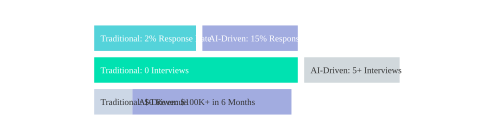
Optimizing for AI tools can transform your job search outcomes—if you combine technology with your own expertise and determination.
Embracing AI as a Partner, Not a Crutch: Secrets to Thriving in a Post-Layoff World
When you’re facing the uncertainty of a layoff, it’s easy to feel like the odds are stacked against you. But in today’s ai-driven job market, you have a powerful ally—if you learn to use it wisely. The secret isn’t just about using AI tools for job search; it’s about treating AI as your partner, not your crutch. Here’s how you can thrive, not just survive, in this new landscape.
Critical Perspective: AI Is as Flawed as It Is Powerful
Let’s be honest: AI is not perfect. It can give you incorrect information, suggest jobs that don’t fit, or even miss the mark entirely. That’s why your human context matters most. You are the subject matter expert of your own life and career. AI-powered career advice is only as good as your ability to validate and interpret it. Before you act on any AI suggestion, pause and ask yourself: Does this align with what I truly want? Does it make sense for my unique situation?
Validate Before You Leap: The Non-Negotiable Step
Learning to validate AI outputs is non-negotiable for real success. Don’t just copy-paste AI-generated cover letters or blindly apply to every job it recommends. Instead, use AI as a brainstorming partner. Dig deeper. If an AI tool suggests a new career path, research it. If it drafts an email, personalize it. This critical thinking is your edge—AI can’t replace your judgment or your lived experience.
Post-Layoff Confidence: New Opportunities Await
After a layoff, it’s tempting to wait for the next job to appear. But, as one professional put it:
"I knew that if I was going to make something of myself, I’m going to have to do it on my own."
There is no magic job falling from the sky. Instead, you have to create your own opportunities. AI can help you spot them, but you must be the one to act. For example, after sending out dozens of applications each week for months, one career changer pivoted to consulting. Their first engagement was worth $70,000, and within six months, that grew to over $100,000—thanks in part to AI tools that helped identify and pitch new clients. The winning combination? AI-savvy optimization plus irrepressible human adaptability and critical thinking.
Creative, Messy, Real-Time Adjustments
Success in the ai-driven job market rarely follows a script. Sometimes, you’ll need to make creative, even messy, real-time adjustments. Maybe AI suggests a role you’ve never considered—like moving from payroll to change management. Maybe it helps you reframe your resume or spot a hidden freelance opportunity. The key is to stay flexible and open-minded. Use AI to spark ideas, then let your resilience and soft skills turn those ideas into reality.
Unscripted Benefits: AI as Your ‘Second Brain’
One of the greatest gifts of AI is its ability to spark lateral thinking. It can uncover hidden paths, offer new perspectives, and even feel like a ‘second brain.’ You might discover career options you never knew existed or find creative solutions to problems that once felt overwhelming. AI tools for job search can give you options, thinking points, and ideas that expand your horizons—if you’re willing to explore them.
Wild Card: Imagine Your Future Self in the AI-Driven Job Market
Here’s a powerful exercise: Imagine yourself five years from now, both advisor and student in this rapidly evolving landscape. What virtual career advice would you give yourself? Would you urge yourself to trust your instincts, to question AI outputs, to stay curious and adaptable? Remember, the most successful careers will belong to those who balance human judgment and AI insights—never relying on one in isolation.
In this new era, your resilience, adaptability, and willingness to question and validate AI advice are your greatest assets. Embrace AI as your partner, not your crutch, and you’ll unlock opportunities you never imagined possible.
Tying It All Together: Practical Takeaways for Your Own AI Job Search
If you’re reading this, you’re probably standing at a crossroads—maybe after a layoff, a career stall, or just a restless urge for something new. The truth is, you don’t need a perfect plan to launch your next chapter. What you need is the courage to experiment, the willingness to laugh at your mistakes, and the grit to keep going. In the world of AI-powered job search and career transitions, relentless experimentation is your best friend. Sometimes, AI will fail you. Good. That’s your cue to prompt better, reflect deeper, and try again. Every stumble is a step forward.
Let’s be honest: the hype around AI tools for job search can feel overwhelming. You might wonder, “Is this just another shortcut?” The reality is, success in an AI job search isn’t about flashy hacks—it’s about critical thinking, iteration, and blending technology with your own human insight. As someone who’s navigated this journey, I can say with certainty:
“Without AI, I would have never been able to create what I have now.”It really is like having a second brain, amplifying your efforts and opening doors you didn’t know existed.
Essential AI Tools and Practices for Job Search Strategies
Start by equipping yourself with the right AI tools for job search. Use ATS resume scanners to make sure your applications get noticed. Try semantic job boards that match you to roles based on your skills and interests, not just keywords. Optimize your LinkedIn profile with AI-driven suggestions, and use advanced skills assessments to highlight what makes you unique. Don’t forget personalized interview prep—AI simulators can help you practice and polish your responses, boosting your confidence for the real thing. These tools aren’t just for techies; they’re for anyone willing to learn and adapt.
Blending AI Outputs with Your Own Observations
Here’s a quick checklist to keep your virtual career advice grounded in reality: Always review AI-generated content for accuracy and tone. Cross-check facts and tailor language to reflect your authentic self. Use AI as a springboard, not a crutch—your own insights and experiences are what make your application stand out. Remember, the best results come when you blend machine intelligence with your own creativity and judgment.
Embracing the Messy Middle
Don’t be afraid of a little chaos. Sometimes your approach will be messy, your prompts imperfect, and your path unclear. That’s okay. In fact, that’s where the magic happens. When you pair resilience and adaptability with AI-driven strategies, you can trigger breakthroughs—even six-figure results—faster than you might imagine. In my own journey, it took less than six months to pivot from layoff to launching a new business, all because I was willing to experiment, iterate, and learn from every misstep.
FAQ: Fears, Myths, and Surprises in the AI Job Search
It’s normal to feel intimidated by AI, especially if you’re new to these tools. Common fears include “Will AI make me sound robotic?” or “What if I get it wrong?” The surprise is, AI is only as good as the person guiding it. The more you play, prompt, and reflect, the better your results. Another myth is that you need to be a tech expert to benefit. You don’t. All you need is curiosity and the willingness to try, fail, and try again.
So, as you step into your own AI-powered job search, remember: you don’t need to have it all figured out. Take risks, experiment with new tools, and let your journey be a little messy. The breakthroughs come not from perfection, but from persistence and play. If you’re ready to reinvent your career, give AI a shot—and don’t forget to enjoy the ride. Your next breakthrough might be just one experiment away.
TL;DR: When layoffs shattered my career, brute resilience, candid experimentation, and a little help from AI transformed roadblocks into a six-figure consulting business. Don’t count yourself out when doors close—sometimes you build your own. Scroll up for the full, untidy journey and the surprising tools that changed everything.
Post a Comment