

If you’ve ever felt pinned down by a label or locked out of opportunities, you’re not alone. I still remember biting into my first Goodies Soul Kitchen sandwich—spoiler: it was dripping barbecue and hope in equal measure—and thinking, wow, every bite tastes like a second chance. Dawon Matthews’ story isn’t just about food, it’s about flipping rock-bottom into a launchpad. Rejection. Jail time. Losses on the scoreboard—and in the bank. But let’s get off the menu for a second: what does it really take to turn 'no' into a million-dollar business?
Rejection, Rock Bottom, and the Birth of Goodies Soul Kitchen
If you want to know what it really takes to build a million-dollar food truck business, you have to start with rejection. For Dawon Matthews, founder of Goodies Soul Kitchen, rejection wasn’t just a bump in the road—it was the road. Dawon’s story is the ultimate entrepreneur success story about overcoming a criminal record, losing everything, and betting it all on a dream in the heart of Houston’s food truck scene.
Losing Money as a Rite of Passage
There’s a saying Dawon lives by:
"You don't make your first $10,000 until you lose $1,000. You don't make your first $100,000 until you lose $10,000. You don't make your first million until you lose $100,000."It’s not just a catchy quote—it’s the truth for anyone hustling in the food truck business. Dawon lost more than just money. After a college party brawl, he served 6 months in jail, losing time, social capital, and a shot at a “normal” career. When he got out, he faced a wall of rejection—over 200 job applications and not a single offer. The reason? His criminal record.
Locked Out, Not Locked Down
Imagine applying for job after job, only to get turned away every time. That’s what Dawon faced. He was 32, broke, and carrying the weight of a felony. Friends and family doubted him. He doubted himself. The stigma was real. But Dawon refused to let his past define his future. Instead, he saw an opportunity in his pain.
Risking It All: The $40,000 Gamble
With poor credit and little support, Dawon took out a $40,000 loan—all in. That was the seed money for Goodies Soul Kitchen. He knew the odds were stacked against him, but he also knew that Houston was the perfect place to launch. Why Houston? The city is famous for its late-night food culture and diverse crowds. And why soul food? Because it’s comfort food, and Dawon wanted to serve up hope with every plate.
Facing the Microwavable Generation
Dawon understood that today’s customers hate waiting. “We’re in a microwavable generation,” he says. So, he built his food truck business around speed, flavor, and experience. Social media and word-of-mouth did the rest. People lined up around the block, hungry for more than just food—they wanted a taste of resilience.
The First Big Break: $10,000 in a Day
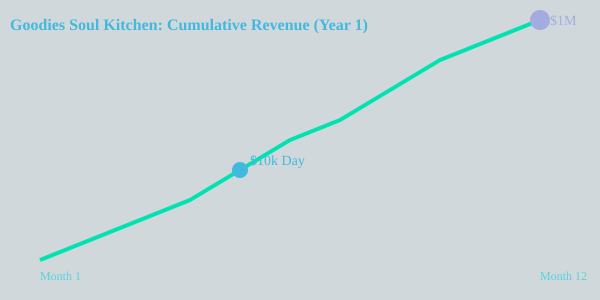
The breakthrough moment? One day, Dawon’s food truck pulled in $10,000—in a single day. The line wrapped around the corner. “I’m about to go crazy,” he remembers thinking. From there, it just exploded. In just 11 months, Goodies Soul Kitchen grossed over $1 million. As Dawon puts it:
"Now, his food truck brings in over a million dollars a year."
Chart: Goodies Soul Kitchen’s First Year Revenue
Life Before the Kitchen: From Inner City Dreams to Systemic Barriers
If you grew up in North Philadelphia like Dawon Matthews, you know what it’s like to dream big in a place where hope feels rare. Dawon’s entrepreneur success story didn’t start with a kitchen or a food truck—it started on the tough streets of Philly, in a neighborhood where positive role models were almost impossible to find.
Dawon remembers, “I didn’t see people I wanted to be like. I always saw people I didn’t want to be like.” In his world, success stories were few and far between. “I can name on my hands, right? I’m 32 years old, and I can’t remember anybody growing up in Philadelphia that was successful. Not drug dealers, not businessmen—nobody.” This lack of mentors and local heroes shaped his early years and made the idea of breaking out seem almost impossible.
Early Hustle: Vision and Grit from the Start
Even as a kid, Dawon’s entrepreneurship journey was already in motion. He shares,
“I always been a visionary. I remember one time... we decided, let’s make the corner store more convenient.”At just 11, Dawon and his friend DJ bought snacks from the corner store and resold them from a crate on a neighbor’s porch. They didn’t make much money, but the spark was there: a drive to create, to hustle, to do something different.
High School Hope: Athlete and Academic
Dawon wasn’t just a dreamer—he was a doer. In high school, he excelled both academically and athletically, determined to carve out a future that looked nothing like the world he saw around him. For many inner-city kids, sports and grades are the ticket out, and Dawon was on that path, proving that hard work could open doors.
College Culture Shock: Systemic Barriers and a Pivotal Night
But when Dawon got to Millersville University, he faced a whole new set of challenges. The campus was a different world—one where he was suddenly the outsider, one of the few Black students, and constantly reminded of it. “It was a culture shock for me,” he says. “I ended up getting myself in trouble there.”
A wild college party turned into a life-changing moment. What might have been just another fight on the streets of Philly was seen as something much worse on campus. “If you get in a fight on the streets, it’s like, ‘Oh, they were just fighting.’ But in college, it’s ‘assault with a deadly weapon.’” Dawon was expelled after just one year and sentenced to six months in jail for aggravated assault. The impact of a criminal record hit hard—not just in the eyes of the law, but in the eyes of his community and himself.
Systemic Exclusion and the Weight of Labels
After jail, Dawon faced the harsh reality of overcoming a criminal record. The stigma followed him everywhere, making it even harder to find his footing. “People who have a background, who’ve been doubted, told no, labeled—I hope they can take this story and get inspired,” he says. The intersection of race, systemic exclusion, and opportunity gaps shaped his journey, fueling his motivation to prove everyone wrong.
Comparing Survival: Streets vs. Campus
Dawon’s story highlights the difference between surviving in the streets and navigating the rules of a world that wasn’t built for him. On campus, actions that were normal back home became criminal. The consequences were bigger, the labels heavier, and the path forward less clear. But even then, Dawon’s vision never faded.

Hustle as Healing: Building Goodies Soul Kitchen and Beyond
If you’ve ever wondered how someone can turn pain into profit, just look at Goodies Soul Kitchen. Dawon Matthews didn’t just build a food truck Houston loves—he built a whole new business playbook out of hustle, healing, and a deep understanding of what hungry people want. It wasn’t about fancy connections or celebrity chefs. It was about showing up, grinding, and making every second count.
Turning Trauma and Hustle Into Business Systems
For Dawon, the grind was more than just making money. It was about transforming rejection and tough times into a system that worked. Instead of letting his past define him, he used it as fuel. Every 12–16 hour day in that truck was a step away from trauma and a step toward something bigger. The daily hustle wasn’t just about surviving—it was about building something that could last.
Daily Grind: 12–16 Hour Days and Operational Intensity
In the first year, Dawon was in the truck almost every day, working 12 to 16 hours. That’s not glamorous—it’s grit. While other food trucks might close early or take days off, Goodies Soul Kitchen was there, night after night, serving up hot plates to Houston’s late-night crowd. This operational intensity was key. Dawon didn’t have industry connections, but he had hustle and a clear focus on efficiency and customer turnover. That’s what made the difference.
Smart Marketing: Word of Mouth and the Late-Night Crowd
Forget billboards and big ad budgets. Dawon’s marketing was simple: word of mouth and serving the impatient, hungry people who didn’t want to wait. Houston is a city that never sleeps, and Goodies Soul Kitchen became the go-to spot for late-night eats. People talked, posted, and brought their friends. The food truck’s unique selling point? Speed. As Dawon puts it:
“We were really intentional about [speed]. People hate waiting.”
He understood the “microwavable” generation—folks who want good food, fast. That insight shaped everything, from the menu to the way orders were handled. It’s a lesson in knowing your market and giving them exactly what they want, right when they want it.
From Food Truck Revenue to Scaling Operations
Goodies Soul Kitchen didn’t just survive—it exploded. In just 11 months, the food truck grossed $1 million. On its fastest day, it pulled in $10,000. That’s not luck; that’s a business model built on speed, service, and relentless hustle. Dawon’s playbook was different: focus on operational efficiency, high customer turnover, and never underestimate the power of word of mouth.
| Milestone | Data |
|---|---|
| First 11 months revenue | $1,000,000 |
| Fastest day revenue | $10,000 |
| Future goal | Open brick-and-mortar by 2026 |
Looking Beyond the Truck: Plans for Brick-and-Mortar
Now, Dawon is thinking bigger. The next step for Goodies Soul Kitchen is scaling operations and opening a physical restaurant by 2026. The food truck Houston loves is just the beginning. Dawon’s journey proves that with the right business playbook, you can turn hustle into healing—and healing into a million-dollar empire.
Stacking the Plates: Diversifying with Multiple Businesses and Real Estate
When you’re coming back from rock bottom, you can’t afford to put all your eggs in one basket. That’s something Dawon Matthews learned early on. After his release, he didn’t just stop at building a food truck empire—he started stacking his plates, expanding into new businesses and real estate investment to create a safety net and a legacy.
From Food Truck Hustle to Multi-Business Mogul
You might know Dawon as the food truck king, but his vision was always bigger than one kitchen on wheels. He saw the power in business scaling and decided to branch out. First, he launched Wonderful Cleaning, a commercial cleaning company that quickly found its groove, hitting $12,000 in monthly revenue by year two. Then came R&R Junk Removal, a business that cleared over $100,000 in its first year alone. These weren’t just side hustles—they were full-fledged companies, each with their own teams and systems.
- Wonderful Cleaning: Commercial cleaning contracts, steady clients, and reliable cash flow.
- R&R Junk Removal: Fast-paced, high-demand service with six-figure returns in year one.
Dawon didn’t stop there. He added trucking to his portfolio, proving that when you master business scaling, you can take on just about any industry. Every new venture was a chance to reinvest profits, diversify income, and reduce risk.
Leveraging Profits for Real Estate Investment
The real game-changer for Dawon was real estate investment. He took the money from his food truck and service businesses and started buying buy-and-hold rental properties in the Houston area. This wasn’t about flipping houses for quick cash. It was about building something that would last—steady rental income, property appreciation, and a cushion against the ups and downs of entrepreneurship.
If you’re hustling every day, you know how unpredictable business can be. Real estate became Dawon’s great equalizer. While the food truck and cleaning gigs brought in fast money, his rentals grew quietly in the background, stacking wealth for the long haul. It’s the difference between street returns—quick, but risky—and the slow, steady climb of rental income.
Building Generational Wealth and a Blueprint for Others
For Dawon, this wasn’t just about getting rich. It was about building generational wealth and creating a blueprint for others coming from tough backgrounds. He says,
“I run a consulting platform, Food Truck Hero’s, to mentor aspiring entrepreneurs and help them launch food trucks.”But the real lesson is in how he reinvested his wins. By moving from day-to-day grind to an asset-building mindset, he’s showing ex-convicts and hustlers everywhere that there’s a legal, long-term way to stack your plates.
Multiple Revenue Streams: The Key to Financial Comeback
Diversification and asset reinvestment are the secret sauce. By integrating multiple revenue streams—food trucks, commercial cleaning company, junk removal business, and buy-and-hold rental properties—Dawon reduced his risk and set himself up for long-term stability. Here’s a quick look at his numbers:
| Business | Revenue |
|---|---|
| Wonderful Cleaning | $12,000/month (Year 2) |
| R&R Junk Removal | $100,000+ (Year 1) |
| Rental Properties | Multiple units (Houston area) |
By stacking the plates and focusing on both active hustle and stable assets, Dawon Matthews turned rejection into a million-dollar comeback—and a roadmap for anyone ready to diversify and build real wealth.
No-Sugarcoating the Struggle: Mental Health, Social Stigma, and Finding a Mission
If you’re on a motivational journey like Dawon Matthews, you know there’s no shortcut around the hard parts. Dawon’s story isn’t just about overcoming a criminal record—it’s about facing the mental and emotional toll that comes with rejection, jail time, and public backlash. He doesn’t sugarcoat what it’s like to hit rock bottom, and that honesty is what makes his story so powerful for anyone looking for an adversity advantage.
Mental Toll of Rejection and Jail Time
Dawon’s first call from jail was shaky. “You remember what that first call with your mom was like?” he was asked. He replied, “Yeah. It was like shaky. Um, she was like, ‘She going to get me out of here.’ You know what I’m saying? But we don’t really have money. So, you got to sit there until you got to find somebody who do got money.” That feeling of helplessness—waiting on the outside world to come through—hits hard. For Dawon, it wasn’t just about the physical confinement, but the mental weight of knowing you’re stuck, relying on others, and feeling like you let people down.
Loneliness and Social Stigma
After a newspaper article and expulsion, Dawon felt the sting of public rejection. The media and community turned their backs, and suddenly, he was alone. The loneliness was real. “You feel stupid because you’re around a bunch of people who literally, you know, do dumb things and they—you could tell somebody’s supposed to be here, right?” Dawon shared. The embarrassment and confusion of being labeled and isolated can haunt you long after you leave the cell.
Life After Prison: Everyday Struggles
Getting out didn’t mean life snapped back to normal. Dawon struggled with the basics—like using a phone. The world had moved on, and he had to catch up. Adjusting to civilian life after six months in jail, including time in solitary confinement, meant relearning simple things and facing the constant reminder of his past. Social redemption isn’t instant; it’s a slow, sometimes painful process.
Surviving ‘The Hole’: Faith and Mindset
Solitary confinement, or “the hole,” is a mental battle. Dawon described it like this: “They say before you make a decision and before you think about doing something, lock yourself in the bathroom for 30 days and don’t open the door.” In that space, your mind goes to dark places. He admitted,
“You start to hallucinate... if you don’t got God in that space you ain’t going to make it.”For Dawon, faith was his anchor. Mental resilience and a sense of mission became more important than any financial gain.
Pressure and Purpose: Inspiring Others
Once out, Dawon felt the pressure to represent and inspire others with similar backgrounds. He knew people were watching, hoping he’d prove that overcoming a criminal record is possible. That’s why he built a mentorship platform—to give back, to show that pain can fuel purpose. His story is now a business mentorship blueprint for anyone told “no” who needs a reason to get up and try again.
- Key takeaway: The journey from cell to success isn’t just about money—it’s about mental health, community, and finding a mission that’s bigger than yourself.
Second Chances in Action: Matthewa’ Mentorship and Paying It Forward
Imagine sitting in a jail cell, surrounded by people who’ve made choices that changed their lives forever. Dawon Matthews has been there. He’s talked about the moment he realized how much prison changed him. “I was in jails with people who murdered people. I was in the hole with a guy who literally went to court and got a life sentence for murdering people.” That experience didn’t just shape Matthews—it lit a fire in him to make his second chance count, not just for himself, but for others who needed a way out.
From Food Truck Empire to Mentorship Platform
After turning his own rejection into a million-dollar food truck business, Matthews saw a bigger mission: helping others do the same. That’s why he launched Food Truck Hero’s, a consulting and mentorship platform designed for aspiring food truck owners. As Matthews puts it:
“I run a consulting platform, Food Truck Hero’s, to mentor aspiring entrepreneurs and help them launch food trucks.”
He’s not just sharing business tips—he’s opening doors for people who, like him, have a record and a dream. His business mentorship is about more than profit; it’s about purpose.
Turning Lived Experience into Actionable Advice
Matthews knows firsthand the obstacles returning citizens face. That’s why his mentorship platform is built around real, actionable advice. He helps mentees avoid the mistakes he made, speeding up their learning curve and saving them time and money. Through market gap analysis and a proven business playbook, Matthews gives new entrepreneurs the tools to spot opportunities and build sustainable businesses.
- Market Gap Analysis: Matthews teaches mentees how to find the right spot in the market—where demand is high and competition is low.
- Business Playbook: He shares step-by-step guides, from getting permits to building a menu, so new owners don’t have to guess their way through.
- Real Talk: Matthews is honest about the grind, the setbacks, and the wins. He’s been there, and he’s not sugarcoating anything.
Blueprint for Reentry: Opening Doors for Others
Matthews sees mentorship as a duty. He’s living proof that a second chance is possible, and he’s determined to be the example others need. By helping returning citizens launch food truck businesses, he’s creating a blueprint for reentry—one that’s built on entrepreneurship, dignity, and community.
Scaling Impact: Community Partnerships and Speaking Events
Mentorship multiplies the impact of individual success. Matthews has mentored dozens of aspiring food truck owners, and he’s always looking for ways to scale that impact. He’s an active participant in workshops and speaking events, partnering with community organizations to reach even more people. Every time he shares his story, he’s planting seeds for new beginnings.
Wild Card: The Domino Effect of Inspiration
Here’s a thought: what if Matthews had never seen that one inspirational article about another entrepreneur? Sometimes, all it takes is one domino to fall for the whole game to change. Matthews knows that’s why sharing stories, building community, and paying it forward matters. You never know who’s watching—or who’s next in line for a second chance.
Table Stakes: How the Numbers Stack Up
If you want to know what business scaling really looks like, Dawon Matthews’ journey is a masterclass in using every dollar to fuel the next big leap. Let’s break down how his business portfolio grew, how he juggled cashflow between ventures, and why Goodies Soul Kitchen became the million-dollar engine driving it all.
Business Timeline & Revenue Breakdown
| Business | Launch Year | Major Milestones | Annual Revenue | Unique Selling Proposition |
|---|---|---|---|---|
| Goodies Soul Kitchen | 2017 | First $1M in 11 months; $10K+ days; lines around the block | $1M+ | Fast, authentic soul food; “microwavable generation” service |
| Wonderful Cleaning | 2018 | Steady contracts; cashflow reinvested into new ventures | $12K/month | Reliable, scalable commercial cleaning |
| R&R Junk Removal | 2019 | Expanded service area; cross-promoted with cleaning | $100K+/year | Quick, affordable junk removal with flexible scheduling |
| S&J Trucking | 2020 | Added logistics arm; supported other businesses | Private | In-house logistics for cost control |
| Real Estate Portfolio | 2020 | First property flips; rental income begins | Private | Asset diversification, passive income |
Which Business Fueled Which?
Matthews didn’t just stack businesses—he layered them. Goodies Soul Kitchen was the breakout, generating over $1 million in food truck revenue within its first year. That cashflow didn’t just sit in the bank. Instead, Matthews poured profits into Wonderful Cleaning, then used cleaning profits to launch R&R Junk Removal. Each business became a stepping stone, funding the next and reducing risk along the way.
As Matthews explains, “You don’t make your first 10,000 until you lose a thousand. You don’t make your first 100,000 until you lose 10,000. You don’t make your first million until you lose 100,000.” Sequential expansion and smart cashflow reinvestment made high growth possible, even when banks wouldn’t lend and investors wouldn’t listen.
How Does Goodies Soul Kitchen Compare?
In Matthews’ business portfolio, Goodies Soul Kitchen is the clear heavyweight. Its $1M+ annual revenue dwarfs the $12K/month from Wonderful Cleaning and the $100K+/year from R&R Junk Removal. But each business played a role: cleaning and junk removal provided steady, lower-risk income streams, while the food truck’s explosive growth gave Matthews the capital to diversify and expand.
Single-Venture Risk vs. Diversification
Matthews’ story is a lesson in why putting all your eggs in one basket is risky. If Goodies had failed, the cleaning and junk removal businesses—and later, real estate—gave him a safety net. This layered approach to business scaling is what turned rejection into resilience.
Mini FAQ: What Would Matthews Do Differently?
| Question | Matthews’ Take |
|---|---|
| Start with food or services? | “I’d still start with food—fast cashflow, but I’d build systems sooner.” |
| Biggest mistake? | “Not diversifying earlier. Single-venture risk is real.” |
| Best business strategy? | “Reinvest every dollar. Let your business fund your next move.” |
Business Portfolio Growth: Quick Visual
- 2017: Goodies Soul Kitchen launches
- 2018: Wonderful Cleaning starts, funded by food truck profits
- 2019: R&R Junk Removal added, cross-promoted with cleaning
- 2020: S&J Trucking and real estate investments diversify income
His businesses include Goodies Soul Kitchen, Wonderful Cleaning, R&R Junk Removal, S&J Trucking, and a real estate portfolio.
Conclusion: More Than a Success Story—It’s a Blueprint for Second Chances
When you look back on Dawon Matthews’ journey, it’s easy to get caught up in the headline: “From Cell to Soul Kitchen.” But if you dig deeper, you’ll see that this isn’t just an entrepreneur success story—it’s a living, breathing blueprint for second chances. Matthews’ path from rejection and a criminal record to business ownership and mentorship is messy, nonlinear, imperfect, and still unfolding. That’s exactly what makes it so powerful for anyone searching for their own motivational journey.
Let’s be real: there’s no straight line from rock bottom to millionaire. Dawon lost big before he won bigger. As he puts it,
“You don’t make your first $10,000 until you lose a thousand. You don’t make your first $100,000 until you lose $10,000. You don’t make your first million until you lose $100,000.”In 2023, he lost everything. In 2024, he grossed a million in just 11 months. That’s not luck—it’s resilience, risk, and relentless learning.
What can you take from this? First, risk is inevitable. If you’re waiting for the perfect moment or a guarantee, you’ll be waiting forever. Dawon’s story proves that setbacks are not just possible—they’re required. Second, systems trump hustle. Matthews didn’t just work harder; he worked smarter. He recognized that people hate waiting, so he built a food truck business that prioritized speed and customer experience. That’s a lesson in entrepreneurship that goes beyond the grind: build systems that solve real problems, and success will follow.
But maybe the most important lesson is about community. Dawon’s rise wasn’t a solo act. He built a team, listened to his customers, and shared his story—even when it was uncomfortable. He knows that community matters most, especially when you’re overcoming a criminal record or any other label society tries to stick on you. His willingness to be vulnerable and visible has inspired others who’ve been told “no” to see their own obstacles as raw material for their own success stories.
Here’s the truth: second chances aren’t just about private redemption. They’re a public good. When someone like Dawon gets a shot at business ownership and mentorship, the benefits ripple out—jobs are created, stereotypes are shattered, and hope is restored in communities that need it most. Matthews’ life is evidence that blueprints for second chances do exist, and that they’re not reserved for the lucky few.
So, what’s your first step if you’ve been told “no”? Maybe you’re sitting with $1,000 and a police record, wondering if you’ll ever get a shot. Dawon’s answer would be simple: start where you are, with what you have, and don’t let the labels define you. Build something that matters, even if it’s small. Share your story, even if it’s messy. And remember, you might lose big before you win bigger—just ask Dawon Matthews.
Matthews’ trajectory from jail and rejection to millionaire entrepreneur isn’t just aspirational—it’s actionable. His journey is proof that your past doesn’t have to dictate your future, and that every “no” can be the start of your own blueprint for second chances. The only thing left is for you to take that first step.
TL;DR: You might lose big before you win bigger—just ask Dawon Matthews. His journey from criminal record to million-dollar food truck mogul proves second chances aren’t just possible—they’re downright delicious. Hungry for inspiration? This story serves it up hot.
Post a Comment