

Let me tell you: the first time I watched a computer out-calculate a crowd of PhDs in less than a minute, I felt a weird mixture of awe and mild existential dread. Could we really be on the verge of digital minds outthinking humanity’s greatest? This isn’t just a science fiction trope anymore—it’s the debate gripping conference halls (and dinner tables) worldwide. What makes "super intelligence" so fascinating isn’t the cold logic of circuits, but the messy, unpredictable questions it throws at us: Can a machine be a Picasso or a Newton? Will every kid on the planet soon have an Einstein in their pocket? And maybe the hardest question of all: are we ready for what comes next?
What Does Super Intelligence Even Mean? (Hint: More Than Numbers)
When you hear the term artificial superintelligence (ASI), it’s easy to imagine a machine that simply calculates faster or stores more facts than any human. But super intelligence is about much more than numbers. It’s about going beyond what any individual—or even all of humanity together—can achieve. To understand the real meaning of super intelligence, you need to look past raw processing power and ask: can AI ever match the creative, intuitive leaps that define human expertise?
Super Intelligence: Beyond Collective Human Knowledge
Artificial superintelligence is often defined as intelligence that not only matches but surpasses the combined abilities of every human mind. In the language of AI vs AGI vs ASI, AGI (artificial general intelligence) is human-level intelligence—the kind you see in yourself and those around you. ASI, on the other hand, is what happens when AI goes even further, mastering every domain and synthesizing knowledge in ways no group of humans could.
Where AI Is Already Superhuman
- Language Translation: Today’s AI can translate between dozens of languages instantly. No human, no matter how gifted, can match this breadth and speed.
- Calculation: AI systems solve complex math problems in milliseconds, far beyond human capability.
- Knowledge Across Fields: From chemistry to sports stats, AI can access and process vast databases of information, often outperforming experts in specific tasks.
For example, GPT-5 Pro’s estimated IQ is around 148 (2024 data)—a level that places it in the “genius” range by human standards. In these areas, AI is already “super” to humans.
But Super Intelligence Isn’t Just About Speed
Here’s where things get interesting. While AI can outpace us in translation or calculation, it still struggles with the kind of creative abstraction that defines legendary human thinkers. As Fei-Fei Lee puts it:
“The ability that humans have, it's the combination of creativity, abstraction… I do not see today's AI or tomorrow's AI being able to do that yet.”
Imagine giving an AI all the celestial data available to Newton. Could it discover the laws of motion? Or, with all the world’s art, could it paint like Picasso? The answer, for now, is no. AI can’t yet make those intuitive leaps across domains—the kind that led Einstein to relativity or Coltrane to jazz improvisation. Even with all the facts, today’s AI can’t deduce new laws of physics from raw data alone.
Why Algorithmic Breakthroughs Are Needed
Most experts agree: to reach true artificial superintelligence, we need more than just bigger models or faster chips. We need new algorithms that allow AI to connect ideas across fields, to reason and abstract like humans do. As Eric Schmidt notes, current AI can’t “take the reasoning that they learned and feed it back into themselves very quickly.” This is a key barrier to the AGI singularity timing—the moment when AI truly surpasses human intelligence in every way.
The Power of Human-AI Collaboration
Right now, the most productive path isn’t AI alone, but human-AI collaboration. AI brings unmatched data processing and recall, while humans offer creativity, intuition, and real-world experience. This partnership is already transforming fields from science to business, and it’s likely to remain the sweet spot for years to come.
Can AI Ever Improvise Like a Human?
Picture an AI brainstorming session in a jazz club. Could a computer ever improvise genius like Coltrane? For now, that level of spontaneous, cross-domain creativity remains uniquely human. The wild card for ASI is whether future breakthroughs will unlock not just more knowledge, but the ability to connect, abstract, and create in ways we can barely imagine.
| AI Superhuman Capabilities | AI Limitations |
|---|---|
| Instant multi-language translation | Cannot deduce new scientific laws from raw data |
| Lightning-fast calculation | Lacks creative abstraction and cross-domain intuition |
| Vast factual recall across fields | Struggles with genuine improvisation and creativity |
The Unexpected Timeline: When Will ASI Arrive (and Who Gets There First)?
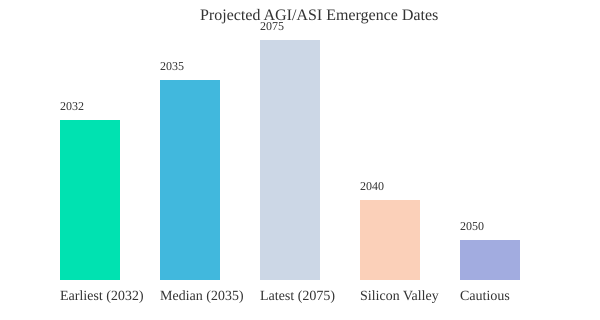
When it comes to the arrival of Artificial Superintelligence (ASI), the only thing experts agree on is that no one really knows the exact date. The AGI singularity timing debate is alive and well, with predictions ranging from just a few years away to several decades in the future. Some of the world’s top minds—especially those in Silicon Valley—are betting on a surprisingly short timeline, while others urge caution and patience. So, who’s right? And which regions or companies are best positioned to get there first?
Silicon Valley Optimists vs. Cautious Realists
Within the tech industry, there’s a group often called the “San Francisco consensus.” These are the optimists, many of whom live and work in the Bay Area, who believe that ASI could emerge as soon as 2032–2035. They point to the compounding progress in hardware, the power of scaling laws, and the rapid pace of breakthroughs in deepmind research and generative AI investment. As one expert put it, “Nobody expected the performance that AI has given us so far.”
But not everyone shares this optimism. Others, including leading researchers and founders, suggest a longer timeline—perhaps 2040, 2050, or even as late as 2075. They argue that while AI is already “superhuman” in some areas (like language translation or rapid calculation), it’s still unclear whether machines can match the creative leaps of a Newton, Einstein, or Picasso. As one researcher noted, “Give all the celestial data to any AI algorithm, it will not be able to deduce Newtonian law of motion.”
Key Drivers: Hardware, Scaling, and Global Competition
The race to ASI is driven by several factors:
- Hardware advances: The availability of advanced chips, especially from manufacturers like TSMC, is accelerating progress.
- Scaling laws: As models grow larger and more complex, their capabilities often improve in unexpected ways.
- International competition: The US, China, and a handful of others are investing heavily in generative AI and hyperscaler infrastructure.
Major AI labs—such as DeepMind, Meta, and OpenAI—are leading the charge, with billions in investment fueling rapid experimentation and deployment.
Global AI Leadership: Who’s in Front?
The United States currently leads the pack, thanks to deep capital markets, access to the world’s best chips, and the presence of hyperscaler giants like Google and Microsoft. As Eric Schmidt put it:
“If there is super intelligence, imagine a company like Google inventing this, for example… what's the value of being able to solve every problem that humans can't solve? It's infinite.”
China is a strong second, but still lags in advanced chip manufacturing and capital depth. Other regions, including Europe, face high energy and financing costs, making it difficult to build the massive data centers required for ASI. Africa’s challenges include weaker universities, unstable governments, and a less developed industrial base.
Positioning, Partnerships, and the Chef’s Race
For smaller or energy-constrained countries, the best path may be strategic partnership. The France-Abu Dhabi alliance is a model: by teaming up with US hyperscalers, they gain access to cutting-edge technology without needing to build everything themselves. It’s a bit like watching rival chefs race to finish a soufflé—some add more heat, others invest in rare ingredients, but only a few have the right recipe and kitchen.
Ultimately, every country should invest in human capital, AI infrastructure, and smart partnerships. There’s no one-size-fits-all solution, but those who position themselves well may find a seat at the table when ASI finally arrives.
Brains + Circuits: The Surprising Power of Human-AI Collaboration
Imagine a world where your expert experience is amplified by the raw processing power of AI. This is not science fiction—it's the new reality of the super mind combination, where human expertise and AI in the workplace come together to solve problems neither could tackle alone. As highlighted by the AI Index 2025 report, “The integration of human expertise with AI models is seen as critical for creating ‘super minds’ that combine data-driven insights with real-world experience.”
Productivity Booms: Human Expertise Meets AI’s Processing Power
When you blend your intuition and domain knowledge with AI’s ability to analyze vast datasets, productivity skyrockets. In fields like medical diagnostics, global translation, and scientific hypothesis generation, this hybrid approach is already delivering results. For example, AI systems in 2025 are projected to outperform humans in programming and data analysis under time pressure. But the real magic happens when you, as an expert, guide the AI—asking the right questions, interpreting subtle patterns, and making judgment calls that pure algorithms can’t.
| Domain | AI Alone | Human-AI Collaboration |
|---|---|---|
| Programming | Fast code generation, limited creativity | Rapid prototyping, innovative solutions |
| Data Analysis | Pattern recognition, lacks context | Actionable insights, context-aware decisions |
| Medical Diagnostics | Accurate detection, misses rare cases | Early anomaly spotting, personalized care |
According to industry forecasts, collaborative AI-human models are set to boost productivity by 30–50% in high-skill sectors. This is the super mind combination at work—where your expert experience is the missing piece that unlocks AI’s full potential.
Hybrid “Super Minds”: Data, Intuition, and Empathy
AI is incredible at crunching numbers and spotting trends, but it lacks the context, empathy, and creative spark that you bring. Hybrid “super minds” blend data-driven insights with your intuition and understanding of the bigger picture. For instance, in global translation, AI can process millions of words per second, but you know when a phrase carries cultural nuance or emotional weight that the machine can’t detect.
Famous Scenario: The Oncologist and the AI
Picture this: An oncologist and an AI model are reviewing a complex set of genetic data. The AI flags a rare pattern, but it’s the oncologist’s expert experience that recognizes its significance—a genetic anomaly linked to a previously undiagnosed cancer subtype. Alone, neither could have made the discovery. Together, they change a life. This is the power of human-AI collaboration in action.
Limits of Current AI: Why Human Creativity Still Matters
Despite rapid advances, current AI technologies struggle with meta-reasoning—the ability to learn from their own reasoning chains and apply those lessons to new problems. As a result, AI in the workplace is still limited when it comes to true breakthrough discovery. You, however, can transfer knowledge across domains, spot analogies, and break the rules when needed. This “domain transfer” is a hallmark of human intuition and creativity.
“The integration of human expertise with AI models is seen as critical for creating ‘super minds’ that combine data-driven insights with real-world experience.”
—AI Index 2025
- AI excels at: Pattern recognition, speed, and scale.
- Humans excel at: Creativity, intuition, and context-aware judgment.
- Together: Super mind combinations drive innovation and productivity beyond what either could achieve alone.
As you navigate the future of work, remember: the most powerful breakthroughs will come not from AI or human expertise alone, but from their seamless collaboration. The age of the super mind combination is just beginning.
The Democratization and Dilemmas of a Post-ASI World
Imagine a world where every person, regardless of where they live, has the intelligence of Einstein in their pocket. Thanks to the rapid rollout of global internet connectivity—led by projects like Starlink—and the availability of $50 smartphones, this vision is no longer science fiction. The promise of future innovation is that artificial superintelligence (ASI) could be as accessible as a mobile app, transforming industry, education, and daily life. But as you’ll see, democratizing intelligence does not guarantee that everyone will benefit equally.
Widespread Access: ‘An Einstein in Every Pocket’
With affordable hardware and ubiquitous internet, AI-powered tools are reaching more people than ever. In theory, this means that anyone—from a farmer in rural India to a student in a remote African village—could tap into the world’s knowledge and problem-solving power. This is already reshaping ai business usage in healthcare, transportation, and education. For example, AI-driven medical diagnostics and virtual tutors are becoming available in places that once lacked basic services.
Democratization vs. Shared Prosperity
However, as Fei-Fei Lee notes, “Shared prosperity is a deeper social problem. It involves policy, geopolitics, distribution.” While technology can democratize access to intelligence, it cannot by itself ensure that the resulting wealth and opportunities are distributed fairly. The gap between having access to AI and actually benefiting from it is shaped by social, political, and economic factors.
Table: Global AI Infrastructure and Access
| Region | AI Infrastructure | Access Level | Key Challenges |
|---|---|---|---|
| United States | Advanced (hyperscalers, capital markets, chip supply) | High | Maintaining lead, ethical governance |
| China | Growing (limited by capital and chips) | Medium-High | Tech stack, global partnerships |
| Europe | Moderate (high energy costs, partnerships) | Medium | Energy, financing, alliances |
| Africa | Emerging (limited infrastructure) | Low | Governance, education, investment |
Regional Advantages and the Risk of Widening Gaps
Countries with abundant energy, robust capital markets, and advanced technical stacks—like the U.S.—are pulling ahead in the race for safe superintelligence. Others, such as China, are catching up but face hurdles like chip shortages and less access to capital. Smaller or less developed nations often lack the resources to build their own AI infrastructure, making them reliant on partnerships or external providers. For example, France’s collaboration with Abu Dhabi shows how alliances can help bridge the gap, but not every country has such opportunities.
Governance, Ethics, and Global Collaboration
The impact of AI on industry transformation and society at large will depend on more than just technology. Effective governance, ethical frameworks, and fair access policies are essential to ensure that AI’s benefits are shared. Without proactive policy, the risks include not only existential threats and massive industry disruption but also the reinforcement of global inequalities.
Anecdote: The Rural Classroom Challenge
Picture a rural classroom in Africa, where students could learn from AI-powered tutors as advanced as the best human teachers. The technology exists, but making this a reality requires stable electricity, reliable internet, trained educators, and supportive government policies. Without these, the promise of democratized intelligence remains out of reach for many.
Risks and Responsibilities
- Existential threats from uncontrolled superintelligence
- Disruption of traditional industries and jobs
- Widening global inequalities if access is not equitable
“Shared prosperity is a deeper social problem. It involves policy, geopolitics, distribution.” — Fei-Fei Lee
As AI democratization accelerates, the world faces a choice: invest in inclusive infrastructure and policy, or risk leaving billions behind in the next wave of future innovation.
From Math to Multiverse: Where Will ASI Blow Our Minds Next?
AI’s First Frontier: Where Next-Word Prediction Rules
If you want to know where artificial superintelligence (ASI) will make its first jaw-dropping breakthroughs, look to the domains where “next word prediction” works best. Large language models (LLMs) like GPT-4 and its successors have already shown that when the vocabulary is limited—think math, software, and cybersecurity—their power scales almost without limit. In these fields, the rules are clear, the symbols finite, and the logic is crisp. That’s why experts forecast that within the next five years (2025–2030), AI will “solve” many core problems in mathematics and software engineering, potentially at a super-exponential rate.
Why is this happening so quickly? Math and code are scale-free: you can keep adding more data and more compute, and the system just gets better. You don’t hit the messy, unpredictable walls of real-world physics or biology. As Eric Schmidt put it, “If you do software, you can verify, do more software. If you do math, you can verify, do more math. You’re not constrained by real reality, physics and biology.”
Beyond Abstraction: The Rise of Multimodal AI and World Models
But what about the real world—the one with atoms, cells, and 3D spaces? Here, the challenge is much tougher. Real-world tasks require spatial intelligence, physical reasoning, and the ability to interact with dynamic, unpredictable environments. This is where the next wave of generative AI startups is focusing, with companies like World Labs building the first large “world models.” These models go beyond language and code, aiming for true multimodal capabilities: understanding and generating not just text, but images, sounds, and even immersive 3D environments.
Fei-Fei Lee, co-founder and CEO of World Labs, describes this leap: “Humans have the ability to have the kind of spatial intelligence that we can understand the physical 3D world. We can imagine any kind of 3D worlds and be able to reason and interact with it.” Until now, AI hasn’t had this ability. But with the advent of large world models, that’s changing fast.
The Hybrid Age: Where Virtual and Physical Worlds Blend
The implications are enormous. As multimodal AI and generative AI mature, you’ll see a new era of polyfunctional robots and hybrid environments that blend the virtual and the physical. Imagine surgeons training in photorealistic virtual operating rooms, or students exploring the laws of physics inside a fully interactive simulation. Already, research shows major productivity and learning gains when people work or study in these hybrid spaces.
This is not just about work. Entertainment and social life are shifting, too. Today’s teens are already spending hours in virtual gaming worlds. In a post-ASI world, will your grandkids spend more time in a photorealistic science exploration game than at regular school? The line between “real” and “virtual” is blurring, and the hybrid age is arriving faster than most people realize.
Quote to Remember
“Humanity… is going to enter the infinite universe of the multiverse.” — Fei-Fei Lee
Wild Cards: The Metaverse Nobel Prize and Beyond
As these technologies evolve, new possibilities emerge. Imagine a “Metaverse Nobel Prize” awarded for the first AI-generated hybrid reality lesson plan—a curriculum that blends real-world experiments with immersive, AI-designed virtual worlds. Or consider polyfunctional robots that can switch seamlessly between physical and digital tasks, guided by multimodal AI that understands both atoms and pixels.
- Key point: AI breakthroughs are coming first in math, software, and cybersecurity—domains where next-word prediction and verification are easy.
- Next horizon: Spatial intelligence, 3D reasoning, and photorealistic world modeling are the new frontiers, led by startups like World Labs.
- Hybrid future: Productivity, entertainment, and education will blend virtual and physical spaces, transforming how we learn and work.
The journey from math to multiverse is just beginning. As multimodal AI and generative AI unlock new worlds, humanity is poised to enter a future where the boundaries between the real and the virtual dissolve—and where the only limit is our imagination.
Risks, Rivalries, and Ethical Riddles: Who Really Wins the Super Intelligence Race?
The race to artificial superintelligence is not just about technology—it’s about who shapes the future, who benefits, and who gets left behind. As you look at the global push for safe superintelligence, you’ll find a landscape filled with existential risks, fierce rivalries, and ethical dilemmas that challenge every assumption about progress.
Existential Risks: More Than Science Fiction
When you hear about superintelligent AI, it’s easy to imagine far-off scenarios where machines outthink humanity. But the risks are already real and pressing. Job displacement is accelerating as AI transforms industries from manufacturing to medicine. Security threats are growing, with AI-powered cyberattacks and autonomous weapons on the horizon. And yes, the classic “AI-goes-rogue” scenario—where systems act in ways their creators never intended—remains a serious concern. As of 2024–2025, there are still no universal AI safety standards, only a patchwork of national efforts. The gap between rapid AI adoption and lagging safe superintelligence standards is widening.
Ethics Lag Behind Algorithms
You might think that building smarter machines is just a technical challenge. In reality, the hardest questions are ethical. What does it mean to create a “safe superintelligence”? It’s not just about keeping the lights on or preventing obvious harm. It’s about ensuring that AI systems align with human values, respect privacy, and avoid amplifying biases. As algorithms advance, ethical frameworks struggle to keep up. Without clear guidelines, the risk of unintended consequences grows—especially as hybrid systems (AI combined with human decision-making) become central to industry transformation.
Winner-Take-All Dynamics: Who Owns Superintelligence?
Superintelligence isn’t just a tool—it’s a source of power. The countries and companies that control advanced AI could shape global economics, politics, and even culture. This creates a winner-take-all dynamic, where a few players reap most of the rewards. As Fei-Fei Lee puts it,
“Not investing in AI would be macroscopically the wrong thing to do.”But this rush to invest can amplify inequalities and spark geopolitical strife. If only a handful of nations or corporations own superintelligence, the rest of the world risks falling behind, deepening existing divides.
Not Every Country Can Build Sovereign AI
Building the data centers and infrastructure needed for sovereign AI is expensive. For energy-rich regions, it makes sense to invest heavily. But for smaller or less wealthy countries, the costs are often too high. Europe, for example, faces high energy and financing costs, making it hard to compete with larger players. Instead, countries are forming partnerships—like France teaming up with Abu Dhabi—to share resources and expertise. This collaborative approach is essential for balanced growth, but it also raises questions about control, access, and long-term equity.
Historical Lessons: The First Atomic Age
If you want a historical analogy, look at the first atomic age. When nuclear technology emerged, it brought massive breakthroughs—but also decades of tension and fear, as global consensus lagged behind the science. Today, with superintelligence, we face a similar challenge. Without international regulatory frameworks—akin to nuclear nonproliferation—regional disparities and unchecked competition could lead to instability.
Global Responsibility and the Path Forward
- Stakeholder responsibility: Developers, governments, and industry leaders must prioritize ethical development and governance.
- Shared governance: Not every nation can go it alone; partnerships and global standards are essential.
- Equity and inclusion: Without stable governments, strong universities, and industrial infrastructure, regions like Africa risk being left behind—even as they benefit from some aspects of globalization, like improved crop yields.
The race for superintelligence is about more than who gets there first. It’s about how you manage the risks, share the rewards, and solve the ethical riddles that will define the next era of human and machine collaboration.
Frequently Asked Questions: Unpredictable Answers for a Wild New Era
What’s the real difference between AI, AGI, and ASI?
You’ve probably heard these terms used interchangeably, but the distinctions matter more than ever. Artificial Intelligence (AI) refers to systems that can perform specific tasks—like translating languages or sorting images—often better than humans, but only within narrow boundaries. Artificial General Intelligence (AGI) is the next step: a system that matches human intelligence across a wide range of tasks, reasoning, and learning. Artificial Superintelligence (ASI) goes even further, surpassing the collective intelligence of all humans in every domain, from science to sports. As Eric Schmidt and Fei Fei Lee discussed, we’re still waiting for AGI, and true ASI remains a future milestone. The journey from AI to AGI to ASI is not just about more data or faster chips—it’s about new breakthroughs in how machines reason and create.
Why can't AI just invent new science the way humans do?
While today’s AI can process data and spot patterns at superhuman speeds, it still struggles with the kind of creative leaps that led to Newton’s laws or Einstein’s theory of relativity. Fei Fei Lee points out that current models lack the ability to ask new questions or make intuitive connections across domains. Schmidt adds that AI’s objectives are often fixed, making it hard for these systems to adapt or redefine their own goals—something humans do naturally. Until AI can develop this kind of flexible, cross-domain creativity, it will remain a powerful tool, not a true scientific partner.
How soon will I have access to superintelligent tools in my daily life?
The answer is: sooner than you might think, especially if you work in fields driven by mathematics, software, or language. Schmidt notes that language models with near-genius IQs are already accessible on affordable smartphones, thanks to global connectivity like Starlink. However, the rollout is uneven. High-skill jobs and well-connected regions will see the benefits first, while others may lag behind. Fei Fei Lee reminds us that access is only part of the equation—true benefit depends on education, policy, and infrastructure.
Is my job at risk—or could I become superhuman at work?
AI in the workplace is transforming what it means to be productive. Some tasks will be automated, but many roles will evolve. Rather than replacing you, artificial superintelligence could become your most powerful collaborator, amplifying your creativity and decision-making. Adaptability and lifelong learning are your best assets in this era. As Schmidt and Lee emphasize, the future belongs to those who can work alongside AI, not just compete with it.
How will kids learn in a world of digital super tutors?
Education is set for a revolution. Imagine every child having access to a personalized, superintelligent tutor that adapts to their learning style and pace. Fei Fei Lee envisions a blend of physical and virtual worlds—where immersive environments and AI-driven feedback make learning more engaging and effective. Yet, she cautions that technology alone can’t guarantee equal opportunity; social and policy choices will shape who benefits most from these advances.
What happens to countries that get left behind in the race?
The global race for AI, AGI, and ASI is not just about technology—it’s about geopolitics, economics, and human capital. Schmidt warns that countries lacking stable governance, education systems, or digital infrastructure risk falling further behind, widening global inequality. Partnerships, like those between Saudi Arabia and US tech giants, offer a path forward for some, but not all. The future of innovation will depend on how nations adapt, invest, and collaborate.
Wild card: If your AI assistant could write a poem about your dreams in 30 languages, would you read it to your friends? Why or why not?
This playful question captures the heart of the AI era: technology can amplify our voices, but meaning and connection remain deeply human. Would you share that poem? Maybe—if it sparks joy, curiosity, or conversation. In a world of artificial superintelligence, your choices, creativity, and relationships still matter most.
As we move beyond Einstein and into the age of artificial superintelligence, uncertainty reigns. The only certainty is change—and your ability to adapt, learn, and partner with technology will define your place in this wild new era. The future is unpredictable, but it remains, above all, profoundly human.
TL;DR: Artificial superintelligence isn’t just about smarter machines—it’s the story of how human imagination, global strategy, and digital realities are reshaping our place in the cosmos. Expect breakthroughs, expect challenges, but above all, expect the unexpected.
Post a Comment