
Let me hit you with something kind of wild: every meaningful achievement in life comes with pain – and you actually get to pick the flavor. I learned this the hard way, waking up one morning after years of chasing goals that mostly just left me exhausted, not satisfied. Maybe you know the feeling? What no one told me (or you, probably) is that suffering is the fixed ticket price for any life worth living. I once broke a record with a book launch – but the most valuable lesson wasn't about sales, it was about suffering on purpose. So let's talk about why you're not broken for finding it hard, and how to make your struggle count.
The Universal Tax: Why Everyone Pays in Suffering – So Make It Worth It
There’s a truth at the heart of entrepreneurship hardship and meaningful goal setting that most people overlook: everyone pays the universal tax of suffering. It doesn’t matter if you’re rich or poor, single or married, an entrepreneur or an employee. The pain is always there—it just changes shape. The only real choice you have is what you get in return for that pain.
Suffering Is a Fixed Cost of Life
Think of suffering as a non-negotiable expense, like a tax you can’t avoid. Whether you’re building a business, raising a family, or just trying to get through the day, discomfort, uncertainty, and criticism are part of the deal. As Alex Hormozi—who set the world record for the fastest selling non-fiction book and generated $105 million in sales in just 72 hours—explains, the pain never goes away. Your business will hurt when it’s shrinking, plateauing, or growing. The struggle is always present; only the context changes.
Pain Is Universal—But What You Trade It For Is Up to You
Here’s the key insight: you can’t avoid suffering, but you can choose what you suffer for. Most people spend their “pain budget” on trivial things—like binge-watching Netflix, sleeping in, or avoiding challenges. It’s like trading your life savings for a bag of chips. You pay the price, but the reward is fleeting and unsatisfying.
Instead, imagine if you had to give up your entire life savings for just one thing. Would you pick something trivial, or would you demand something truly life-changing? The same logic applies to your daily struggles. Since you have to pay the cost anyway, why not invest it in a goal that actually matters?
Entrepreneurship Hardship: The Pain Is the Same, the Reward Is Different
Whether you’re launching a startup or working a steady job, the pain of uncertainty, criticism, and failure is unavoidable. Entrepreneurs suffer through risk and rejection. Employees suffer through monotony and lack of control. The pain is the constant; the outcome is what you get to pick.
“A man who has a big enough why can bear almost any how.” – Victor Frankl
This wisdom from Victor Frankl is at the core of meaningful goal setting. If your “why” is strong enough, you can endure almost any hardship. The difference between a life of meaning and a life of regret is what you choose to suffer for.
Most People Waste Their Effort on Comfort
It’s easy to fall into the trap of trading discomfort for comfort. Many people use their fixed “pain budget” on things that don’t move them forward—like scrolling social media, avoiding feedback, or sticking to routines that feel safe but lead nowhere. This is why so many end up dissatisfied: they’ve paid the universal tax, but received nothing of value in return.
Make Your Suffering Count: The Life Savings Analogy
Alex Hormozi’s analogy is powerful: if you had to spend your life savings on one thing, you’d make it count. The same goes for your suffering. Every moment of embarrassment, every failure, every criticism is a payment. Make sure you’re buying something worthwhile—a meaningful achievement, a lasting impact, or a personal transformation.
Illustrative Chart: The Cost of Meaningful vs. Trivial Goals
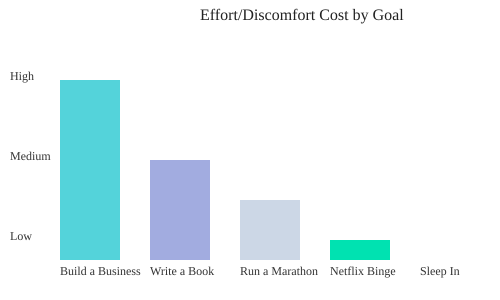
As the chart shows, the “cost” in effort, hours, and discomfort is always paid. The only question is whether you’re investing in something meaningful—like building a business or writing a book—or spending it on short-term comfort. The choice is yours. Make it count.
Cringe, Criticism, and the Art of Embracing Embarrassment
Choosing meaningful goals is not just about ambition—it’s about willingly stepping into a spotlight where feedback, judgment, and criticism are guaranteed. Whether you take bold action or do nothing at all, criticism is a constant companion. The real difference is whether you get criticized for standing still or for moving towards something that matters to you.
Overcoming Criticism in Entrepreneurship: Action Attracts Feedback
It’s a strange truth: if you do nothing, people will still talk. “He never tries anything,” they’ll say. But if you do something—especially something new or bold—they’ll often say, “Look how foolish that is.” The lesson? You can’t escape criticism, but you can choose what you get criticized for. If you’re going to face judgment either way, let it be for pursuing your own purpose.
This is a core lesson in overcoming criticism in entrepreneurship. Every meaningful step you take exposes you to more feedback and judgment. The more you care, the more you’ll feel it. But that’s also where growth happens.
Embrace the Cringe: The Path to Mastering Rejection and Negative Feedback
“You have to embrace the cringe.” – Alex Becker
When you start anything new, you will be awkward, you will make mistakes, and you will look back and cringe. That’s not a sign of failure—it’s a sign that you’re learning. Think about toddlers learning to walk. They fall, stumble, and look silly, but that’s the only way they learn. As adults, we forget that being embarrassed is part of growth.
My own first product pitch was a disaster. I was nervous, my words jumbled, and even my friends laughed. It was rough, but it was better than doing nothing. That first attempt taught me more than months of planning ever could. The instinct to avoid pain and embarrassment is strong, but real progress comes when you go against that instinct and embrace the cringe.
Feedback Cycles and Skill Development: Why Embarrassment is Essential
Feedback—especially negative feedback—is essential for progress. The first 20 hours you spend actively practicing a new skill will teach you more than 100 hours of passive learning. This is true whether you’re learning sales, coding, or public speaking. The embarrassment you feel today is the price you pay for competence tomorrow.
| Skill | Average Public Failures Before Success* | Learning by Doing (20 attempts) | Learning by Watching (100 hours) |
|---|---|---|---|
| Sales | 18 | Base competence, real feedback | Theoretical knowledge, little confidence |
| Public Speaking | 22 | Comfort with audience, improved delivery | Understanding of techniques, little practice |
| Product Pitching | 15 | Refined message, resilience to criticism | Ideas, but no real-world response |
*Hypothetical data for illustration
Why Most People Stop—and How You Can Win
Most people quit when they encounter the shame of rejection, the boredom of repetition, or the sting of negative feedback. But if you can master these moments—if you can keep going after failing publicly, after looking foolish in front of people you care about—you’ll outlast almost everyone. As the saying goes, “You can beat 99% of people if you can master the shame of rejection, the boredom of repetition, and pain of feedback.”
- Zero action = criticism. Bold action = more (and different) criticism.
- Everyone starts as a messy beginner, just like toddlers learning to walk.
- Embarrassment today is the price for competence tomorrow.
- Feedback cycles are the engine of skill development.
So next time you feel the sting of embarrassment or the weight of criticism, remember: you’re not alone, and you’re not failing. You’re simply paying the price of progress.
Volume Beats Talent: How Repetition and Feedback Change Everything
When it comes to volume repetition mastery, most people overestimate the power of talent and underestimate the impact of simple, repeated action. The truth is, skill-building feedback cycles are the real engine behind mastery. You don’t need to be born with a gift—you need to put in the reps and pay attention to what happens each time. This is how transformative action in business and life really works.
The First 20 Hours: Why Action Outpaces Theory
Research and experience both show that you can achieve a basic level of competence in almost any skill with just 20 hours of focused practice. This is true for everything from playing an instrument to learning sales or marketing. In those first 20 hours, you will learn more by doing than you ever could by reading books or watching videos. The reason is simple: feedback cycles.
When you actually try something—make a sales call, write a pitch, or launch a small campaign—you get real feedback. You see what works and what doesn’t. Each attempt is a chance to adjust, improve, and build muscle memory. This is why the first 20 hours of volume repetition mastery are so powerful. You move from theory to practice, and that’s where real learning happens.
Transformative Action: Why Doing Beats Knowing
It’s easy to fall into the trap of endless learning. You might read 14 self-help books in a quarter, watch dozens of tutorials, or listen to countless podcasts. But if you don’t apply what you learn, nothing changes. As the saying goes,
"Learning only manifests with a change in behavior in the same conditions."
This was a personal realization for me. After reading book after book, I found myself in the same job, in the same city, with nothing to show for all that information. It wasn’t until I decided to act on the next book—actually doing everything it suggested—that my life started to change. I quit my job, moved across the country, and saw real transformation. The lesson: action beats information every time.
Volume Is the Great Equalizer
Most people underestimate how much volume is needed to get results. They think one perfect pitch, one flawless presentation, or one big effort will do the trick. But mastery comes from hundreds, even thousands, of repetitions. Think about muscle memory: you don’t get it from imagining the perfect pitch in your head. You get it from practicing, failing, adjusting, and trying again.
- Skill-building feedback cycles are the key metric. The more cycles you complete, the faster you learn.
- Every feedback loop is a chance to do something differently and get closer to mastery.
- Volume of action always outpaces raw talent in the long run.
Active Learning: The Power of Doing Differently
Watching more videos or reading more books doesn’t change your life if your conditions and behaviors stay the same. True learning happens when you take action and adjust based on feedback. This is the heart of transformative action business: you must do something differently after each feedback cycle.
Here’s a simple way to think about it:
- Read or watch something new.
- Apply one lesson immediately.
- Observe the results and adjust your approach.
- Repeat the cycle, increasing your volume of action each time.
Volume, Repetition, and Mastery: A Comparison Table
The Illusion of the Overnight Success: How Many Tries Does It Really Take?
It’s easy to look at a record-breaking business launch or a viral success story and believe it happened overnight. But behind every “overnight success” is a mountain of invisible effort, failed attempts, and uncomfortable success habits that most people never see. If you want to create transformative action in business—or any area of life—it’s crucial to understand the real math behind mastery: compounding skills effort over time.
Why We Underestimate the Power of Repetition
Most people wildly underestimate the number of repetitions needed to get good at anything. You might see someone deliver a flawless presentation or close a huge deal and think, “They’re just a natural.” But as Alex Hormozi puts it:
"If I've posted some of my early videos...I do not sound natural."
What you don’t see are the hundreds—sometimes thousands—of awkward, uncomfortable tries that came before. Think back to your first business call or sales pitch. Chances are, it felt clumsy and forced. Over time, though, those repetitions compound. The more you do, the better you get. This is the essence of compounding skills effort—every attempt builds on the last, even if you can’t see the progress right away.
Public Perception vs. Reality: The Myth of Instant Success
When Alex Hormozi’s book launch generated $105 million in 72 hours, it looked like a miracle. But that “miracle” came after 14 years of business-building, daily practice, and relentless repetition. The public only saw the final result, not the years of transformative action and failed experiments that made it possible.
It’s like buying lottery tickets: you only need one to hit, but you probably need to buy a pile of them before you win. The same goes for business, creative work, or personal growth. Each attempt is a ticket. The more you collect, the better your odds.
How Many Tries Does It Really Take?
Let’s look at some real and hypothetical data to illustrate how many attempts are often required before a breakthrough:
| Example | Years of Effort | Attempts/Projects | Breakthrough Moment |
|---|---|---|---|
| Alex Hormozi | 14 | Hundreds | $105M Book Launch |
| Viral YouTuber | 5 | 300+ Videos | 1st Million-View Video |
| Startup Founder | 7 | 3 Failed Startups | First Profitable Exit |
Notice the pattern: years of effort, hundreds of repetitions, and only then does the world notice. This is the reality of compounding skills effort and transformative action in business.
The Skill Snowball: Transferable Confidence
One of the most powerful realizations is that skills and confidence are transferable. If you’ve succeeded in one area, you can use that evidence to tackle new challenges. As Hormozi says:
"I may not get it the first time. But I will get it."
This belief in transferable skills accelerates future breakthroughs. Each failed attempt is not wasted—it’s a deposit in your skill bank. Over time, these deposits snowball, making you more resilient and capable.
Uncomfortable Success Habits: Trading Comfort for Growth
Mastery requires trading comfort for meaning. The struggle, the awkwardness, and the failed attempts are what make your eventual success meaningful. Every uncomfortable business call, every failed pitch, and every awkward video is a step toward the polished, confident version of yourself that people eventually see.
- Repetition builds mastery, not talent alone.
- Public wins are built on private losses.
- Compounding skills effort is the secret to transformative action in business.
Remember: the illusion of overnight success hides the real story. The only way to make your struggle count is to embrace the volume, keep showing up, and let your effort compound over time.
Trading Comfort: What’s the Real ROI on Your Suffering?
When it comes to trading comfort for meaningful achievements, most people underestimate the true value of their effort and pain. The reality is, you get to pick how big you want your goals to be, but the “cost” you pay—whether it’s time, embarrassment, or discomfort—remains fixed. What you get in return, however, is entirely up to you. This is the heart of long-term thinking in business and life: making sure your suffering is credited toward something that matters, not just lost to distractions.
The Hidden Cost of Comfort
Think about how you spend your energy each day. For many, the biggest trade isn’t between work and rest, but between effort and distraction. Instead of investing in meaningful results, it’s easy to trade your “cost” for things like:
- Netflix binges
- Comfort foods
- Procrastination
- Sleeping in
- Staying in on weekends
As the analogy goes, “Whatever your life savings is, would you make that one thing worth giving your life savings for?” Most people, without realizing it, trade their life’s energy and time for things that don’t move them closer to their goals. The true cost of wasting effort is regret, not just lost time.
Your 'Cost' Is Fixed—But Your Return Isn’t
Here’s the hard truth: suffering, uncertainty, criticism, mistakes, feeling stupid, and even embarrassment are the fixed costs of pursuing anything worthwhile. You can’t avoid these costs if you want to achieve something meaningful. But you do get to choose what you receive in exchange for paying them.
Most people trade these costs for comfort, but you can choose to trade them for pride, growth, and long-term achievement. This is the decision point: comfort now versus pride later. If you’re going to pay the price anyway, why not make the return worth it?
Practical Exercise: Calculate Your 'Suffering ROI'
Let’s make this real. Think back to a recent project or goal you worked on. Ask yourself:
- How many hours did you spend struggling, feeling uncertain, or pushing through discomfort?
- What did you actually get in return? Was it a new skill, a finished product, or just a sense of relief?
- Was your suffering credited toward something meaningful, or did it just disappear into distractions?
Try tracking your time for a month. For example, if you spend 40 hours on Netflix and 10 hours learning a new skill, what’s your real return on investment? The numbers often reveal that most of our “suffering” is spent on things that don’t pay off in the long run.
Wild Card: The Life Savings Analogy
"You get to pick how big we want our goals to be, and so this fixed cost, like, let's say someone says to you...whatever your life savings is, would you make that one thing worth giving your life savings for?"
Imagine you had to give up your entire life savings for one thing. Would you trade it for a lifetime of comfort, or for a once-in-a-lifetime achievement? This analogy highlights the importance of trading comfort for meaningful achievements, especially when you consider the long-term impact on your business or personal growth.
Different Life Stages, Different Trades
Your unique situation changes the leverage you have. If you’re under 30 with few responsibilities, you can afford to work harder and take bigger risks. As one insight puts it, “If you’re under 30 and have no responsibilities, I recommend working as many hours per week as humanly possible. You’ll never be able to work this hard again, and the compounding effects of a few years can set up your life for decades.” If you have a family or other obligations, your trade-offs shift, but the principle remains: make your suffering count for something meaningful.
Tangent: Sometimes Contentment Is the Best Trade
It’s also important to recognize that not every season of life is about pushing for the next big thing. Sometimes, the best trade is simply being content. If you’re genuinely happy and at peace, that’s a meaningful achievement in itself. The key is to be intentional about your choices, so you never look back and wonder if you traded your life’s “savings” for something that wasn’t worth it.
The Magic of Compounding: Why Your Next Step Always Matters More Than Your Last
When you think about personal change, entrepreneurship, or building new skills, it’s easy to get stuck on your past. Maybe you’ve spent years feeling like your efforts were wasted, or you’ve made mistakes that seem impossible to overcome. But the truth is, the most transformative actions and breakthroughs are sparked by what you do right now—not by what you did yesterday. This is the magic of compounding skills and effort: your next step always matters more than your last.
Why Your Next Move Can Change Everything
Consider this powerful idea:
"You can change your entire bloodline the moment you realize what you do next always matters more than what you did last."
This isn’t just motivational talk—it’s a fact rooted in how compounding works. Whether you’re learning a new technology, starting a business, or trying to break a bad habit, the next action you take can pivot your entire trajectory. It’s never too late for a breakthrough, because every step forward compounds on top of the last, no matter how small.
All the 'Wasted' Effort Is Just Preparation
Maybe you’ve read 14 self-help books and still feel stuck. Maybe you’ve watched hundreds of videos, or tried and failed at entrepreneurship more times than you can count. It’s easy to look back and feel like those efforts were wasted. But here’s the secret: all that effort is just groundwork. The moment you take a decisive, transformative action, everything shifts. Your 15th book, your next project, or your next decision could be the one that changes everything.
- Breakthroughs happen in the present. The past is just data. The future is built by what you do now.
- Compound returns favor early, consistent movers. The sooner you start making intentional choices, the more your efforts multiply over time.
Compounding Effort Across Skills and Change
Compounding isn’t just for money—it works for skills, habits, and personal change too. Every time you practice, learn, or push through discomfort, you’re stacking up small wins. Over time, these add up to massive growth. This is true whether you’re quitting a job to pursue meaning, learning a new technology, or simply trying to be a better version of yourself.
| Past Effort | Decisive Next Step | Compound Effect |
|---|---|---|
| Reading 14 books | Taking action on book #15 | Breakthrough, new trajectory |
| Making 500 videos | Changing your approach on #501 | Sudden growth, new audience |
One Degree of Change, A Whole New Path
Imagine you’re steering a ship. If you change your direction by just one degree, it might not seem like much at first. But over time, that tiny shift compounds, and you end up in a completely different place. The same is true for your life. One small, intentional step can lead to a whole new path—one that’s filled with meaning, growth, and opportunity.
Erase Regret with Your Next Action
Here’s a wild thought: what if your next action could erase the regret of the past decade? It sounds impossible, but it’s not. Every day, people pivot from years of feeling stuck to sudden momentum, simply by choosing to act differently now. The past doesn’t limit your future potential. What matters is the step you take next.
- Transitive property of confidence: If you did it once, you can do it again.
- Compound effects: Early effort plus the right moves equals decades of benefit.
So, whether you’re building resilience, chasing entrepreneurship, or just trying to believe in yourself again, remember: your next step is the one that counts. The magic of compounding is always in play, and your breakthrough is always just one action away.
FAQ: Embracing the Suck – Your Most Awkward Questions, Answered
Is there a way to skip the suffering phase?
If you’re hoping for a shortcut around discomfort, here’s the truth: there isn’t one. Every meaningful goal comes with a fixed cost of pain—no matter your background, resources, or talent. The real “hack” is to choose a goal so significant that the suffering feels worth it. You can’t avoid the struggle, but you can decide what you’re struggling for. When you pick a purpose that matters deeply to you, the pain becomes an investment, not a waste. As Alex’s experience launching a record-breaking book shows, the suffering is always there—so make sure it’s buying you something meaningful, not just fleeting comfort or approval.
How do you deal with negative feedback when it seems personal?
Mastering rejection and negative feedback is a superpower. It’s normal to feel stung when criticism hits close to home, but remember: feedback is information, not identity. The market, your audience, and even your competitors don’t care about your feelings—they care about results. If you can separate your self-worth from your work, you’ll learn faster and adapt better. Alex points out that those who can take criticism, learn from it, and keep going are the ones who outpace everyone else. The key is to see feedback as a tool for growth, not a personal attack. The more you expose yourself to it, the less power it has over you.
What if I keep failing – is there a point where I should give up?
Learning failure persistence is the real differentiator. Most people quit after a handful of setbacks, but mastery requires unreasonable volume. If you’re failing, you’re learning. Alex’s journey—and countless others—prove that repeated attempts, even after 20 failures, are what separate the successful from the rest. There’s no magic number of tries before you “should” give up; instead, ask if the goal is still meaningful to you. If it is, keep going. If not, pivot with intention, not out of fear. The only true failure is quitting before the lesson is learned or the skill is mastered.
Can I really start making progress if I feel stuck in a rut?
Absolutely. Feeling stuck is often a sign you’re consuming more than you’re acting. Alex’s story about reading 14 self-help books without changing his life is a perfect example. Progress starts the moment you act, not when you learn more theory. Take one small step—apply what you know, seek feedback, and repeat. Your past doesn’t define your future; the next action does. Even if you’ve failed or stalled before, you can change everything by deciding to do something different today. Skill mastery is always possible if you commit to volume and feedback, not just passive learning.
Why do some people seem to get results much faster than me?
It’s easy to compare your behind-the-scenes struggle to someone else’s highlight reel. But most “overnight successes” are built on years of invisible effort, learning, and persistence. People who move faster usually do more volume—they take more shots, make more mistakes, and get more feedback. They also focus relentlessly, saying “no” to distractions and shiny opportunities. Remember, your effort compounds over time. If you stick with meaningful suffering, keep showing up, and refine your approach based on feedback, you will see results. The only difference is often how long someone is willing to endure and how many trades they’re willing to make.
In the end, there are no shortcuts to mastery—only smarter choices about what you’re willing to suffer for. Embrace the awkwardness, persist through rejection, and trust that every attempt compounds your skill and confidence. The path is hard, but it’s also the only one that leads to real meaning and lasting achievement.
TL;DR: Pick a goal worth the struggle, embrace feedback (no matter how much it stings), and remember: the worst pain is wasting your effort on things that don’t matter. Volume trumps talent, feedback trumps theory, and your next step is always more important than your last mistake.
Post a Comment