

Here’s a confession: Last month, I spent 45 minutes staring at a blinking cursor, convinced that starting imperfectly would curse me with eternal mediocrity. Turns out, I was flirting with a myth that paralyzes so many of us. Whether it’s career dreams, creative projects, or just getting through tough days, it’s dangerously easy to mistake stuckness for failure. Inspired by Jay Shetty’s wisdom and (yes) science, let’s redefine progress. This isn’t another ‘just try harder’ sermon. We’re about to get messy, honest, and take small, weird steps that actually work.
Stuck Isn’t Broken: Reframe Your Launchpad
Understand How Narratives Trap Us: Stabilizing vs. Spiraling
When you feel stuck, it’s easy to believe you’re broken or failing. But as Jay Shetty reminds us on his On Purpose podcast, “You’re not stuck, you’re stabilizing. That’s a part of growth.” The stories you tell yourself matter. If you see your current moment as a trap door, you’ll keep falling. But if you see it as a launchpad, you’ll realize you’re preparing for your next leap. Navigating feelings stuck isn’t about escaping; it’s about reframing. Spiraling means sinking deeper into negative self-talk. Stabilizing is different—it’s the pause that lets you catch your breath and gather strength for what’s next.
Personal Anecdote: Career Ruts and the Bus That Never Arrives
Think of your career or personal growth journey like waiting for a bus. You stand at the stop, checking your watch, feeling frustrated as bus after bus passes by—none of them yours. You start to wonder if your bus will ever come. But what if this waiting time isn’t wasted? What if it’s giving you a moment to notice your surroundings, prepare your route, or even meet someone new at the stop? Jay Shetty’s podcast episode summary often touches on this: sometimes, the pause is where the real growth happens. The bus isn’t late—you’re just early for your next opportunity.
Reframing Obstacles: Detours, Not Dead-Ends
Obstacles can feel like dead-ends, but what if they’re just detours? Imagine stepping into an elevator, expecting to shoot straight up, but instead, it stalls. You’re not plummeting—you’re simply paused between floors. This “stagnant elevator” isn’t broken; it’s stabilizing before moving again. In personal growth self-improvement, these plateaus are normal. They’re not signs of failure, but signals that you’re consolidating your progress. The next floor is coming, even if you can’t see the buttons lighting up yet.
The Frequency Illusion Mindset: Why You See Red Cars Everywhere
Jay Shetty introduces the frequency illusion—a powerful concept that shapes your mindset. Have you ever decided you want a red car, and suddenly, every car on the road seems to be red? That’s not magic; it’s your brain tuning in to what you’re focused on. The same thing happens with setbacks. If you believe nothing’s working, you’ll notice every little thing that goes wrong. But if you shift your focus, you’ll start to see small wins and moments of progress. The frequency illusion mindset means your awareness creates your reality.
- If you look for signs you’re stuck, you’ll find them everywhere.
- If you look for signs of growth, you’ll see those too.
What you notice becomes your truth. This is why reframing stuckness as a natural phase, rather than a permanent setback, is so important for personal growth self-improvement.
Embrace Stabilizing—The Fertile Pause Before Growth
Don’t mistake stabilizing for failure. In every journey, there’s a season of plateau—a quiet period where nothing seems to move. But this is where your roots grow deeper. Jay Shetty’s insight is clear: “You’re not stuck, you’re stabilizing. That’s a part of growth.” Embrace this fertile pause. It’s your launchpad, not your limit.
“You’re not stuck, you’re stabilizing. That’s a part of growth.” – Jay Shetty
Podcast Growth: A Metaphor for Saturation and Opportunity
When Jay Shetty launched his podcast in 2019, there were about 700,000 podcasts. Today, there are over 5 million. The world has become more saturated, just like your awareness of red cars or setbacks. But saturation doesn’t mean there’s no room for you. It means more people are launching, learning, and growing—proof that the launchpad is always expanding.

This chart shows the explosive growth of podcasts—reminding you that even in a crowded field, there’s always a new launchpad waiting.
Break the Mental Loop: Move Your Body, Free Your Mind
When you’re caught in a spiral of overthinking, perfectionism, or mental overload, it can feel like your brain is running in circles. You analyze, negotiate, and replay the same thoughts, hoping for a breakthrough. But what if the real solution isn’t in your head at all? What if breaking mental loops and finding clarity starts with moving your body?
Action: The Antidote to Mental Overload and Rumination
Here’s the truth: when your mind is stuck, action is your secret weapon. You don’t need to run a marathon or lift heavy weights. Sometimes, the simplest physical acts—like folding laundry, washing dishes, or walking around the block—are exactly what you need to break the cycle of mental overload. These “pointlessly physical” actions, as Jay Shetty describes, are powerful tools for breaking mental loops and boosting your sense of motivation.
- Fold laundry (you have to do it anyway!)
- Wash the dishes—no phone, no podcast, just you and the motion
- Take a walk around the block, even if it’s just for five minutes
- Do one push-up or stretch your arms overhead
The Science: How Physical Movement Jumpstarts Problem-Solving
It’s not just a motivational trick—science backs up the power of physical movement for mental clarity. According to a 2015 Harvard Medical School study, repetitive physical activities like walking, cleaning, or showering activate the brain’s default mode network. This network is responsible for creative insight, self-reflection, and problem-solving. When you engage in these simple movements, your brain shifts gears, quieting the mental noise and making space for new ideas.
| Activity | Effect on Brain (Harvard Medical School, 2015) |
|---|---|
| Walking | Activates default mode network, boosts insight |
| Cleaning | Reduces overthinking, calms mental noise |
| Showering | Improves problem-solving, increases creativity |
So, the next time you’re overwhelmed by analysis paralysis, remember that breaking mental overload can be as simple as moving your body. This is one of the most practical mindfulness mental health tips you can use for personal growth and self-improvement.
Jay’s Tip: Move Your Body, Free Your Mind
“When your mind is stuck, move your body. And when your body is stuck, move your mind.” – Jay Shetty
Think of it as a reset button. If your thoughts are going in circles, don’t wait for inspiration to strike. Get up and move. If you’re physically sluggish, try shifting your mental focus—read something new, brainstorm, or talk to a friend. It’s about creating momentum, in either your mind or your body, to break the loop.
Invented Scenario: The Domino Effect of Physical Action
Imagine you’re brainstorming a new product, but nothing is clicking. You start pacing your living room, letting your feet move while your mind wanders. Suddenly, a breakthrough idea pops up. Or picture yourself scrubbing dishes after a long, frustrating day. As your hands move in rhythm, your mind begins to settle, and you see a solution to a problem that’s been bothering you for weeks. This is the domino effect of physical action—motivation and clarity follow movement.
Repetitive Actions: Activate Your Brain’s Reset Switch
Repetitive, simple actions—walking, cleaning, showering—aren’t just chores. They’re your brain’s reset switch. They activate the default mode network, reduce overthinking, and help you break stubborn cognitive cycles. The next time you feel stuck, don’t wait for your mind to move. Start with your body. You’ll be surprised how quickly breaking mental loops with physical movement can lead to insight, creativity, and renewed energy for personal growth and self-improvement.
Stop Waiting for the Perfect Moment: The Myth of ‘Readiness’
Why ‘Right Timing’ Is a Fantasy (and Preparation Has Its Limits)
How many times have you caught yourself thinking, “Is this the right time?” Maybe you’re waiting for the market to calm down, for your skills to sharpen, or for your confidence to magically appear. Here’s the truth: the perfect moment is a myth. The idea that you’ll feel 100% ready before you start is a fantasy that keeps you stuck. Preparation is valuable, but it has limits. You can’t prepare your way into certainty. In fact, the feeling of readiness comes after you take action, not before. This is the heart of a process mindset mentality—progress is made by moving, not by waiting.
Jay’s Story: Starting ‘Late’ and Thriving Anyway
If you think you’ve missed your window, you’re not alone. Jay Shetty, in his podcast episode summary, shares that he started creating digital content in 2016—five years after the earliest YouTubers. When he launched his podcast in 2019, people told him the market was already too crowded. At that time, there were about 700,000 podcasts. Fast forward to 2024, and there are over 5 million. If Jay had waited for the “right time,” he would have missed out on everything he’s built. The lesson? There are always more creators as time goes on, and the best time to start is always now.
| Year | Jay’s Milestone | Market Data |
|---|---|---|
| 2016 | Started content creation (felt 5 years late) | Early YouTubers already established |
| 2019 | Launched podcast | 700,000 podcasts |
| 2024 | Continued growth | 5 million+ podcasts |
“The Best Time to Plant a Tree…”: Cozy Truth, Painful Relevance
There’s an old proverb that says, “The best time to plant a tree was 20 years ago. The next best time is today.” It’s cozy, it’s true, and it stings a bit. You can’t go back and start earlier, but you can start now. Every day you wait, the world gets a little more crowded, a little more competitive. But opportunities increase for those who act early, no matter their skill or confidence.
Experience Trumps Perfect Preparation—Science Agrees
You might believe that if you just prepare enough, you’ll avoid mistakes and uncertainty. But research shows the opposite: Action creates motivation techniques that build confidence and clarity. People who take action before they feel ready actually develop more confidence through experience, not endless preparation. Your brain builds certainty from doing, not from waiting. Making peace with career plateaus is about understanding that growth happens in the messy middle, not in the planning stage.
Invented Example: Waiting for ‘The’ Moment
Imagine someone who dreams of starting a business. They wait for the perfect market, the perfect product, the perfect year. Each year, new competitors enter, the market shifts, and their “window” closes a little more. By the time they feel ready, the opportunity has passed them by—again and again. This is the cost of waiting for readiness.
The ‘Start Messy’ Directive: Readiness Is a Result, Not a Requirement
Here’s the truth: Readiness is not a requirement. It’s a result. You don’t wait for the right time—you create it by showing up. As Jay Shetty says,
“The right time doesn’t show up. You do.”The timing will never feel perfect, because you’re not supposed to feel certain before you grow. Good things come to those who move, who try, who ask, who don’t wait for permission.
- Pick one thing you’ve been putting off.
- Instead of asking, “Is this the right time?” ask, “What’s one move I can make in the next 10 minutes?”
- Send the email, record the draft, fill out the form.
- Take the first imperfect step.
Time won’t invite you. You have to show up anyway. Stop waiting. Just start.
Making a Move: Action Overcomes Anxiety (and Perfectionism)
Debunking the Motivation Myth: Action Comes First
Here’s a truth that can change everything about how you work and create: Stop trying to feel motivated before you start. We all fall into the trap of waiting for a spark—hoping to feel excited, ready, or inspired before we take action. But as Jay Shetty wisely puts it:
“Motivation is this myth... Action creates motivation, not the other way around.”
If you wait for motivation, you’ll be waiting a long, long time. The people who make progress, who overcome perfectionism and anxiety, are not the ones who feel motivated all the time. They’re the ones who move even when they don’t feel like it. This is the heart of all effective overcoming perfectionism strategies.
The Zeigarnik Effect: Why Starting Matters More Than Finishing
Science backs this up. The Zeigarnik Effect explains why it’s so much easier to keep going after you’ve started—even if you start awkwardly. When you begin a task, your brain creates a mental loop, a kind of tension that keeps tugging at your attention until the task is finished. This is why unfinished tasks are so hard to ignore, and why Zeigarnik Effect productivity is so powerful.
Once you start, even imperfectly, your mind is wired to want to finish. That’s why the hardest part is always beginning. The good news? You don’t need to finish the whole thing today. You just need to shrink the vision and start badly, start briefly.
Start Bad, Start Briefly: Small Steps, Big Momentum
Perfectionism loves to whisper that you must do everything perfectly or not at all. This all-or-nothing trap is a recipe for feeling stuck. Instead, try this: set a timer for three or five minutes. Open the document. Do one push-up. Write one sentence. Send a single email. These small consistent steps are the foundation of action creates motivation techniques.
- Set a five-minute timer and write the opening line of your blog post.
- Do one push-up to start your workout.
- Send one email you’ve been avoiding.
- Record a 30-second voice memo with your idea.
- Open the project file and jot down three bullet points.
These micro-actions lower your mental barriers and trigger momentum. The Zeigarnik Effect ensures that, once you’ve started, your brain will want to keep going.
Perfectionist Traps: The All-or-Nothing Mindset
Perfectionists often swing between two extremes: “I have to do everything perfectly and completely,” or “I can’t do anything because it’s too overwhelming.” Both mindsets set you up for disappointment and paralysis. The solution? Shrink the vision. Focus on starting, not finishing. Progress is built on imperfect, consistent action—not on waiting for the perfect moment or perfect plan.
Personal Anecdote: My First Awkward Blog Post
I remember my first blog post. I spent hours overthinking every word, rewriting sentences, and doubting whether anyone would care. When I finally hit publish, I cringed. The post wasn’t perfect. It wasn’t even good by my own standards. But something surprising happened: I felt a rush of energy to write the next one. That awkward, imperfect start created momentum. The Zeigarnik Effect pulled me forward, and each post got a little easier. Imperfect action led to real progress—and sustainable growth.
Quick-Start Ideas: Lower the Barrier, Build the Habit
- Set a three-minute timer—just begin.
- Write one messy sentence.
- Do one push-up or stretch.
- Send a quick check-in message.
- Sketch a rough outline on a sticky note.
Remember, unfinished tasks tug at your attention. The tension from starting—even messily—increases your persistence to complete them. Don’t aim for perfect. Start messy, start small, and let momentum do the rest.
Persistence Beats Talent (Wildly Unfair? Maybe, But It Works)
Persistence Is Louder Than Talent—Real Life and Research Agree
You might believe you need to be brilliant to make a difference. Maybe you’ve looked at someone on TV, or scrolled past a creator on social media, and thought, “How did they make it? I’m more talented than them.” If you’ve ever wondered why you’re still on the sidelines while others are in the spotlight, here’s a truth that might sting a little: Persistence over talent is the not-so-secret sauce to creative success. As Jay Shetty says,
“Persistence beats talent and talented quitters.”
Why Talented People Quit—And How Consistent Action Trumps ‘Genius’
The world is full of talented people who never finish what they start. Perfectionism whispers that if you’re not the best, you shouldn’t even try. But here’s the wild, unfair reality: the people who win are the ones who keep showing up. They don’t wait for perfect timing or flawless skill—they just keep going. The importance of persistence over talent is backed by research and real-world results. Consistency compounds over time, and even average talent, when paired with relentless effort, will outpace raw genius that fizzles out.
Comparing ‘Grit’ to Raw Skill: The Research (and a Chart)
Let’s look at what science says. Harvard studies show that students with lower IQs but higher grit often outperform their “smarter” peers who lack persistence. Deliberate, sustained effort produces stronger outcomes than natural talent alone. Here’s an invented chart to make it clear:
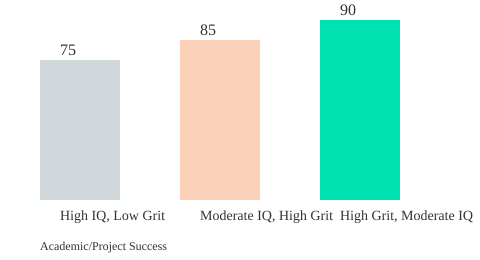
In this invented example, Student A (IQ 110, Grit 5/10) averages a grade of 75. Student B (IQ 95, Grit 10/10) averages 85. The message? Small wins goal gradients and steady effort matter more than being a “natural.” The importance of persistence over talent isn’t just a motivational slogan—it’s how results are built, one step at a time.
Creative Success and Unconventional Methods: The Podcaster Scenario
Let’s make it real. Imagine two podcasters start on the same day. One is obsessed with polish and perfection, releasing only a handful of “flawless” episodes each year. The other ships an episode every week, even if some are rough around the edges. Fast forward five years: the consistent podcaster has 250+ episodes, a loyal audience, and a library of small wins. The perfectionist? Maybe 10 episodes, still waiting for the “right” moment. In the real world, creative success often rewards those who show up, not just those who shine.
Overcome the Perfectionist Mindset—Keep Showing Up
You don’t need to be the most talented person in the room. You need to be the one who doesn’t quit. If your talent feels like a five out of ten, work on it—but crank your consistency to a ten. Over time, you’ll outpace the “naturally gifted” who step back. The importance of persistence over talent is this: the average person who keeps going will break down the barriers that stop perfectionists and “geniuses” alike.
Persistence beats talent and talented quitters. – Jay Shetty
Flip the Script: Mindfulness, Mistake-Friendly Growth, and ‘Affect Labeling’
Mindfulness and Mental Health: Your Launch Pad, Not a Trap Door
Where you are right now isn’t a trap—it’s a launch pad. The story you tell yourself about being “stuck” is just that: a story. Jay Shetty reminds us, “You’re not stuck, you’re stabilizing. That’s a part of growth.” Mindfulness is the practice of noticing your thoughts and feelings without judgment. When you pause and become aware, you realize you’re not failing—you’re getting feedback. This is how you build mental health and resilience, not by avoiding discomfort, but by meeting it with curiosity and self-compassion.
Affect Labeling Clarity Control: Name It to Tame It
Ever felt overwhelmed but couldn’t put your finger on why? That’s where affect labeling comes in—a sneaky, science-backed way to wrestle worries. Affect labeling means simply naming your emotions: “I’m frustrated,” “I feel anxious,” or “I’m disappointed.” Research shows that this simple act can calm the brain’s emotional centers and increase clarity and control. It’s like shining a flashlight into a dark room—suddenly, the monsters aren’t so scary.
- Pause when you feel a wave of emotion.
- Name what you’re feeling, out loud or in your head.
- Notice how naming it gives you a sense of clarity and control.
This is mindfulness in action, and it’s a powerful tool for mental health and emotional regulation.
Making Peace with Mistakes: Mistake-Friendly Growth
Perfectionism tells you that mistakes are disasters. But the truth? Embracing small losses and failures makes you more resilient—not fragile. Jay Shetty puts it simply:
“Embracing mistakes and fostering self-compassion frees you from the perfectionism trap.”When you burn dinner, notice the frustration. Say, “I’m annoyed.” Then, let it go instead of spiraling. Each mistake is feedback, not a final verdict. This is how you make peace with career plateaus and setbacks—by seeing them as part of your growth, not proof of inadequacy.
Taking Breaks and Burnout Prevention: The Dopamine Reset
Trying to power through without rest leads straight to burnout. But taking short, mindful breaks isn’t laziness—it’s science. Studies show that taking breaks during tasks helps balance dopamine, the brain’s motivation chemical, and prevents burnout. Even a quick walk, a stretch, or a few deep breaths can reset your mind and boost progress sustainability. These pauses are where growth often happens, especially when you’re not “winning.”
- Set a timer for focused work, then take a 5-minute break.
- During your break, breathe deeply or step outside—no screens.
- Notice how your energy and clarity return.
Making Peace with Career Plateaus: Growth in the Quiet Moments
It’s easy to dread plateaus, but Jay Shetty’s advice is to make peace with them. Growth doesn’t always look like a highlight reel. Sometimes, it’s quiet, slow, and invisible. Plateaus are not proof you’re failing—they’re where your roots grow deeper. Mindfulness and self-compassion help you see these moments as necessary, not negative. Remember: Persistence beats talent when talent quits.
Quick-Hit Mindfulness Habits for Everyday Progress
- Breathing: Take three slow, deep breaths before starting a new task.
- Affect Labeling: Name your emotion when you feel stuck or overwhelmed.
- Pausing: Insert a short pause between finishing one task and starting another.
These micro-habits build self-compassion and make achievable goals feel within reach. They’re the small steps that help you outrun perfectionism, one mindful moment at a time.
FAQ: Real Answers for Real (Stubborn) Stuckness
How do I know the difference between ‘stuck’ and ‘stabilizing’?
It’s easy to tell yourself that you’re stuck, but what if you’re actually stabilizing? Jay Shetty reminds us that where you are right now is a launch pad, not a trap door. When you feel like you’re not moving, it doesn’t mean you’re failing—it means you’re gathering feedback, learning, and getting ready for your next move. Overcoming perfectionism strategies start with reframing your story: instead of “I’m stuck,” try “I’m stabilizing.” This small shift is the first step in the practice focus process—noticing your growth, not your lack of movement. Remember, you’re not broken. You’re building your foundation.
Can physical movement really help with anxiety or lack of motivation?
Absolutely. Science—and Jay Shetty quotes insights—show that when your mind is spinning, your body can reset it. Movement activates your brain’s default mode network, which helps solve problems and calm mental noise. If you’re overwhelmed, don’t wait for motivation to strike. Go for a walk, fold laundry, or do a few stretches. These simple actions break the brain loop of overthinking. Action creates motivation techniques work because even pointless physical movement can shift your mindset and help you see new possibilities. When your mind is stuck, move your body. When your body is stuck, move your mind.
What if I’m just not ready—am I doomed to fail?
Feeling unready is not a sign you’ll fail; it’s a sign you’re human. The truth is, no one ever feels totally ready. Jay Shetty says,
“The right time is a feeling that shows up after you start, not before.”The best time to plant a tree was 20 years ago. The next best time is now. Overcoming perfectionism strategies mean starting before you feel safe or certain. Experience, not endless preparation, builds confidence. The practice focus process is about doing, not waiting. Take one small step today—send the email, record the draft, or fill out the form. Readiness is not a requirement; it’s a result.
How do I handle critics or doubters when I finally start?
Critics and doubters are part of the journey. When you begin, people will question your choices. But remember: the people ahead of you aren’t necessarily better—they just started earlier. Jay Shetty quotes insights remind us that persistence beats talent and talented quitters. Those who keep going, even when criticized, are the ones who break through. Let your consistency speak louder than your critics. The only way to silence doubt is through action and repetition. Every time you show up, you prove to yourself that you belong here.
Is there a way to break the perfectionism cycle for good?
Yes, but it’s not about a one-time fix. It’s about repetition of small steps and reframes. Perfectionism thrives on all-or-nothing thinking. The antidote is to start messy, start small, and keep moving. Action creates motivation techniques show that momentum comes from doing, not waiting for perfect conditions. The first thing you make won’t be great—and that’s okay. The practice focus process is about progress, not perfection. Each imperfect action chips away at the cycle and builds your confidence over time.
Any quick hacks for staying consistent when motivation disappears?
Consistency is built on tiny, repeatable actions. Set a timer for five minutes and just begin. Don’t aim to finish; aim to start. When motivation fades, let momentum carry you. Remember the Zeigarnik Effect: your brain wants to finish what you start. Overcoming perfectionism strategies mean lowering the bar for action, not for your dreams. Show up, even when you don’t feel like it. That’s how you build a habit of movement, not waiting. The more you practice, the easier it gets—and the less you’ll rely on fleeting motivation.
In the end, the real answer for stubborn stuckness is simple: stop waiting, start moving. You don’t need to be perfect, ready, or motivated. You just need to begin. Your launch pad is right beneath your feet.
TL;DR: It’s perfectly normal to feel stuck, but you’re never actually standing still. Cut the perfectionist scripts, start small (and messy), and let movement—mental or physical—spark real change. Waiting for the right time is the greatest myth; begin now, however awkward, and watch momentum do its thing.
Post a Comment