

Sometimes the biggest breakthrough starts with the simple realization that most of the world isn’t rooting for your wildest goals. That realization hit me in my early twenties, sitting in a crowded coffee shop, listening to 'helpful' friends explain why leaving my steady job would be a disaster. I’d internalized everyone’s advice—parents, classmates, coworkers. But while their voices were loud, my own was getting lost. It turns out, as Alex Hormozi argues, tuning out the herd is where transformation begins. This post dives into the messy, human-side of breaking away, pushing limits, and why a little bit of extremism might be exactly what you need to thrive.
Ignore the Opinions of the Crowd: The Unseen Costs and Benefits
One of Alex Hormozi’s boldest lessons on overcoming criticism and negativity is simple: stop caring about what other people think of you. If you’re aiming for radical success, the opinions of the average crowd are often just noise—sometimes even obstacles. Hormozi, founder of Acquisition.com, whose portfolio companies generated over $250M in revenue last year, learned this the hard way. He lost friends, faced family disapproval, and endured criticism from people who didn’t understand his path. Yet, these personal costs are often the price of an unconventional career and true growth.
Why Average Advice Is Often Just Noise
Most people around you—friends, family, acquaintances—will offer advice based on their own comfort zones, not your aspirations. Hormozi puts it bluntly:
“If you don’t want someone’s life, don’t take their advice.”The truth is, richer people won’t judge you for saving money, and fitter people won’t criticize your healthy habits. It’s usually those who aren’t moving forward who have the most to say. Their criticism is less about your choices and more about their own insecurities.
Personal Costs: Skipping Major Social Events for Bigger Goals
Choosing your own path often means making tough decisions, like skipping important social events. Hormozi shares that he missed two close friends’ weddings due to COVID, yet those friendships remained strong. Personally, I once missed a close cousin’s wedding to hit a business milestone—and we’re still close. These moments force you to see the difference between real friendship vs acquaintances. Real friends understand your journey and support your growth, even if you break the ‘norm’. Acquaintances, on the other hand, may only value your presence at their events, not your progress.
Real Friends vs. Acquaintances: Who Stays When You Break the ‘Norm’?
Hormozi points out that most people have only two real friends; the rest are acquaintances. When you start making bold moves, acquaintances may fall away, but true friends stick around. If a friendship ends because you missed a party or a wedding, it was likely never that deep to begin with. As Hormozi says, “If your friendship is lost, a lifetime of friendship is lost over your attendance over a party, then it’s probably not a friendship worth keeping.”
How Strangers’ Criticism Signals You’re Growing
When you step off the well-trodden path, criticism from strangers and even family can intensify. But this is often a sign you’re on the right track. Hormozi reframes it:
“You do not live in a way that I would prefer. That’s all it is.”Their negativity is just a reflection of their own discomfort with change. In fact, persistent criticism from people who aren’t where you want to be is a leading indicator that you’re growing beyond your current environment.
Social Pressure vs. Your Inner Compass
Social and family expectations can feel warm and comforting in the short term, but they can be stifling in the long run. Hormozi’s own story—leaving a prestigious consulting job that made his father proud—shows that approval can keep you stuck on a path that isn’t yours. Wrestling with these expectations is part of the journey. The key is to focus on voices aligned with your goals, even if that means consuming content from mentors you’ve never met, rather than those physically closest to you.
Types of Criticism: Who Should You Listen To?
Not all criticism is equal. Use the table below to evaluate the advice you receive:
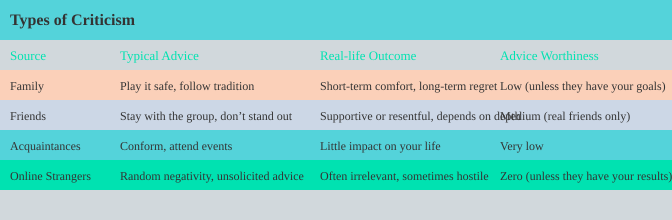
Remember, ignoring irrelevant opinions is a prerequisite for personal growth. Focus on those who have achieved what you want, not just those who are nearby. As you rewire your mindset, you’ll find that the real costs—lost approval, strained relationships—are outweighed by the benefits of living life on your own terms.
Why Extreme Commitment Yields Extraordinary Results: The Science (and Struggle) of Going All-In
If you’ve ever been called “unbalanced” or “too intense,” you’re not alone. In fact, as Alex Hormozi puts it, “Extreme people get extreme results.” The world often labels high achievers as obsessive or unstable, but science and real-world data show that obsessive commitment is not just a quirk—it’s a requirement for extraordinary results. Let’s break down why going all-in is essential, the trade-offs you’ll face (especially in your 20s), and why the struggle is not only normal, but necessary.
Most People Who Call You ‘Unbalanced’ Prefer Mediocrity to Mastery
From a young age, Alex Hormozi was told by his father to seek “balance.” But as Alex shares, those who obsess over balance often end up mediocre at everything. The truth is, society values conformity and comfort. When you push beyond the norm—working late, skipping parties, or focusing relentlessly on your goals—people may criticize you. But this criticism is often a reflection of their own comfort with mediocrity, not a sign you’re on the wrong path.
Statistical Reality: Million-Dollar Goals Are 1-in-200, Not 1-in-100
If your goals are extraordinary, your actions must be too. Consider the data:
| Income Level | Percentile in US | Odds |
|---|---|---|
| $600,000/year | Top 1% | 1 in 100 |
| $1,000,000/year | Above Top 1% | 1 in 200–300 |
Want to make $1 million a year? That’s not a 1-in-100 shot. It’s more like 1-in-200 or 1-in-300. If you behave like the 299, you’ll get their results. Extreme commitment is the only way to stand out.
Personal Example: Burning the Career Bridge—Alex’s Hardest Decision
Hormozi’s journey wasn’t easy. He describes being told his whole life that he was “too extreme” and “too obsessive.” He had to fight to stay true to himself, even when it meant burning bridges and facing uncertainty. For many high achievers, the path to radical success means making decisions that others see as reckless—quitting stable jobs, moving cities, or working through weekends and holidays. These are the trade-offs in your 20s that most people aren’t willing to make.
Trade-Offs in Your 20s: Social Currency vs. Hustling Alone
- Missing weddings, parties, and vacations
- Working weekends while friends relax
- Choosing growth over comfort, even if it means loneliness
These sacrifices are real. Building resilience through hardship and embracing loneliness in the pursuit of success are part of the price for extraordinary results.
Obsessiveness Isn’t a Bug—It’s a Feature for the Ambitious
There’s a direct correlation between obsessive commitment and above-average achievement. Research shows that high achievers often display “productive obsessions”—a relentless focus that outsiders may misunderstand. The world rewards extremity but punishes difference. As Hormozi says, “If you want something, you have to go get it. The world will try to drag you down.”
Entropy Is Real: The World Rewards Extremity but Punishes Difference
Society tries to dilute your ambition, pushing you to fit in. But if your goals are rare, your actions must be rare, too. Many will question your sanity, and you’ll face periods of doubt and loneliness. But remember: “We’re the result of our actions, not our aspirations.” Most people have similar dreams, but few match them with extreme commitment.
Extreme people get extreme results. – Alex Hormozi
If you want something, you have to go get it. The world will try to drag you down. – Alex Hormozi
The science and struggle of going all-in show that the path to radical success is paved with unbalanced effort, misunderstood habits, and the willingness to be different. If you want extraordinary results, you must embrace the extraordinary commitment—and all the trade-offs that come with it.
Raising Your Standards: Reprogramming What’s Possible
One of the boldest mindset shifts for success, as Alex Hormozi teaches, is raising your standards for personal growth. This isn’t just about expecting more from yourself—it’s about fundamentally questioning what you believe is possible. As Alex puts it, “We live inside of prisons of our own making based on our belief system.” Most of these limits aren’t real; they’re inherited from family, society, or peers. To achieve radical success, you must rewire these beliefs and consciously set new, higher standards.
Belief Systems: The Invisible Prison
Your belief system is the foundation for every decision you make. But here’s the catch: most of your beliefs are not your own. They’re handed down by parents, teachers, friends, and the culture around you. Rarely do we stop to challenge these beliefs, even though they quietly dictate what we think is possible. Alex highlights that, “almost none of our beliefs are our own. They’re not yours. They’re someone else’s.”
| Type of Belief | Percentage |
|---|---|
| Inherited (Family, Society, Peers) | 80% |
| Consciously Chosen | 20% |
When you realize this, you see how much room there is for personal development concepts to take root. By intentionally questioning and reconstructing your beliefs, you unlock new levels of possibility.
Proximity to High Achievers: The Shortcut to Raising Standards
One of the fastest ways to experience emerging discomfort growth is by surrounding yourself with people who have already shattered the limits you accept as normal. Alex’s network—ranging from MrBeast (Jimmy) to insights from Elon Musk’s biography—demonstrates how high performers operate on a different plane. They have what Alex calls a “level of unreasonableness around their goals and what they believe to be possible, that they just do not accept less.”
When you witness someone demand the impossible and then methodically break down every objection, it forces you to reconsider your own boundaries. This is how learning from high achievers expands your mental boundaries. Exposure to higher performers can rapidly shift your perceived limits, making what once seemed impossible feel like a new baseline.
Charlie Munger’s Wisdom: The Power of Overestimating Yourself
Charlie Munger famously said, “Never underestimate the man who overestimates himself.” While he recognized the risks of big egos and wild aspirations, he also admitted that these people tend to win. Alex echoes this, saying, “Many people who know me would consider me one of the most unreasonable people they have met.” It’s not about being combative—it’s about refusing to accept the limits others try to impose on you.
| Trait | High Performer | Average Person |
|---|---|---|
| Standard Setting | Self-imposed, Unreasonable | Inherited, Cautious |
| Response to “Impossible” | Breaks down barriers | Accepts limitations |
| Peer Perception | “Unreasonable” | “Realistic” |
The ‘One of Zero’ Concept: Becoming Your Own Category
Raising your standards isn’t just about doing more—it’s about becoming one of zero: a category of one, defined by your own self-imposed standards. This means standing alone, if necessary, and defending your vision against a sea of doubters. Alex describes how high performers will “take the brunt of the storm from the whole army” and still insist on their standard, only accepting physical impossibility as a reason to stop.
To put this into action, start by:
- Identifying beliefs you’ve inherited but never questioned.
- Seeking out and learning from high achievers to stretch your sense of what’s possible.
- Setting unreasonable standards for yourself and refusing to lower them, even when others push back.
Remember, raising expectations is a conscious process, and keeping them high takes effort. But this is the path to true personal growth and radical success.
Navigating the Emotional Fallout: Criticism, Risk, and the Loneliness Tax
Why Even Well-Meaning Friends and Family Root for Your Failure
When you step off the well-trodden path—whether it’s leaving a stable job, starting a business, or simply living differently—expect resistance. Alex Hormozi’s experience shows that overcoming criticism and negativity isn’t just about ignoring haters; it’s about understanding why they react this way. Often, even loved ones secretly hope you’ll stumble. Not out of malice, but as a defense of their own choices. If you succeed at something risky, it challenges their decision to play it safe. Your risk-taking becomes an unspoken critique of their risk aversion, especially from family. This is more about their fears than your path.
Hormozi puts it simply: people want you to fail because it reassures them that their way is right. When you choose an unconventional career, your actions can feel like a silent judgment to those who stuck with the norm. This interpersonal fallout isn’t a bug, but a feature, of meaningful change.
The Upside: Friction Clarifies What You Value
While it’s tough to face negativity, there’s an upside: friction with others forces you to clarify your values. When friends and family question your choices, it’s an opportunity to reflect on what matters most to you. Hormozi reframes criticism as a simple statement: “You do not live in a way that I would prefer.” Recognizing this helps you detach from their expectations and focus on your own goals.
Ask yourself: are you living for their approval, or for your own vision of success? Building resilience through hardship means learning to stand firm in your decisions, even when they’re unpopular.
Personal Costs: Missing Life Rituals Without Losing Real Friends
One of the personal costs of an unconventional career is missing out on traditional milestones—weddings, parties, reunions. Hormozi shares that he skipped many friends’ weddings in his 20s, not out of disrespect, but because he was focused on building his future. He even faced criticism online for this, but his perspective is clear:
“If your friendship is lost over your attendance at a party, it probably wasn’t a friendship worth keeping.” – Alex Hormozi
He recounts missing two major weddings due to COVID, yet those friendships remained strong. True friends don’t require your presence at every event; they understand your journey. If a relationship can’t survive your absence at a party, it’s likely not a real friendship.
Loneliness as a Test: Do You Want This Life Badly Enough?
The loneliness pursuit success brings is real. High achievers often accept loneliness as a cost of leadership. Hormozi describes how, as you grow, the importance of being at every event shrinks into irrelevance. Surviving loneliness and misunderstanding is the price of admission for radical progress. The question becomes: do you want this life badly enough to do it solo?
Risk Aversion from Loved Ones: Their Fears, Not Yours
When family or friends discourage you from taking risks, remember: their advice is shaped by their own anxieties. Navigating risk aversion family dynamics means recognizing that their fears are not your destiny. Their concern is real, but it doesn’t have to dictate your choices.
Quick Resilience-Building Exercises for When Doubt Creeps In
- Reframe Criticism: Translate every negative comment into “You live differently than I would.” This shrinks its power.
- Clarify Your Why: Write down why you’re on this path. Read it when you feel isolated.
- Audit Your Circle: List your true friends—the ones who support you, not just those who invite you to events.
- Practice Gratitude: Focus on what your choices have given you, not just what you’ve missed.
Trade-Offs Faced by High Achievers in Their 20s
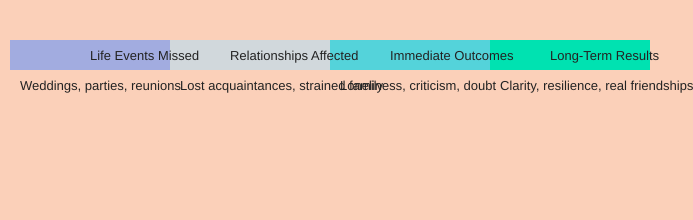
Building resilience through hardship and filtering true connections is not a sign you’re off-track—it’s proof you’re growing. The loneliness tax is real, but so is the payoff.
Determination vs. Intelligence: Why Sheer Will Usually Wins
Paul Graham’s Grid: 100 Points to Distribute Between Intelligence and Determination
Imagine you’re creating a character in a video game. You have 100 points to assign between two key attributes: intelligence and determination. This is the analogy Paul Graham, founder of Y Combinator, uses to explain a fundamental truth about success. You can choose to load up on intelligence or on determination—or try to balance both. But what happens when you push one to the max and let the other slide?
Why Infinite Intelligence with Low Drive Equals Inertia
Let’s say you put all your points into intelligence and leave determination at zero. On paper, you have a genius. But in reality, this person rarely takes action. As Alex Hormozi points out, “You have this very smart person who doesn’t do anything and convinces themselves that nothing will happen.” Intelligence without drive often leads to overthinking, hesitation, and ultimately, inaction. The smartest ideas in the world mean nothing if they stay locked in your head.
Case Studies: Alex’s Take vs. Conventional 'Balanced' Advice
Traditional advice says to balance your skills—be smart, but also work hard. Alex Hormozi, however, challenges this. He argues that value determination over intelligence is the real entrepreneur success strategy. In his own journey, Alex didn’t always have the best ideas or the most experience. What set him apart was his willingness to keep going when others quit. He doubled down on effort, not just cleverness. This is a key mindset shift for success: favoring doggedness over cleverness.
Why Determination Is Underrated—And the Rarest Currency in the Success Marketplace
In the world of startups and entrepreneurship, everyone talks about the next big idea or the genius founder. But if you look at who actually wins, it’s usually the person who refuses to give up. Determination is rare because it’s hard. It means facing risk, rejection, and repeated failure. But it’s also the trait that allows you to get back up, adapt, and keep moving forward. As Paul Graham puts it,
“Determination, even more than intelligence, is what makes people win.”
Mindset Shift: Favoring Doggedness Over Cleverness
If you want to succeed as an entrepreneur, you need to make a conscious mindset shift for success. Stop trying to be the smartest person in the room. Instead, be the one who outlasts everyone else. This is the heart of courage vs genius entrepreneurship. Courage means taking action even when you’re unsure, and sticking with it long after the excitement fades. Genius might open doors, but only grit gets you through them.
Tangent: The Video Game 'Character Build' Analogy for Life
Think back to that video game character. If you max out determination—even if your intelligence is average—you’ll still make progress. You’ll keep leveling up, learning from mistakes, and pushing through obstacles. But if you max out intelligence and leave determination low, your character stands still. In real life, this means that even great ideas need obsession and execution muscle to win. Determination compensates when intelligence falls short, but not vice versa.
Visualizing Success: Determination vs. Intelligence
If you were to chart this, you’d see that as determination increases, so does your chance of success—often more than with intelligence alone. Imagine a bar chart:
| Determination (x-axis) | Intelligence (x-axis) | Success Rate (y-axis) |
|-----------------------|----------------------|----------------------|
| 100                   | 0                    | High                 |
| 0                     | 100                  | Low                  |
| 50                    | 50                   | Moderate             |
The data is clear: 100/100 determination wins more often than 100/100 intelligence.
In the end, if you want to master entrepreneur success strategies, remember that determination is the rarest—and most valuable—currency in the success marketplace.
Bonus: Two Wild Cards – Visual Lessons from Alex’s Journey
Table: Sources of Criticism vs. Their Impact—Who Should You Really Listen To?
One of the most powerful mindset shifts for success is learning to filter feedback. Alex Hormozi’s journey is a masterclass in overcoming criticism and negativity. He learned to separate noise from signal by asking: Who is this advice coming from? Use the table below to visualize your own support and resistance networks:
| Source of Criticism | Typical Impact | Should You Listen? |
|---|---|---|
| People not pursuing your goals | Discouragement, self-doubt | No – They project their limits onto you |
| Peers stuck in comfort zones | Pressure to conform, fear of standing out | No – Their advice keeps you average |
| High achievers in your target field | Constructive, actionable insights | Yes – They understand the path |
| Online critics/strangers | Random negativity, little context | No – Irrelevant to your journey |
As Alex says, “If you don’t want someone’s life, don’t take their advice.” Visualizing who influences you—positively or negatively—empowers smarter decisions and helps you focus on voices that matter for your growth.
Chart: What’s Actually Scarce? – Mapping Ambition Levels to Prevalence
Extreme commitment leads to extraordinary results, but how rare are your goals, really? Most people underestimate the scarcity of true ambition and effort. Here’s a simple chart to illustrate:
| Ambition Level | Population Prevalence | Example |
|---|---|---|
| Average (status quo) | ~80% | Steady job, minimal risk |
| Above Average | ~15% | Small business, side hustle |
| Top 1% | 1% | $600k/year income (US) |
| Top 0.3% | 0.3% | $1M+/year income (US) |
Alex’s point is clear: “If you behave like the 299, you’ll never become the 1.” If your goals are rare, your actions must be rare, too. Getting comfortable with being ‘extreme’ is the shortcut to outcomes you can’t otherwise reach.
Quick-Hit: ‘One of Zero’ vs. ‘One in a Million’—How to Become Incomparable
Most people aim to be “one in a million.” Alex’s wild card lesson: become “one of zero.” That means building a life, skillset, or business so unique that comparisons don’t even apply. This is the essence of extreme commitment for extraordinary results—and it’s only possible if you ignore conventional limits.
Imaginary Scenario: What If Alex Had Listened to ‘Balanced’ Advice?
Imagine if Alex had followed the advice to “stay balanced,” keep his consulting job, and never risk rejection. He’d have missed out on building a $250M+ portfolio, and the world would have lost a powerful example of the importance of high achievers. Conventional ‘balance’ would have meant a radically different—and likely less fulfilling—life.
Personal Reflection: How My Own Career Detours Led to Unlikely Opportunities
Reflecting on my own path, the biggest breakthroughs came after ignoring well-meaning but limiting advice. Like Alex, I found that the people urging caution were rarely those living the life I wanted. Each detour—each “unbalanced” leap—opened doors I didn’t know existed. Visualizing who’s in your corner (and who isn’t) can help you make bolder, better choices.
“If you behave like the 299, you’ll never become the 1.” – Paraphrased from Alex Hormozi
Use these visual lessons to reassess your own journey. Who are you listening to? How rare are your ambitions? And are you willing to be ‘extreme’ enough to become incomparable?
Conclusion: Turning Down the World’s Volume to Amplify Your Own
If you’ve made it this far, you already sense the truth: the world’s noise is a distraction, not a guide. Alex Hormozi’s journey is a powerful case study in the mindset shifts for success that matter most—those that come from within, not from the herd. The consensus of the crowd is overrated. Extremity, on the other hand, is the secret ingredient behind radical personal growth lessons and exceptional achievement. If you want more than average, you must do more than what’s expected. You must be willing to look unreasonable, obsessive, and even foolish to those who are content with comfort.
Hormozi’s story is a reminder that every step away from the crowd is a step toward your own voice. He left behind a prestigious consulting job, the approval of his family, and the comfort of old friendships to chase a vision that only he could see. The price? Criticism, misunderstanding, and loneliness. The reward? Ownership of his standards, and the freedom to define his own success. As Hormozi puts it,
“Why should I live my life the way you prefer? That makes no sense.”This is the heart of self-ownership: refusing to outsource your standards, your dreams, or your definition of success to anyone else.
Borrow less, invent more. The world will always offer you templates, but the most meaningful progress comes when you become the author of your own standards. Hormozi’s advice is clear—raise your standards for what’s possible, not just for yourself, but for everyone around you. This is self-love at its highest form: holding yourself to higher behavioral standards, even when it’s uncomfortable, even when no one is watching or cheering. True self-love is not about easy comfort; it’s about demanding more from yourself than anyone else dares to.
Real freedom is not found in applause or validation. It comes from the quiet conviction that you are living on your own terms. The world’s approval is fickle and fleeting. What lasts is the grit to persist when the room is silent, to keep going when the only hands clapping are your own. Hormozi’s personal growth lessons teach us that the most important audience is the one in your own head. Every uncomfortable choice, every risk you take, is another line rewritten in the story of your future.
Overcoming fear is not about eliminating doubt, but about acting in spite of it. Hormozi’s lessons on courage and resilience remind us that the only way to build an extraordinary life is to accept the discomfort of standing out. You must be willing to look like an idiot, to fail in public, and to persist long after others have given up. This is how you build the “streak of unreasonableness” that separates the exceptional from the average.
Insulating yourself from the world’s noise is not selfish—it’s essential. The opinions that matter are those from people whose lives you would trade places with. Everyone else’s criticism is just static. As you move forward, ask yourself: Where will you draw your line in the sand? Will you choose boldness over comfort, invention over imitation, and self-ownership over applause?
The final call is simple: Go get it. Even if no one is clapping for you. Every uncomfortable choice you make is a vote for your future self. The world will always try to pull you back to the middle, but your job is to keep turning down its volume and amplifying your own. Success is not about being liked—it’s about being true to yourself, even when it means being the lone dissenter. That’s how you rewrite what’s possible, for yourself and for everyone who’s watching.
TL;DR: Alex Hormozi’s journey proves that escaping the gravitational pull of other people’s opinions and raising your personal standards—no matter the loneliness or discomfort involved—is how you unlock real freedom and success. Embrace the extremes, pick your influences carefully, and be bolder than feels reasonable.
Post a Comment