

Picture this: You’re standing at the edge of a rickety bridge, chasm below, alligators grinning. That's how chasing big dreams feels. I remember the first time I tried launching a side business in my 20s—naive, hopeful, ready for my overnight success. Instead, it was faceplants, fizzled ideas, and more awkward phone calls with my parents than I care to admit. But every flop stacked another brick on that bridge. The irony? The moment you look like an 'overnight success' to others is often the exact second you realize you’ve become an expert bricklayer in climbing out of failure. We're unpacking what it really takes: not a magic leap, but a deliberately weird path of risk-taking, grit, and tinkering with what actually works for you.
Section 1: The Bricklayer’s Secret—Why Overnight Success Is a Myth
Success Is Built Brick by Brick, Not in a Single Leap
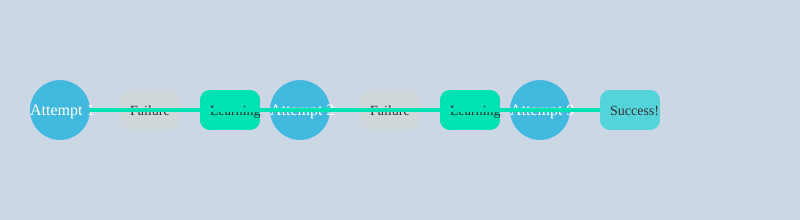
When you look at someone who seems to have achieved “overnight success,” it’s easy to imagine they simply leapt across the chasm between where they started and where they are now. But the truth is, success is rarely a single, dramatic jump. Instead, it’s much more like building a bridge—one brick at a time, failure by failure, lesson by lesson. Each attempt, whether it ends in triumph or setback, is another brick in your path. This is the real secret behind maximizing success and building skills early in your career.
The Illusion of Sudden Breakthroughs
It often feels like nothing is happening for a long time—then suddenly, everything works. But this is an illusion. The “overnight” part is just the moment when all your previous work, learning from failure, and persistence finally pay off. The process is linear and stepwise, even if the outcome looks binary from the outside.
Personal Journey: Nine Failures Before One Success
Let me share a personal story to illustrate this point. Before I found a business that truly worked, I had already failed nine times. That’s nine separate ventures that didn’t pan out. Each time, I thought maybe this would be the one. Each time, I faced the emotional sting of another setback—like falling into a pit of alligators or trying to cross a bridge over lava. But each failure brought with it a lesson, a new skill, or a fresh perspective. That’s the real value: every failure is a step forward, not a step back.
You never actually start from scratch ever again. Because every time after the first time you start from scratch, you start with an experience.
Life as an Infinite Game: Staying in the Arena
One of the most important mindsets you can adopt is to see life and your career as an infinite game. In a finite game, you play for a set amount of time, and then it’s over. But in an infinite game, the goal is to keep playing, keep learning, and keep growing. The point of business isn’t just to start a company—it’s to stay in business. The point of building skills early isn’t just to get a job—it’s to keep improving and adapting.
Learning from Failure: Your Most Valuable Asset
Every failed attempt is a chance to learn and increase your optionality in your career. The more you try, the more you learn, and the more options you create for yourself in the future. You never truly go back to zero, because you always carry your accumulated experience forward. This is why failing gracefully is so important—it allows you to keep moving, keep stacking bricks, and keep building your bridge to success.
Facing the Chasm: The Emotional Side of Setbacks
It’s natural to feel fear when you’re staring at the gap between where you are and where you want to be. The risks feel real—like alligator pits and lava flows. But the only way across is to keep laying bricks, even when you fall. Each time you get up and try again, you’re stronger and wiser than before. The only real failure is giving up on the process.
Stacking Asymmetric Bets: Take More Shots When the Downside Is Low
Especially early in your career, your downside is limited. You have little to lose and everything to gain. This is the best time to take asymmetric bets—risks where the potential upside far outweighs the downside. Each attempt is like a lottery ticket: if you don’t win, you’re not worse off, but if you do, the payoff can be huge. The more shots you take, the more likely you are to hit something big.
Section 2: Asymmetric Bets—Stacking the Odds in Your Favor
Why Your 20s Are Prime Time for Taking Risks
If you’re in your 20s, you’re in a unique position to make what are called asymmetric bets. These are opportunities where the downside is minimal—often just your time or a little money—while the upside could be life-changing. As the saying goes, “If you're under 30, you have no reason not to go 100% all in on your goals. The downside is nothing, and the upside is everything.” When you have little to lose, you can afford to take more shots than anyone else. The real risk isn’t failure—it’s not trying enough times.
Life’s Lottery Tickets: Scratch Off as Many as Possible
Think of your early career as a series of lottery tickets. Each new project, job, or business idea is a scratch-off. Most won’t win big, but the cost of losing is low. If you don’t win, you’re out a little time or effort. But if you do, the reward can be massive. The more tickets you scratch, the higher your chances of hitting something meaningful. This is the essence of optionality through risk: by taking more shots, you open doors that would otherwise stay closed.
Understanding Asymmetric Bets: Small Risks, Massive Rewards
An asymmetric bet is a chance where your potential loss is capped, but your potential gain is huge. For example:
- Starting a side business while working a day job
- Pitching a bold idea at work
- Learning a high-value skill in your spare time
Failure Is Learning, Not Loss
Most people are held back not by real risk, but by the fear of judgment. We worry about what others will think if we fail. But the truth is, most of those people won’t even be in your life years from now. What matters is that every attempt, win or lose, builds your skills and confidence. The only way to pay off your “ignorance debt”—the cost of not knowing what you need to know—is by being willing to fail, look bad, and try again.
Mentally Reframing Risk: Focus on Upside and Learning
To stack the odds in your favor, reframe how you see risk. Instead of focusing on what you might lose, look at what you could gain or learn. Each attempt is a step forward, not a setback. The process of becoming an “overnight success” is really about showing up, failing, and improving over and over. Success is built brick by brick, not in one giant leap.
Practical Tips for Making Asymmetric Bets
- Take more shots: The more you try, the more you learn and the higher your odds of a big win.
- Focus on one thing: Don’t spread yourself too thin. Excellence comes from depth, not breadth.
- Ignore the crowd: Don’t let fear of judgment stop you from taking risks that matter.
- Accept boredom: Consistency and repetition are key, even when they aren’t exciting.
- Trade wisely: Every hour spent on distractions is an hour not invested in your future.
Comparing Bet Types: Downside vs. Upside
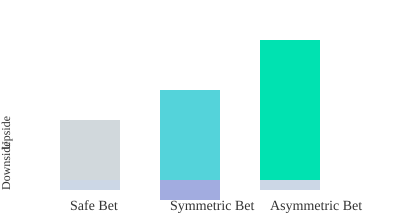
The chart above shows how asymmetric bets offer limited downside (small loss) but massive upside (large gain), compared to safe or symmetric bets. This is why taking risks early in your career can create meaningful upside and give you more options for the future.
Section 3: Passion’s Bait-and-Switch—Why Skill Beats Enthusiasm
Passion vs. Competence: Why “Follow Your Passion” Is Misleading
You’ve probably heard the advice, “Follow your passion.” It sounds inspiring, but it can set you up for disappointment. The truth is, passion is vague and ever-changing. What excites you in your twenties might not matter to you in your forties. If you build your entire career around a fleeting interest, you risk feeling lost when your passion shifts. Instead, it’s far more effective to focus on building competence—because skill compounds over time, while passion often fades or changes direction.
Competence Usually Breeds Passion, Not the Other Way Around
Here’s a crucial insight:
“Passion usually then comes from competence, not creates competence.”Most people believe that loving something will make them good at it. In reality, you tend to love what you’re good at. When you develop a skill and start seeing results, enjoyment follows. Think about it: you might enjoy playing the guitar, but you’ll love it even more once you can play your favorite songs effortlessly. That satisfaction comes from mastery, not just enthusiasm.
Story: Practical Advice from a Father—Making Money vs. Chasing Passions
Consider this story: The speaker’s father once said, “If I were following my passion, I’d be a bartender at a ski slope. If you can just make money, the rest of your life, you can do whatever you want.” This advice highlights a key point in navigating career choices: making money reliably gives you freedom and options. Chasing a passion that doesn’t pay the bills can limit your future, while building valuable skills opens doors.
Building Competence: The Monotony Before the Reward
Getting good at anything worthwhile is often boring and repetitive. You might love the idea of playing ping-pong, but are you willing to hit 500 forehands and 500 backhands every morning and night? Building competence means slogging through monotony before you reach the rewarding part. This is where most people give up—because it doesn’t feel passionate at first. But if you stick with it, your skill grows, and so does your enjoyment.
Focus on Monetizable Skills, Not Fleeting Interests
Enjoying something doesn’t guarantee you’ll be good at it, or that you can make a living from it. The market rewards value, not just enthusiasm. If you want to make an impact and create real options for your future, focus on skills that others already pay for. This approach gives you a higher chance of success and the freedom to pursue your interests later.
Bet on What You’re Good At—and What People Value
When you stack asymmetric bets, you want to place them on things where you have an edge. That edge comes from competence, not just excitement. Ask yourself:
- What am I already good at?
- Do people pay for this skill?
- Can I get even better with practice?
Data: Passions Change—Skills Compound
| Age | Common Passions | Reality Check |
|---|---|---|
| 20s | Travel, music, adventure | Often not monetizable; interests shift |
| 30s | Career growth, stability, family | Skills become more valuable |
| 40s+ | Health, legacy, freedom | Financial security enables choice |
| Example: Speaker’s father—could have been a ski bartender, but chose to build skills and income for lasting freedom. | ||
Key Takeaways: Navigating Career Choices with Competence
- “Follow your passion” is misleading—passion changes, but skill compounds.
- Competence usually breeds passion, not the other way around.
- Making money opens options; following pure passion can limit your future.
- Repetitive, hard work is necessary to build skill—not always enjoyable, but always valuable.
- Focus on monetizable skills that others value for real impact and freedom.
Section 4: Monotasking for Mavericks—The One-Thing Rule
Why Dabbling Spreads You Thin
When it comes to career development and maximising success, there’s a common trap: trying to do too much at once. Many people believe that juggling multiple projects, businesses, or skills will increase their odds of winning big. In reality, dabbling in too many things only spreads your energy, focus, and resources thin. Excellence requires obsessive focus on one pursuit. If you want to build skills early and stand out, you need to focus on one thing and go all in.
The Cost of Multitasking: A Personal Anecdote
Let’s look at a real-world example. Imagine running six businesses at once: a chiropractor agency, a dental agency, a gym turnaround business, and five gyms of your own. That’s exactly what I did early in my entrepreneurial journey. On paper, it sounded impressive. I could tell people I was a CEO with multiple companies. But here’s the truth: I was stressed out of my mind, constantly overwhelmed, and none of those businesses were outstanding. I had lots of things that generated revenue, but I didn’t make any real money. The only thing that grew was my ego—not my bank account.
As I later realized, “You have to focus. And it’s arrogant to think that you could do multiple things at once and beat someone who does one thing with all their effort.” The breakthrough came only after I cut everything else and focused on a singular vision. That’s when momentum, success, and profit finally followed.
| Scenario | Outcome |
|---|---|
| 6 businesses run simultaneously (pre-success) | High stress, thin effort, no outstanding results, ego win only |
| Cut down to 1 business (post-focus) | Momentum, success, profit, deep growth |
The One-Thing Rule: The Hardest, Most Valuable Move
The hardest—and most valuable—move in your career is to cut everything but one thing. This is the essence of the One-Thing Rule. It’s not about being busy or having a flashy list of projects. It’s about going deep, not wide. When you commit to one pursuit, you become unique and “hard to beat.” You build a reputation for excellence, not for being average at many things.
If you want to impress the right people—those who matter in your industry or network—become truly great at one thing. Consistency in taking asymmetric bets on your chosen path increases your chances of achieving exciting outcomes and building a strong network. People remember the person who’s the best at something, not the one who’s just okay at many things.
Imposter Syndrome and the Power of Honest Focus
Imposter syndrome often creeps in when you misrepresent scattered efforts as expertise. If you’re juggling multiple projects and pretending to be an expert in all of them, you’ll always feel like a fraud. But when you align your image with honest, deep skill in one area, that feeling fades. You become confident because your results speak for themselves.
Ask yourself: Are you impressing the right people? Are you building real value, or just feeding your ego? Thoughtful focus matters more than flashy busyness.
Going All In: How to Maximise Success
- Pick one thing that excites you and has the potential for asymmetric returns.
- Cut out distractions and competing projects.
- Dedicate your energy, learning, and resources to mastering that one thing.
- Let your results and reputation grow from deep, consistent effort.
Remember:
You have to focus. And it’s arrogant to think that you could do multiple things at once and beat someone who does one thing with all their effort.
Focus is the true differentiator. By cutting unprofitable distractions and going all in, you unlock deep growth and become the person who’s hard to beat.
Section 5: Networking vs. Working—Choosing the Right Season
Building a Network vs. Building Skills: Timing Is Everything
When you’re navigating career choices, it’s tempting to believe that building a network is the fastest way to success. You hear everywhere that “your network is your net worth.” But here’s a truth that’s often overlooked: networking and collaborating won’t substitute for focused, valuable work. The most successful people know when to say yes to new connections and when to say no so they can focus on building unique experiences and deep skills.
Explore Widely Early: The Power of Saying Yes
In the early stages of your career or creative journey, it’s smart to say yes to a lot. This is your exploration phase. Try different projects, meet new people, and experiment with side hustles. This is the time to make loose connections and gather a wide range of experiences. Sacrificing time for asymmetric opportunities—those with big potential upside and small downside—can lead to greater personal and professional growth. For example, taking on a small freelance project or collaborating on a startup idea could teach you more than any networking event ever could.
- Try many things to discover what excites you
- Meet people from different backgrounds
- Say yes to projects that stretch your abilities
Think of this as planting seeds. Some will grow, some won’t—but you’re learning what works for you.
Exploit Deeply Later: The Discipline of Saying No
Once you find your focus—your unique skill or lane—it’s time to shift gears. This is the exploitation phase. Here, you say no to most things so you can go deep and master your craft. ‘Winners isolate’ is a phrase worth remembering: real success comes from depth, not constant mingling. Your progress and results will open more doors than shaking hands ever will.
- Double down on your strengths
- Invest long hours in building skills
- Let your work speak for itself
As one expert put it:
The only way that people let you into circles that you don't deserve to be in is work ethic. There is no other way. It is the universal currency of respect across cultures, across time periods, across cohorts, across generations.
Networking Is Useful—But Only After You’ve Built Value
Many people confuse busy-building with value-creating. Attending endless events, collecting business cards, and chasing introductions can feel productive, but it rarely leads to real opportunities. The best networks form after you’ve created outsized value through focus and grind. When you have something unique to offer, people seek you out. Door-opening happens after results, not before.
- Your work ethic and results are your best calling cards
- People want to connect with those who have proven themselves
- Relentless work, not schmoozing, is the universal currency
Change Your Circle as Your Goals Change
As you grow, your reference group—friends, mentors, collaborators—should evolve too. Upgrading your references is more important than just expanding your network size. If you want to change your life trajectory, surround yourself with people who reflect your next level, not your past. It’s natural (and necessary) to shed old friendships or mentors as you evolve. This is part of the growth cycle and helps you stay aligned with your new ambitions.
Key Takeaways for Navigating Career Choices
- Explore widely and say yes early to build unique experiences and skills.
- Exploit deeply and say no later to master your chosen path.
- Focus on building skills and work ethic—these open more doors than networking alone.
- Upgrade your reference group as your goals change.
- Remember: relentless work ethic is the universal currency, not schmoozing.
Section 6: Money Loves Speed—Decision-Making in Action
In the pursuit to Maximise Success and capture Asymmetric Opportunities, one principle stands out: Money loves speed. This simple rule can transform how you approach decisions, especially when experimenting with new ideas or navigating your career. In fast-moving environments, opportunities are perishable. If you wait until you have every piece of information, you’ll often find that, as the saying goes, “By the time you have all the information, the opportunity is gone.”
Opportunities Are Perishable—Act Before the Window Closes
Every day, you encounter chances that could shift your trajectory—new projects, investments, collaborations, or creative experiments. These are classic asymmetric bets: the downside is limited, but the upside can be enormous. However, these windows don’t stay open forever. In competitive environments, the first movers are often the ones who reap the rewards. If you hesitate, someone else will seize the moment.
Fast, Imperfect Action Beats Endless Deliberation
It’s tempting to wait for certainty before acting. But in reality, certainty is a luxury you rarely have. The world changes quickly, and the cost of waiting is often higher than the cost of making a small mistake. This is especially true when you’re stacking asymmetric bets or experimenting with ideas. The key is to develop a bias for action—move quickly, learn from the outcome, and adjust as needed.
- Speed compounds advantages: Quick, iterative decisions build momentum and create a compounding effect over time.
- Analysis paralysis kills optionality: Overthinking leads to missed opportunities and stagnation.
- Lean startup mindset: Treat each decision as a small, rapid experiment. Test, learn, and iterate.
Fix Mistakes as You Go—If It’s Easy to Fix, Decide Fast
Here’s a practical rule: If a decision can be fixed quickly, make it fast. Ask yourself, “How long would it take to fix this if I’m wrong?” If the answer is minutes or hours, don’t waste days deliberating. For example, if deciding takes five minutes and fixing a mistake takes ten, act now. If you spend two hours agonizing, you’ve lost valuable time and possibly the opportunity itself.
“By the time you have all the information, the opportunity is gone.”
Procrastination is often riskier than making a small error and correcting course. In fact, the ability to fail gracefully—to make a mistake and quickly recover—is a superpower in fast-paced environments. This approach not only increases your chances of success but also builds resilience and optionality in your career.
Embrace Uncertainty—It’s the Job
Whether you’re launching a startup, building a creative career, or investing, uncertainty is the job. The most successful people are not those who avoid uncertainty, but those who become skilled at navigating it. Consistently taking asymmetric bets, even in the face of ambiguity, increases your odds of discovering outsized opportunities and building a strong network of collaborators and supporters.
- Estimate time-to-fix vs. time-to-decide: Use this as a guide for when to act quickly.
- Iterative decisions: Make small bets, learn, and adjust. This reduces risk and maximizes learning.
- Optionality in career: Fast decision-making opens more doors and keeps you agile as circumstances change.
Summary Table: When to Act Fast
| Situation | Time to Decide | Time to Fix | Recommended Action |
|---|---|---|---|
| Small project pivot | 5 minutes | 10 minutes | Act now |
| Major investment | 2 weeks | 6 months | Deliberate |
| New collaboration | 1 hour | 1 day | Act now |
Remember: Speed is your ally when stacking asymmetric bets and experimenting with ideas. The faster you move, the more opportunities you can capture—and the more you’ll learn along the way.
Section 7: Failing Forward—Making Every Loss Count
Learning to fail gracefully is the secret ingredient behind every remarkable career development story. If you want to build a legacy and make a real impact, you need to reframe failure—not as something to be feared or hidden, but as the essential tuition you pay for future success. Think of every setback as a brick in the bridge to your goals. Each time you fall short, you’re not starting over from scratch; you’re starting over with experience. This is the foundation for learning from failure and making every loss count.
Imagine success as a bridge spanning a dangerous chasm—alligators, lava, and all. Most people try to leap the gap in one go, hoping for that perfect opportunity. But in reality, you build the bridge one brick at a time, learning where each one holds and where it crumbles. Every failed attempt isn’t a debt you owe; it’s tuition paid for the education only real-world experience can provide. Over time, your failures compound into a sturdy path, and suddenly, what looked like “overnight success” is just the visible result of years of learning and refining your approach.
What if, instead of only celebrating wins, you celebrated ‘learning milestones’? What if your biggest applause came not from a successful launch, but from the lessons you extracted from a failed one? This mindset shift is powerful. Your history of failures becomes your greatest proof of resilience and adaptability. In fact, keeping a ‘failure journal’ for a year taught me more about progress than any ‘win list’ ever did. Each entry was a small victory—a record of risks taken, lessons learned, and bets refined. Looking back, I realized that my nine failed businesses weren’t wasted years; they were the foundation for the one that finally worked.
Building a legacy isn’t about avoiding mistakes—it’s about stacking asymmetric bets, learning from each misstep, and refusing to quit. The only real downside is giving up. As long as you stay in the arena, you’re always moving forward. Every time you try, fail, and try again, you’re investing in your own self-designed education. Each lost bet increases your base of experience, and that learning capital compounds quickly over time. Success isn’t linear; it’s a string of failures that, together, form the stepping stones to your authentic win.
Here’s a hypothetical: What if you only measured your progress by the number of new things you learned, not by the number of wins you racked up? You’d start to see failure as a feature, not a bug, of an ambitious career. You’d realize that documenting and embracing your losses is a mindset shift that pays off in the long run. Every setback would become a data point, a lesson, and a reason to refine your next bet—not a reason to quit betting altogether.
As you move forward, remember: you will be rewarded far more in life for your determination than your intelligence. The real winners are those who keep showing up, keep learning, and keep stacking their bets—even when the odds seem long. When you look back, your legacy will be built not on a spotless record, but on the courage to fail forward and make every loss count. So, keep your own failure journal, celebrate your learning milestones, and never stop building your bridge—one brick, one lesson, one bet at a time.
In the end, learning to fail gracefully isn’t just a skill—it’s the cornerstone of building a legacy that lasts. Every loss is a step forward, every setback is a lesson, and every bet—win or lose—brings you closer to outrageous success.
TL;DR: Real success (and that elusive 'overnight win') isn’t a single, heroic leap, but a wonky, sometimes embarrassing collection of attempts, each teaching you how to make better bets, focus deeper, and reframe failure as your best tutor. Stack your asymmetric bets and fail forward—there’s no downside to owning your journey.
Post a Comment