

You know that feeling when you walk into a room full of buzzing AI chatter, but somehow everyone’s stuck at the shallow end? I’ve been there—twenty years ago, tinkering with code nobody cared about. Today, I watch millions fumble with AI like it’s a vending machine, leaving the real secrets untouched. This isn’t another dry listicle. I’m sharing the real deal: how to leap past the 81% who think typing "fix my resume" is AI mastery. It’s weird, it’s hands-on, and you just might laugh (at me, or yourself). Ready to pick a side?
1. The Reality Check: Why Most AI Users Get It Wrong…and How You Won’t
Here’s a wild truth: 81% of AI users are missing the mark. That’s not just a random number—it’s the reality I’ve seen firsthand in over 20 years as a tech CEO, investor, and AI board member. And the gap between hobbyists and true AI masters? It’s getting wider, faster. As I often say,
"The gap between people who understand AI and those who don't is getting wider, faster."
Why Most AI Users Fumble: The Common Pitfalls
Most people treat generative AI—like ChatGPT, Gemini, or Claude—like a clever friend. They type in vague requests, expecting magic. But here’s the catch: AI doesn’t “understand” language like we do. It predicts the next word, much like Google’s autocomplete, using tokens, vectors, and embedding spaces. That’s why so many users get stuck.
Anecdote: When AI Poetry Goes Corporate
Let me share a quick story. I once watched someone ask ChatGPT to “write a heartfelt poem about love.” The result? A block of corporate gibberish—think mission statements with rhymes. Why? The prompt was fuzzy, lacking context and structure. This is the classic AI user pitfall: assuming AI “gets” you without clear direction.
Machine English: The Secret Language of AI Prompts
Here’s the game-changer: Learning to talk AI’s language—what I call “Machine English”. Most users chat with AI like it’s a person, but AI models like ChatGPT, Gemini, and Claude don’t “think.” They predict based on patterns in their training data. If you want results that stand out, you need to structure your prompts with clear context, intent, and step-by-step instructions.
- Context: Set the scene. Tell the AI what role it’s playing or what style you want.
- Structure: Break down your request into logical steps or bullet points.
- Intent: Be explicit about your goal and the outcome you expect.
Prediction vs. Understanding: How Generative AI “Thinks”
Generative AI doesn’t store answers. It doesn’t “know” facts. Instead, it predicts the next token in a sequence. That’s why context and structure beat luck every single time. When you master Machine English AI prompts, you leap ahead of the 81% who are still guessing.
Chart: AI User Mastery Levels
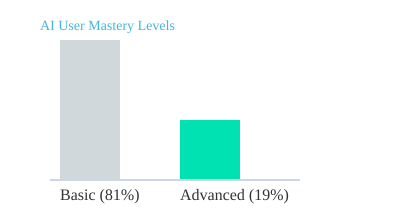
81% of AI users operate at a basic level due to common AI user pitfalls. Only 19% achieve advanced mastery by understanding Machine English and the mechanics of generative AI.
2. Week One: Speaking Fluid 'Machine English' (And Why AIM is Your Secret Weapon)
Stop Chatting, Start Engineering: The Rise of AI Prompt Engineering
If you want to outsmart 81% of AI users, it’s time to stop chatting and start engineering. The secret? Mastering AI prompt engineering—the art of giving AI clear, structured instructions. Think of AI like an improv actor with no script: it doesn’t store facts or memorize answers. Instead, it predicts what comes next based on context, just like Google’s autocomplete but with a twist. When you give it a vague prompt, you get vague, generic answers. But when you speak its language—what I call Machine English—you unlock wildly better results.
Meet AIM: The Framework for Contextual Prompts for AI
Here’s your AI mastery roadmap 2025 essential: the AIM framework. AIM stands for Actor, Input, Mission. This structure transforms how AI understands and responds to you. Research shows that using AIM can boost your results by 5-10x. Here’s how it works:
- Actor: Tell the AI who it should be (the persona or role).
- Input: Give it the context or data it needs.
- Mission: Specify exactly what you want it to do.
AI as an Improv Actor: Why Specifics Matter
Imagine AI as an improv actor. If you just say, “Fix my resume,” it has no script, no context, and no clear goal. The result? A generic, unhelpful answer. But if you set the stage with AIM, you get sharp, targeted, and actionable responses. As the saying goes:
'Only when you learn its language does AI finally start working for you.'
Try It Live: Rewriting the Classic Resume Prompt, AIM-Style
Let’s see AIM in action. Instead of typing:
Fix my resume.
Try this:
Hey ChatGPT, you are the world’s most sought-after resume editor and business writer. (Actor)

I’m attaching my resume and the job description for a senior product manager role at a fintech company. (Input)

Review it and give me a bullet list of 10 specific ideas to improve clarity and add measurable impact, aligned with the role. (Mission)
This contextual prompt for AI gives you a resume review that’s 5-10x more useful, specific, and actionable.
Your Practice Challenge: Write 3 AIM Prompts for Daily Life
- Draft an email to your boss as a professional executive assistant.
- Plan a weeknight dinner menu as a celebrity chef with your pantry list.
- Summarize a news article for a 10-year-old as a children’s educator.
With AIM, you’re not just talking to AI—you’re engineering results. Welcome to the new era of AI mastery.
3. One Model, Deep Dive: Why 'Playing the Field' Fails (The Guitar and Drummer Analogy)
If you want to master AI tools effectively in 2025, here’s a truth bomb: ‘AI tool hopping’ is a myth that holds you back. Most people start their AI journey by Googling the “Top 50 AI tools,” picking a handful, and skimming through each. It feels productive, but it’s a recipe for shallow learning and quick burnout. The real AI mastery roadmap? Go deep, not wide.
The Myth of 'AI Tool Hopping': Why Depth Beats Breadth
Jumping from one AI tool to another is like trying to play every instrument in a band at once. You’ll never find your rhythm. Instead, focus on learning one AI platform deeply. This approach is the secret behind the AI learning roadmap that outsmarts 81% of users.
Tale of Two Musicians: Drumming and Guitar
Think of learning AI like learning an instrument. There’s a fascinating study in Frontiers in Psychology showing that drummers pick up guitar faster than total beginners. Drumming isn’t about melody, and it uses different muscles, but the key skill—recognizing patterns and practicing with intent—transfers. I’ve lived this: after thousands of hours drumming, picking up guitar wasn’t easy, but it wasn’t foreign. My brain already knew how to practice and spot structure.
'The deeper you dig into one foundational model, the faster you will find the rhythm of all the others.'
How Learning One AI Platform Deeply Unlocks Faster Mastery of Others
When you immerse yourself in a single AI tool, you learn its strengths, quirks, and cadence. This deep familiarity trains your mind to recognize patterns and workflows that are common across platforms. Research shows that this kind of skill transfer accelerates your ability to pick up new tools later—just like a drummer learning guitar.
Analysis: ChatGPT, Gemini, Claude—Picking Your 'Instrument' Wisely
Which AI tool should you choose for your first deep dive?
- ChatGPT: The most mature and widely used—great for general tasks and creative work.
- Gemini: Ideal if you’re invested in Google’s ecosystem and want seamless integration.
- Claude: Best for business, project management, and advanced reasoning tasks.
Honestly, it matters less which you pick—what matters is that you stick with one for at least a week, exploring its personality, cadence, and limits.
Discovering Tool ‘Personalities’: Strengths, Cadence, Quirks
Every AI tool has its own ‘feel’—its rhythm, strengths, and weaknesses. Spend your first week immersed in one, and you’ll start to sense its unique patterns. This is the foundation of your AI mastery roadmap.
| AI Tool | Strengths | Best For | Quirks |
|---|---|---|---|
| ChatGPT | Conversational ability, creativity, broad knowledge | Writing, brainstorming, coding help | Sometimes verbose, needs clear prompts |
| Gemini | Google integration, search, data access | Research, productivity, Google apps | Prefers Google ecosystem, less creative |
| Claude | Business logic, project management, reasoning | Business workflows, analysis, summaries | May lack creative flair, formal tone |
4. Why Context is King: MAP Framework, Memory, and Making AI Actually Think
Let’s get real: even the world’s smartest AI can sound absolutely clueless if you don’t give it the right context. I learned this the hard way when my AI assistant once gave me a completely off-base answer to a simple question. Was it the AI’s fault? Not really—it was mine. I hadn’t fed it enough context. This is the secret sauce behind contextual prompts for AI and the heart of any effective AI learning roadmap.
“Context is the map that helps you navigate that space to tell AI where to look and what matters.”
Meet MAP: The Other Half of Great AI Prompt Engineering
To outsmart 81% of AI users, you need more than clever instructions. You need the MAP framework: Memory, Assets, Actions, Prompt. This is your toolkit for building depth, structure, and continuity in every AI conversation. Here’s how each piece works:
- Memory: This is your chat history, notes, or summaries you carry over between sessions. Want continuity? Start by copy-pasting previous threads or asking the AI to summarize before you continue. This creates a persistent context, making your AI smarter with every exchange.
- Assets: Assets aren’t just files—they’re any resources, links, data, or snippets you feed into the prompt. These ground the model in reality, letting it reference real facts, figures, or even your own writing style.
- Actions: Don’t let your AI just dream—let it do. Actions are tools the AI can use: searching the web, scanning your drive, writing code, or creating documents. The more you enable, the more powerful your AI strategy and implementation becomes.
- Prompt: This is the instruction itself. The richer your prompt, the better the AI’s reasoning and response.
How to Build ‘Memory’ in Chat: Continuity & Threading Sessions
Always bring relevant history into your session. If you’re switching topics or starting fresh, ask the AI to summarize what it “remembers” so you can paste that summary into your next prompt. This is a core skill in AI prompt engineering.
Assets: Feeding Reality Into AI
Don’t stop at files. Paste in tables, links, or even your own notes. The more grounded your assets, the better the AI’s output.
Actions: Letting the Model Execute
Modern AI isn’t just about text. Use plugins or integrations to let your AI search, code, or create docs. This turns your AI from a passive responder into an active assistant.
| MAP Element | Real-World Example | Best Practice | Pitfall | Pro Tip |
|---|---|---|---|---|
| Memory | Threaded chat for ongoing project | Summarize & paste history | Forgetting past context | Use AI to create session summaries |
| Assets | Upload data tables or style guides | Feed relevant data each session | Overloading with irrelevant info | Curate assets for each prompt |
| Actions | AI searches web for latest stats | Enable external tools | Relying only on static info | Integrate plugins for dynamic tasks |
| Prompt | Clear, specific instructions | Iterate and refine prompts | Vague or generic requests | Use examples to clarify intent |
5. Debug or Die: Iterating Like a Pro, Cheat Codes, and My Favorite AI Meltdowns
First Contact: My Daylong Battle with Early OpenAI Models
Let’s rewind to the pre-2020 era, before “AI prompt engineering techniques” were even a thing. My first encounter with an OpenAI model was a wild ride—an entire day spent wrestling with unpredictable, random outputs. I was frustrated, confused, and convinced the AI was broken. But here’s the twist: the real issue wasn’t the AI. It was my prompts and assumptions. Debugging AI outputs starts with debugging your own thinking.
“Prompting isn’t typing, it’s iterating.”
Debugging Isn’t Fixing AI—It’s Fixing Your Prompts
When you get a weak answer, don’t blame the model. Ask yourself:
- Did I set the right persona?
- Did I give enough context?
- Was my goal clear?
Sometimes, I even ask the AI, “Why did you choose that answer?” You’ll be surprised—AI can explain its logic, and that’s when the real learning begins. This is the heart of the AI mastery roadmap: treat every output as a mirror for your own clarity.
Iterative Patterns: The Three Cheat Codes
To level up your AI learning roadmap, use these three “cheat codes” for prompt debugging:
-
Chain-of-Thought: When answers seem off, say:
“Think step by step. Show your reasoning. Then give me the final concise answer.”This forces the AI to break down its logic. -
Verifier: Ask the AI:
“Ask me three questions to clarify my intent, one at a time. Then try again.”This helps the model (and you) get on the same page. -
Refinement: Prompt:
“Before answering, propose two sharper versions of my question. Ask which I prefer.”Now the AI helps you ask better questions.
| Debug Pattern | Usage Frequency (Expert Users) | Effectiveness |
|---|---|---|
| Chain-of-Thought | 68% | High for logic-heavy tasks |
| Verifier | 54% | Great for clarifying intent |
| Refinement | 47% | Best for question quality |
AI Meltdown Moments: When It’s (Probably) Your Fault
Every AI “meltdown” is a chance to learn. If the output is off the rails, it’s almost always because your prompt was fuzzy. Use the cheat codes above to force better logic and edge-case reasoning. Remember, you’re not just talking at AI—you’re in a feedback loop, learning how it “thinks.”
Wild Card: If AI Could Talk Back…
Imagine if AI could ask you: “What do you really want? Can you clarify your goal? Is there a better way to phrase your question?” That’s the spirit of expert-level iteration—debug, refine, and repeat until you’re not just using AI, but mastering it.
6. Steer Away From Average: Channel the Experts, Don’t Settle for AI 'Junk Food'
Let’s face it: most AI-generated content is bland, forgettable, and stuffed with buzzwords. Why? Because generic prompts create generic outputs. If your AI prompt is vague, you’re likely to get the AI equivalent of fast food—quick, easy, but not nourishing. To unlock real AI mastery in 2025, you need to practice expert steering in AI prompts and demand more from your AI tools.
Why Most AI Outputs Are Bland
When you ask a broad question like, “How do I make my team more innovative?” you’re sampling from the middle of the AI’s knowledge—where answers are safe, average, and overused. As one expert puts it:
'You direct the model away from the middle and toward the sharper edges of its brain.'
The AI’s “brain” is a sea of probabilities—some ideas are brilliant, some average, some just plain wrong. Your job is to steer toward brilliance.
Steering Prompts to Experts and Unique Frameworks
Instead of settling for AI 'junk food,' direct your prompts to reference real-world experts and frameworks. For example:
- “Explain how to make a team more innovative using ideas from Pixar’s Brain Trust, Satya Nadella’s strategy, and Harvard research.”
This approach pulls the AI from mediocrity into mastery, leveraging expert-driven and specific prompts for high-quality, non-generic output.
Case Study: Black Hole Research—Who Are the Real Experts?
Suppose you want to learn about black holes but don’t know where to start. Use this two-step method:
- Ask AI: “List the top experts, researchers, and current research papers on black holes.”
- Then prompt: “Using these experts and sources, synthesize an original framework that fills the current gap in black hole science.”
This method ensures your AI isn’t just echoing common knowledge but is channeling the latest thinking from real authorities.
Sharpen Responses: Instruct AI to Cite, Critique, and Compare
Want even better results? Ask AI to cite sources, critique viewpoints, and compare frameworks. This not only increases depth but also helps with AI verification methods—crucial for your AI mastery roadmap.
Prompt Specificity vs. Output Quality
| Prompt Specificity | Output Quality |
|---|---|
| Generic | Low (buzzwords, superficial) |
| Expert-driven | High (original, insightful, actionable) |
Data shows that prompt specificity correlates 5x with output quality and usefulness.
Testing Across AI Tools 2025: ChatGPT, Gemini, Claude
Try running the same expert-driven prompt across ChatGPT, Gemini, and Claude. Compare their outputs, cited sources, and depth. You’ll see how AI tools 2025 differ in versatility and quality—proof that steering matters.
7. Don’t Believe Everything: Build AI Outputs You Can Trust (Verification in Action)
Ever seen an AI confidently declare, “68% of Americans are getting divorced”? You know it’s not true, but here’s the kicker: AI will sound just as confident when it’s wrong as when it’s right. This is called AI confabulation—the model’s tendency to make up facts with a straight face. Because AI models are generative by design, making things up is part of their DNA. So, how do you outsmart the 81% of AI users who just take outputs at face value? You verify. Here’s your AI mastery roadmap for making every output defensible and reliable.
Five-Step AI Verification Methods
-
Assumptions: Ask and List
Start by asking the AI to list every assumption it made in its answer. For each, have it rank its confidence. This step exposes the hidden scaffolding behind the output and helps you spot shaky logic. -
Sources: Demand Evidence
For every major claim, ask for at least two independent sources. Request the title, URL, and a one-line quote for each. This makes it easy to cross-check and ensures you’re not just taking the AI’s word for it. -
Counter-Evidence: Push for Balance
Challenge the AI to find one credible source that disagrees with its answer. Ask it to explain the dependencies and context. This is where real reasoning and critical thinking emerge, helping you spot bias or overconfidence. -
Auditing: Show Your Work
Have the AI recompute every figure and show the math or code behind its answers. You’ll be surprised how often numbers change when you slow the process down and audit each step. This is crucial for improving AI response accuracy in critical scenarios. -
Cross-Model Verification: Compare and Critique
Run the same prompt through multiple models—like ChatGPT, Gemini, and Claude. Take the output from one and ask another to critique or verify it. This cross-examination is a powerful AI prompt engineering technique for detecting hallucinated or fabricated data.
Checklist: Making AI Outputs Defensible
- List and rank assumptions
- Require independent sources with citations
- Seek out counter-evidence
- Audit calculations and logic
- Cross-verify with other AI models
AI will sound just as confident when it’s wrong as when it’s right.
By following these AI verification methods, you’ll transform every AI output from a possible hallucination into a defensible, trustworthy answer—giving you a real edge in the world of AI mastery.
8. Add Your Own Flavor: The OCEAN Framework & Arguing With Your AI (Developing Taste)
By your fourth week on the AI learning roadmap, you’ll notice something: you’re no longer just pressing buttons and accepting whatever the machine spits out. Most people treat AI like a vending machine—choose a prompt, get the same bland, generic output, and move on. But if you want to outsmart 81% of AI users and truly master the art of transforming AI interactions, you need to add your own flavor. That’s where the OCEAN framework for AI content comes in.
Here’s the secret: the best AI outputs in 2025 won’t sound like a bot—they’ll sound like you. The OCEAN framework helps you turn generic responses into something personal, original, and unmistakably yours:
- O – Original: Is there a non-obvious idea in the output? If not, push your AI. Ask for three angles nobody else would think of. Tell it to label one as risky, and recommend its favorite. Don’t settle for LinkedIn-speak.
- C – Concrete: Are there names, examples, or numbers? If the answer is vague, demand specifics. “Back every claim with one real example.”
- E – Evident: Is the logic clear? Ask your AI to show its reasoning in three bullets, and provide evidence before it delivers a final answer.
- A – Assertive: Does the output take a real stance? If it’s wishy-washy, push it: “Pick a side. State your thesis. Defend it. Then address the best counterpoint.”
- N – Narrative: Does it flow like a story? Make your AI organize the response with a hook, insight, proof, and action. Guide the narrative, don’t just list facts.
Think of this as sparring practice.
'Treat AI like your sparring partner, argue with it, push back, sharpen your thinking, sharpen its thinking.'The more you debate, the more your AI learns your taste—and the more your results stand out from the crowd. This ongoing feedback loop is how you develop a unique voice with AI.
Here’s a wild card: Once, while prepping for a product launch, I challenged my AI’s bland suggestions. I argued, asked for riskier ideas, and demanded proof. The back-and-forth got heated (for a bot), but suddenly, it offered a bold angle I’d never considered. That insight became the hook for my campaign—and the results blew past my expectations.
Combining frameworks like OCEAN with iterative, argumentative practice is the key to AI mastery. Don’t let your outputs sound like everyone else’s LinkedIn post. Push, prod, and personalize until your AI sounds like you—because in 2025, that’s what real AI mastery looks like.
9. FAQ: Quirks, Troubles, and 2025’s Burning Questions
What’s the quickest way to jump from AI dabbler to top 10%?
To leapfrog the average AI user, you need to move beyond just writing prompts. Every prompt you write, every revision you push, every judgment you make—these are not just about training the model; you are training yourself. The fastest path on the AI mastery roadmap 2025 is to iterate relentlessly. Analyze your outputs, tweak your instructions, and reflect on what works. Don’t just accept the first answer—challenge the AI, and yourself, to do better. This habit alone will set you apart from 81% of users who never go past surface-level interactions.
Which model should I start with if I’m not technical?
If you’re new or non-technical, start with user-friendly models like ChatGPT or Claude. These platforms are designed for accessibility and have robust communities. They’re perfect for learning prompt basics and exploring frameworks like AIM, MAP, or OCEAN without needing to code. As you grow, you can explore more advanced models, but the complete AI learning roadmap always starts with mastering the basics.
How do I stop AI from making up facts?
This is a classic pitfall on any AI mastery roadmap 2025. AI models often “hallucinate” or invent information. To minimize this:
- Ask for sources or citations in your prompts.
- Double-check important facts with trusted external sources.
- Use fact-checking plugins or tools where available.
AI is coming, whether we like it or not. But critical verification is still your job.
Why do my outputs still sound boring even with frameworks?
Frameworks like AIM, MAP, and OCEAN are powerful, but they’re just starting points. If your outputs feel dull:
- Layer in creativity—ask for analogies, stories, or humor.
- Iterate: Revise your prompts and push for more engaging language.
- Combine frameworks for richer results (see below).
Can I combine frameworks (AIM, MAP, OCEAN) in the same project?
Absolutely! Many advanced users blend frameworks to cover more ground. For example, use AIM for structure, MAP for process, and OCEAN for personality. The best AI user pitfalls to avoid here are overcomplicating your prompts—start simple, then layer complexity as needed.
Are there risks to relying on AI too much in 2025?
Yes. Over-reliance can dull your own critical thinking and creativity. Always verify outputs, keep learning, and use AI as a tool—not a crutch. The complete AI learning roadmap is about balance: leverage AI’s speed, but never outsource your judgment.
10. Finale: Training You (Not Just Your AI) for the Human Revolution
Let’s get real: mastering AI isn’t just about learning prompts, plugins, or the latest tools. The true AI mastery roadmap is about training yourself—your mind, your habits, your sense of humor. Every time you tinker with a chatbot or automate a boring task, you’re not just teaching your AI. You’re sharpening your own thinking, creativity, and adaptability. In fact, learning AI is the perfect excuse to train your mind for the future.
Here’s a personal confession: I’ve spent hours arguing with AI over everything from email drafts to dinner recipes. Sometimes I win, sometimes the AI does. But every debate makes me sharper—at work, at home, and everywhere in between. The more I challenge the machine, the more I learn about myself. That’s the secret sauce of any AI learning roadmap: it’s as much about personal growth as it is about technical skills.
Remember this:
“AI is not here to replace human work. It’s here to restore human worth.”As AI gets smarter, human skills matter more. Empathy, curiosity, resilience, and the ability to laugh at your own mistakes—these are the real superpowers in the age of automation. The best way to future-proof your career? Practice being more human, not less.
So, what’s next? I’m doubling down on the basics: OCEAN (Openness, Conscientiousness, Extraversion, Agreeableness, Neuroticism), AIM (Awareness, Intent, Mastery), and MAP (Mindset, Action, Practice). These aren’t just acronyms—they’re the foundation of my AI career transformation plan for 2025 and beyond. I’ll keep experimenting, learning, and yes, occasionally breaking the rules (and laughing at myself when I do).
Here’s my open invitation: join me on this journey. Over the next 30 days, you can leap ahead of 81% of AI users—not just by mastering tools, but by treating AI as your mirror and your mind gym. Don’t be afraid to make mistakes, ask weird questions, or challenge the status quo. The real revolution isn’t in the code; it’s in you.
So, as we wrap up this quirky roadmap, remember: the ultimate AI learning phases are about self-improvement. Stay optimistic, stay curious, and don’t forget to have fun. The future belongs to those who train themselves as much as their AI. See you on the road to real AI mastery!
TL;DR: Mastering AI in 2025 is less about chasing the next trend and more about changing how you think, ask, verify, and create. Use frameworks like AIM, MAP, and OCEAN, geek out on practice, focus on context, and turn AI into your creative sparring partner. You’ll outsmart 81% of users in 30 days—promise.
Post a Comment