

I once spent three hours writing a business plan for a lemonade stand I never bothered to launch. Sound familiar? In 2025, everyone seems to have an opinion on “the ONE thing” that creates unstoppable business growth—yet, if you ask Warren Buffett and Bill Gates, their answer is shockingly simple, and probably *not* what you’d expect from billionaires. In this guide, we’re diving into the messy, sometimes counterintuitive reality of entrepreneurial success, where laser focus matters more than perfect plans, fast failure is a badge of honor, and sometimes the best way to move forward is to pause. (Spoiler: You might reconsider how you use your phone by the end of this read.)
1. Breaking the Multitasking Myth: The Surprising Power of Ruthless Focus
Buffett, Gates, and Gates Sr.: The Ultimate Focus Group
If you ask the world’s most successful entrepreneurs about the secret to their achievements, you’ll hear one answer repeated again and again: focus. There’s a famous story featuring Warren Buffett, Bill Gates, and Bill Gates Sr. at a dinner party. When asked what single quality was most important for success, all three “broke off their conversation and turned and simultaneously said focus.” In a world obsessed with multitasking, their answer is a wake-up call for every entrepreneur.
Why Focus for Entrepreneurs Is the #1 Driver of Business Growth in 2025
In 2025, focus for entrepreneurs is more than a buzzword—it’s a proven strategy for business growth and operational efficiency. Research shows that 94% of organizations are prioritizing digital transformation, but only those that execute with focus see real results. The ability to identify and pursue high-impact activities is what separates thriving businesses from those that stagnate.
Personal Tangent: My Most Productive Week—And the Birthday I Nearly Missed
Let me share a quick story. My most productive week ever? I turned off every notification—email, Slack, even my phone. I dove deep into one project, and the results were incredible: I finished a month’s work in five days. The only downside? I was so focused, I nearly missed my own birthday dinner. That’s the power (and the risk) of ruthless focus.
High Potential Consequences vs. Busywork: How to Spot the Difference
Legendary management thinker Peter Drucker put it best: “The very worst use of time is to do very well what need not be done at all.” Entrepreneurs often confuse activity with achievement. The real trick is to focus on tasks with high potential consequences—the ones that move the needle for your business. Here’s how to tell them apart:
- High-impact activities: Directly drive revenue, customer growth, or strategic advantage.
- Busywork: Feels productive but has little or no effect on your bottom line (think endless emails, unnecessary meetings, or tweaking your logo for the tenth time).
Operational Efficiency: The Cost of Multitasking and Tech Distractions
Modern tech is a double-edged sword. While it enables fast communication and automation, it’s also a source of endless distractions. Studies show that entrepreneurs spend 40% of their workday on low-value activities. Even worse, multitasking can reduce productivity and decision quality. When you activate “focus modes”—like turning off notifications or blocking social media—productivity increases by 25% on average.
Strategic Decision-Making: The 80/20 Rule in Action
The Pareto Principle (or 80/20 rule) is alive and well in entrepreneurship. 80% of your results come from just 20% of your tasks. The challenge is to identify and double down on those high-impact activities. In 2025, with digital initiatives everywhere, only focused execution delivers real growth.
Busy for the Sake of Busy: The Hustle Culture Trap
Hustle culture often rewards the wrong behavior. It’s easy to say yes to every “cool” project or shiny opportunity. But the entrepreneurs who win are those who say no to distractions and yes to the one thing that matters most. I once turned down three exciting side projects to focus on a single, high-consequence launch. That decision doubled my revenue in six months.
Visualizing the Difference: High-Impact vs. Low-Impact Activities
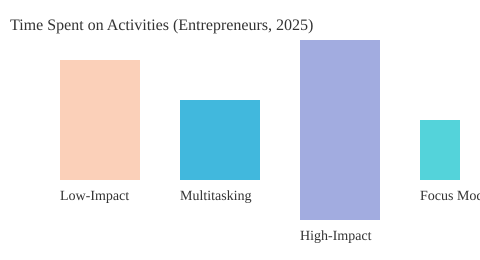
Chart: Entrepreneurs spend more time on low-impact and multitasking activities, but productivity soars when focus modes are used for high-impact work.
All three broke off their conversation and turned and simultaneously said focus. Focus is the most important requirement for success in our fast moving world today.
2. Failing Faster to Succeed Sooner: Why Bold Entrepreneurs Court Mistakes
Forget flawless plans—today’s most successful entrepreneurs know that action beats endless planning. In fact, 49 out of 50 businesses (98%) launch without a formal business plan, even at the global level. The secret? They embrace failure as a fast track to learning, growth, and—ultimately—success. If you want to thrive as a scrappy entrepreneur in 2025, it’s time to stop fearing mistakes and start seeing them as your best teachers.
Case Study: From Broke to 80 Coffee Shops—The Power of Failing Fast
Consider the story of a New Zealand entrepreneur who, after attending a Brian Tracy seminar, learned the power of focus. He was broke and unemployed, but he walked out of that seminar with written goals and a new mindset. Soon after, he read about the rise of specialty coffee shops like Starbucks in the U.S. He knew nothing about coffee, but he acted quickly—testing ideas, learning from missteps, and iterating. Before the dust settled, he owned 80 coffee shops. His journey wasn’t about perfect planning; it was about lean testing, customer validation, and the willingness to fail fast and adapt.
“If you want to double your success, double your failure rate.”
If you want to increase your rate of success you must double your rate of failure because success lies on the far side of failure.
— Thomas J. Watson
This mindset is echoed by million-dollar founders everywhere. In 2025, “fail fast, learn fast” is the top advice cited by those who’ve built thriving companies. The reason is simple: Learning faster beats playing it safe. Iteration is king. Every failed experiment is a step closer to what works, especially when you use lean testing and rapid customer validation to guide your next move.
Why Lean Testing and Customer Validation Matter
Entrepreneurial education often skips the messy reality of trial, error, and iteration. But in the real world, most iconic businesses prioritized action and learning over planning perfection. Lean testing—the build>test>learn cycle—lets you:
- Reduce risk (by up to 30%, according to recent studies)
- Optimize your product-market fit quickly
- Spot and fix mistakes before they become expensive
- Gather real feedback from real customers
Trying, failing, and optimizing wins over static planning every time. That’s why 63% of businesses plan to expand in 2025 using agile, iterative approaches rather than rigid roadmaps.
Failing Forward: Real Lessons from Real Mistakes
“Failing forward” is not just a buzzword—it’s a proven path to business agility and continuous learning. Personally, I’ve tanked two product launches before the third one finally hit it big. Each failure taught me something I couldn’t have learned from a textbook: what customers actually wanted, which features mattered, and where my assumptions were wrong. The faster you fail and learn, the faster you succeed.
Fail Fast, Win Big—Real-World Failures and Lessons in 2025
| Company/Entrepreneur | Initial Failure | Successful Pivot |
|---|---|---|
| New Zealand Coffee Mogul | First two shops struggled with low foot traffic | Added Wi-Fi & community events—grew to 80 shops |
| Tech Startup X | App launch flopped due to poor user engagement | Lean tested features, pivoted to B2B SaaS—now industry leader |
| Fashion Brand Y | Overstocked first collection, lost capital | Adopted pre-order model, validated with customers—profitable in 6 months |
| Personal Example | Two failed launches (wrong audience, unclear value) | Iterated messaging, tested with real users—third launch succeeded |
In 2025, business agility and continuous learning are your greatest assets. The entrepreneurs who win are the ones who aren’t afraid to fail fast, learn faster, and keep moving forward.
3. Fast vs. Slow Thinking: The Brainy Secret to Risk-Proof Decisions
Insights from ‘Thinking, Fast and Slow’: The Right Type of Thinking at the Right Moment
Years ago, Nobel Prize winner Daniel Kahneman introduced the world to two modes of thinking in his groundbreaking book, Thinking, Fast and Slow. He called them “fast thinking” and “slow thinking.” Fast thinking is your brain’s autopilot—intuitive, quick, and automatic. It’s what you use when you’re driving in traffic or grabbing lunch from a buffet. Slow thinking, on the other hand, is deliberate and reflective. It’s what you need when the stakes are high—like making a major investment, hiring a key employee, or planning your next big move for business growth in 2025.
When Quick Thinking Is Your Downfall—Costly Hiring and Investment Mistakes
As an entrepreneur, it’s tempting to make snap decisions. You’re busy, you trust your gut, and sometimes, you just want to get things done. But research and real-world experience show that fast thinking can be your downfall, especially with high-impact decisions. Kahneman’s core insight is that the biggest problem isn’t that we think fast or slow—it’s that we use the wrong type of thinking at the wrong moment. Too often, entrepreneurs make critical decisions—like hiring or large purchases—using fast, instinctive thinking. The result? Costly mistakes, wasted resources, and sometimes, business failure.
Slow It Down for Big Choices: Actionable Tools to Force Yourself to ‘Sleep on It’
How do you avoid these traps? The answer is simple: slow down. When you face decisions with long-term consequences, force yourself into slow thinking mode. Here are some actionable tools:
- Sleep on it: Never make a major decision in the same day. Give your mind time to process.
- SWOT analysis: Use this classic strategic planning tool to weigh strengths, weaknesses, opportunities, and threats.
- Zero-based thinking: Ask yourself, “Knowing what I know now, would I still make this choice?”
- Consult trusted advisors: Bring in outside perspectives to challenge your assumptions.
- Set a decision deadline: Give yourself enough time to reflect, but not so much that you get stuck in analysis paralysis.
Trend Data: Longer Decision-Making Increases Quality
Recent studies and business trend data are clear: the longer you take to make an important decision, the better the decision will be, the higher quality decision. For example, high-performing firms take an average of three weeks to hire for key roles. Their hiring accuracy jumps to 90% when they follow a slow, intentional process. In contrast, 80% of startups that made impulse decisions reported costly mistakes—especially in hiring and major investments.
| Decision Type | Average Time Taken | Success Rate |
|---|---|---|
| Slow, Deliberate Hiring | 3 weeks | 90% |
| Impulse Hiring | 1-2 days | 20% |
| Major Purchases (Slow) | 5+ days | 85% |
| Major Purchases (Fast) | <1 day | 30% |
Quick Scenario: Your Biggest Purchase—Would You Decide in 5 Minutes or 5 Days?
Imagine you’re about to make your biggest business purchase of the year. Would you decide in five minutes or five days? The data—and the experts—say take your time. I remember nearly accepting a job offer on the spot, only to “sleep on it” and realize overnight that the company’s values clashed with mine. That pause saved me from a career disaster.
Key Takeaways for Strategic Planning and Decision-Making
- Use fast thinking for low-stakes choices; reserve slow thinking for decisions that shape your business growth in 2025 and beyond.
- Adopt tools like SWOT analysis and zero-based thinking to force reflection.
- Remember:
The longer you take to make an important decision, the better the decision will be, the higher quality decision.
Decision Speed vs. Success Rate for Key Entrepreneurial Moves
Let this be your guide: Slow thinking isn’t hesitation—it’s strategic planning. The best entrepreneurs know when to pause, reflect, and make risk-proof decisions for long-term success.
4. Zero-Based Thinking: Hitting the Reset Button for Real Growth
When to Ask the Hardest Question: ‘Knowing What I Now Know, Would I Start This Again Today?’
Zero-based thinking is a radical but essential tool for scrappy entrepreneurs. It’s not about trimming costs or tweaking processes—it’s about the courage to ask yourself the hardest question in business and life: “Knowing what I now know, would I start this again today?” This question is the ultimate reset button. It forces you to re-examine your business model resilience, performance metrics, and process efficiency from the ground up.
The most important requirement for practicing zero-based thinking isn’t a spreadsheet or a consultant—it’s courage. Or as I call it, the “C word.” You need the guts to look at every part of your life and business and admit when something just isn’t working, no matter how much time or money you’ve already invested.
Zero-Based Thinking: Why Courage, Not Spreadsheets, Is the True Requirement
Most entrepreneurs are trained to optimize, not obliterate. But sometimes, the bravest thing you can do is walk away. Zero-based thinking means you don’t let sunk costs or old promises dictate your future. Instead, you make decisions based on today’s reality and tomorrow’s potential.
Annual or semiannual zero-based reviews can dramatically improve performance and mental health. Leaders who act decisively free up resources and increase business model resilience. This approach isn’t just about numbers—it’s about freeing yourself from chronic stress and stagnation.
Spotting Chronic Stress as the Biggest Clue You Need to Pivot or Stop
Chronic, ongoing stress is the number one signal that you need zero-based thinking. If you’re working your head off but feel stuck, frustrated, or unhappy, it’s time for ruthless self-reflection. Often, the source isn’t a broken process or a bad quarter—it’s a relationship, a client, or a project you would never choose again if you had the chance.
Ignoring these stress signals can be costly. 26% of entrepreneurs admit ignoring chronic stress for over a year before acting. But when leaders finally make the tough call—whether it’s ending a partnership or dropping a toxic client—70% report a major breakthrough in business performance and mental clarity.
From Personal Life to Personnel: How Often Should You ‘KWIN-K’ Everything?
Zero-based thinking isn’t a one-time event. It’s an ongoing process. I call it the “KWIN-K” method: Knowing What I Now Know, do a quick analysis on everything. This applies to your personal life, your team, your clients, and your business model.
- Personal relationships: Are there people in your life who drain your energy or hold you back?
- Personnel: Would you hire every team member again today?
- Clients and projects: Are there clients or projects you would never take on if you had a choice?
- Processes: Are your workflows and systems still delivering real process efficiency?
Schedule a zero-based review at least once a year—or whenever you notice chronic stress cues. Encourage your team to do the same. This is how you build true business model resilience.
Table: Chronic Stress Cues—What Entrepreneurs Shouldn’t Ignore
| Chronic Stress Cue | What It Means | Action |
|---|---|---|
| Persistent dread before meetings | Relationship or project misfit | Re-evaluate or exit |
| Constantly fixing the same issues | Inefficient process or wrong hire | Redesign or replace |
| Physical symptoms (insomnia, headaches) | Chronic stress overload | Immediate review needed |
| Loss of excitement for your business | Misaligned business model | Zero-based rethink |
Data: Ongoing stress is the #1 signal for zero-based thinking needs. 70% of leaders report a major breakthrough after dropping a toxic client or project. 26% of entrepreneurs admit ignoring chronic stress for over a year before acting.
Short Tangent: The Time I Fired a Client and Could Finally Sleep at Night
I once had a client who paid well but made every interaction a nightmare. I dreaded every call, lost sleep, and my team morale tanked. After months of “KWIN-K” analysis, I finally let them go. The relief was instant. My performance metrics improved, my team was happier, and I remembered why I started my business in the first place. Sometimes, the fastest way to grow is to hit the reset button.
The most important requirement for practicing zero-based thinking... is courage. I call it the c word.
5. Tech: The Frenemy—Why Digital Tools Can Help or Kill Your Focus
Our ‘Digital Drug’: Why Attention Is the New Scarcity
Look around any coffee shop or office, and you’ll see it: heads bent, eyes glued to glowing screens, fingers tapping in a trance. Our obsession with digital tools—especially smartphones—has become so intense that it’s often compared to addiction. As one entrepreneur put it,
This obsession with looking at the screen and staying connected is killing people because it stops them from focusing.
The real cost isn’t just your phone bill or app subscriptions. It’s your attention. In 2025, attention is the new scarcity. Every ping, buzz, and notification chips away at your ability to focus, think deeply, and make fast, smart decisions. For scrappy entrepreneurs, this is a silent killer of operational efficiency and innovation mindset.
Digital Transformation: Investment vs. Return
The numbers are clear: 94% of organizations plan digital transformation initiatives in 2025. Digital tools are everywhere, and most businesses see them as essential for business growth. But here’s the catch—not all see a return on that investment. Why? Because technology is neutral. It can amplify your focus and productivity, or it can scatter your attention and undermine your best work.
A recent study found that 87% of executives cite digital tools as key for driving innovation. Yet, only those who use these tools deliberately—rather than compulsively—see real gains in operational efficiency. It’s not about having the latest app or platform. It’s about how you use it.
Best Practices: How Top Entrepreneurs Use (Not Abuse) Digital Tools
After years of interviewing and working with high-performing founders and billionaires, I’ve noticed a pattern: the most successful entrepreneurs treat technology as a tool, not a master. Here are habits they share:
- Set boundaries: They schedule “deep work” blocks with all notifications off.
- Single-task: They use digital tools for one purpose at a time—no endless tab surfing.
- Curate inputs: Only essential apps are on their home screens; everything else is hidden or deleted.
- Automate the routine: Repetitive tasks are handled by software, freeing up brainpower for creative thinking and fast decisions.
These habits aren’t just for show. They’re proven to boost both focus and innovation, driving business growth in 2025 and beyond.
Quick Ideas: Stop Tech from Sabotaging Your Innovation Mindset
- Notification diet: Turn off all but mission-critical alerts. Try a digital detox day each week.
- Batch communication: Check email and messages at set times instead of constantly reacting.
- Redesign workflows: Use project management tools to track tasks, but don’t let them become another distraction.
- Physical cues: Place your phone out of reach during strategy sessions or creative work.
Deliberate digital tool usage isn’t just a productivity hack—it’s a way to reclaim your attention and fuel an innovation mindset.
Case Example: 30% Productivity Boost by Reducing Notifications
Consider a startup that redesigned its workflows and limited notifications to only the most urgent. Within three months, they measured a 30% increase in productivity. Employees reported fewer mistakes, faster decision-making, and more time for strategic thinking. This is the power of mindful digital transformation—using tech to serve your goals, not sabotage them.
Wild Card: If Your Phone Could Only Send One Notification Per Day…
Imagine your phone could only send you one notification per day. What would it say? Would it remind you of your biggest priority? Nudge you to take a break and think? Or simply say, “Stay focused”? This thought experiment highlights the real value of digital tools: when used intentionally, they can amplify your focus and drive business growth in 2025.
6. Leadership Isn’t a Solo Sport: How Hiring Slow (and Firing Fast) Fuels Real Growth
Leadership development isn’t about going it alone—it’s about building a team that can drive business growth year after year. The way you hire, retain, and engage your people is the foundation of your company’s success. As Peter Drucker famously said, “The biggest mistakes you make is hiring fast. You hire people quickly... The best decisions you make are when you really take your time to hire slowly.” Let’s break down why slow, thoughtful hiring and fast, decisive firing are the keys to real, sustainable growth.
Why Slow Hiring Matters: Accuracy Up to 90%
When you rush hiring decisions, you risk bringing in people who aren’t the right fit for your culture or your goals. Research and best practices from Fortune 500 companies show that using a structured, consistent hiring process can increase your hiring accuracy to 90%. This isn’t luck—it’s the result of a disciplined approach that prioritizes talent retention and employee engagement from day one.
- Structured interviews and multi-step assessments help you see beyond the resume.
- Inclusive culture is built by considering diverse perspectives and experiences during hiring.
- Taking your time means fewer costly mistakes and a stronger, more engaged team.
The Hidden Danger of ‘Gut Feeling’ Hires
It’s tempting to trust your instincts, especially when you’re moving fast. But ‘gut feeling’ hires often lead to long-term dysfunction and lost revenue. A single bad hire can disrupt your team’s chemistry, drain morale, and cost your business up to 30% of the employee’s first-year earnings. High-engagement, inclusive cultures consistently outperform on productivity and retention—by as much as 17% according to recent studies.
Personal Reflection: The Cost of Keeping a Bad Hire
I once made the mistake of hiring someone based on a strong first impression and a glowing reference. I ignored the warning signs during onboarding, thinking things would work out. Months later, I was dealing with missed deadlines, frustrated team members, and lost clients. The real cost wasn’t just financial—it was the hit to our culture and momentum. Letting that person go was tough, but it was the turning point for our team’s performance and engagement.
Lessons from Fortune 500s: Applying ‘Brian’s Rule’
Top-performing companies don’t leave hiring to chance. They follow what’s known as Brian’s Rule: Never hire without following a standardized, proven process—no exceptions. This rule, adopted by many Fortune 500s, includes:
- Multiple interviews with different team members
- Skills assessments and culture-fit evaluations
- Reference checks and trial projects
These steps may seem slow, but they’re proven to boost talent retention and build an inclusive culture where people thrive.
Consistent Talent Reviews: The Secret to Year-Over-Year Growth
Winning companies don’t just hire well—they review their talent regularly. Data shows that 61% of top firms have formal retention programs, and most review their teams quarterly. This keeps employee engagement high and ensures you’re developing leaders at every level.
FAQ: People Decisions in Practice
- How often should you review personnel?
Quarterly reviews are best practice for leadership development and business growth. They help you spot issues early and keep your team aligned. - What if your gut and the data disagree?
Always trust the data. Your instincts matter, but structured processes and feedback are more reliable for long-term success.
The biggest mistakes you make is hiring fast. You hire people quickly... The best decisions you make are when you really take your time to hire slowly.
Remember, leadership isn’t a solo sport. Building a high-performing, engaged team through slow hiring and fast firing is the surest way to fuel real, lasting growth.
7. Wild Card Wisdom: Sleep on Big Decisions, Celebrate Fast Failures, and Other Unlikely Moves for 2025
In the fast-paced world of entrepreneurship, it’s easy to think that speed is everything. But here’s a secret that Nobel Prize winners, billionaire founders, and even a lemonade stand dropout all agree on: the smartest moves often come from knowing when to slow down—and when to speed up. If you want actionable entrepreneurship insights for 2025, it’s time to master the art of mixing strategic patience with relentless experimentation.
Let’s start with the big stuff. Any decision that could shape your business for years to come—whether it’s a major pivot, a new product launch, or a partnership—deserves your slowest, most careful thinking. This isn’t just about weighing pros and cons. It’s about giving your mind space to process. Take a walk. Sit quietly. Talk it over with your team or trusted advisors. And yes, sleep on it. Science and experience both show that letting your subconscious work overnight can lead to clearer, more creative answers. Even if you’re impatient, resist the urge to rush. This is one of the most essential business plan essentials you can practice.
But here’s where the wild card comes in: while you’re patient with the big calls, you need to be fast and fearless with the small stuff. The most successful founders in 2025 are those who run constant, low-risk experiments. They try new marketing messages, test features, or explore new customer segments—then quickly double down on what works and drop what doesn’t. This approach isn’t just about speed; it’s about building a culture of continuous learning. Every small failure is a lesson. The faster you fail, the faster you learn, and the quicker you can adapt your expansion strategies.
Take it from the lemonade stand dropout. She didn’t quit because she failed—she quit because she learned what didn’t work, then moved on to her next idea. That’s the heart of actionable entrepreneurship insights: treat every experiment as a step forward, even if it doesn’t lead where you expected. The best founders celebrate fast failures, because each one brings them closer to a breakthrough.
Leadership in 2025 isn’t about doing it all yourself. It’s about teaching your team these habits, too. Encourage them to bring you their toughest decisions for slow, thoughtful discussion. But also empower them to run their own quick experiments, learn from mistakes, and share insights openly. When everyone is accountable for learning—not just results—your business becomes more resilient, creative, and ready to scale.
FAQ: Your Real Questions, Answered
How do I know which decisions to sleep on? If a choice will have long-term consequences or is hard to reverse, it’s a candidate for slow thinking. If it’s low-risk and easy to change, experiment fast.
What if my team is afraid of failing? Model the behavior yourself. Share your own failures and what you learned. Celebrate effort and learning, not just wins. Over time, this builds a culture where innovation thrives.
How do I balance planning and experimentation? Use your business plan as a living document. Set your direction, but expect to update it as you learn. Personal accountability and learning are more important than sticking to a static plan.
Thought Exercise: What’s the One Thing You’d Stop Doing If You Could? Why?
Take a moment to reflect. What’s one task, habit, or process you’d eliminate from your business if you had the chance? Why does it hold you back? This simple question can spark powerful changes—freeing up time, energy, and focus for what matters most.
As you move forward into 2025, remember: the not-so-secret sauce is blending slow, strategic reflection with fast, fearless experimentation. Make space for both, teach your team to do the same, and watch your business thrive. The future belongs to those who learn, adapt, and aren’t afraid to play their wild cards.
TL;DR: In 2025, the rulebook for entrepreneurial success isn’t what you think. Focus, intelligent failure, slow thinking for big decisions, and ruthless self-reflection are your unsung superpowers. Ditch the needless hustle, embrace strategic rest, and get clear about what truly matters for business growth.
Post a Comment