

Picture yourself staring up at a midnight sky, perhaps with a cold coffee in hand, thinking you've got the Big Bang theory figured out. That was me not long ago—smugly certain, only to get sideswiped by the inconvenient truth that nearly everything I'd learned at school was, well, wrong or at least woefully incomplete. Instead of a tidy cosmic firework show, it turns out the universe’s story is messy, strange, and full of surprising twists. Ready for a mind-bend? Forget what you think you know about the ‘beginning’ of everything, and let’s do some cosmological myth-busting together.
Big Bang Myths Busted: What You Didn’t Learn in School
Why Common Explanations of the Big Bang Miss the Mark
If you learned about the Big Bang in school, chances are you were taught a version that most physicists don’t actually believe anymore. The classic story goes like this: the universe began as a tiny point, exploded, and expanded into everything we see today. But this is one of the biggest Big Bang misconceptions out there. In reality, the Big Bang theory is much more complex—and a lot more interesting—than a simple explosion.
The Universe’s Expansion vs. a Typical Explosion
A key Big Bang theory misconception is thinking of the Big Bang as an explosion in space, like a cosmic firework. But the Big Bang wasn’t an explosion in space; it was an expansion of space itself. Every point in the universe moved away from every other point, not from a single center. Imagine dots on a balloon: as the balloon inflates, the dots move apart, but there’s no central “blast.” This expansion is what physicists mean when they talk about the Big Bang.
Textbook vs. Physicist: What Most Scientists Actually Believe Now
You might be surprised to learn that most physicists today no longer believe that the Big Bang was the beginning of the universe. In fact, recent surveys suggest that over 60% of cosmologists reject the idea that the universe started from a true singularity—a single, infinitely dense point. Many modern textbooks still teach the “singularity” version, but the scientific community has moved on to more nuanced ideas.
| Concept | Textbook Version | Physicist Belief (Poll) |
|---|---|---|
| Universe began from a singularity | Yes | Over 60% say No |
| Big Bang as an explosion in space | Yes | No (Expansion of space) |
| Age of the universe | ~13.8 billion years | ~13.8 billion years |
The Myth of the Initial Singularity—What Really “Banged”?
Here’s the big question: What actually “banged” in the Big Bang? For decades, the answer was “a singularity”—a point where physics breaks down. But now, many physicists think this is just a placeholder for our ignorance. The truth is, we don’t know exactly what happened at “time zero.” Some theories suggest the universe never had a true beginning, or that the Big Bang was just one phase in a larger cosmic cycle.
Why Redefining the Start of the Universe Is So Hard
Part of the confusion comes from the word “beginning.” What does it even mean for the universe to have a start? Is it the beginning of time, space, or something else? Philosophers and physicists alike debate this question. The more we learn, the more it seems that the universe’s origin is not a simple event, but a deep mystery that challenges our understanding of reality itself.
Anecdote: The Shock of Realizing Your Teachers May Have Oversimplified the Cosmos
When you first hear that what you learned in school about the Big Bang might be wrong, it can be a shock. Many physics students, even after years of study, discover that the real story is far stranger—and more fascinating—than the textbook version. It’s a reminder that science is always evolving, and sometimes, the biggest myths are the ones we never thought to question.
Cosmic Whodunit: How Humans Explained the Night Sky Before Science
Creation Myths and Historical Views of Universe Origins
Long before telescopes and equations, you would have looked up at the night sky and wondered: Where did all this come from? Across the world, people invented stories to explain the stars and the universe. There were hundreds of gods, each with their own creation tales. The Greeks, for example, had the atomists who believed, as one famous quote says,
'The Greek atomists believed that the universe was infinite in space and time.'Meanwhile, Hindu, Stoic, and Buddhist traditions described the universe as going through endless cycles of creation and destruction—an eternal cosmic dance.
Newton’s Static Universe: An Early Scientific Model
When science began to take shape, the questions didn’t go away—they just changed form. In 1687, Isaac Newton published his Principia, introducing the law of gravity. Newton realized that if every object attracts every other object, then the universe should collapse in on itself. To avoid this, he borrowed from Greek ideas and proposed a static, infinite universe—one with no center, stretching forever in all directions. In this model, the pull of gravity would be perfectly balanced everywhere, and the universe would neither expand nor contract.
Newton’s static universe was also infinite in time. As a Christian, Newton believed that God created the universe, but not at any specific moment. This idea became widely accepted and shaped early cosmology facts for centuries.
Olbers’ Paradox: The Dark Night Sky Mystery
But there was a problem with this infinite, static universe. If you look up at the night sky, you see stars—and a lot of darkness. But if the universe were truly infinite and eternal, as Newton described, then in every direction you should eventually hit a star. The night sky should be blazing with light, as bright as the surface of the sun. This puzzle is known as Olbers’ Paradox, first popularized in the early 19th century. It directly challenged the static universe model and forced people to rethink their assumptions about the cosmos.
Underestimating the Universe’s Weirdness
Early models like Newton’s missed something big: the universe isn’t static, and it isn’t infinite in the way people once thought. These models couldn’t explain why the night sky is mostly dark, or why the universe doesn’t collapse under its own gravity. They also ignored the idea of cosmic expansion, which would later become a key part of modern cosmology facts.
Personal Reflection: What Would You Have Believed?
If you had lived 200 years ago, what would you have believed? With no telescopes to peer into distant galaxies, and no scientific method to test wild ideas, you might have accepted the stories of gods, or Newton’s elegant but flawed static universe. It’s a reminder that our understanding of the cosmos is always shaped by the tools and ideas we have at the time.
Why Do We Even Ask How It All Started?
Humans have always felt compelled to ask where we come from and why the universe exists. Maybe it’s curiosity, or maybe it’s the need to make sense of our place in the vastness of space. Whatever the reason, these questions have driven us to invent myths, build telescopes, and develop new cosmology facts—always searching for the true story of our universe.
Einstein, Relativity, and When the Universe Took Center Stage
When you think of gravity, you might picture apples falling from trees or the moon orbiting Earth. But in 1915, Einstein’s theory of relativity changed everything you thought you knew about the universe. Instead of seeing space and time as separate, Einstein revealed they are woven together into a single, flexible fabric: spacetime.
Space and Time: Meet Spacetime (Coffee Analogy)
Imagine you’re stirring cream into your coffee. The cream and coffee swirl together, becoming inseparable. That’s how space and time work in Einstein’s universe—they blend into one entity. This means that as you move faster, time slows down for you, and distances shrink. At the speed of light, time would stop entirely. Einstein’s theory of relativity impact is that it redefined the very stage on which the universe plays out.
Gravity Isn’t a Force—It’s Geometry!
Forget the idea of gravity as a mysterious force pulling objects together. According to Einstein, gravity is the result of massive objects bending spacetime itself. Picture a heavy bowling ball on a trampoline: it creates a dip, and smaller marbles roll around it. That’s how Earth orbits the sun—not because of an invisible force, but because the sun warps the spacetime around it.
The Sun’s Gravity Bends Starlight: Eddington’s 1919 Eclipse Experiment
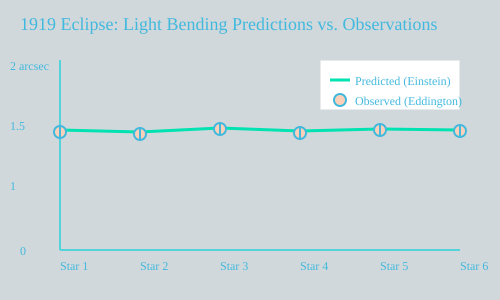
How do you prove that spacetime can bend? In 1919, astronomer Arthur Eddington set out to test Einstein’s prediction during a total solar eclipse. If Einstein was right, the sun’s gravity would bend the path of starlight passing nearby. During the eclipse, Eddington photographed stars near the sun and found they had shifted position by about 1.75 arcseconds—exactly as Einstein predicted.
"The Times of London reported, 'New theory of the universe, Newtonian ideas overthrown.'"
This experiment made Einstein an overnight celebrity and confirmed that even light follows the curves of spacetime.
Einstein’s Cosmological Constant: The Universe’s “Fudge Factor”
Einstein’s equations suggested the universe should be either expanding or contracting, not static. To keep the cosmos still, he added a “cosmological constant” (Λ)—an energy built into empty space itself. Think of it as a dial he could turn to balance the universe. Later, when evidence showed the universe was expanding, Einstein called this his “biggest mistake.” Ironically, today the cosmological constant is linked to dark energy, the mysterious force driving the universe’s accelerated expansion.
Wild Card: Are We All Just Marbles in a Cosmic Bowl?
If gravity is just the shape of spacetime, then you, the Earth, and even galaxies are like marbles rolling on a gigantic, invisible bowl. The universe isn’t a static stage—it’s a dynamic, ever-changing fabric, shaped by everything within it. Einstein’s theory of relativity didn’t just upend Newton’s ideas; it put the universe itself at center stage, showing us that reality is far stranger—and more beautiful—than anyone had imagined.
Stargazers, Computers, and the Birth of Galactic Distance: How We Measured the Expanding Universe
Before you could even imagine the universe expanding, astronomers faced a much simpler but stubborn mystery: what were those fuzzy clouds in the night sky? For centuries, these “nebulae” puzzled everyone. Some, like the philosopher Immanuel Kant, guessed they might be “island universes”—but no one knew how far away they really were. The answer would come from an unexpected place: the careful, patient work of a group of women known as the Harvard computers.
'Leavitt was a part of a small group of poorly paid female astronomers known as the Harvard computers.'
Henrietta Swan Leavitt: The Key to Cosmic Distances
Henrietta Swan Leavitt’s contributions to astronomy are foundational. Working as a “computer,” she spent her days cataloging the brightness of stars on photographic plates. While studying a special class of stars called Cepheid variables, she noticed something remarkable: the longer a Cepheid’s pulse, the brighter it truly was. This relationship—now called Leavitt’s Law—meant you could measure a Cepheid’s period, determine its actual brightness, and compare it to how bright it looked from Earth. That comparison gave you its distance. Suddenly, astronomers had a cosmic ruler for the first time.
Edwin Hubble and the Andromeda Breakthrough
Armed with Leavitt’s discovery, Edwin Hubble turned his telescope toward the Andromeda Nebula. He found a Cepheid variable, measured its period, and calculated Andromeda’s distance: 900,000 light-years away (later corrected to about 2.5 million). This was far beyond the edge of the Milky Way. In that moment, the universe didn’t just get bigger—it exploded in size in our minds. All those nebulae? They were entire galaxies, each filled with billions of stars.
Redshift, Runaway Galaxies, and Hubble’s Law
But the story didn’t stop there. Another astronomer, Vesto Slipher, noticed that most galaxies had their light “redshifted”—stretched to longer wavelengths. This redshift origin lies in the Doppler effect, and it meant those galaxies were racing away from us at hundreds of kilometers per second. Hubble combined Slipher’s redshift data with Leavitt’s distance measurements. When he plotted galaxy distances against their speeds, a clear trend emerged: the farther away a galaxy is, the faster it’s moving away. This is Hubble’s law galaxy expansion—the first direct evidence that the universe itself is expanding.
Visualizing the Data: Galaxy Distances and Speeds
Imagine seeing Hubble’s table for the first time—a list of galaxies, their measured distances, and their redshift velocities. The numbers told a story: the universe was not static. It was dynamic, growing, and changing. Here’s a simplified version of what that data might look like:
Imagining the Awe of Discovery
Picture yourself as an astronomer in the 1920s, seeing these results for the first time. The universe had just grown a million times larger in your mind. Thanks to Henrietta Swan Leavitt’s contributions, the origin of redshift, and Hubble’s law galaxy expansion, you were witnessing the birth of a new cosmic story—one where the universe itself was expanding, and our place in it had changed forever.
From Primeval Atom to Steady State: Cosmic Rivalries and the Birth of the Big Bang Name
When you think about the Big Bang origins, you might picture a massive explosion from nothing. But the real story is much more complex—and even the name “Big Bang” has a surprising history. Let’s unravel how competing ideas and a bit of scientific rivalry shaped our modern understanding of the universe’s beginning.
Georges Lemaître’s ‘Primeval Atom’ and the Fireworks Metaphor
In the early 20th century, physicists like Alexander Friedmann and Georges Lemaître used Einstein’s equations to predict a dynamic, expanding universe. Lemaître, a Belgian physicist and Catholic priest, took this idea further. He proposed that if the universe is expanding now, then rewinding time would mean everything was once packed into a single, incredibly dense point. He called this the primeval atom and described our universe as the “smoke and ashes of a bright but very rapid fireworks.” This poetic image helped people imagine the universe’s explosive origins, even though Lemaître himself never used the term “Big Bang.”
Einstein’s Quiet Pursuit of a No-Origin Universe
Despite the evidence, Einstein was uncomfortable with the idea of a universe that had a beginning. He preferred a “static” universe—one that always existed. To make this work, he quietly explored a model where new matter was continuously created as the universe expanded, keeping the overall density constant. This idea, however, was never published during his lifetime and only came to light in his archives in 2014. Even Einstein struggled with the concept of a universe with a true beginning.
Fred Hoyle’s ‘Steady State’ and the Accidental Coining of ‘Big Bang’
In 1945, three British scientists—Fred Hoyle, Thomas Gold, and Hermann Bondi—independently developed the steady state cosmology. They argued that the universe had no beginning or end, with new matter forming continuously. Fred Hoyle, a vocal supporter, often discussed these ideas on the radio. In the early 1950s, while describing the rival “primeval atom” theory, he said,
“All the matter in the universe was created in one big bang at a particular time in the remote past. The big bang name was born and it stuck.”Ironically, Hoyle meant it as a jab, but the catchy phrase captured the public’s imagination and became the label for the theory he opposed.
Why Theoretical Rivalries Sharpen Scientific Models
These cosmic rivalries—between the primeval atom and steady state—were more than academic squabbles. They pushed scientists to gather better evidence, refine their models, and communicate more clearly. The dramatic language of “Big Bang” helped shape public understanding, even if it led to Big Bang myths about a literal explosion.
Wild Card: How Would You Name the Universe’s Origin?
If you could name the universe’s beginning, what would you call it? Would you choose something poetic like “cosmic dawn,” or something scientific like “universal expansion event”? Share your ideas—sometimes, the right name can change how everyone sees the universe.
Anecdote: The Big Bang’s Branding Problem Among Physicists
Many physicists actually disliked the “Big Bang” label, finding it misleading. Yet, thanks to a radio quip and the power of catchy language, it’s now the most famous name in cosmology. Sometimes, the story behind the name is as fascinating as the science itself.
The Universe’s Hot Mess: Cosmic Soup, Nucleosynthesis & The Light That Proved Everything
Imagine rewinding the universe all the way back to its beginning. What you find is not a calm, empty space, but a wild, chaotic “cosmic soup.” Right after the Big Bang, everything was packed together in a hot, dense mess of protons, neutrons, electrons, and photons. There was no empty space—just a swirling plasma where matter as we know it didn’t even exist yet.
Life Immediately After the Big Bang: A Particle Party
Physicists George Gamow and Ralph Alpher traced the universe’s history back to this early chaos. As the universe expanded and cooled, it was so hot that protons and neutrons couldn’t stay together for long. Instead, they zipped around in a sea of particles, constantly colliding and interacting with photons (particles of light).
Nuclear Fusion on a Universal Scale: The 5-Minute Light Element Bonanza
For the first five minutes, the universe acted like a gigantic nuclear reactor. Protons and neutrons started to “snap together,” forming the nuclei of the lightest elements. This process is called Big Bang nucleosynthesis. Gamow and Alpher predicted the outcome with surprising accuracy:
'Gamma and Alpha predicted that 75% of the nuclei would be hydrogen, 25% would be helium, and a tiny proportion of things like lithium would be found.'
Modern astronomical observations confirm these ratios. The abundance of hydrogen, helium, and trace lithium in the universe matches the predictions from Big Bang nucleosynthesis, providing strong evidence for the theory.
Photons Trapped in Plasma: The Universe’s Glow
After nucleosynthesis, the universe was still a hot, dense plasma. Photons—the particles of light—couldn’t travel freely. They were constantly absorbed and re-emitted by electrons and nuclei, trapped in a cosmic fog. This state lasted for about 380,000 years, until the universe cooled to around 2,700°C.
The Cosmic Microwave Background: A Snapshot of the Universe’s Youth
At that critical temperature, electrons finally joined up with nuclei to form neutral atoms. Suddenly, photons were free to travel through space. If you could have seen this moment, the universe would have glowed bright red. These photons have been traveling ever since, stretched by the expansion of space. Today, we detect them as the cosmic microwave background (CMB)—a faint glow at about 2.7 Kelvin.
The cosmic microwave background discovery was a game-changer. It’s a direct view of the early universe, showing us the moment when light broke free. The uniformity of the CMB across the sky also supports inflation theory, which explains why the universe looks so similar in every direction.
Chart: How Element Ratios and Temperatures Changed in the Early Universe
| Epoch | Key Event | Element Ratios | Temperature |
|---|---|---|---|
| First 5 minutes | Nucleosynthesis | 75% H, 25% He, trace Li | Billions of °C |
| ~380,000 years | Photons released (CMB) | Locked in | 2,700°C |
| Today | CMB observed | Same ratios | ~2.7 K |
The cosmic microwave background and the observed ratios of light elements remain two of the strongest pieces of evidence for the Big Bang. They show us not just what the early universe was like, but how well our theories match reality.
The Hunt for Proof: How We Finally Photographed the Universe’s Childhood
Imagine trying to photograph your own baby picture, but the only clues are faint whispers echoing across the cosmos. That’s what astronomers faced when searching for proof of the Big Bang theory and the universe’s expansion. The breakthrough came not from a grand experiment, but from an accidental discovery—a story that changed everything we know about our cosmic origins.
The Accidental Discovery of the Cosmic Microwave Background
In the 1960s, Arno Penzias and Robert Wilson were working at Bell Labs with a giant radio antenna. Their goal wasn’t to solve the mysteries of the universe, but to study radio signals. Yet, they kept hearing a persistent hiss in their data—a noise they couldn’t explain or remove, no matter how much they cleaned their equipment or chased away pigeons nesting in the antenna.
Meanwhile, astronomers at Princeton were actively searching for the cosmic microwave background (CMB)—the faint afterglow left over from the Big Bang. Unknown to Penzias and Wilson, their mysterious hiss was exactly what the Princeton team was hoping to find. When the two groups finally connected, it became clear: the hiss was the CMB, measured at about 2.7° Kelvin. This discovery was the “smoking gun” for the Big Bang theory, offering direct evidence that the universe had a hot, dense beginning and has been expanding ever since.
Early Miscalculations and the Universe’s True Age
Before this discovery, there were major debates about the universe’s age and origin. In the 1940s, astronomer Andrew McKellar measured the temperature of space as 2.3° Kelvin, but didn’t realize its significance. At the same time, the steady state model—claiming the universe had always existed—was losing ground. The Big Bang theory faced its own problem: early calculations underestimated the universe’s age, partly due to errors in measuring distances to galaxies like Andromeda. Once new data showed Andromeda was over 2.5 million light-years away, astronomers revised the universe’s age to between 10 and 20 billion years, solving the age problem and strengthening the Big Bang theory.
How a Hiss Changed Everything
The CMB discovery didn’t just confirm the Big Bang—it revolutionized cosmology. Suddenly, scientists had a way to “see” the universe as it was just 380,000 years after its birth. This faint glow, spread evenly across the sky, became the ultimate baby picture of the cosmos.
| Year | Experiment | Key Finding |
|---|---|---|
| 1940s | Andrew McKellar | Measured space temp as 2.3 K (unrecognized as CMB) |
| 1964 | Penzias & Wilson (Bell Labs) | Discovered CMB at 2.7 K |
| 1992 | COBE Satellite | Mapped CMB variations, confirming Big Bang predictions |
| 2001–2010 | WMAP Satellite | Detailed CMB map, refined universe’s age and composition |
Tangential Musing: What Else Are We Missing?
If a simple hiss could change our understanding of the universe, what other cosmic secrets are waiting in the noise? Sometimes, the biggest discoveries come when we’re not even looking for them—reminding us to keep listening.
“They received the Nobel Prize for this discovery and the Big Bang theory was finally confirmed.”
Conclusion: The True Cosmic Mystery—And Why We Still Ask, "What Actually Banged?"
If you’ve ever gazed up at the night sky and wondered where it all began, you’re not alone. The Big Bang theory is the most widely accepted explanation for the origin of our universe, but it’s also one of the most misunderstood. Even with all the cosmology facts we’ve gathered—from the red glow of the cosmic microwave background to the ongoing expansion of galaxies—one question keeps coming up: What actually banged?
This question highlights a deeper truth about science: some mysteries may never be fully solved, and that’s not a failure—it’s a sign of progress. The Big Bang theory has faced many challenges, and each one has made our understanding richer. Scientists have confirmed that the universe is expanding and that relic radiation—the afterglow of the Big Bang—still fills the sky. If you could have taken a picture when this light was first emitted, you would see a red glow from every direction, a silent witness to the universe’s fiery birth.
No Model Is Perfect—And That’s Healthy
Every scientific model, including the Big Bang theory, is a work in progress. New discoveries often lead to updates or even major changes. This ongoing debate is not a weakness; it’s what makes science strong. By questioning, testing, and sometimes even overturning old ideas, scientists keep moving closer to the truth. The fact that there are still challenges to the Big Bang theory shows just how lively and dynamic cosmology is as a field.
Curiosity: The Engine of Discovery
So why do we keep asking, “What actually banged?” The answer lies in our nature. Humans are storytellers. We crave explanations for where we came from and how everything began. The search for answers is driven by curiosity—a force as powerful as gravity. Even when we know we might never get a complete answer, we keep looking up, wondering, and imagining.
Is “What Banged?” the Wrong Question?
Here’s a final analogy to consider: asking “what banged?” might be like asking “what’s north of the North Pole?” The question itself may not make sense, because the Big Bang wasn’t an explosion in space—it was the rapid expansion of space itself. There was no “before” or “outside” in the way we usually think. Sometimes, the limits of our language and imagination are part of the mystery.
Cosmic mysteries fuel both frustration and wonder—an open invitation to keep questioning.
Cosmic Humility—Embracing the Unknown
In the end, the greatest lesson from the Big Bang theory and all of cosmology is humility. We may never have all the answers, but that’s what keeps the adventure alive. The universe invites us to keep asking, keep learning, and keep embracing the unknown. The true cosmic mystery isn’t just about what happened at the beginning—it’s about our endless drive to understand, and the beauty of not knowing everything.
FAQ: Your Cosmic Questions, Human Answers
What does the Big Bang theory actually describe?
The Big Bang theory is often misunderstood as the story of the universe exploding out of nothing. In reality, it describes the universe’s evolution from a hot, dense state to the vast, expanding cosmos we see today. It’s not about a literal “bang” in space, but about the rapid expansion of space itself. The theory explains how the universe cooled, formed atoms, galaxies, and stars, and left behind evidence like the cosmic microwave background. Modern physics has moved away from the idea of a singularity (an infinitely small, dense point) and now focuses on the period of rapid inflation that set everything in motion.
Is the Big Bang really the start of everything?
This is one of the most common Big Bang misconceptions. The Big Bang event is not necessarily the absolute beginning of time, space, and matter. Instead, it marks the earliest moment we can currently describe with physics: the end of inflation and the start of the universe as a hot, dense “soup.” What happened before inflation—or even if “before” makes sense—is still unknown. Time and space themselves may have begun with the Big Bang, but most physicists now reject the idea that it was the ultimate origin of everything.
How do we know the universe is expanding?
The expansion of the universe is one of the most important discoveries in cosmology. Astronomers like Edwin Hubble observed that galaxies are moving away from us, and the farther they are, the faster they recede. This is seen through the redshift of light from distant galaxies—light stretches as space expands, shifting to longer, redder wavelengths. This evidence, combined with the cosmic microwave background and the abundance of light elements, strongly supports the idea of an expanding universe.
What is the cosmic microwave background, and why does it matter?
The cosmic microwave background (CMB) is the faint afterglow of the early universe, dating back to about 380,000 years after the Big Bang event. It’s the oldest light we can observe, stretched into microwaves by the expansion of the universe. The CMB’s uniform temperature across the sky is a key prediction of the Big Bang theory, and its discovery confirmed that the universe was once hot and dense. Mapping the CMB has given us a snapshot of the universe’s infancy, helping us understand its age, composition, and structure.
Weren’t other theories (like steady state) equally plausible?
For a time, the steady state model—which proposed that the universe has always existed and is constantly creating new matter—was a serious rival to the Big Bang theory. However, the discovery of the cosmic microwave background and the observed abundance of light elements matched Big Bang predictions and contradicted steady state ideas. While steady state was creative, it couldn’t explain the evidence as well as the Big Bang model with inflation.
Who were some unsung heroes of cosmic discovery?
Many key figures in cosmology remain underappreciated. Henrietta Swan Leavitt developed a method to measure stellar distances, enabling Edwin Hubble to prove that galaxies exist beyond our own. Vesto Slipher first measured galaxy redshifts, paving the way for the discovery of universe expansion. George Lemaître, a priest and physicist, was the first to propose an expanding universe and the “primeval atom.” Their work, along with contributions from many others, laid the foundation for our modern understanding of the cosmos.
In summary, the story of the Big Bang is far richer and more complex than textbook summaries suggest. By questioning Big Bang theory misconceptions and exploring the evidence—from universe expansion to the cosmic microwave background—you now have a clearer, more accurate view of our universe’s origins. The journey of discovery continues, and so does our quest to unravel the true story of the cosmos.
TL;DR: The real history and physics of the Big Bang are far more complex, fascinating, and unresolved than most textbooks reveal. Misconceptions abound—but understanding how our universe truly began, and why we even care to ask, will blow your cosmic mind.
Post a Comment