

Let’s face it: few people wake up excited for another day of corporate hustle, fearing layoffs while suppressing dreams of something more... Believe it or not, freedom sometimes sneaks in through the most unwelcome door—in Fred’s case, a layoff when he least expected it, right as life seemed set for chaos. If you think losing your job is only a setback, Fred’s story will have you seriously rethinking what it means to start over. Here’s what I learned sipping lukewarm coffee and listening to his tale of reinvention.
1. When Security Fails: The Unexpected Gifts of Getting Laid Off
If you’ve ever believed that a steady job equals a secure life, Fred’s story might surprise you. For over a decade, Fred worked in a corporate liaison role, reporting directly to a VP in a global company. On the surface, he had everything—stability, a clear career path, and the kind of job that many people spend years chasing. But beneath that polished exterior, Fred never truly felt safe or in control. As he puts it,
"I never felt safe in these corporate jobs. I didn't have that feeling of, 'I'm in charge of my life.' One day, it was my turn, and they just out of the blue. 'Sorry, you're laid off.' And my wife was 7 months pregnant. I felt free for the first time since I was 15."
Fred’s layoff came at what should have been the worst possible time. At age 32, with a baby on the way, most people would expect panic, fear, or even despair. But for Fred, the moment he was handed that pink slip, something shifted. Instead of dread, he felt a profound sense of relief—a quiet glee, even—as he packed his box and walked out of the office for the last time. The future, once mapped out in corporate memos and annual reviews, suddenly felt wide open.
The Illusion of Job Security
Many of us play by the rules, believing that loyalty and hard work will protect us from sudden change. But as Fred’s experience shows, the rules can change without warning. Layoffs are often seen as disasters, but they can also be unexpected launching pads for new possibilities. The illusion of job security can be so strong that you don’t even realize you’re trapped—until someone opens the cage.
Fred’s story is a powerful reminder that even the most stable careers can vanish overnight. The shock of losing a job, especially when your family is about to grow, can be overwhelming. But sometimes, what feels like a loss is actually the first step toward something better. For Fred, it was the beginning of his entrepreneurship journey, eventually leading him to start a print-on-demand business that gave him the creative freedom he never found in the corporate world.
From Panic to Possibility
The transition from employee to entrepreneur is rarely smooth. Fred admits that he was scared to take the next step. The trauma of a layoff affects you in ways you can’t always see, and fear can keep you stuck. But Fred’s story shows that pushing past that fear is where real growth happens. As he reflected on his life at age 50, he realized how little time he had left to make it count.
- Layoffs can be a catalyst for self-discovery. When the old path disappears, you’re forced to ask what you really want.
- Authenticity and self-direction often emerge from forced career changes. Fred never felt in charge of his life until the choice was made for him.
- Starting a print-on-demand business became appealing not just as a way to make money, but as a way to reclaim ownership of his time and creativity.
Most people never push past the fear of the unknown. They stay in jobs that don’t fulfill them, hoping that security will bring happiness. But as Fred’s journey shows, security can be an illusion—and sometimes, the greatest gifts come when that illusion fails. The moment you’re forced out of your comfort zone may be the moment you finally find your freedom.
Fred’s Flowchart: From Corporate Chains to Creative Freedom
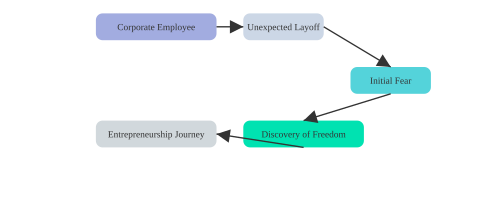
Fred’s journey is proof that life after layoff can be the start of something extraordinary. If you’re facing a similar crossroads, remember: sometimes, the end of one path is the invitation you need to finally choose your own.
2. Unseen Baggage: Overcoming Addiction and Breaking Family Cycles
When you step into entrepreneurship, you bring your whole self—including the invisible weight of family trauma and personal struggles. For Fred, this meant facing a family history of substance abuse head-on. His journey shows that overcoming addiction and breaking family cycles is not just about personal growth, but also about building the resilience needed for creative and business success. If you’re an entrepreneur, understanding and addressing your own unseen baggage can be a turning point for your mental health and your business.
Family Trauma: The Hidden Legacy
Fred’s story begins with a family deeply affected by substance abuse. As he shares, “My family has substance abuse problems, tends to run like a fire through families. And whether that be alcoholism or overeating or drug abuse or any of those things.” This legacy is subtle but powerful—it shapes how you handle stress, risk, and relationships, often without you realizing it. Growing up with a parent struggling with alcoholism, Fred absorbed coping mechanisms and emotional patterns that would later affect his own choices.
Recognizing the Cycle: From Denial to Acceptance
One of the most challenging aspects of overcoming addiction is admitting there’s a problem. Fred describes his own denial: “I was one of those people who thought, oh, I know alcoholics. So I can't possibly be one.” This is a common reaction, especially if you’ve witnessed addiction in others—you believe knowledge alone protects you. But as Fred learned, “It took life to show you that it can affect anybody, and, you know, it affected me and I had to get a handle on it.”
For nearly 25 years, from his teenage years until age 40, Fred struggled with alcoholism. The turning point came not from a dramatic event, but from the slow realization that “it's harder to live that sort of life. Things start piling up.” He recognized that ignoring the problem would only lead to more pain and missed opportunities, both personally and professionally.
Action and Humility: The Real Tools for Change
Fred’s experience highlights a crucial lesson for entrepreneurs: you can’t out-think or out-run addiction. Real change comes from action and humility. He shares, “I had to get a handle on that before it, you know, really destroyed your life.” This meant seeking help, being honest with himself, and accepting that healing is not about comparing pain. As Fred puts it:
"I used to knee jerk reaction, well, let me share mine with you. And I think somewhere along the line that it's just dawned on me that it's like it's not a contest. I don't want to out trauma your trauma."
This mindset shift—from competition to compassion—opened the door for true personal growth.
Therapy, Openness, and Breaking the Stigma
One of the most powerful tools Fred used was therapy. Despite lingering social stigma, especially among entrepreneurs who pride themselves on independence, seeking outside help is a sign of strength. Therapy provided Fred with a safe space to unpack years of family trauma and develop healthier coping strategies. He emphasizes that healing isn’t about making pain a competition, but about finding what works for you and committing to the process.
Honest conversations about addiction and mental health for entrepreneurs are still rare, but they’re essential. By sharing his story, Fred shows that talking openly about ‘failures’ like addiction actually leads to stronger, more resilient business owners. Addressing your unseen baggage doesn’t just improve your personal life—it makes you a better leader, partner, and creator.
Fred’s Journey at a Glance
| Challenge | Details |
|---|---|
| Alcoholism Duration | Teenage years to age 40 (~25 years) |
| Family History | Substance abuse affected multiple generations |
| Turning Point | Realized the lifestyle was unsustainable at age 40 |
| Tools for Recovery | Therapy, self-work, honest conversations |
Fred’s journey is a reminder that overcoming addiction and breaking family cycles is possible—and that doing so is a foundation for lasting personal and entrepreneurial growth.
3. Ditching the Conveyor Belt: Building a Print-On-Demand Business (with Data Table)
Imagine trading in the daily grind of the corporate world for the creative freedom of running your own print-on-demand business. That’s exactly what Fred did. As a graphic designer at heart, Fred’s journey took him from being a corporate liaison to the VP of a global company to managing multiple ecommerce apparel stores—all powered by print-on-demand technology.
From Corporate Chains to Creative Control
For years, Fred followed the traditional path: college, corporate job, and the promise of security. But even as he rose through the ranks, he never truly felt in control. “I never felt safe in these corporate jobs,” Fred recalls. The turning point came unexpectedly when he was laid off while his wife was seven months pregnant. Instead of panic, Fred saw an opportunity. With a severance check in hand, he decided to finally build something of his own—using his graphic design skills to launch online apparel stores.
Why Print-On-Demand?
Fred’s decision to embrace the print-on-demand business model was both practical and strategic. Unlike traditional retail, print-on-demand means you don’t need to buy or store inventory. There’s no risk of unsold stock piling up in your garage. Instead, products are created and shipped only when a customer places an order. This approach reduces overhead, minimizes risk, and lets you experiment with new designs quickly. As Fred puts it:
"I think I like this better because I have a direct connection to my customers. I see directly what they like... Printing on demand, so no overhead costs, you're running an online business, you can do from anywhere in the world."
Leveraging Printify for Seamless Store Management
To bring his vision to life, Fred turned to Printify, a leading print-on-demand platform. With Printify Premium subscription, he gained access to a wide network of print providers, automated order fulfillment, and easy integration with his ecommerce stores. This meant he could focus on what he loved—designing new products—while Printify handled the logistics. The flexibility of this model allowed Fred to run his business from anywhere, scaling up as demand grew.
Business Lessons: Loving Your Product and Learning from Data
Building a successful print-on-demand business isn’t just about uploading designs and waiting for sales. Fred learned that you have to love your products and stay connected to your customers. The real-time feedback loop—seeing which T-shirts sell and which don’t—helped him refine his offerings. Services like Printify make it easy to test new ideas without major upfront investment, so you can quickly pivot based on what your audience wants.
Charting the Path: From Severance Check to Full-Time Entrepreneur
Fred’s journey from corporate employee to full-time online store owner was marked by key decisions and milestones. He leveraged his severance as startup capital, invested in a Printify Premium subscription, and gradually expanded his product range. The table below outlines the major steps in Fred’s business journey, including the challenges he faced and the strategies that helped him succeed.
| Stage | Key Decision | Milestone | Stumbling Block | Solution |
|---|---|---|---|---|
| Corporate Layoff | Use severance as startup capital | First online store launched | Uncertainty about next steps | Focused on graphic design strengths |
| Store Launch | Choose print-on-demand model | No inventory or in-house fulfillment needed | Learning ecommerce platforms | Leveraged Printify’s integrations |
| Scaling Up | Subscribe to Printify Premium | Multiple apparel stores running | Managing multiple stores | Automated order fulfillment |
| Growth & Feedback | Test new designs regularly | Full-time income as entrepreneur | Product flops and slow sellers | Use sales data to refine products |
Fred’s story shows how leveraging the print-on-demand model and tools like Printify can turn creative skills into a sustainable business, all while maintaining flexibility and a direct connection to your customers.
4. Printify Premium Unpacked: The Real Benefits for Bootstrapped Businesses (with Features Table)
If you’re building your print-on-demand business from scratch, every dollar counts. That’s why understanding the real value of a Printify Premium subscription is crucial for maximizing your profit margins and scaling efficiently. Whether you’re selling T-shirts like Fred, mugs, or tote bags, Printify’s platform can help you avoid inventory headaches and focus on what matters most: creating and earning.
How Printify Premium Boosts Your Profit Margins
One of the biggest advantages of Printify Premium is the up to 20% discount on all products. This means that with every sale, you’re keeping more profit in your pocket. For bootstrapped businesses, these savings can quickly add up—especially as your order volume grows. As one user put it:
"Printify Premium subscription offers up to 20% discount on all products, making it cost-effective for merchants with growing sales."
With lower product costs, you can price competitively, run more promotions, or simply enjoy higher margins. This is a game-changer when you’re trying to break even and reinvest in your business.
Premium vs. Free: Number of Stores, Discounts, and Exclusive Features
Printify’s Free plan is a solid starting point, but if you’re managing multiple brands or want to expand, Premium unlocks significant advantages:
- Product Discounts: Up to 20% off with Premium vs. no discount on Free.
- Store Management: Manage up to 10 stores with Premium (vs. 5 on Free), perfect for multi-brand operators or agencies.
- Product Catalog: Access to over 1,300 customizable products and 90+ print providers on both plans.
- Unlimited Designs: Both plans allow you to upload as many designs as you want.
What No One Tells You: When the Upgrade Pays Off
The real question is: When does Printify Premium start to make sense? Here’s a quick break-even analysis:
- Monthly Subscription Cost: $29/month (or $24.99/month billed annually)
- Average T-shirt Discount: Around $2 per shirt with Premium
- Break-Even Point: Sell about 15 T-shirts per month and your subscription pays for itself through product discounts alone.
If you’re consistently hitting or aiming for this sales volume, upgrading to Premium is a smart move. Otherwise, the Free plan or exploring Printify alternatives like Printful or Gelato might be a better fit.
Printify Premium vs. Printify Free and Alternatives: At-a-Glance Comparison
Here’s a quick table comparing Printify’s plans and main competitors, so you can see which option aligns best with your entrepreneurial goals:
| Provider | Monthly Price | Product Discounts | Number of Stores | Product Catalog | Integrations |
|---|---|---|---|---|---|
| Printify Free | $0 | None | 5 | 1,300+ | Shopify, Etsy, WooCommerce, more |
| Printify Premium | $29/mo ($24.99/mo annual) |
Up to 20% | 10 | 1,300+ | Shopify, Etsy, WooCommerce, more |
| Printful Free | $0 | None | Up to 5 | 300+ | Shopify, Etsy, WooCommerce, Amazon, more |
| Gelato Free | $0 | None | Up to 5 | 130+ | Shopify, Etsy, WooCommerce, Wix, more |
| Gelato+ | $14.99/mo | Up to 30% on shipping | Unlimited | 130+ | Shopify, Etsy, WooCommerce, Wix, more |
Does Printify Align with Your Entrepreneurial Goals?
If your focus is on maximizing profit margins, managing multiple stores, and accessing a vast product catalog, Printify Premium is a strong contender. However, if you’re just starting out or need specific features (like advanced branding or local fulfillment), exploring Printify alternatives such as Printful or Gelato may be worthwhile. The key is to match your business model and growth plans with the platform that offers the best value for your needs.
5. Human First, Entrepreneur Second: Authenticity, Bravery, and Finding Meaning in the Mess
Authentic Living: The Real Foundation of Entrepreneurial Success
When you step into entrepreneurship, it’s easy to get swept up in the hustle mentality—chasing productivity hacks, comparing yourself to others, and rehearsing what you think you “should” say. But Fred’s journey with print-on-demand taught him that true business resilience and happiness come from living authentically. As he puts it,
"Try my best to be me. I don't want to rehearse things... this is what I truly feel and I hope it comes across that way."This commitment to authenticity—showing up as yourself, flaws and all—became the bedrock of Fred’s sustainable happiness, not just his business growth.
Daily Practice: Presence, Honesty, and Helpfulness Over Perfection
Instead of obsessing over perfect systems or productivity, Fred built his days around three core values: authenticity, helpfulness, and bravery. These simple habits, reinforced through daily self-reflection for entrepreneurs, helped him stay grounded and present. Each morning, Fred would open his “one percent better” journal and jot down a small way to improve or something he was grateful for. This practice didn’t just track business wins—it captured moments of personal growth, kindness, and courage.
- Authenticity: Show up as your real self, even when it’s uncomfortable.
- Helpfulness: Make it your mission to be useful to others, no matter how small the gesture.
- Bravery: Push yourself to try new things, even if anxiety or fear creeps in.
By focusing on these values, Fred found that being present and honest beat any productivity system. He learned that work-life balance isn’t about rigid routines, but about aligning your actions with what matters most.
Pitfall: The Trap of Comparison and Rehearsed Positivity
One of the biggest challenges in authentic living is the urge to compare yourself to others or to present a polished, rehearsed version of yourself. Fred admits he sometimes wished he was more extroverted, especially when he saw outgoing entrepreneurs thriving in the spotlight. But he realized that rehearsing positivity or chasing someone else’s style only led to frustration and burnout. Instead, he leaned into his strengths as an introvert entrepreneur, focusing on deep connections and thoughtful communication.
If you find yourself rehearsing your words or comparing your journey to others, pause and ask: What do I truly feel? What do I want to share, even if it’s imperfect? This is where real growth and connection happen.
Anecdote: Embracing Introvert Strengths
Fred’s story is a reminder that you don’t have to be the loudest person in the room to make an impact. He often admired extroverts, wishing he could be more like them, but also recognized the unique strengths of being an introvert entrepreneur. He learned to put himself out there in his own way—through honest writing, small acts of bravery, and meaningful conversations. As Fred says, “Life is better when you put yourself out there,” even if it doesn’t always go smoothly.
Wild Card: The Power of a ‘One Percent Better’ Journal
A simple tool like a “one percent better” journal can transform your approach to business and life. Each day, jot down one thing you’re grateful for or one small improvement you can make. Over time, these tiny steps add up to big changes in mindset, resilience, and fulfillment. Research shows that building habits around gratitude and kindness leads to deeper satisfaction, both professionally and personally.
Practical Tips: Self-Reflection Beyond Business Metrics
- Start each day with a gratitude entry or a small goal for personal growth.
- Check in with your core values: Are you being authentic, helpful, and brave today?
- Celebrate progress, not perfection—focus on getting one percent better.
- Embrace your introvert strengths: deep listening, thoughtful action, and meaningful work.
- Remember, real business resilience grows from personal integrity and self-acceptance, not just hustle.
By putting your humanity first, you’ll find meaning in the mess and build a business—and a life—that feels truly your own.
6. Charting Your Own Exit: Can Print-On-Demand Work for You? (Chart: Break-Even & Growth)
Are you considering breaking free from your corporate routine and starting a creative business? Print-on-demand (POD) platforms like Printify make it possible to launch your own brand with minimal risk and no inventory headaches. But before you take the leap, it’s important to understand the real costs, potential returns, and how Printify Pricing Plans—especially the Printify Premium subscription—can impact your journey from side hustle to sustainable income.
Breaking Down the Real Costs: Printify Pricing Plans
Printify offers two main subscription tiers: Free and Premium. The Free Plan allows you to start without any upfront costs, paying only for products as you sell them. The Printify Premium subscription costs $29/month (or $24.99/month if paid annually), and unlocks up to 20% product discounts—a game-changer for your profit margins.
- Free Plan: No monthly fee, pay per product, standard pricing.
- Premium Plan: $29/month or $24.99/month (annual), up to 20% off product costs, better margins, exclusive discounts.
"Printify Premium membership can improve profit margins by reducing product costs and providing exclusive discounts."
Cost vs. Return: When Is the Leap Worth It?
The big question: When should you upgrade to Printify Premium? The answer depends on your sales volume and business goals. If you’re selling only a handful of items each month, the Free Plan may be enough. But as your sales grow, those product discounts from Premium can add up fast.
Let’s break it down with a simple example:
- Average profit per T-shirt (Free Plan): $7
- Average profit per T-shirt (Premium Plan): $9 (thanks to product discounts)
- Monthly Premium cost: $29
To cover the $29 Premium fee, you need to sell about 15 T-shirts per month. After that, every sale increases your profit margin compared to the Free Plan. This is your break-even point.
How to Calculate Your Break-Even Point
Calculating your break-even is simple. Use this formula:
Break-even sales = Monthly Premium fee / Extra profit per item

Break-even sales = $29 / ($9 - $7) = 14.5 (rounded up to 15 T-shirts/month)
If you expect to sell 15 or more shirts each month, Printify Premium can start saving (and making) you money right away. For mugs, tote bags, or other products, just adjust the numbers based on your average profit per item.
Growth Potential: From Side Hustle to Global Business
With thoughtful planning, print-on-demand can quickly transition from an experimental side hustle to a sustainable income source. Printify’s business scalability means you can start small—selling to friends or local markets—and grow to reach customers worldwide without ever handling inventory or shipping. The more you sell, the more you benefit from Premium’s product discounts and exclusive features.
- Side Hustle: Great for testing ideas and earning extra income.
- Full-Time Business: Premium discounts and automation make scaling up realistic and manageable.
- Personal Fit: Flexible for any age or lifestyle—work from anywhere, anytime.
Visualization: Break-Even & Growth Chart
| Plan | Monthly Cost | Avg. Profit per T-shirt | Break-Even Sales (T-shirts/month) | Growth Potential |
|---|---|---|---|---|
| Free | $0 | $7 | 0 | Best for testing, low volume |
| Premium | $29 | $9 | 15 | Best for scaling, higher margins |
Whether you’re looking for a creative side hustle or aiming to build a global brand, Printify’s flexible pricing and business scalability can fit your goals. By understanding your break-even point and leveraging product discounts, you can chart your own exit from the corporate grind and move toward creative freedom.
7. FAQs: Real Answers for Aspiring Print-On-Demand Trailblazers
Starting your own print-on-demand business can feel overwhelming, especially if you’re leaving behind the security of a corporate job. Fred’s journey from corporate chains to creative freedom is proof that anyone can make this leap, but it’s natural to have questions. Here, you’ll find honest, practical answers to the most common concerns—helping you lower the barrier to entry and make informed decisions as you build your own ecommerce venture.
What is print-on-demand?
Print-on-demand (POD) is a business model where you sell custom products—like t-shirts, mugs, or tote bags—without holding any inventory. When a customer places an order, a third-party supplier prints and ships the product directly to them. This means you can focus on creating designs and marketing your store, while the order fulfillment is handled for you. It’s a flexible, low-risk way to start selling online, and you can run your business from anywhere in the world.
Is Printify Premium worth it for new sellers?
Printify Premium is a subscription that gives you access to product discounts and allows you to manage up to 10 stores across different ecommerce platforms. For new sellers, the main benefit is the lower base cost on every product, which can help you keep more profit per sale. If you’re just testing the waters, you might start with the free plan. But if you plan to scale up, or want to maximize your margins from the start, the Printify Premium subscription can pay for itself quickly—especially if you’re running multiple stores or seeing steady sales.
How do product discounts affect profit?
Product discounts from Printify Premium or similar plans directly increase your profit margin. For example, if a t-shirt costs $10 on the free plan but $8 with Premium, you keep an extra $2 per sale. Over time, this adds up, especially as your order volume grows. It’s important to factor in these savings when setting your prices and planning your business growth.
What about product quality and delivery speed?
Quality and delivery speed are top concerns for any print-on-demand business. Printify and its alternatives work with a network of print providers. This means quality can vary depending on the supplier you choose. Always order samples before launching a new product, and read reviews from other sellers. Delivery speed depends on the provider’s location and your customer’s address. Most platforms offer estimated shipping times, so be transparent with your customers to set clear expectations.
Are there Printify alternatives?
Yes, there are several Printify alternatives, including Printful, Gooten, Teespring, and SPOD. Each platform has its own strengths—some offer faster shipping, others have a wider product range or unique integrations with ecommerce platforms like Shopify, Etsy, or WooCommerce. Comparing these options can help you find the best fit for your business model and target market.
How many stores can you manage with each Printify plan?
With Printify’s free plan, you can manage up to five stores. The Printify Premium subscription increases this limit to 10 stores, making it easier to diversify your brands or test different niches. If you’re planning to scale or run multiple stores, Premium is a smart investment.
What personal qualities help most in this journey?
Fred’s story highlights the importance of resilience, authenticity, and bravery. Handling setbacks, learning from mistakes, and being willing to seek help—whether through therapy or mentorship—are crucial. The ability to adapt, stay true to yourself, and keep moving forward, even when things get tough, will serve you well in the print-on-demand world.
Is print-on-demand suitable for introverts?
Absolutely. Many successful print-on-demand entrepreneurs are introverts. You can build your business behind the scenes, focusing on design, strategy, and customer experience. As Fred shared, putting yourself out there can be challenging, but it’s also rewarding. The beauty of this business is that you can shape it to fit your personality and lifestyle.
In the end, launching a print-on-demand business isn’t just about selling t-shirts or mugs—it’s about taking control of your life, learning from your past, and building something that reflects who you are. Whether you’re considering Printify, exploring Printify alternatives, or weighing the value of a Printify Premium subscription, remember: the first step is the hardest, but it’s also the most freeing. Your journey to creative freedom starts now.
TL;DR: Fred’s story proves that even the thorniest setbacks—a surprise layoff or battling addiction—can become unexpected invitations to rewrite your story. By choosing authenticity over convention, investing in personal growth, and seizing opportunities like print-on-demand entrepreneurship, your ‘failures’ might just become the building blocks of a life you actually want.
Post a Comment