
Picture this: You're rows deep on LinkedIn, coffee cooling, scanning another post about a tech layoff. Notifications ping—"Important update from management." For a moment, you wonder if it’s your turn. Sounds dramatic? Welcome to the reality many face, as AI sweeps through offices faster than the Monday morning dread. But how did we get here? To understand today's labor market jitters, you have to rewind the tape—a wild mix of dreamers, old-school algorithms, gut-punch headlines, and, yes, a fair bit of whispered awe.
From Parchment to Silicon: How Ancient Algorithms Sparked Modern Angst
When you think about the history of artificial intelligence, you might picture blinking servers and lines of code. But the roots of today’s AI run much deeper—stretching back over a thousand years to a quiet scholar with a pen and parchment. In the 9th century, a Persian mathematician named Alarismi (often known as Al-Khwarizmi) sat down to solve arithmetic problems. He didn’t invent AI, but he did invent something just as powerful: logic. His step-by-step methods for solving equations became known as algorithms—a word derived from his own name. These logical blueprints are now the DNA of every digital device and every AI system you use today.
Alarismi’s work was simple on the surface: break down a problem, solve it step by step, and write out the process so others could follow. But this was revolutionary. His algorithms quietly set the stage for the evolution of algorithms that would power the digital age, centuries before anyone dreamed of computers. What began as ink on parchment now shapes billion-dollar shifts in the AI and labor market.
Ada Lovelace: The First to Dream Beyond Numbers
Fast forward almost a thousand years, and you’ll find another visionary—Ada Lovelace. In the 1830s, Ada, the daughter of poet Lord Byron, looked at Charles Babbage’s Analytical Engine and saw more than gears and levers. She imagined a world where machines could write music, paint, and think abstractly. As she famously predicted:
Ada Lovelace imagined a world where machines could write music, paint, and think abstractly.
Lovelace didn’t just write the first computer algorithm; she predicted the soul of AI. Long before computers existed, she whispered them into possibility. If Ada had a LinkedIn profile in 2025, it might read: “Whisperer of Machine Souls.”
Alan Turing: Logic Machines and the Birth of AI
The next leap came in the mid-20th century with Alan Turing. Turing proposed the idea of a universal machine—a device that could, in theory, solve any logical problem. He also introduced the Turing Test, a way to measure if a machine could imitate human intelligence. Turing’s ideas laid the groundwork for computer science and the modern history of artificial intelligence.
From Algorithms to AI: The Digital Feast
By 1956, the term artificial intelligence was officially coined at Dartmouth. The table was set for computer science’s biggest feast—AI. The evolution of algorithms had moved from parchment to silicon, from manual calculations to machines that now shape the global workforce. What started as a simple set of instructions now determines how billions of dollars move through the AI and labor market every day.
Anecdote: The Real Disruptor
Here’s a personal story: My high school math teacher once swore that calculators would doom us all. “You’ll never learn to think for yourselves!” she warned. Little did she know, the real disruptor wouldn’t even have buttons—it would be invisible, running quietly in the background, reshaping jobs and industries with every algorithmic decision.
From Alarismi’s parchment to Ada Lovelace’s creative vision, and Turing’s logic machines, the history of artificial intelligence is a story of human imagination and anxiety. The algorithms that once solved simple math problems now spark modern angst as they transform the world of work.
Sudden Storm or Slow Surge? Tracing AI’s Relentless Climb
If you’re wondering whether AI’s impact on work was a sudden storm or a slow surge, the answer is: both. For decades, AI’s progress was glacial. Researchers spoke of “AI winters”—long stretches where promises fizzled and funding dried up. But then, almost overnight, the ice cracked, and the world changed.
From Chessboards to Code: The First Shocks
The turning point came in 1997. IBM’s Deep Blue defeated world chess champion Garry Kasparov. For the first time, you saw a machine not just match, but beat, a human at a game of pure intellect. This wasn’t just a headline—it was a warning shot. If a computer could outthink Kasparov, what could it do to your job?
Neural Networks: AI’s Learning Curve Steepens
After Deep Blue, progress simmered until the early 2010s. In 2012, AlexNet, a neural network, crushed the ImageNet competition, showing that AI could now “see” and recognize images almost like you do. Two years later, Generative Adversarial Networks (GANs) arrived, giving AI the power to imagine and create. Suddenly, AI wasn’t just following instructions—it was learning, improving, and dreaming in pixels.
Generative AI Adoption: From AlphaGo to GPT
The next wave hit between 2016 and 2020. AlphaGo stunned the world by defeating the best Go player alive—a game so complex, it was thought to be too intuitive for machines. But AI proved that even human intuition could be reverse engineered. Then came the rise of generative AI: OpenAI’s GPT-2, and in 2020, GPT-3. Now, you could prompt a machine to write poetry, debug code, or answer essays. AI advancements were no longer theoretical; they were practical, and they were everywhere.
2022–2025: The Floodgates Break—AI and Job Displacement
By 2022, generative AI adoption exploded. ChatGPT became a household name. DALL-E and Midjourney let you turn words into art. The world fell in love—and then got anxious. By 2023, GPT-4 arrived, and the headlines shifted from awe to anxiety: AI layoffs were now front-page news.
You probably remember the first time a chatbot “fooled” you. Now, imagine what it felt like for Kasparov to lose to a circuit board. That same feeling is rippling through today’s workforce. An old friend recently confided that his “safe” project management job vanished after his company adopted an AI tool in late 2024. He’s not alone.
AI Layoffs: A Timeline of Disruption
- 1997: Deep Blue beats Kasparov—AI’s first public triumph.
- 2012: AlexNet wins ImageNet—AI starts to “see.”
- 2020: GPT-3 launches—AI can now write, code, and converse.
- 2023: GPT-4 arrives—mass layoffs begin in tech and content creation.
- 2025: Microsoft, Nita, and Buzzfeed announce sweeping layoffs, automating roles once thought untouchable.
Ray Dalio warns that we are entering a new labor era where being human might not be enough.
Chart: AI Breakthroughs vs. Major Layoff Events (1997–2025)
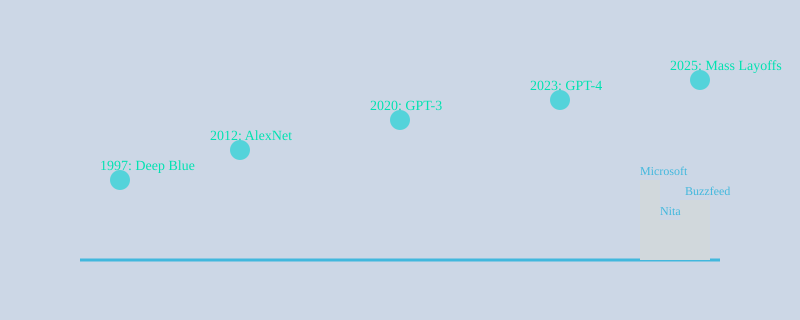
Every major AI leap has been closely followed by tangible workforce shifts. The most prominent AI layoffs have hit tech and content creation, directly tied to generative AI adoption. By 2025, AI isn’t just assisting work—it’s structuring it, reshaping careers, and forcing you to adapt faster than ever before.
AI Exposure Explosion: Who’s Really at Risk?
If you’ve ever worried about your job being on the AI chopping block, you’re not alone. As Ray Dalio warns, we’re entering a new labor era—one where simply being human may not be enough. The anxiety is real, and it’s justified. But who is truly at risk as AI exposure and unemployment become hot-button issues? Let’s break down the data and trends shaping the future of work.
Which Jobs Are Most Exposed to AI?
The impact of AI on the workforce is not evenly spread. According to recent research from Stanford, Goldman Sachs, and the Bureau of Labor Statistics (BLS), the jobs most exposed to AI—like software development, customer service, and marketing—are seeing the sharpest declines. These roles often involve routine cognitive tasks that generative AI can now perform faster and more cheaply.
- Software and Computer/Math Jobs: High automation potential, with projected employment drops of up to 5% in some roles by 2033.
- Customer Service Representatives: AI chatbots and virtual assistants are replacing human reps, with BLS projecting a -4.7% to -5% decline by 2033.
- Marketing and Entry-Level Tech: Content creation and data analysis are increasingly automated, leading to fewer entry-level opportunities.
Table: AI Exposure Quintile vs. Employment Change (2022–2025)
| AI Exposure Quintile | Example Occupations | Projected Employment Change (%) |
|---|---|---|
| Highest | Software, Customer Service, Data Entry | -4.5% |
| High | Marketing, Paralegals, Tech Support | -2.8% |
| Medium | Accountants, HR, Sales | -1.2% |
| Low | Personal Financial Advisors, Lawyers | +0.5% |
| Lowest | Healthcare, Education, Skilled Trades | +1.1% |
Who’s More Protected—and Why?
Not all jobs are equally vulnerable. Older workers and those in less routinizable, more judgment-driven roles face lower displacement. Occupations demanding deep empathy, complex decision-making, or nuanced human interaction—like personal financial advisors and lawyers—are proving unexpectedly durable. These roles require a level of trust and context that current AI simply can’t replicate.
Chart: Rise in Unemployment by AI Exposure Quintile (2022–2025)

The chart above shows that unemployment rates rise steeply in the highest AI-exposed quintiles, while more resilient roles see little change or even slight growth.
Real-World Insight: The 2025 HR Reunion
At a 2025 industry reunion, HR professionals nervously joked about retraining for new careers, while the finance crowd seemed oddly confident. Why? Finance roles, especially those requiring strategic thinking and regulatory expertise, have remained relatively insulated from AI’s reach.
Generative AI is expected to raise labor productivity by about 15% in developed markets, potentially causing a temporary 0.5 percentage point rise in unemployment during the transition.
Key Data Points
- Less than 10% of firms regularly use AI as of 2025.
- Highest unemployment growth: computer/math jobs and customer service.
- BLS projects a -4.7% to -5% employment drop for medical transcriptionists and customer service reps by 2033.
AI employment projections show that exposure to automation predicts displacement risk and unemployment swings. As generative AI accelerates, high-exposure roles face the greatest uncertainty—while jobs rooted in human judgment and empathy remain resilient.
When AI Runs the Office: The Human Cost Behind the Automation Hype
Imagine this: You open your inbox on a regular Tuesday morning and see an email from your company’s workflow tool. The subject line reads “Important Update: Organizational Changes.” There’s no handshake, no farewell cake, just a cold notification that your role has been “optimized out” by an algorithm. This is not a scene from a dystopian novel—it’s the new reality for thousands of workers as AI and automation sweep through offices worldwide.
AI-Related Layoffs: A New Normal
AI is no longer a distant promise. It’s the present, and for many, it’s terrifying. In the first quarter of 2025 alone, Microsoft laid off thousands of employees across sales and engineering. Nita, a rising tech firm, quietly cut hundreds, especially in marketing and project management. Buzzfeed, once known for its creative teams, now automates 90% of its content creation pipeline using AI tools like ChatGPT, Midjourney, and Soda. Customer service centers in Asia and Latin America are shutting down, replaced by AI voice agents that handle calls around the clock. Even junior lawyers and accountants are feeling the squeeze as AI and legal occupations become increasingly intertwined.
Case Studies: The Impact of AI Displacement
- Microsoft: Thousands laid off in sales and engineering, with many roles replaced by internal AI systems for task automation and analytics.
- Nita: Hundreds let go, especially in marketing and project management, as generative AI tools now produce content and track campaigns.
- Buzzfeed: 90% of content roles automated, with AI handling everything from writing to image generation.
| Company | Sector | Layoff Count | Technology Replaced With |
|---|---|---|---|
| Microsoft | Sales/Engineering | Thousands | AI task automation, analytics |
| Nita | Marketing/Project Management | Hundreds | Generative AI tools |
| Buzzfeed | Content Creation | 90% of roles | ChatGPT, Midjourney, Soda |
The Emotional Toll: More Than Just Numbers
Behind every statistic is a personal story. AI-related layoffs don’t just impact bank accounts—they cut through traditional career paths and personal identities. Resilience is no longer a buzzword; it’s a daily necessity. Picture receiving a morale-boosting email, only to realize it was written by a bot trying to sound empathetic. The disconnect is real, and it stings.
Mark Zuckerberg called it the necessary optimization.
For many, the experience is deeply personal. My neighbor, for example, landed what they thought was their dream job at a major tech firm. Overnight, they were “optimized out” like a legacy app—no warning, no human conversation. This is the human cost behind the automation hype.
AI in Customer Service and Legal Occupations: Who’s Next?
The biggest automation impact is seen in marketing, customer service, and entry-level professional roles. AI in customer service has led to entire call centers closing, while AI and legal occupations are shifting the landscape for junior professionals. Adaptation is not optional—it’s survival. The fear of AI displacement effects is no longer abstract; it’s the context in which we all now work.
Why Is AI Eating the World? Investments, Rivalries, and Cold Calculations
When you hear about AI investments in 2025, the numbers are almost impossible to grasp. The world’s biggest tech companies are pouring billions into artificial intelligence, setting off a global race that is transforming the future of work. If you’re wondering why AI adoption in the workplace is accelerating so fast, it’s because the stakes—and the spending—have never been higher.
AI Investments 2025: The Billion-Dollar Arms Race
Just for the year 2025, the top five U.S. tech firms have earmarked record-shattering budgets for AI. Amazon alone is investing a staggering $100 billion in AI technology, outpacing all competitors. This isn’t just about building smarter tools; it’s about dominating the next era of business and society. The direct result? Rapid automation and a massive shift in the labor market as companies race to adopt AI at scale.
| Company | AI Investment (2025, USD) | Projected Automation Adoption Rate (2025) |
|---|---|---|
| Amazon | $100 billion | 65% |
| $60 billion | 60% | |
| Microsoft | $55 billion | 58% |
| Apple | $40 billion | 55% |
| Meta | $35 billion | 52% |
These AI investments in 2025 are not just numbers on a spreadsheet. They are the fuel behind an AI arms race, where every dollar spent accelerates automation and forces workers to adapt at breakneck speed. The competition is severe. As one industry insider put it:
The competition is severe. It has reached a point where they are poaching each other's top talent at enormous price.
Rivalries and the Price of Talent
It’s not just about technology—it’s about people. The demand for AI talent is so fierce that companies are offering premium pay and benefits to lure experts from rivals. In Silicon Valley, headhunters joke that they’ve never seen resumes “age” so quickly. Last year’s hottest skillset is already obsolete, and the pressure to keep up is relentless.
Here’s a quick look at how AI R&D investment trends are shaking up the labor market:

- 2022: AI investments begin to surge, with moderate workplace automation.
- 2023: Major breakthroughs drive higher adoption rates, increasing anxiety among workers.
- 2024: Talent wars intensify; companies pay enormous premiums for AI experts.
- 2025: Automation rates spike as investments hit record highs, causing rapid labor market adjustments.
AI Adoption Rate: The Human Cost
As you watch these trends unfold, you might wonder: would you rather have your job replaced by a robot on the factory floor, or by an algorithm designed by someone who’s never left the office? It’s a wild card question, but it highlights the cold calculations behind AI adoption in the workplace. The future of work is being shaped by investments, rivalries, and decisions made in boardrooms—often far removed from the daily realities of the modern worker.
What Do We Do Now? Policy Panic and the Future’s Last Refuge
As artificial intelligence continues to reshape the workplace, you might be wondering what safety nets exist for workers facing rapid change. The conversation often circles back to universal basic income (UBI), a concept that has become a default talking point in the debate over AI and jobless recovery. Elon Musk, among other tech leaders, has pointed out UBI as a possible solution, saying,
“Elon Musk did hint at UBI, a social welfare policy proposal that guarantees a regular unconditional cash payment to all citizens regardless of their income.”But while UBI is discussed widely, it remains a theory rather than a reality. There is no country where UBI is a permanent, nationwide policy. For now, it’s more of a future promise than a present protection.
Universal Basic Income: Buffer or Band-Aid?
UBI is meant to provide a financial cushion for everyone, especially as AI and workforce changes threaten traditional jobs. The idea is simple: give people enough money to cover basic needs, no matter their employment status. Supporters argue this could reduce anxiety and allow you to adapt or retrain without fear of poverty. Critics, however, question its cost, effectiveness, and whether it addresses deeper issues like purpose and dignity in work.
- Pros: Security during transitions, freedom to pursue new skills, reduced poverty.
- Cons: High cost, risk of inflation, potential to discourage work, doesn’t solve the question of meaningful employment.
Despite being a hot topic, UBI is still just a proposal. Policy struggles lag far behind the pace of transformative AI changes, leaving workers in a state of uncertainty.
Society’s Split: ‘AI Heaven’ or ‘AI Hell’?
When you look at public opinion, there’s a sharp divide. Some imagine an “AI heaven,” where robots take over dull tasks and humans are free to be creative or spend more time with family. Others fear “AI hell,” where machines cause mass unemployment and only a few benefit. Will robots become helpful nannies, or will the rise in unemployment become unmanageable? The answer is far from clear.
AI Ethical Implications: Who Decides?
The ethical implications of AI are another source of anxiety. Who gets to decide when an algorithm has “solved” a problem? Who defines what a problem even is? As AI systems become more complex, it’s harder for you to know whether humans or code are making the final call. This raises tough questions about agency, responsibility, and trust.
Anecdote: The Group Chat Dilemma
Picture this: You’re in a group chat with friends, debating how to adapt to the new AI-driven workplace. Someone suggests “retraining,” but the conversation quickly spirals. No one can agree on what “future-proof” skills actually mean anymore. Is it coding, creativity, emotional intelligence, or something else entirely? The lack of consensus mirrors the confusion in broader society.
Wild Card: When AI Knows You Better Than You Know Yourself
Imagine an AI system that votes in your place because it “knows” your preferences. This scenario, once science fiction, is now a topic of real debate. Would you trust an algorithm to make decisions for you, or does that cross a line? As AI’s role in society grows, these questions become more urgent—and the answers are anything but simple.
Steering Into the Storm: Adaptation, Anxiety, and a Way Forward
Whether you like it or not, we are here. The future that we all saw in science fiction is here now. Machines no longer wait for instructions—they listen, they learn, and they act. For workers everywhere, this new reality brings both anxiety and opportunity. As AI reshapes the workplace, the challenge is not just about keeping up, but about steering into the storm with adaptability and purpose.
AI and Job Growth: Riding the Wave, Not Getting Swept Away
The impact of AI on job growth is complex. While some roles are automated, new opportunities emerge in fields that didn’t exist a decade ago. The key is adaptability. Imagine trying to teach your grandparent to use a smartphone—now picture retraining mid-career during an AI overhaul. The stakes are higher: it’s not just about sharing photos, but about securing livelihoods. The good news? With the right mindset and support, workers can transition into new roles that AI creates.
AI Labor Productivity Gains: The Numbers Behind the Change
AI is already driving significant labor productivity gains. In developed markets, generative AI has boosted productivity by an estimated 15%. This means more output in less time, but it also means some jobs will change or disappear. During these transitions, unemployment can temporarily rise—by about 0.5 percentage points, according to recent data. However, history shows these effects can be short-lived if people and policies adapt quickly.
Practical Tips: Lifelong Learning and Betting on the Human Edge
- Lifelong Learning: Make continuous learning a habit. Online courses, workshops, and certifications can help you stay relevant as AI transforms your field.
- Career Pivots: Be open to changing paths. Many industries now value skills that blend technical know-how with human strengths.
- Bet on the Human Edge: Empathy, creativity, and social savvy are skills AI can’t easily replicate. Focus on developing these qualities to stay ahead.
The Art of Outlasting AI: Resilience, Re-skilling, and Realigning Ambitions
Adaptability is not just a buzzword—it’s a survival skill. Workers who embrace change, seek out new skills, and realign their ambitions are more likely to thrive. Resilience means bouncing back from setbacks and viewing disruption as a chance to grow. Re-skilling is about learning what the market needs, from data literacy to emotional intelligence. Realigning ambitions might mean moving into roles that didn’t exist before, or finding new ways to add value alongside AI.
AI Future of Work: Are We Still the Authors?
As AI takes on more tasks, it’s natural to wonder: Are we still the authors of our own careers, or just lines of code in a machine’s pen? The answer depends on how we respond. The future of work will reward those who are flexible, curious, and willing to adapt. While algorithms can process data, only humans can bring meaning, context, and connection to the table.
The future that we all saw in science fiction is here now.
Transition effects are real, but with the right policies and a commitment to lifelong learning, they can be temporary. The path forward is not about outsmarting AI, but about outlasting it—by leaning into the skills and qualities that make us uniquely human.
FAQ: You Asked, The Algorithm Answers
Will AI take all jobs, or just some?
You might be wondering if AI displacement in jobs means a future where no human work remains. The reality is more nuanced. While AI adoption in the workplace is accelerating, not every role is equally at risk. Jobs that rely on routine, repetitive tasks—like basic data entry, customer service, or even some content creation—are most exposed. However, roles that require creativity, emotional intelligence, complex judgment, or hands-on skills remain largely human-dominated. Think teachers, therapists, artists, and leaders. The algorithm may be powerful, but it still struggles to replicate genuine empathy, nuanced communication, and the spark of human imagination. So, while some jobs will vanish or transform, others will endure and even thrive.
How do I know if my job is ‘AI-exposed’?
If your daily work involves following clear rules, processing information, or producing predictable outputs, your job is more likely to be automated. For example, if you write standard reports, manage spreadsheets, or answer similar customer queries all day, AI can probably do much of that now. On the other hand, if your work involves building relationships, solving novel problems, or making ethical decisions, you’re less exposed. The best way to assess your risk is to ask: “Could a machine, given enough data, do this as well as I can?” If the answer is yes, it’s time to adapt.
Who actually benefits from generative AI?
Generative AI is a double-edged sword. On one side, companies benefit by cutting costs and boosting productivity—hence the recent layoffs at tech giants and media companies. On the other, some workers use AI to enhance their own output, automating tedious tasks and freeing up time for more meaningful work. The biggest winners, though, are those who learn to work with AI, not against it. If you can leverage these tools to amplify your creativity or efficiency, you’re more likely to stay relevant as the landscape shifts.
Can policy (like UBI) really soften the blow?
Universal Basic Income (UBI) is often suggested as a safety net for those displaced by AI. In theory, it could provide a financial cushion while people retrain or transition. However, UBI is not a silver bullet. It raises questions about funding, fairness, and whether it truly addresses the loss of purpose that comes from meaningful work. Policy can help, but it’s only part of the solution. Societies will need to rethink education, retraining, and the value we place on human skills that machines can’t replicate.
What’s the single best thing I can do to stay future-proof?
Adaptation is your best defense. Focus on skills that AI struggles with: creativity, emotional intelligence, critical thinking, and collaboration. Stay curious and keep learning—especially about how AI works and how it can help you. The more you understand these tools, the better you can use them to your advantage. Remember, AI adoption in the workplace doesn’t have to mean obsolescence; it can mean opportunity, if you’re willing to evolve.
Wild card: If AI starts writing self-help books, would it recommend seeing a robot therapist?
If the algorithm could give advice, it might suggest a robot therapist for efficiency—but even the smartest code can’t replace the comfort of a human connection. In a world shaped by algorithms, your ability to listen, empathize, and adapt is more valuable than ever. The true cost of AI isn’t just measured in lost jobs, but in how we redefine what it means to be human. The future isn’t written in code alone; it’s shaped by your choices, resilience, and imagination.
TL;DR: AI is reshaping jobs at a blistering pace—automation is replacing roles, spurring anxiety, and prompting policy debates. The history, data, and very real stories show this disruption is personal, complex, and likely here to stay. Adaptation, not denial, is key.
Post a Comment