

Picture this: It’s 5 a.m., your mind is racing, and you’re pondering why everyone raves about discipline but dreads cold calls. I’ve run companies hitting $250 million in revenue, smashed book sales records, and sat across tables with hundreds of business owners—and here’s what they never tell you. Your breakthrough rarely arrives when you’re enjoying the process; it happens in those nose-to-the-grindstone moments when motivation is at an all-time low. If I had a dollar for every time someone mistook liking an activity for being disciplined, well, I’d add a line-item on my P&L for ‘false pride.’ So, let’s break down the raw truth of growing a business in 2025—with some candid confessions and a little data-driven disruption, just to keep things spicy.
Discipline Isn’t Doing What You Love—It’s What Happens When You Don’t
When it comes to business growth discipline, most entrepreneurs get it wrong. They think discipline is about waking up early, hitting the gym, or working long hours on things they enjoy. But true discipline in business growth isn’t about doing what you love—it’s about showing up and delivering on the tasks you’d rather avoid. As one business leader put it:
“Discipline is about being able to be consistent with things you don’t like.”
Passion Isn’t Discipline: The Common Mistake
Let’s be honest: it’s easy to be “disciplined” when you’re doing something you love. In my years in the fitness industry, I met countless gym owners who bragged about their 5 a.m. workouts and perfect meal plans. They’d say, “I’m so disciplined—I never miss a session.” But when I asked about their sales leads or follow-ups, the story changed. Suddenly, they’d admit, “I haven’t been working them as hard as I should.”
This is the classic mistake: confusing passion for discipline. If you love lifting weights or boxing, showing up isn’t hard. There’s no friction or resistance to overcome. But business growth discipline is measured by your consistency with the things you don’t like—like cold calls, lead follow-ups, or tedious admin work.
My 5 a.m. Gym Routine vs. My Aversion to Leads
For years, I prided myself on my early morning gym routine. But the truth is, I enjoyed it. It didn’t take discipline for me to get up and train—it was a highlight of my day. Where I struggled was in the daily grind of working leads and following up with prospects. That’s where my discipline was truly tested. It’s the same for most entrepreneurs: the real challenge is sticking with the “boring” or uncomfortable tasks that drive growth.
Frustration Tolerance: The Muscle You Must Train
Think of delayed gratification entrepreneurship as a muscle—your “frustration tolerance.” This is your ability to do things you don’t want to do, without an immediate reward, for an extended period of time. The good news? This muscle can be trained. It’s not a fixed trait; it’s a skill you build with deliberate practice.
Start small. If you hate outreach, do 10 calls today. Tomorrow, do 20. Then 30. The goal is to gradually increase your tolerance for the “boring” work. Over time, you’ll find it gets easier, and the results compound.
The Rule of 100: Volume and Consistency in Business
Here’s a proven framework: the Rule of 100. Pick one key action that moves your business forward—like sales outreach, proposals, or content creation. Commit to doing it every day for 100 days. No exceptions. As the saying goes:
“If you do the rule of 100, you do that for a 100 straight days, your business will grow.”
Across my portfolio companies, which generated $250 million in aggregate revenue last year, the entrepreneurs who embraced the Rule of 100 saw dramatic results. Some reported their entire business transformed well before day 100. During a recent book launch, this approach helped drive $106 million in revenue in just three days.
Building Discipline as a Skill: How to Increase the ‘Boring’ Work
- Start with manageable targets. If 100 calls feels impossible, start with 10 and build up.
- Track your progress. Use a simple chart or spreadsheet to log your daily actions.
- Celebrate consistency, not just results. The act of showing up matters more than immediate wins.
- Reflect and adjust. If you miss a day, analyze why and recommit—don’t quit.
SVG Chart: Business Growth Over 100 Days (Rule of 100)
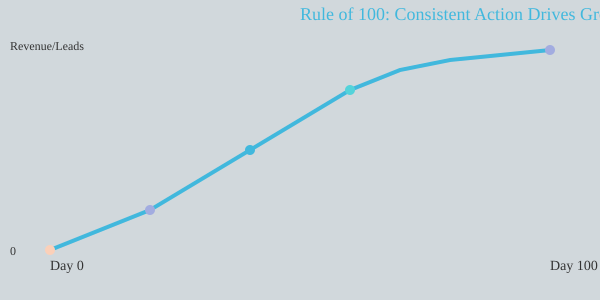
This chart shows how volume and consistency in business—taking one key action every day—leads to steady, compounding growth over 100 days.
The Paradox of Knowing What to Do, But Not Doing It: Reward, Uncertainty, and Mental Blocks
Most business owners and entrepreneurs already know their next move. You’ve read the books, watched the webinars, and maybe even paid for the course. Yet, when it comes to execution, you freeze. Why? The answer often lies in the struggle with delayed gratification entrepreneurship, the discomfort of uncertainty, and the mental blocks that come from unclear instructions and skill gaps.
Instant Gratification vs. Long-Term Growth
At the heart of the execution gap is a simple truth: humans are wired to seek immediate rewards. If you’re used to getting quick feedback or instant results, it’s hard to push through actions that don’t pay off right away. In business, this means you stick to what’s comfortable and proven, even if you know it won’t get you to the next level. The inability to delay gratification is one of the main reasons entrepreneurs stall, even when the path forward is clear.
The Wandering Marathon: Why Uncertainty Stops You Cold
Imagine you’re told to run a marathon. You know it’s 26.2 miles, and you can pace yourself accordingly. Now imagine someone says, “Just run. I’ll tell you when to stop.” Suddenly, every step feels heavier. You don’t know if you’re halfway done or just getting started. This is what entrepreneurship often feels like. The finish line is invisible, and the pain of not knowing when your effort will pay off can be paralyzing.
"Entrepreneurship, a lot of it is just the ability to tolerate uncertainty, which feels very painful the entire time."
This uncertainty—wondering if your sweat, dollars, and time are compounding or just being wasted—is a core pain point for founders. Many never start the race, or they quit early, simply because the payoff is too far away or too nebulous.
Specificity of Instruction: Why ‘Just Do Outreach’ Isn’t Enough
Another hidden barrier is the gap between knowing what to do and knowing how to do it. If someone tells you to “do outreach,” it sounds simple. But for many, that’s a bundled term hiding a hundred micro-skills. You need to know how to warm up a domain, write an opener, integrate tools, manage replies, and more. The lower your skill level, the more granular the instructions need to be. If you’re not clear on the steps, you’ll get stuck on the first unfamiliar task and stop.
- High skill level: Can break down vague tasks into actionable steps.
- Low skill level: Needs detailed, step-by-step instructions for each micro-task.
Unpacking Bundled Tasks: The Hidden Complexity
Identifying business constraints often means unbundling complex instructions into manageable pieces. “Outreach” isn’t one job—it’s a series of actions, each requiring its own learning curve. If you don’t recognize this, you’ll feel overwhelmed and frustrated, mistaking a skill gap for a motivation problem.
Dealing with Frustration and Lack of Immediate Results
Learning new business tasks is rarely a straight line. It’s a wandering process, full of trial and error. You might spend days on a problem and see no progress. This lack of instant feedback is where most people give up. Volume and consistency in business—showing up and trying again, even when results are delayed—are what separate those who outlast and outperform.
The Pain of Sustained Uncertainty
Every entrepreneur faces the same question: “Will this pay off?” The pain isn’t just in the work—it’s in not knowing if the work is moving you forward. This is the true test of delayed gratification entrepreneurship. If you can tolerate the uncertainty and keep moving, you’ll eventually break through. But if you need constant reassurance or immediate wins, you’ll stay stuck in your current equilibrium.
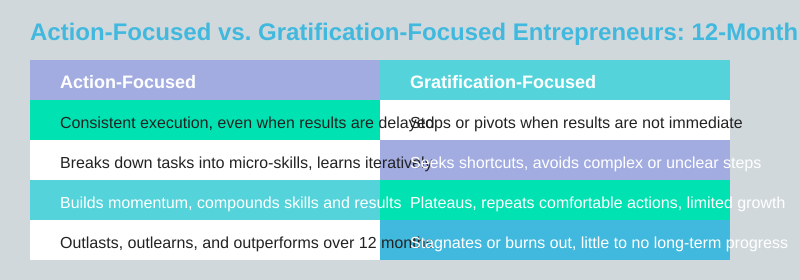
Self-Awareness in the Noise: Navigating Conflicting Advice and Your Personalized Growth Path
In the world of business growth, you’ll quickly notice a paradox: the more you seek advice, the more conflicting opinions you’ll encounter. One expert swears by one strategy, while another—equally successful—insists on the opposite. The real skill isn’t just in finding advice, but in knowing which advice fits your situation. This is where self-awareness business success becomes your superpower.
Self-Awareness: Your Most Valuable Business Skill
Self-awareness is the rarest and most valuable skill you can develop as an entrepreneur. It’s the ability to judge what’s right for you, given your unique resources, skills, and constraints. As one lesson puts it:
"Understanding what is right for you given your existing resources and skills is probably the most valuable thing, which is self-awareness."Instead of chasing every guru or trend, self-aware leaders filter advice through the lens of their own context. This prevents wasted time and energy on strategies that don’t fit your business reality.
Personal Example: Binge-Reading to Break Through
Consider this real-world example: When facing the challenge of starting a family office, I read 15 books in two weeks. I dove deep into every angle—structures, investment theses, and case studies from industry leaders. This wasn’t about becoming a generalist; it was about targeting the exact constraint that was holding me back. Once that bottleneck was cleared, I ruthlessly shifted focus to the next challenge. This is the discipline of identifying business constraints and attacking them with everything you’ve got.
| Action | Purpose |
|---|---|
| Read 15 books in 2 weeks | Overcome a new business challenge |
| Aggressively ‘bomb’ primary constraint | Remove chokepoint before moving on |
Laser Focus Amid a Tsunami of Input
Today, you’re bombarded by a constant stream of information—social media, books, podcasts, newsletters. The key to business growth discipline is developing laser focus. Here’s how you can do it:
- Identify your primary constraint: What’s the single biggest thing holding your business back right now?
- Go all-in on solving it: Don’t dabble. Attack the problem from every angle—read, watch, hire, and practice until it’s no longer a bottleneck.
- Eliminate distractions: Ruthlessly cut out activities and advice that don’t address your main constraint.
- Move on only when solved: Once the constraint is gone, shift your focus to the next most pressing issue.
Why Picking a Constraint and Going All-In Wins
Many entrepreneurs fall into the trap of scattergun growth hacking—trying a little bit of everything, hoping something sticks. But the hidden pillar of commitment is the elimination of alternatives. By focusing all your resources on your biggest constraint, you create the conditions for real breakthroughs. This approach is far more effective than spreading yourself thin across multiple fronts.
Maniacal Problem-Solving: Bombing the Bottleneck
When you identify a constraint, don’t just try one solution—try them all. Read every relevant book, consume every video, hire experts, and practice relentlessly. This maniacal approach ensures that you don’t just chip away at the problem; you obliterate it. Only then do you move on to the next constraint. This cycle of focus, action, and elimination is the engine of relentless business growth.
Commitment and Focus: The Power of Saying No
True commitment means saying no to almost everything except your current constraint. Learning what not to do is as important as choosing what to focus on. This discipline—eliminating alternatives—keeps you from being distracted by every shiny new tactic and ensures your energy is spent where it matters most.
In summary, self-awareness business success is about knowing yourself, your business, and your constraints. It’s the foundation for efficient, focused, and relentless growth—even when the world is shouting contradictory advice at you from every angle.
The Volume Illusion: Why You Underestimate How Much It Takes (and Why That’s Good!)
Why Most People Miss the Real Volume and Consistency Business Demands
When you set out to grow your business, it’s easy to underestimate just how much work, repetition, and discipline it will take. Most people imagine a handful of big efforts or a few intense sprints. The reality? Success in business growth discipline is built on a staggering amount of volume and consistency—far more than you can picture at the start.
This is the Volume Illusion: you think you know what it will take, but you’re almost always off by orders of magnitude. The number of sales calls, product tweaks, marketing experiments, or late nights required is so much higher than you expect. And here’s the twist: that’s actually a good thing.
“If People Really Knew How Much Volume and Repetition It Took, They Wouldn’t Begin”
If people really knew how much volume and repetition it took they wouldn’t begin.
This quote captures a little-known phenomenon in entrepreneurship. If you could see the true distance to your goal—the thousands of hours, the endless cycles of trial and error, the mountain of invisible work—you might never take the first step. The illusion protects you from overwhelm and burnout. It keeps you moving forward, one small action at a time, rather than freezing in the face of an impossible mountain.
The 4 a.m. Gym Witness: Consistency’s Invisibility
Imagine showing up at the gym every day at 4 a.m. You only see the other people who are also there, day after day. To everyone else, the discipline and consistency required are invisible. The same is true in business. Only those who show up, put in the reps, and stick with the process can truly see what it takes. Outsiders see the results, but not the invisible grind that made them possible.
Consistency and volume are invisible to all but those who participate. External results always lag behind the substantial input. True progress is measured in invisible reps—only by being there every day do you see the true path to mastery.
The Exponential Effect: Small Improvements, Massive Results
Here’s where the magic happens. When you combine volume and consistency business practices, you unlock the power of compounding. Tiny improvements, repeated hundreds or thousands of times, lead to exponential growth. This is the heart of delayed gratification entrepreneurship: you don’t see the results right away, but over time, the gains stack up in ways that seem impossible at first.
| Action | Short-Term Result | Long-Term Result (100+ Days) |
|---|---|---|
| Show up at 4 a.m. daily | Minimal visible progress | Significant skill and strength gains; only the consistent witness each other’s growth |
| Daily business outreach | Few responses, slow traction | Network, reputation, and opportunities multiply exponentially |
The Trap of Expecting Instant Results
One of the biggest mistakes in business growth discipline is expecting quick wins. The reality is that compounding outcomes take time. You might feel like you’re making no progress for weeks or months. But when you look back after 100 days of consistent action, the distance you’ve traveled is astonishing. Exponential growth is often only clear in hindsight—look back to appreciate the distance traveled.
Wild Card: “If the Goalpost Were Visible, the Stadium Would Be Empty”
Here’s a quirky analogy: imagine if every entrepreneur could see exactly how far away the goalpost was at the start. Most would never step onto the field. The stadium would be empty. But because the true distance is hidden, you take the first step, then the next, and before you know it, you’re halfway across the field. This psychological quirk actually protects you and keeps you moving forward.
- Key Point: Most underestimate the sheer quantity and repetition necessary to succeed; it’s orders of magnitude more than you imagine.
- Little-known phenomenon: If people saw the real volume required, many would never start (and that’s okay).
- Consistency and volume: Only visible to those who participate; results always lag input.
Managing Distractions, Harnessing Ideas: When Doing Nothing Is Really Doing Something
When it comes to managing distractions as entrepreneurs, the greatest threat to business growth discipline isn’t a lack of ideas—it’s having too many. Every founder knows the rush of inspiration that comes with a new concept. But here’s the hard truth: executing every idea is a recipe for disaster. The real challenge is not in generating ideas, but in filtering, prioritizing, and, most importantly, waiting.
Too Many Ideas: The Hidden Danger
Entrepreneurs are natural idea machines. In fact, Jeff Bezos once said that in just 30 minutes, he could write down 100 ideas that would destroy his company. This isn’t an exaggeration. The volume and consistency business leaders face in idea generation can easily overwhelm even the most organized teams. The key is recognizing that not every idea deserves immediate action. Selective execution is crucial to business survival and long-term scaling.
The ‘Idea Parking Lot’: Your Secret Weapon
One of the most effective tactics for managing distractions entrepreneurs face is maintaining an ‘Idea Parking Lot’. Personally, I keep what I call “Alex’s big list of ideas.” Every time a new idea pops up, I don’t dismiss it or act on it right away. Instead, I document it thoroughly—sometimes even linking to a detailed memo outlining how it would work, what it would make, and why it might matter. Then, I leave it alone.
This approach creates emotional and temporal distance from the idea, allowing you to return to it later with a clear head. More often than not, what seemed brilliant in the heat of the moment looks questionable after some time has passed. This simple discipline has dramatically changed my trajectory as an entrepreneur and is a cornerstone of business growth discipline.
Sandra Bullock’s ‘Shirt Rule’ for Ideas
Here’s a wild card: Sandra Bullock has a rule for buying shirts—if she thinks about a shirt for two weeks, she goes back and buys it. You can apply the same principle to your ideas. If an idea keeps nagging at you after two weeks (or more), maybe it’s worth a second look. Most ideas lose their shine once the initial excitement fades. The ones that stick are often the ones worth pursuing.
The Discipline of Patience: Waiting as a Growth Accelerator
Patience is a counterintuitive accelerator for business growth. As one private equity leader told me,
“The most profitable thing you can do is wait… doing nothing is something.”It takes real willpower to not start new things, especially when you’re surrounded by opportunity. But waiting—deliberately choosing not to act—banks goodwill with your business and your team. It gives you time to assess whether your idea is truly valuable or just another distraction.
Respecting Output Capacity and Team Bandwidth
Before acting on any new idea, it’s vital to understand your business’s and your team’s true output capacity. Even the best idea will fail if your team is stretched thin or burned out. Great ideas without a rested, ready team are self-sabotage. Watch for signs of fatigue or overwhelm. When your team looks well-rested and energized, that’s when you can consider pulling an idea from your parking lot and moving forward.
Proof in Patience: Selective Execution Wins
Consider this: a record $106 million in book sales was achieved in just three days, but only after extensive waiting and preparation. The lesson? Volume and consistency in business ideation are only valuable when paired with patience and selective execution. The most impactful entrepreneurs talk openly about restraint and bandwidth management as their ultimate edge. They know that unchecked ideation or hustle rarely leads to sustainable growth.
- Document your ideas, but don’t act on them immediately.
- Give yourself and your team time to rest and reflect.
- Revisit ideas only when your business has the bandwidth to execute well.
- Remember: “The most profitable thing you can do is wait.”
Building with People: The Hidden Limiter—A-Level Talent & Team Output
As your business begins to scale, you’ll quickly discover a surprising truth: your biggest bottleneck isn’t your next big idea, your access to capital, or even your personal drive. It’s the people you can attract, develop, and keep. Hiring A-level talent and building high-performing teams are the ultimate limiters for growth. Once you’ve solved for product-market fit and basic operations, the ceiling on your business is set by the quality of your team—not your own willpower.
Manpower and Talent: The Real Bottleneck at Scale
Many entrepreneurs believe that if they just work harder or come up with a better strategy, they’ll break through to the next level. But as you scale, you’ll realize that manpower—specifically, talent—is almost always the true limiter. This is why you see billionaires on stage repeating the same advice: “Get a good team and get out of their way.” The challenge, of course, is that good people don’t want to work for you—not you, entrepreneurs in general.
Wild Card Scenario: Inheriting a Business Without the Best Minds
Imagine you inherit a business, but the best minds in the industry won’t work for you. What now? This scenario highlights the hidden multiplier in business growth: your ability to attract and retain high-performing teams. Without A-level talent, even the best business model will plateau. The lesson is clear—talent, not just founder hustle, is the true bottleneck for companies aiming for breakout growth.
Organizational Culture Values: The Magnet for A-Level Talent
So, how do you bridge the gap and get A-level talent to join your mission? It starts with organizational culture values. Top performers are drawn to environments where they can grow, contribute meaningfully, and work with other high-caliber people. Your culture must signal that you value excellence, autonomy, and continuous learning. This is not just about perks or pay—it’s about creating a place where the best want to be.
Practical Tip: Output Capacity Is About the Team, Not Just You
It’s tempting to believe that your own grit and long hours will drive results. But in reality, output capacity is directly tied to the quality, fit, and rest level of your team. If your team is burned out or mismatched, your business will stall. If you invest in hiring A-level talent and give them space to recharge, your business can achieve much more than you could alone.
- Quality: Prioritize skills and mindset over just filling seats.
- Fit: Ensure alignment with your mission and values.
- Rest: Encourage healthy work-life balance to sustain high output.
Lessons from Billionaires: People Over Strategy
Even legends like Jeff Bezos emphasize people over strategy at scale. In private equity, heirs to billion-dollar fortunes often spend more time on team-building than on chasing new ideas. In fact, a recent case study of a billionaire’s private equity heir found that their first priority was assembling a world-class team—not launching new products. The most successful entrepreneurs at scale cite talent attraction as the single most important factor in their growth.
“Good people don’t want to work for you—not you, entrepreneurs in general.”
The Tough Truth: A-Level Talent Works for Themselves or the Best
Here’s the tough truth: A-level talent usually works for themselves or for the very top companies. To bridge this gap, you must create an environment that rivals the best. This means:
- Building a reputation for excellence and integrity.
- Offering meaningful work and growth opportunities.
- Actively developing and promoting from within.
- Listening to your team and adapting your leadership style.
Ultimately, team talent and culture are the ultimate scaling bottlenecks once the basics are in place. The entrepreneurs who outlast, outlearn, and outperform are those who master the art of attracting, developing, and retaining A-level talent—and who know when to push, when to rest, and when to double down on hiring.
Wrapping Up: Growth Isn’t Pretty, But It’s Predictable (If You’re Willing to Bleed for It)
After 14 years in business, building a portfolio that crossed $250 million in aggregate revenue, and learning from both world records and world-class failures, I can tell you this: business growth discipline isn’t glamorous. It’s not about the highlight reels or the viral moments. It’s about the daily grind—doing the work when no one’s watching, especially when you’d rather be doing anything else. If you want to outlast, outlearn, and outperform in 2025, you need to embrace the ugly, repetitive, and sometimes thankless parts of growth. That’s where the real breakthroughs happen.
Let’s recap the core themes that drive relentless business growth:
Discipline means showing up for the tasks you dislike, not just the ones you love. It’s easy to be “disciplined” when you’re in your comfort zone. The real test is whether you can be consistent with the boring, uncomfortable, or unrewarding work. As I’ve seen time and again, “Your breakthrough rarely arrives when you’re enjoying the process; it happens in those nose-to-the-grindstone moments.”
Delayed gratification is the superpower most entrepreneurs lack. The ability to do hard things today, without any immediate reward, is what separates those who talk about business growth from those who actually achieve it. If you can tolerate frustration and uncertainty—if you can keep going when the finish line is nowhere in sight—growth becomes predictable, even if it never feels pretty.
Relentless focus and constraint hunting are your best friends. Most business owners already know what to do—they just don’t do it, or they get distracted by shiny new ideas. The real winners are those who identify the single biggest constraint in their business and attack it with volume and consistency. If you’re not sure what’s holding you back, develop self-awareness business success: ask yourself what skill, resource, or bottleneck is truly limiting your growth, and then go all-in on solving that one thing.
Mindful idea management is a survival skill. Every entrepreneur has enough ideas to kill their business. I’ve learned to write down every new idea, flesh it out, and let it sit. If it still excites me weeks later, I’ll revisit it. Most of the time, restraint is more valuable than action. Sometimes, the most profitable thing you can do is wait.
And finally, the criticality of team: As you scale, you’ll realize that your business’s output is limited by the quality of your people. You can’t do it alone. All the best lessons are carved out of repetition, patience, and the humility to recruit, train, and trust better talent as you grow.
Here’s my personal reflection: I have scars from missed opportunities and from chasing too many ideas at once. I’ve learned that restraint and discomfort tolerance are my growth superstitions. The more I can sit with the boring, the hard, and the uncertain, the more predictable my results become. Sustained, honest effort—even when it looks plain—yields growth if you’re patient with the process.
So here’s the unexpected truth: Your next leap will probably feel like more work and less glory than you expect. But that’s exactly as it should be. If you’re willing to bleed for it—to grind long past the fun part, to keep learning, adjusting, and recruiting better talent—growth isn’t just possible, it’s inevitable.
Here’s your call to action: Choose one ‘boring’ action that you know will move your business forward—maybe it’s daily outreach, content creation, or team check-ins. Start doing it every day, and track your progress for the next 100 days. Volume and consistency business growth isn’t complicated, but it is demanding.
And finally, I want to hear from you. Record your own wild metric—whatever matters most to your growth—and message me in three months with your results (seriously). Let’s see what happens when you commit to the grind. The next chapter of your business is written in the repetition, not the excitement. Are you willing to bleed for it?
TL;DR: You’ll walk away understanding that relentless focus, honest self-awareness, and the ability to slog through the boring stuff are the unsung heroes of true business growth. Add a dash of data, two tables, a couple of eye-opening charts, and you’ve got a manual for 2025 success—no sugarcoating, just strategies that work.
Post a Comment