

Some years ago, as I raced through back-to-back board meetings, firefighting emails on my phone with half a sandwich in hand, I realized something: my calendar was full, but nothing that truly mattered was moving forward. It was in the chaos of this daily grind that I stumbled upon a new way to work, not just harder but actually smarter—the 321 productivity system. This isn’t another time-blocking tip or app recommendation—it’s a mindset shift that the top 1% live by, whether they're building billion-dollar companies, launching world tours like Taylor Swift, or inventing the next iDevice. So, let’s turn the usual productivity playbook on its head and get real about what drives results.
The 321 Productivity System: Beyond To-Do Lists and Overhyped Hacks
If you want to manage your time like the top 1%, you need to stop following the same old productivity advice and start using a system that rewires your brain. For years, my life as a CEO, board member, and investor at some of the fastest-growing companies was a constant firefight. Every second mattered. I had to make time for what drives results, cut distractions, and stay in control—even when chaos reigned. The truth? Most mainstream productivity advice falls short, especially when you’re in the trenches, juggling high-stakes decisions, and the tyranny of unread emails is your daily reality.
Why Most Productivity Advice Fails the ‘Firefighting’ Crowd
Let’s be honest: To-do lists, color-coded calendars, and the latest “hack” might help you feel organized, but they rarely move the needle when your day is a blur of meetings, emergencies, and shifting priorities. If you’re just focused on the tactics of managing time—batching, prioritizing, time blocking—that’s great, but you will still miss the big picture. The real challenge isn’t squeezing more into your day. It’s about making sure your attention is aimed at what matters most.
How the 321 Productivity System Reframes Your Day
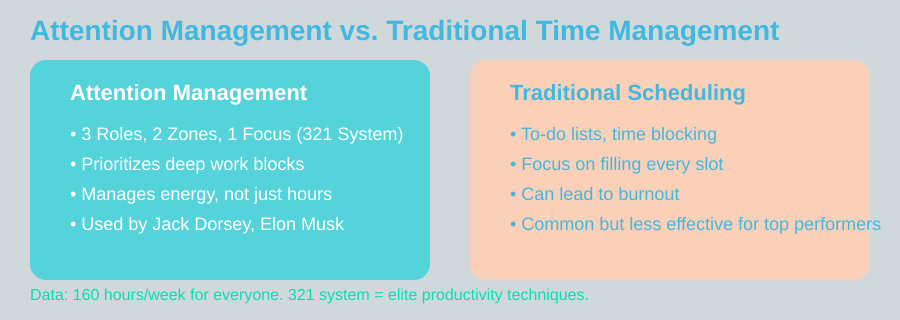
The 321 productivity system is different. It’s not about cramming more tasks into your schedule. It’s about managing attention versus time—a core distinction that sets elite productivity techniques apart. The system is simple but powerful:
- 3 Roles: Define your three most important roles (for example: CEO, Parent, Creator). These are your identity anchors for the week.
- 2 Zones: Block out two zones each day for deep focus. These are your non-negotiable windows where you work on what drives results.
- 1 Non-Negotiable: Set one thing each day that must get done, no matter what. This is your daily win, your anchor in the storm.
This structure gives you clarity and control, even when everything around you is in flux. It’s a framework that helps you prioritize, set clear focus, and protect your best energy for what matters most.
Unpacking Real-Life Chaos: A CEO, a Sandwich, and the Tyranny of Unread Email
Picture this: You’re a CEO, it’s lunchtime, and you’re eating a sandwich at your desk while your inbox explodes. Your phone buzzes with urgent messages. Meetings run late. The day feels like it’s slipping away. Sound familiar? This is where the 321 productivity system shines. Instead of reacting to every ping and request, you return to your three roles, focus on your two zones, and protect your one non-negotiable. Suddenly, you’re not just surviving the chaos—you’re directing it.
What’s Your Current Mode? (Personal Reflection, Not Self-Shaming)
Take a moment to reflect: Are you managing your day, or is your day managing you? Are you spending your best energy on what truly matters, or are you stuck in reactive mode? This isn’t about self-shaming. It’s about honest awareness. The 321 productivity system gives you a way to reset and reclaim control, no matter how busy life gets.
Managing Attention vs. Managing Time: The Game-Changer
Here’s the secret top performers know: Managing attention is more impactful than managing time. Everyone has the same 160 hours per week, right? Why do the top performers get dramatically more done without burning out? Jack Dorsey ran Twitter and Square in the same week you and I have. Elon Musk runs multiple companies with the same hours. Their edge isn’t a secret calendar app—it’s ruthless focus. They use elite productivity techniques like the 321 productivity system to protect their attention and energy, not just their schedule.
"Everyone has the same 160 hours per week, right? Why do the top performers get dramatically more done without burning out?"
Don’t Skip This: The Avalanche Question That Cuts Through the Noise
Before you apply any system, ask yourself: “Am I managing my time, or am I managing my attention?” This single question can help you cut through the avalanche of online advice and focus on what truly drives results. The 321 productivity system is your blueprint for making every hour count—by making every moment matter.
Three Roles: Are You a Maker, Marker, or Multiplier (And Why It Matters)?
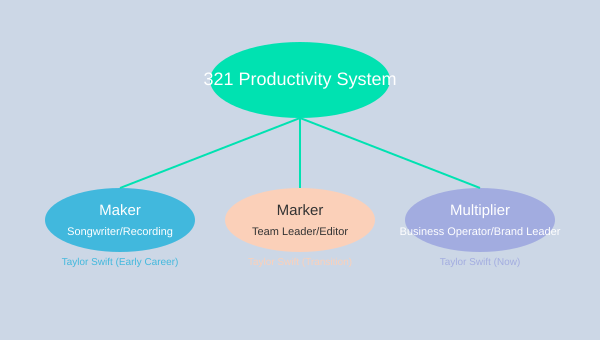
One of the most powerful insights from the 321 productivity system is that top performers don’t just manage their time—they reinvent their entire approach as their roles evolve. The system models three productivity archetypes: the Maker, the Marker, and the Multiplier. Understanding which role you’re in—and why it matters—can be the difference between feeling stuck and unlocking your next level.
Meet the Three Productivity Archetypes
- Maker: The hands-on creator, focused on deep work and individual output.
- Marker: The team leader or editor, guiding, refining, and delegating.
- Multiplier: The strategist and connector, orchestrating teams and scaling impact.
Personal Anecdote: My Marker Mode Meltdown
Let me be honest: I once tried to leap from Maker to Marker mode overnight. I went from managing my own projects to suddenly “leading” a team—without changing my habits. The result? Glorious chaos. I micromanaged, rewrote everyone’s work, and burned out fast. I was playing the wrong game for my level, and it showed. That’s when I learned that, as Marshall Goldsmith says, “What got you here won’t get you there.”
Taylor Swift’s Productivity Evolution: From Songwriter to Global Multiplier
Taylor Swift is a perfect example of why role adaptation is essential. In the early days, she wrote songs and recorded them herself—a classic Maker. Today, her responsibilities have exploded: she writes, produces, records, performs, creates music videos, runs business operations, manages brand partnerships, does philanthropy, and oversees a global tour schedule. The time management system that worked for her as a young songwriter would destroy her productivity now. Her game—and her role—have changed completely. This is the essence of the Taylor Swift productivity evolution.
“Habits that tend to work in simple phases of life actively harm you when you graduate to a role that demands complex responsibilities.”
What Mode Are You In? Are You Playing the Right Game?
Here’s the hard truth: most people fail at productivity because they’re playing the wrong game for their current level. The 321 productivity system helps you diagnose your role and shift your strategies for managing multiple responsibilities.
- Maker: If you’re juggling a handful of priorities or working as an individual contributor, this is your zone. You do everything yourself, focus on deep work, and own the details. Your time management should be built around clear deliverables and timelines.
- Marker: As you move up, you start managing teams and balancing 10–20 priorities. You can’t touch everything yourself—and you shouldn’t. Your job is to give feedback, build processes, and delegate. But beware: delegating too soon or micromanaging can backfire. I’ve seen (and lived) both sides of this mistake.
- Multiplier: When your responsibilities multiply—think 30, 40, 50 at once—you become the “most expensive router” (as Eric Schmidt puts it). You’re not creating or editing; you’re recruiting, orchestrating, and aligning. You connect people, make strategic bets, and focus on the big picture. Micromanaging here is a recipe for disaster.
Why ‘What Got You Here Won’t Get You There’ Is Truer Than Ever
As Marshall Goldsmith career advice reminds us, the habits that made you a great Maker will sabotage you as a Marker or Multiplier. Delegating in Maker mode or micromanaging as a Multiplier leads to failure. The 321 productivity system is your roadmap for evolving your strategies as your responsibilities grow.
SVG Mind Map: The 3 Roles in Action (Taylor Swift Example)
Wartime vs. Peacetime: Why Your Environment Redefines Productivity (and When to Break Your Own Rules)
What makes top performers truly different? It’s not just their work ethic or their favorite productivity hacks. It’s their ability to read the room—and know when to throw out the rulebook. The secret is understanding the difference between wartime vs. peacetime leadership, and how your environment can completely redefine what productivity means for you and your team.
Brian Chesky’s Crisis: From Textbook Peacetime Scaling to Hands-Dirty Wartime Overhaul at Airbnb
Let’s talk about one of the boldest pivots in recent business history. From 2016 to 2020, Airbnb was in full-on peacetime mode. Brian Chesky followed every business school play: hire great people, delegate, and get out of their way. The company grew, and Chesky thrived as a multiplier—empowering others, scaling through trust, and letting his team do their magic.
But in 2020, everything changed. COVID hit. Growth stalled. Costs exploded. Suddenly, the old playbook wasn’t just ineffective—it was dangerous. Chesky faced a hard truth: the environment had shifted. It was time for wartime leadership.
"He removed layers of leadership to make the company lean and flat. He got deeply involved in product, in every critical decision, every important detail, and the result, the company delivered over 500 product improvements in just three years."
This is the heart of Brian Chesky leadership lessons: when the world changes, you must change with it. Chesky’s hands-on approach during crisis didn’t just save Airbnb—it sparked a wave of innovation that delivered over 500 product improvements in three years and returned the company to profitability.
The Two Zones of Productivity: How Environments Shape Your Role and Dictate Your Tactics
Here’s the truth: your productivity system is only as good as your ability to adapt it. The 321 Productivity System recognizes two distinct zones:
- Peacetime: Growth is steady, the market is calm, and your job is to multiply your impact through others. This is when you delegate, empower, and scale.
- Wartime: Crisis hits. The market shifts. Suddenly, you need to roll up your sleeves, get close to the details, and make tough calls. Your environment demands you become a maker or marker, not just a multiplier.
Ask yourself: Which zone are you in right now? Are you in the war room, fighting fires and making rapid decisions? Or are you in the calm headquarters, building for the future and empowering your team?
Wild Card: If Bart Simpson Ran a Startup, Would He Ever Leave ‘Wartime’?
Imagine Bart Simpson at the helm of a startup. Would he ever stop breaking the rules? In reality, even the most rebellious leaders need to know when to shift gears. Staying in ‘wartime’ mode forever leads to burnout and chaos. But never entering it means you’ll miss the chance to innovate when it matters most.
When to Throw Out Every Productivity Hack You Know (Seriously)
Every productivity book tells you to stick to your routines. But when your environment shifts, clinging to old habits can sink you. During wartime, you might need to:
- Cancel all recurring meetings
- Take personal ownership of critical projects
- Flatten your org chart and cut bureaucracy
- Break your own rules to get results fast
That’s the real impact of environment on productivity: it forces you to adapt, improvise, and sometimes, break every rule you thought was sacred.
Unexpected Upside: Crisis as a Catalyst for Innovation
Wartime isn’t just about survival. It’s a wild card that can drive massive change. Airbnb’s 500+ product improvements didn’t happen in spite of crisis—they happened because of it. When you’re forced to rethink everything, you unlock creativity and speed you never knew you had.
| Phase | Years | Leadership Approach | Key Results |
|---|---|---|---|
| Peacetime | 2016-2020 | Multiplier, Delegation | Steady growth, scaling |
| Wartime | 2020 (COVID crisis) | Hands-on, Layers removed | 500+ product improvements, return to profitability |
So, as you build your own system for strategies for managing multiple responsibilities, remember: the best leaders are those who know when to break their own rules—and when to write new ones.
One Non-Negotiable: The Brutal Focus Secret Top Performers Swear By
The Real CEO Dilemma: Bottleneck or Amplifier?
If you’re leading a team, a company, or even just your own ambitious project, you’ll eventually face a brutal truth: you can either be the bottleneck that slows everything down, or the amplifier that makes everyone better. This is the crossroads where the top 1% of performers separate themselves from the rest. The importance of non-negotiable focus isn’t just a productivity hack—it’s the secret weapon behind the 321 productivity system and the reason why some leaders scale, while others stall.
My Lived Lesson: Losing Sleep Over a Scaling Company
A few years ago, when I served as the CEO of our AI company, everything looked perfect on paper. We had a world-class team, the timing was right, and our product was winning awards. We were even named one of the top 20 fastest growing tech companies in the US by Deloitte Fast 500. But behind the scenes, every day was chaos. Every night, I’d lie awake, worrying—could we hire fast enough? Were our customers truly delighted? Was I missing something critical?
Then, I realized I was becoming the bottleneck. Every decision, big or small, came through me. That’s when I had to ask myself the hardest question of my career:
"What is the one thing that only I can do—one thing I should focus on while I delegate everything else?"
This question changed everything. It’s the heart of the 321 productivity system: 3 roles, 2 zones, and 1 non-negotiable focus.
The Power of Identifying Your ‘One Thing’ (and Dropping the Rest)
Elite performers don’t try to do it all. They identify their one non-negotiable focus—the thing that moves the needle for everyone—and then they align their energy, calendar, and team around it. Everything else? They delegate or drop it. This is how you scale your impact and keep your clarity, even as the world spins faster.
For me, that one thing was relationships. If I could build trust with our team, nurture our culture, and partner deeply with our customers, I could articulate our mission more clearly and inspire everyone to do their best work. So, I focused on recruiting, culture, internal communication, and customer partnerships. Every touchpoint became a chance to build trust in team management. The rest, I delegated.
Mission-Driven Focus: It’s Personal
Your non-negotiable focus might be different. For some, it’s product vision. For others, it’s customer experience or innovation. The key is that it’s personal—it’s the unique thing only you can do, and it’s what your organization needs most from you right now.
Steve Jobs Leadership: Trust, Not Micromanagement
Consider Steve Jobs and Jony Ive at Apple. Jobs didn’t micromanage design. Instead, he met with Jony daily—not to control, but to learn, to share context, and to build trust. Jony once said:
"Jony never felt micromanaged. Because Steve Jobs was there as a partner, not as a boss. He was in the details to learn everything, not to control everything."
This is the essence of the importance of non-negotiable focus and building trust in team management. Jobs’ focus was on vision and culture, while empowering his team to execute.
| Company/Leader | Non-Negotiable Focus | Execution Example |
|---|---|---|
| Top 20 Fastest Growing Tech Firm (Deloitte Fast 500) | Relationships, Team Culture, Customer Partnerships | CEO focused on trust and mission, delegated other tasks |
| Steve Jobs & Jony Ive (Apple) | Vision, Design Culture | Daily meetings for review and context, not micromanagement |
Exercise: What’s the Unique Thing Only YOU Can Do This Week?
Here’s your challenge: Ask yourself, “What is the one thing that only I can do—one thing I should focus on while I delegate everything else?” Write it down. Make it your non-negotiable. Then, ruthlessly delegate or drop everything else. This is the brutal focus secret top performers swear by—and the heart of the 321 productivity system.
The Quiet Superpower: Managing Trust and Delegation (And Why It Feels Weird at First)
Let’s be honest: most people struggle with delegation. You might worry that if you let go, everything will fall apart. Here’s the spoiler—if you get trust right, it won’t. In fact, effective delegation strategies are the quiet superpower that sets top performers apart. The 321 productivity system isn’t just about what you do; it’s about how you manage trust and empower others to do their best work. That’s what truly separates leaders from doers.
Why Delegation Feels Uncomfortable (At First)
It’s natural to feel uneasy when you start delegating. You’ve identified your one non-negotiable task—the thing only you can do. But what about everything else? The fear is real: “If I don’t oversee every detail, will things fall apart?” The truth is, most people mishandle delegation because they equate letting go with losing control. But the best leaders don’t manage time—they manage trust. That’s the foundation of building trust in team management, and it’s the secret sauce behind the 321 productivity system.
Steve Jobs & Jony Ive: The Gold Standard for Creative Partnership
Look at the legendary partnership between Steve Jobs and Jony Ive at Apple. Jony led the design of the iPod, iPhone, iPad, and Apple Watch—some of the most complex projects in tech history. Steve Jobs was deeply involved, reviewing every detail, but not to control. Instead, he partnered with Jony, asking questions, providing context, and learning alongside him. Jony never felt micromanaged. Why? Because Jobs was there to coach, not to command. He reviewed things to coach. He connected to provide context. He stepped in to unblock others. That’s the difference between hovering and leading.
"You review things, but to coach. You connect, but to provide context. You step in, but to unblock others."
Effective Delegation Strategies: Matching Support to Skill Level
One of the most overlooked strategies for managing multiple responsibilities is matching your delegation style to the experience level of your team. Trust-based delegation isn’t one-size-fits-all. Here’s how the 321 productivity system helps you adapt:
- New Hires: Work alongside them. Build trust by giving comfort. Show them the ropes and let them know you’re there as a safety net.
- Intermediates: Guide closely and review steps. Build trust by giving clarity. Help them see the bigger picture and understand why things are done a certain way.
- Experts: Step in only to unblock. Build trust by giving context. Let them run with their expertise, and provide the information they need to make smart decisions.
Steve Jobs and Jony Ive’s daily rhythm was a masterclass in this approach. Jobs didn’t micromanage, but he didn’t disappear either. He provided just enough context and support to keep things moving at lightning speed.
Are You Hovering or Coaching?
Here’s a quick gut-check: If you find yourself double-checking every move, you’re hovering. If you’re asking questions to help your team grow, you’re coaching. The difference is subtle, but it’s everything. Trust-based delegation prevents both micromanaging and neglect, creating a space where your team can thrive—and where you can focus on your own deep work.
Trust: The Ultimate Speed Booster
When you build trust, you speed up execution. Your team moves faster, bottlenecks disappear, and even your home life gets easier. Imagine delegating your grocery list—what would you do with that time? The wild card is, trust-based delegation doesn’t just help your team; it frees you to focus on what matters most, both at work and at home.
The 321 productivity system is your framework for this: three roles, two zones, one non-negotiable. But the real magic happens when you use effective delegation strategies and trust as your guiding principles. That’s how you manage multiple responsibilities without losing your mind—or your edge.
Start Here: Your Personal 321 Challenge (With a Few Tangents for Good Measure)
Let’s get one thing straight: the 321 productivity system isn’t reserved for CEOs, founders, or productivity gurus. It’s for anyone who wants to shift their productivity mindset, improve their work-life balance, and—most importantly—make more time for what actually matters. Whether you’re managing a team, wrangling kids, or just trying to get through your weekly Target run without forgetting the laundry detergent, you can start using the 321 system right now. No permission required.
Pick Your Starting Point: Four Simple Ways to Begin
Here’s your invitation: this week, try one small experiment. Pick any of the following options and see what changes in your work, your mood, or your sense of control:
- Define your current role: Get clear on what you’re actually responsible for. Are you the project lead, the supportive partner, the chief snack provider, or all of the above?
- Name your zone: Identify the area where you do your best work. Is it early mornings at your kitchen table, or late nights after everyone else is asleep?
- Write your one non-negotiable: What’s the one thing you absolutely must do today, no matter what? It could be a work task, a workout, or simply calling your mom.
- Delegate one repeatable task: Is there something you do every week that someone else could handle? (More on this in a moment…)
These aren’t just productivity improvement hacks—they’re ways to bring clarity and intention to your day, one small shift at a time. Incremental application of the 321 system leads to perseverance and lasting change. You don’t need to overhaul your entire life overnight. Just pick one and see what happens.
The 321 System: Not Just for the Office
Here’s the beauty of the 321 productivity system: it works everywhere. Apply it to your calendar at work, your family’s weekly schedule, your roommate’s cleaning chart, or even your own self-care routine. The principles are the same, whether you’re leading a team meeting or planning a Sunday grocery run.
Let me take a quick tangent. My old roommate once tried to ‘delegate’ their laundry routine to me. The logic was sound: “You’re already doing a load, can you just throw mine in too?” What followed was a week of mismatched socks, shrunken sweaters, and a very awkward conversation about boundaries. The lesson? Delegation is powerful—but only when you’re clear, respectful, and everyone’s on board. The 321 system isn’t about dumping tasks on others; it’s about making space for what matters, together.
The Illusion of Control: Why You Shouldn’t Try to ‘Master’ Time
Here’s a truth most productivity books won’t tell you: you cannot control time. You can only steward the time you have. The idea that you can “master” every minute is an illusion—and chasing it will only leave you frustrated. Instead, focus on what you can influence: your choices, your energy, and your priorities.
"You cannot control time. You can only steward the time you have."
Real productivity isn’t about squeezing more output from every hour. It’s about making time for what brings you joy, satisfaction, and a sense of purpose. That’s the heart of the 321 productivity system: aligning your work with your life, not just your to-do list.
Your 321 Challenge: One Small Shift, Big Results
This week, try one of the four options above. Don’t overthink it. Just pick the one that feels most doable and give it a shot. Maybe you’ll define your role at work, or finally delegate that recurring task at home. Maybe you’ll write down your one non-negotiable and protect it like gold. Whatever you choose, notice what changes—not just in your productivity, but in your mood, your relationships, and your sense of balance.
Remember: the 321 productivity system is about progress, not perfection. Start small, stay curious, and see where it leads you. Sometimes, the smallest experiment can spark the biggest shift.
FAQ: Clearing the Fog Around 321 Productivity (With a Dash of Real Talk)
Let’s be honest: productivity advice can feel like it’s written for someone else—maybe a CEO, a founder, or someone with total control over their calendar. But the 321 productivity system isn’t about your job title or your industry. It’s about how you show up, wherever you are, and how you make the most of the time you have. Let’s tackle the most common questions and misconceptions, with a little real talk and a lot of clarity.
What if my job won’t let me choose my role?
This is a big one. Maybe your job description is set in stone, or your boss hands you tasks with zero negotiation. But here’s the truth: you always have some agency. The 321 productivity system isn’t about rewriting your job title—it’s about defining your role in your own mind. Even if you can’t change your official responsibilities, you can clarify what you want to be known for, what strengths you bring, and how you approach your work. That’s your “zone.” You can apply this mindset to your calendar, your team, your family, or even your roommate. It’s about intentionality, not authority.
Does the 321 system work for freelancers or creatives?
Absolutely. In fact, the adaptive productivity framework of 321 is perfect for freelancers, creatives, and anyone whose work doesn’t fit a neat box. Your “one thing” might shift from project to project, or even day to day. That’s not a flaw—it’s a feature. The system is designed for regular reflection, so you can adapt as your priorities and circumstances change. Whether you’re juggling clients, gigs, or creative sprints, 321 helps you stay grounded and focused on what matters most right now.
Isn’t this just repackaged ‘goal setting’?
It’s a fair question. But the 321 productivity system goes deeper than traditional goal setting. It’s not just about writing down what you want to achieve—it’s about clarifying your role, naming your zone, and identifying your non-negotiable focus for the day or week. It’s a living, breathing process, not a one-time exercise. And it’s built on the understanding that you can’t control time—you can only steward it. That’s what sets top performers apart: they make time for what matters, even as life shifts around them.
How do I know I’m not delegating too much or too little?
Delegation is a skill, not a checkbox. It’s about matching the task to the right person, at the right time, with the right level of trust. As the saying goes,
"Delegation without trust is just abdication—not leadership."The 321 system encourages you to regularly reflect on what you’re holding onto and what you can let go. If you’re feeling overwhelmed, you might need to delegate more. If you’re feeling disconnected, maybe you’ve delegated too much. The key is ongoing calibration, not a one-and-done handoff.
What if my ‘one thing’ is always changing?
This is one of the most persistent myths: that your focus should be static. In reality, your “one thing” will evolve as your context changes. That’s why regular check-ins are baked into the 321 system. Life isn’t static—your focus shouldn’t be, either. By taking a few minutes each day or week to reflect, you’ll stay aligned with what matters most, even as your circumstances shift.
What’s the shortest daily ritual to stay aligned with 321?
You don’t need an hour-long morning routine. In fact, the most effective productive rituals are short and sweet. Spend 5-10 minutes each morning or evening to identify your role, name your zone, and set your non-negotiable focus. That’s it. This tiny investment pays off in clarity, momentum, and peace of mind.
In the end, the 321 productivity system is about making time for what brings you joy and fulfillment—at work, at home, and everywhere in between. You can’t control time, but you can choose how you show up. That’s what sets top performers apart. So, this week, pick one piece: define your role, name your zone, write your non-negotiable, or delegate one repeatable task. Start where you are, and watch your productivity—and your happiness—grow.
TL;DR: You don’t have to be Elon Musk or Taylor Swift to master the 321 productivity system. By consciously playing the right role, adapting to your environment, and narrowing your focus to what only you can do, you’ll accelerate your results—and maybe even enjoy the ride a little more. Start small: clarify your role, check your current ‘zone,’ and choose one non-negotiable focus. That’s it; that’s the groundwork for real elite productivity.
Post a Comment