
When I look back at my early 20s, all-nighters and fast-food binges seem like the least of my regrets. It wasn't the lost sleep or the hangovers that kept me stagnant; it was mistaking endless dopamine loops—chasing shallow highs—for progress. Most advice about your 20s has the subtlety of a fortune cookie and leads you straight into a comfort trap. So, here's something raw: If you keep replaying what feels good now, you'll blink and find a decade's gone by. Ready to break the cycle? Let's get candid about the real work of designing a life that ages well—with a few hard truths, a self-inflicted roast or two, and some unconventional advice you won't hear at grandma's table.
Rewind or Reboot? The Harsh Loop of 'Living' vs. Growing
It’s a tough pill to swallow, but most people hit a personal growth plateau in their early 20s—and then hit repeat. You might not even notice it happening. One day, you’re excited about new experiences, and the next, you’re stuck in a loop of the same six months, over and over. If you ask someone in this phase, “What are you doing with your life?” they’ll often reply, “I’m just living life.” It sounds harmless, even positive. But is it really?
Most people plateau around the age of 23, and then when you start to ask them, like, what are you doing with your life, in a genuine way, they confidently say that I'm just living life.
Why 'Living Life' Can Become a Trap
Society celebrates your 20s as the time for peak experiences—nights out, parties, travel, and endless social outings. These moments are fun, but they’re also fleeting. Over time, they can become identity traps. You start to believe that happiness is found only in these highs, and you chase them, hoping for lasting fulfillment. But happiness isn’t the same as euphoria. Chasing only the highs stalls real personal growth and keeps you from building the life skills young adults actually need.
- Peak experiences: Bars, video games, raves, and parties—fun, but shallow if they’re your main focus.
- Identity trap: Your sense of self becomes tied to repeating these moments, rather than growing past them.
- Loop duration: For many, this cycle repeats every 6–12 months, sometimes endlessly.
The Illusion of Progress: Comfort vs. Growth
It’s easy to confuse comfort with progress. Routines feel safe, but without intentional change, they quickly become ruts. Most people don’t realize that there’s no such thing as staying the same. You’re either getting better, or you’re slowly getting worse. That decline doesn’t show up right away—it sneaks in years later, often as regret or a sense of being left behind.
There’s only you get better, or you think you’re staying the same, but you’re actually just getting worse, and that worse doesn’t show up until years later.
Avoiding Discomfort: The Deep Hole
Why do so many people avoid discomfort? Because it feels safer to stick with what you know. But avoiding challenge and discomfort is like digging a hole you can’t see the bottom of. The longer you stay in your comfort zone, the harder it is to climb out. Personal growth and a true growth mindset for teens and young adults require you to do things that scare you, challenge you, and make you uncomfortable.
- Discomfort = Growth: The best way to make the most of your 20s is to make them your worst—meaning, push yourself through tough times to build resilience and skills.
- Comfort = Stagnation: Settling for comfort leads to a loop of anxiety and overwhelm as you realize you’re not moving forward.
Personal Anecdote: When Fun Times Hold You Back
I remember a period in my early 20s when every weekend was a blur of parties and late-night adventures. At first, it felt like I was living my best life. But after a while, I noticed something unsettling: I wasn’t growing. My goals were on hold, my career stalled, and my sense of purpose faded. The fun times were actually holding me back from real self-awareness and personal growth. It took stepping away from the loop—and embracing discomfort—to finally reboot my life and move forward.
Visualizing the Plateau: The Growth Chart
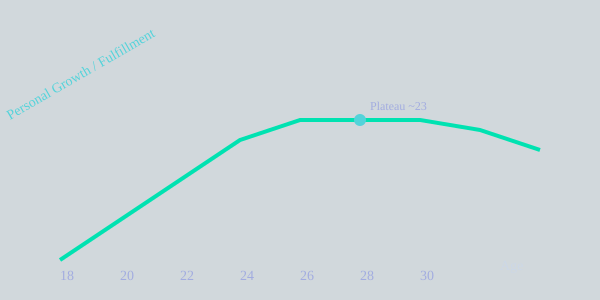
As shown above, personal growth rises quickly in the late teens and early 20s, but for many, it plateaus around age 23. Without intentional effort, this stagnation can last for years, repeating the same experiences and routines. The key is to recognize the loop and choose to reboot, not rewind.
If you don't nearly max out your potential in your 20s, you can simply observe society and see where your life will probably end up.
'Staying the Same' is a Beautiful Illusion (That Ages Badly)
When you think about personal growth, it’s tempting to believe that you can just hit pause—coast for a while, keep things “steady,” and avoid the stress of constant change. But here’s the fiercely honest truth: stagnation is a myth. As the saying goes, “There’s no such thing as staying the same. There’s only you get better, or you think you’re staying the same, but you’re actually just getting worse.” The comfort of “maintenance mode” is a beautiful illusion, and it ages badly.
You Either Improve or Decline—Stagnation Is a Myth
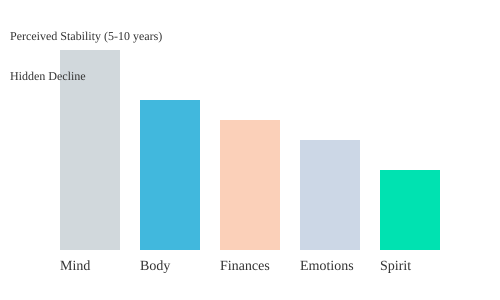
Most people don’t realize that the world is always moving forward. Technology advances, industries shift, and social expectations change at a pace that only accelerates. If you’re not actively working on personal growth—developing self-awareness, building resilience, and practicing stress management—you’re not standing still. You’re falling behind. The illusion of stability can last for five, even ten years, but underneath, decline is quietly taking root.
Decline Is Often Invisible in the Moment, Glaring in Hindsight
One of the most dangerous aspects of this illusion is how subtle decline can be. You might feel like you’re holding steady in your job, relationships, or health. But the consequences of ignoring growth don’t show up overnight. They accumulate slowly, becoming obvious only years later. By the time you reach your thirties or forties, you might look around and realize that you’ve been left behind—emotionally, financially, and professionally.
“Most people turn 30 to 40 years old with the emotional maturity of a 15-year-old.”
This isn’t just rhetoric. Studies and anecdotal evidence suggest that an estimated 40%–60% of people experience an emotional plateau by age 30. The world keeps moving, but if you’re not growing, you’re digging yourself deeper into a hole that’s harder to climb out of as time passes.
Society Rewards Appearances of Stability While Hiding Decay
On the surface, society often celebrates those who appear stable—steady jobs, predictable routines, and “adulting” on autopilot. But this appearance can mask a slow decline. Emotional immaturity, financial stasis, and a lack of adaptability are common signs that you’re not actually maintaining; you’re quietly losing ground. The world is pushing forward, and if your mind, body, spirit, and finances are “staying in the same place,” you’re actually falling behind.
The Mindset of ‘Just Living’ Shields Us from Deeper Questions
It’s easy to slip into a mindset of “just living”—going through the motions without questioning whether you’re actually growing. This mindset shields you from uncomfortable truths, but it also prevents you from building the resilience and self-awareness needed for real personal growth. Over time, the cost of this avoidance becomes painfully clear.
Tangential Story: When ‘Maintenance Mode’ Backfired
I once believed that “maintenance mode” was a smart goal. I thought if I could just keep things steady—same job, same habits, same friends—I’d be fine. But after a few years, my energy tanked. I felt stuck, uninspired, and anxious. Only then did I realize that what I called stability was actually slow decline. My skills were outdated, my finances were flat, and my emotional resilience was at an all-time low. The wake-up call was harsh, but it forced me to confront the reality: staying the same is not an option.
Signs of Hidden Decline
- Emotional immaturity: Struggling to handle stress, conflict, or change.
- Financial stasis: No increase in savings, skills, or earning potential.
- Lack of adaptability: Feeling overwhelmed by new technology or shifting social norms.
These signs are easy to ignore in your twenties, but they become glaring in your thirties and forties. The deeper you get into this hole, the harder it is to see the light at the top.
Whose Advice Are You Taking? The 1% Difference
When it comes to career development goals and life skills for young adults, the loudest voices are rarely the wisest. Most advice you’ll hear in your 20s comes from people who are simply echoing what they did, or what they wish they’d done. But here’s the hard truth: less than 1% of people actually live the kind of life you probably aspire to. The rest? They’re often stuck in survival mode, clinging to outdated paths that don’t fit today’s world.
Conventional Wisdom: Designed for Survival, Not Growth
Think about the advice you get from family, friends, or even random acquaintances. It usually sounds like this:
- “Get a stable job.”
- “Don’t take too many risks.”
- “Be realistic with your dreams.”
- “Make sure you have a backup plan.”
This guidance is rooted in a survival mentality. It’s about safety, not thriving. It’s advice shaped by tradition, not innovation. The world has changed—technology has outpaced the old rules. Yet, most people are still handing out playbooks written for a different era.
Why Most Advice Keeps You Average
The reality is, 99% of people are giving advice based on what worked for them—and often, what worked for them was settling for less than they wanted. They’re not living the life you want. They may have never even imagined it. If you bring them bold goals—like building a business, traveling the world, or forging a unique career path—they’ll likely tell you to “be more realistic.”
Here’s a personal example: My uncle, a kind man who worked the same 9-to-5 job for 40 years, once told me, “You should just find a good company and stick with it until you retire.” He meant well, but he couldn’t imagine a career beyond the traditional path. If I’d listened, I’d have missed out on opportunities that didn’t exist when he was my age.
Practice Deliberate Ignorance: Build Your Advice Firewall
To grow, you need to filter guidance ruthlessly. This means practicing what I call deliberate ignorance. Entertain advice, but don’t let it take root in your mind unless it comes from someone who actually embodies the life you want. Most people are “adamant on convincing you that the greatest things to do are the greatest things that they did, and those things aren’t that great at all.”
“You need to do your own independent research and you need to actively search for the less than 1% of the population that have the life you want.”
Seek Out the 1%: Mentorship, Networking, and Research
Instead of accumulating advice, curate it. Build a mental firewall. Focus on career path networking mentorship—find those rare individuals who have achieved what you aspire to. Study their journeys, ask questions, and experiment with their strategies. Don’t take their word as law, but use their insights as raw material for your own personal development strategies.
| Statistic | Insight |
|---|---|
| 1% (or fewer) | Actually embody aspirational lifestyles |
| 99% | Give advice shaped by tradition, not innovation |
| Top sources for career development | Networking, personal research, mentorships |
How to Filter Advice for Growth
- Ask: Does this person have the life or career I want?
- If not, practice deliberate ignorance—listen politely, but don’t internalize.
- Seek out mentors, even if they’re rare. Use books, podcasts, or direct outreach.
- Experiment with advice from the 1%, but adapt it to your unique path.
Remember, most people are in survival mode. Their advice is about not failing, not about truly succeeding. If you want to thrive, you have to be selective about whose voices you let shape your journey.
Make Mistakes—Quickly, Cheaply, and With Purpose
Why a Brief Affair with Distractions Teaches More Than Abstinence
In your 20s, it’s easy to fall into the trap of thinking you need to avoid all distractions for the sake of personal growth development. But the truth is, a short, intentional encounter with your vices—whether it’s partying, binge-watching Netflix, or just lounging around—can teach you more about yourself than strict abstinence ever could. The key is to interact with your distractions purposefully and to set clear, SMART goals that guide your actions.
Distractions as Tuition, Not Doom—When Paired With Clear Goals
Let’s be honest: most people in their 20s will party, experiment, and waste time at some point. These activities aren’t inherently bad. In fact, they only become harmful if they consume the time, energy, and focus that are your prime resources for independence personal development. The real danger is drifting without purpose, letting years slip by without learning anything meaningful about yourself or the world.
“I’m not telling you to get rid of these distractions altogether… but it would be wise to get your taste of them quickly.”
If you approach distractions as a kind of tuition—a cost you pay to learn your limits and what truly matters—you can actually accelerate your growth. The trick is to set real goals before you dabble. Without a bigger purpose, you won’t even recognize what’s holding you back.
Interacting With Your Vices Can Fast-Track Growth—If You Have a Purpose
During my own college years, I was no stranger to late nights, parties, and failed attempts at starting businesses. But even when I was out with friends or recovering from a rough night, I made it a point to spend at least an hour a day working on something that might buy my freedom—whether that was researching business ideas, learning new skills, or improving my health. I didn’t always know what I was doing, but I knew I didn’t want to end up unhealthy, broke, or stuck.
This approach—balancing experimentation with a commitment to personal growth development—meant that even my failures stacked up into something valuable. Every failed project, every awkward networking event, and every rough morning after a party taught me something new about myself and the world.
Stacking Minor Failures Builds Skill and Self-Knowledge for the Long Haul
Most attempts at learning new skills or starting something new will fail. That’s not just normal—it’s essential. Each “intelligent error” is a brick in the foundation of your future success. This is called skill stacking: the process of accumulating small, diverse abilities and experiences that eventually combine into something powerful and unique.
If you spend even an hour a day on goal-oriented projects, you can dramatically change your trajectory. The key is to keep your distraction phase short and purposeful. Six to twelve months of rapid-fire experimentation is enough to learn your limits and build a toolkit for the future. Spending years in a holding pattern, on the other hand, is a recipe for regret.
| Strategy | Optimal Duration | Impact |
|---|---|---|
| 1 hour/day on goal-oriented projects | 6-12 months | Can change life trajectory, accelerates skill stacking |
| Distraction phase without purpose | Multi-year | Leads to stagnation, wasted prime resources |
| Skill stacking through minor failures | Ongoing | Most attempts fail, but cumulative skills multiply over time |
Set Real Goals Before Dabbling—Otherwise, You’re Just Drifting
You can’t even register an activity as a distraction unless you care about something bigger. That’s why setting SMART goals—Specific, Measurable, Achievable, Relevant, and Time-bound—is so important before you experiment. When you have a purpose, every mistake becomes a lesson, not just a regret.
In your 20s, making mistakes quickly, cheaply, and with purpose is the best investment you can make in your personal growth development. Don’t waste your prime years drifting—use them to experiment, fail, and build the skills and self-knowledge that will set you free.
'Getting a Job' Isn't the Only Rite of Passage: Write Your Own Script
When you’re in your twenties, everyone seems to have the same advice: go to college, get a job, and settle into a “stable” life. This script is so common that it almost feels like a law of nature. But in today’s tech-driven world, navigating the job market isn’t as straightforward as it used to be—and the traditional path is increasingly obsolete.
The Outdated Script: Why the Old Path No Longer Fits
For generations, the formula was simple: finish school, land a job, and stay there until retirement. This “industrial mindset” made sense in an era when jobs were stable, and the economy rewarded loyalty. But now, less than 50% of college graduates work in their field of study within five years. The world is changing faster than ever, and sticking to the old script can leave you feeling stuck, unfulfilled, and underutilized.
Independence and Fulfillment: The Case for Unconventional Paths
True personal growth and independence rarely come from doing what everyone else does. In fact, the most valuable skills and the deepest sense of fulfillment often come from taking risks and exploring alternative routes. Whether it’s starting a side hustle, freelancing, or launching a small business, these paths teach you how to adapt, solve problems, and build real independence.
- Side hustles and startups are more common among Gen Z than any previous generation.
- Non-traditional paths build resilience, creativity, and a sense of ownership over your life.
- Even failed attempts teach you more than years spent in a job you hate.
Early Experiments: Learning by Doing
When I was 15, I didn’t wait for someone to hand me a safe job offer. I started side hustles—some failed, some barely broke even, but every single one taught me something new. I researched business ideas, learned about health, and worked on mastering my mindset. I wasn’t sure where it would lead, but I knew I didn’t want to wake up at 50, drained and unfulfilled, just because I followed someone else’s plan.
Many people say they want the best for you, but in reality, they just don't want to feel inferior to you.
Don’t let other people’s fear of survival set your limits. Just because your parents or teachers are anxious about the unknown doesn’t mean you have to be. Society often underestimates the value of alternative career paths, but that’s no reason to avoid them. In fact, experimenting with your career early on is one of the best ways to develop career development goals that actually matter to you.
Society’s Blind Spot: The Value of Experimentation
There’s a huge misconception that only “real jobs” count as progress. But the truth is, every attempt to escape the 9-to-5 grind—no matter how small—can lead to new skills, connections, and opportunities. Whether you’re freelancing, building an app, or learning a trade, you’re gaining experience that most people never get from sitting at a desk all day.
- Trying and failing is better than never trying at all.
- Experimentation leads to self-discovery and independence personal development.
- Alternative paths can open doors you never knew existed.
Write Your Own Script
Don’t let outdated advice or other people’s insecurities dictate your journey. The world is wide open, and there’s no single right way to build a life or a career. Take risks, start projects, and chase what excites you—even if it doesn’t fit the traditional mold. The skills, confidence, and independence you gain will be worth far more than any “safe” job ever could.
From Peak-Chasing to Real Fulfillment: Building Lasting Foundations
It’s easy to believe your 20s are the main event—the time to chase every high, tick off bucket lists, and squeeze the most out of fleeting youth. But here’s the truth: your 20s are the tutorial phase, not the endgame. This decade is your chance to build the foundations for personal growth and wellbeing that will support you for the rest of your life. If you treat these years as preparation, not arrival, you’ll set yourself up for a future where your quality of life keeps rising—even when your youth is no longer on your side.
Your 20s: The Tutorial, Not the Main Game
Think of your 20s as the “practice mode” before the real game begins. This isn’t about missing out or delaying happiness. It’s about realizing that the habits, mindsets, and skills you invest in now will pay off exponentially later. Studies show that time spent on foundational habits—like mindfulness meditation practice and journaling self-reflection—during your 20s strongly correlates with higher life satisfaction and lower stress after 30.
Foundational Work Now, Exponential Benefits Later
The urge to chase peaks—those quick hits of pleasure, validation, or excitement—is strong. But lasting contentment doesn’t come from momentary highs. It’s built on early self-investment: learning who you are, what you value, and how to handle life’s ups and downs. This is the heart of any effective personal development model. The work you do now—building self-awareness, resilience, and a habit of continuous learning—creates a foundation that supports every future success.
Three Traps to Avoid
- Stagnation: Getting comfortable and staying the same for months at a time. Growth requires movement, even if it’s slow.
- Peak-Chasing: Jumping from one thrill to the next without building anything lasting.
- Comparison: Measuring your progress against others instead of focusing on your own journey and values.
Three Tools to Build Lasting Fulfillment
- Mindfulness Meditation Practice: Regular mindfulness helps you notice your thoughts and feelings without judgment. This creates space for better decisions and deeper contentment. Research shows mindfulness reduces stress and boosts wellbeing in young adults.
- Journaling Self-Reflection: Writing about your experiences and emotions helps you process challenges, clarify goals, and track your growth. Journaling is a proven tool for building self-awareness and emotional resilience.
- Skill-Building with SMART Goals: Set Specific, Measurable, Achievable, Relevant, and Time-bound goals. Whether it’s learning a new language, picking up a creative hobby, or developing career skills, these investments compound over time.
From Surface-Level Highs to Deeper Contentment
It’s tempting to chase what feels good in the moment. But true personal growth and wellbeing come from building systems that support you through every season of life. This means prioritizing habits that nurture your mind, body, and relationships. When you focus on self-awareness, resilience, and continuous learning, you move beyond surface-level highs to a deeper, more stable sense of fulfillment.
Imagine Your 40th Birthday
Picture yourself at 40. Will you thank your past self for investing in your growth, or will you wish you’d started sooner? The choices you make in your 20s—how you spend your time, what you practice, and what you build—shape the quality of your life for decades to come. As one wise reminder puts it:
"If you can set yourself up in your 20s, your quality of life will only continue to increase, and that's even when your youth is no longer on your side."
Remember, the systems and habits you create now are the real main event. They’re the foundation for a life that gets better with time.
Wild Cards: Uncomfortable Truths, Unlikely Wins, and a Lightning Survival Challenge
Let’s get real: growth rarely happens when you’re comfortable. If you’re reading this, you probably want more than just a highlight reel of “success tips.” You want the wild cards—the uncomfortable truths, the unlikely wins, and the moments that force you to ask, “Am I really growing, or just staying busy?” This is where the growth mindset teens crave is forged, and where overcoming challenges resilience becomes more than just a buzzword. It’s about continuous learning growth mindset, even when it feels awkward or risky.
Lightning Survival Challenge: Your Three Dumbest Distractions
Here’s your first wild card: the Lightning Challenge. Grab a piece of paper or open your notes app. Write down the three dumbest distractions or mistakes you’ve made in the last year. Maybe you spent six months doom-scrolling, obsessed over someone else’s life, or ghosted on a project that could have changed everything. Now, ask yourself: What did I actually learn? This isn’t about shaming yourself. It’s about seeing how even your “failures” can be fuel for growth. I’ve been there—stuck in the same place for months, convinced I was moving forward when I was just treading water. The moment I started facing these truths head-on, my life changed. Yours can, too.
Quote Roulette: The Power of Deliberate Ignorance
Here’s a quote to spin your brain:
“Deliberate ignorance can be a superpower if wielded with purpose.”In a world obsessed with knowing everything, sometimes the bravest thing you can do is tune out the noise. Focus on what matters to you. That’s how you build a growth mindset teens and young adults need—by choosing what you let in and what you leave out. When you stop comparing your journey to everyone else’s, you make space for your own unlikely wins.
Hypothetical: Would You Trust a Time Traveler?
Imagine a time traveler appears and hands you a career plan tailored for 2050. It’s bold, weird, and nothing like what your friends are doing. Would you have the guts to follow it? Most people wouldn’t. Why? Because stepping into the unknown is terrifying. But here’s the thing: unexpected wins often follow the biggest risks. The people you admire most didn’t play it safe—they bet on themselves, even when it felt ridiculous. That’s the heart of overcoming challenges resilience: being open to what scares you, not just what’s comfortable.
Mini-Tangent: Your Comfort Zone Is a Padded Cell with Better WiFi
Let’s talk about comfort zones. They feel safe, but they’re really just padded cells with better WiFi. You can spend years in there, scrolling, binge-watching, and convincing yourself you’re “waiting for the right time.” But growth doesn’t live there. Transformation demands risks, experiments, and honest reflection. If you want a continuous learning growth mindset, you have to be willing to leave the comfort zone behind—even if it means feeling exposed or uncertain.
Unlikely Wins and Quiet Reinventions
Here’s the wildest truth: you’re not alone. Many people are quietly reinventing themselves under the radar. They’re not posting about it, but they’re taking risks, learning from mistakes, and building resilience where no one can see. The next unlikely win could be yours—if you’re willing to play your wild cards.
So, as you close this chapter, remember: your 20s are not the main event. They’re the training ground. Embrace the wild cards—face your uncomfortable truths, celebrate your unlikely wins, and take the lightning survival challenge. Growth isn’t about being perfect; it’s about being brave enough to keep moving, learning, and reinventing. The real main event is the person you become along the way.
TL;DR: Your 20s are a crucible for growth, not a holding pattern. If you challenge comfort, strategically embrace mistakes, and question stale advice, you'll build a life that actually gets better with age. Forget endless peak-chasing—lay your real foundations now.
Post a Comment