
A few years ago, I found myself sharing pizza with a stranger who–unbeknownst to me–was about to become my first paying client. I had zero clue how to start a business, not a lot of cash, and even less confidence that I had anything worth selling. Fast-forward to today, and I’ve seen firsthand (and helped thousands more) that the secret to business isn’t some overnight eureka moment–it’s figuring out your 'best bad idea' and making it less wrong, one step at a time. Forget waiting for lightning to strike–in this post, we’ll unpack the 3Ps, the value of being oddly specific, and why the only way to start is, well, to start.
1. Throwing Darts Blindfolded: Why 'The Best Bad Idea' Beats Paralysis
If you’re broke and have no idea what business to start, you might feel like you’re standing in front of a dartboard—blindfolded, with a handful of darts, and no clue where to throw. Here’s the truth: perfectionism is a trap. Waiting for the “perfect” business idea or the “right” time will keep you stuck. The only way to win at business launch is to pick something—anything—and get moving.
Perfectionism Is a Trap: Just Pick an Idea, Any Idea
Most people think starting a business means endless business plan writing and market research. But obsessing over the “right” idea leads to analysis paralysis. The reality? Your first goal isn’t ‘right,’ it’s ‘less wrong.’ As one founder put it, “Picking anything is the first step because that begins the iteration process of feedback.”
Iterating in Public: Mistakes Are Launch Fuel, Not Landmines
Launching a business is not about getting it perfect from day one. It’s about putting your idea out there, getting real feedback, and making improvements. Think of your first attempt as your “best bad idea.” It’s not supposed to be flawless—it’s supposed to get you in the game. Every mistake is a lesson, not a failure. In fact, business idea validation happens in public, not in your notebook.
Anecdote: The $100 Pizza Parlor Moment
Consider the story of a would-be entrepreneur who, with only $100, decided to throw a pizza party for friends. The event was simple, but the feedback was real: people loved the pizza and started asking if they could order more. That accidental feedback turned a casual gathering into a real business. The lesson? Sometimes, your “bad” idea is just the start of something great—if you’re willing to listen and adapt.
You Can’t Research Your Way Into Certainty
It’s tempting to believe that more research will give you certainty. But in business, certainty comes from action, not theory. You can’t Google your way to a guaranteed win. The only way to know if your idea works is to test it in the real world. Business idea validation is an ongoing process, not a one-time event.
Unexpected Metaphor: Learning to Ride a Bike
Think of starting a business like learning to ride a bike. You don’t wait until you’ve read every manual or watched every video. You get on, wobble, fall, and adjust. Balance comes after you start pedaling. The same goes for starting a business: you refine your balance as you go.
“Picking anything is the first step because that begins the iteration process of feedback.”
Data: The Power of Just Starting
At School.com, we see this in action. One out of two people who start a paid community on our platform make their first dollar. That’s a 50% success rate—far higher than most online business models. Why? Because they take action, get feedback, and iterate quickly.
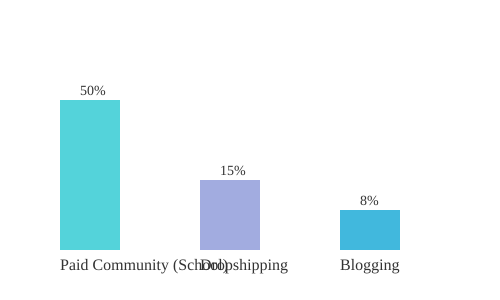
Bar chart: Success rate of making your first dollar with a paid community on School (50%) compared to dropshipping (15%) and blogging (8%).
- Key insight: Picking anything gets you in the game—it’s easier to refine a bad idea than to imagine up a perfect one.
- The ‘best bad idea’ is a process that leverages feedback loops and real-world testing.
2. The 3Ps That Actually Matter: Pain, Profession, Passion
When you’re broke and have no idea where to start, forget the generic business plan templates and endless brainstorming. The real goldmines for business ideas are hidden in your own life, through the 3Ps: Pain, Profession, and Passion. These three categories are where most successful businesses actually begin. Let’s break down how each P can help you uncover unique business opportunities, conduct meaningful market research, and identify pain points that lead to niche marketing and business growth.
Pain: What Have You Figured Out the Hard Way?
Some of the best business ideas come from personal struggles—those moments when you had to solve a problem because no one else could. This is the “pain” category. If you’ve ever found yourself thinking, “There has to be a better way,” you’re not alone—and that’s your opportunity.
Take the story of a mom with nine kids. Her daily challenge was making lunch efficiently for her entire family. Over time, she developed a system: personalized bags, organized prep, and a routine that saved time and money. What seemed like a simple household hack was actually a marketable system—a solution other parents desperately needed. If you’ve overcome a pain point, chances are others are looking for that exact solution. These ideas are deeply relatable and authentic, making them ideal for niche marketing and customer analysis.
Profession: Turn Your Day Job Skills into a Niche Hit
Think about your current or past jobs. Every skill you use at work is something businesses pay for. Why not turn that into your own business? Profession-based ideas often have built-in market demand because you’re leveraging skills that already generate income for companies.
Consider the registered dietitian who was working long hours at a hospital. She learned the ins and outs of complex insurance billing out of necessity, then started teaching other dietitians how to do the same. Her focus was narrow—just billing for dietitians—but that’s exactly why it worked. She built a business around a specific, unsexy problem and now earns nearly $1,000,000 a year with just 5,800 Instagram followers. As the saying goes:
If you solve one very specific problem for somebody, that is a business.
Whether you’re in HR, accounting, video editing, or any other field, your professional skills can become the foundation for a consulting, coaching, or training business. Niche focus usually trumps broad appeal, making it easier to stand out and charge premium prices.
Passion: The Stuff You Get Nerdy About
Finally, look at what you do in your free time. What are you obsessed with? What do you read about, watch on YouTube, or listen to on podcasts? These passions can be the seeds of a thriving business—if you validate them with market research to ensure others share your interest.
For example, one fitness enthusiast spent every evening reading T-Nation articles, soaking up knowledge about lifting and training. His coworkers saw his obsession and encouraged him to open a gym. That deep, genuine interest became his business foundation. If you’re always diving deep into a topic, there’s a good chance you can turn that passion into a business—especially if you can identify a niche audience with similar interests.
Chart: Comparing Businesses Born from Pain, Profession, and Passion
| Origin | Example | Type of Market | Initial Audience | Scale Potential |
|---|---|---|---|---|
| Pain | Lunch System for Large Families | Parenting/Niche Family Solutions | Parents with 3+ kids | Moderate (expands with content/products) |
| Profession | Dietitian Billing Training | Professional Services/Education | Registered Dietitians | High (courses, consulting, licensing) |
| Passion | Fitness Coaching & Content | Health & Wellness | Fitness Enthusiasts | High (online/offline products, community) |
Use the 3Ps to dig into your own experiences. Unique business opportunities often emerge from overlooked, personal experiences. Remember, unsexy, narrow solutions can become goldmines if you focus on real pain points and validate your ideas through market research and customer analysis.
3. Who Needs You? Getting Weirdly Specific About Your Target Market
When you’re broke and just starting out, the last thing you want to do is waste time and energy pitching your business to “everyone.” The truth is, your ideal customer already looks, thinks, and dreams like someone you know—or even like you. Effective customer analysis starts with getting weirdly specific about your target market. This is the foundation of niche marketing, and it’s where your competitive advantage begins.
Skip ‘Everyone’: Find Your Real Avatars
Most successful businesses don’t launch by chasing the masses. Instead, they focus on three classic customer avatars:
- People like you: You’ve faced a problem, figured out a solution, and now want to help others like you.
- People you’ve helped before: Maybe you’ve given advice, solved a problem, or shared a skill—paid or unpaid.
- Underserved markets: Groups with a clear need that aren’t being addressed by current solutions.
Great businesses get built by helping highly specific people, not by chasing the masses. If you’ve experienced the pain, you know the language, struggles, and dreams of your audience. This is the heart of effective market research.
Case Study: Sara Blakely and the Power of Niche Origin
Sara Blakely didn’t set out to serve “all women.” She was frustrated that no underwear did what she wanted—so she invented Spanx. Her solution was so personal and specific that it resonated deeply with millions. The result? Spanx sold to Blackstone for over $1 billion.
| Business | Niche Focus | Outcome |
|---|---|---|
| Spanx (Sara Blakely) | Women seeking better-fitting underwear | Sold to Blackstone for $1B+ |
| Instagram Health Service | 5,800 followers, narrow health niche | Nearly $1M/year income |
Go Beyond Age and Gender: Mix in Profession, Pain, and Passion
To sharpen your offer, layer in more details. Don’t stop at “35-year-old women.” Instead, try: “35-year-old female accountants who feel stuck in their careers and dream of starting a creative side hustle.” The more real your avatar, the more your solution feels tailor-made—and the more you can charge.
- Age & Gender: Who are they, demographically?
- Profession: What do they do every day?
- Pain: What’s their biggest struggle?
- Passion: What do they care about most?
The more specific you get, the more you can charge.
Contrary Insight: Narrower Focus, Higher Price
It feels risky to narrow your focus, but it’s actually a pricing strategy superpower. A generic time management guide might sell for $19. But a time management system for salespeople could fetch $199. Make it for “outbound sales teams in the garden and power tools industry,” and you could charge $1,999—or more. Premium pricing becomes possible when your solution feels tailor-made.
Wild Card: Visualize Your Room
Imagine walking into a room filled with your target customers. If you’re not excited to help them, you’re not specific enough. Drill down until you can picture their faces, hear their struggles, and get energized by the idea of serving them. That’s when your niche marketing and customer analysis will give you a true competitive advantage.
4. Offers That Don’t Suck: The Value Equation in Real Life
When you’re starting a business from scratch, the heart of your marketing strategy isn’t just what you sell—it’s how your offer transforms your customer’s life. Forget generic features. The real winners in business are those who deeply understand what their audience dreams about, what keeps them up at night, and how to communicate both sides of that equation. This is the “value equation” in action, and it’s the foundation of a compelling business message and a strong unique selling proposition.
The Four Levers of the Value Equation
Every irresistible offer pulls four levers:
- Ease: How much simpler does your product make their life?
- Guarantee: How certain is the outcome?
- Speed: How much faster do they get what they want?
- Fit: Is it exactly what they want, delivered how they want it?
As you shape your product development, ask yourself: “How can I make it easier, faster, more certain, and a perfect fit for my customer?”
Real-World Example: Gym Launch’s B2B Offer
Let’s look at a real B2B example. Gym Launch promises that the average gym owner can make $30,000 in their first 30 days using their system. Compare that to the typical U.S. gym owner’s annual take-home income of $36,000. That’s not just a feature—it’s a transformation. They’re not selling software or coaching; they’re selling a shortcut to a dream scenario: a full gym and real money, fast. As Alex Hormozi puts it:
"Here's all this good stuff you want, and here's how I make it easier, faster, guaranteed, and this is what it looks like when it's right."
This approach nails every lever of the value equation and speaks directly to the customer needs of gym owners.
Describe the Dream—In Their Words
To optimize your marketing strategy, you must describe your customer’s dream scenario in their own language. Don’t just say “lose weight fast.” Instead, paint a vivid picture: “Imagine walking into a room and feeling confident in your favorite jeans.” The more specific you are, the more believable and compelling your business message becomes.
The Flip Side: List the Nightmares You Prevent
Motivation isn’t just about the upside. The best offers also address the downside—the risks, delays, and sacrifices your solution helps them avoid. This is the other half of the value equation:
- Risk: What could go wrong without your help?
- Delay: How long will it take if they don’t use your solution?
- Sacrifice: What pain or effort do they have to endure otherwise?
For example, instead of vague promises, get specific: “Stop feeling your thighs chafing in the sun.” This level of detail cuts through skepticism and makes your offer real. As the saying goes:
"If you can name the pain, you own the authority to cure it."
Authenticity: Speak from Experience
The most effective unique selling proposition comes from real understanding. If you’ve lived your customer’s struggles, you can describe their pain and their dreams with authenticity. This is the secret to crafting offers that don’t suck—and to building a business that actually solves real problems.
5. Out of Your Head and Into the World: Crafting the Message & Making Your First Dollar
When it comes to a business launch, forget about slick ads or waiting for the perfect business website. The fastest way to make your first dollar is through warm outreach—actually talking to people like you, solving real problems, and learning as you go. This is where your branding strategy and online business dreams become reality, not in some secret marketing playbook.
Start with Warm Outreach, Not Fancy Funnels
Most people think they need a polished brand or a viral ad to start. In reality, your first sales will almost always come from personal, proactive outreach. DM, email, or talk to people you already know—or those who share your struggles. These are your warm leads, and they’re far more likely to buy than strangers seeing a cold ad.
- Forget perfection: Don’t wait for a perfect business website or logo. Start conversations now.
- Be human: Ask about their problems, share your story, and offer to help.
Call-Out Messaging: Describe Their Situation, Invite Action
Your message should literally call out your ideal customer’s situation. For example: “Are you a 35-year-old accountant bored at your job and looking for a change?” The more specific, the better. This isn’t just branding strategy—it’s how you show people you truly understand them.
- Age, gender, profession
- Their main pain or frustration
- What they want instead
When you describe someone’s life back to them, they feel seen—and are much more likely to respond.
Your First Sale: A Revelation, Not a Marathon
Making your first dollar isn’t about grinding through endless pitches. It’s about helping one person, right now. Here’s a real example:
The first actual dollar that I ever made was at a pizza shop, helping a lady from my gym with her food choices. I just listened, gave her advice, and at the end, she handed me a $100 check. I didn’t even set a price. I could get paid to do this.
No fancy funnel, no business website, just solving a problem for someone like you. That’s the power of warm outreach and authentic connection.
Feedback Loop: Every Conversation Is a Lesson
Each real conversation you have is a goldmine of feedback. You’ll learn:
- What messaging resonates
- Which problems people will pay to solve
- How to improve your offer
Don’t overcomplicate it. Imperfect, personal, and honest always wins with early customers. Every chat is a chance to tweak your approach and get better.
Specificity = Higher Value (and Higher Prices)
The more specific your message, the more you can charge. For example, “time management” is broad and cheap. “Time management for outbound sales reps in the garden and power tools industry” is niche—and worth much more. When you’re the only one solving a specific problem, you’re in a blue ocean with little competition.
Real Data: Community-Driven Business Launches Work
| Platform | New Businesses/Month | First Dollar Success Rate | Resource |
|---|---|---|---|
| School.com | Tens of thousands | 1 out of 2 | School Games (Free) |
As School.com shows, tens of thousands launch an online business each month, and one out of two people who start a paid community make their first dollar. The first sale changes everything: it brings confidence, legitimacy, and a clear next step.
6. Bonus Round: Common Misconceptions (And Secret Advantages of Starting 'From Scratch')
Myth-Busting: You Don’t Need a Perfect Pick or a Huge Following to Get Paid
One of the biggest misconceptions about starting a business is that you need the “perfect” idea or a massive audience before you can make money. In reality, most successful founders started with a problem they personally hated and simply tried to fix it. As one founder put it:
“Many of them started with a founder in a garage with some problem that they hated, and then tried to fix.”
Think Spanx, Facebook, or Gym Launch—none of these began with a polished business structure or a crowd of eager buyers. They started small, scrappy, and specific.
Scarcity Breeds Creativity: Constraints Spark Innovation and Hustle
If you’re broke, you’re forced to focus on what matters: solving real problems for real people. Lack of resources means you can’t hide behind fancy branding or expensive marketing. Instead, you get creative, move fast, and iterate based on feedback. This is where true business growth begins. When you have to hustle, you find undervalued markets and unique angles that bigger, slower competitors miss.
Small, Overlooked Markets (‘Blue Oceans’) Hide Big Opportunities
Many new founders fear that going “niche” will limit their earning potential. The truth? The more specific your target market, the less competition you face—and the more you can charge. For example:
- Generic time management guide: $19
- Time management for salespeople: $199
- Time management for outbound sales reps in garden and power tools: $1,999+
When you’re the only one serving a specific need, you create a competitive advantage in a “blue ocean” with almost no rivals. This is a proven path to business growth and premium pricing.
Iterative Launches Beat Grand Unveilings: Every Great Business Started Scrappy
Forget the myth of the perfect launch. The best businesses start with a “best bad idea,” test it quickly, and improve as they go. Facebook began as a simple solution for college students. Spanx was born from a homemade prototype. These brands didn’t wait for perfection—they built, launched, learned, and adapted. This iterative approach is your secret weapon when starting from scratch.
Why Starting Broke Might Actually Be a Superpower
Being broke isn’t just a challenge—it’s often the very thing that forces you to focus on value instead of glitz. When you have nothing to lose, you’re more willing to take risks, listen to your customers, and pivot fast. Many top companies were born “garage-style,” with no external validation or fancy investors. This hunger and resourcefulness are what set you apart from well-funded, slow-moving competitors.
Key Reminder: Every Big Brand Began as a 'Best Bad Idea'
Don’t let mainstream myths hold you back. Underserved markets and niche-by-necessity are recurring themes among successful founders. Skeptics beware: being broke is often the necessary ingredient for focusing on what matters most—creating real value for a specific group of people. Every big brand you know started as someone’s “best bad idea.”
7. FAQ: Launching Your First (Imperfect) Business
What’s the fastest way to validate my business idea?
The quickest path to business idea validation is to make a real offer to a real person. Don’t wait for a perfect website or logo. Instead, use the “Mosey money Mad Lib”: “I help [who] get [good stuff] without [bad stuff].” Share this with your network and ask if they—or someone they know—would pay for your help. If you get a “yes,” your idea is validated. If not, tweak your offer and try again. The School Games at school.com/games shows that over half of participants make their first dollar this way, proving that rapid, simple outreach works.
How specific should my target market really be?
The more specific your avatar, the easier it is to attract and convert clients. Use the five criteria: age, gender, profession, problems/pains, and interests/passions. For example, “35-year-old female HR managers struggling with remote team engagement” is much stronger than “people who want better teams.” Specificity lets you charge more and face less competition. Remember, a narrow niche doesn’t limit your income—it increases your value.
Do I need a website before getting my first sale?
No. Many successful online business founders land their first clients without any website. Focus on direct outreach and conversations. Use simple tools like email, DMs, or even a Google Doc to present your offer. Once you’ve validated your idea and made your first sales, then consider building a website to scale.
How do I price my niche offering?
Start by looking at the value equation: How much time, money, or pain do you save your customer? The more specific your solution, the higher you can price it. For example:
- General time management guide: $19
- Time management for salespeople: $199
- Outbound time management for garden tool sales: $1,999+
What’s a 'call-out' and how do I use it?
A call-out is a direct message that identifies your ideal customer and their pain. For example: “Are you a new mom struggling to find time for fitness?” Use call-outs in your outreach, social posts, or emails to attract the right people and make them feel seen. This is a core part of your messaging and helps you stand out in a crowded market.
Is it smarter to start as a freelancer, consultant, or coach?
Choose the structure that fits your skills, life stage, and goals:
- Freelancer: Best if you want to sell a skill (writing, design, tech) and work on projects.
- Consultant: Ideal if you have specialized knowledge and want to advise businesses or individuals.
- Coach: Great if you enjoy guiding people through transformation or personal growth.
8. Conclusion: Stop Waiting, Start Tinkering
If you’re still hesitating about starting a business because you feel broke, uncertain, or convinced you need the “perfect” business plan, it’s time to reframe your thinking. The truth is, no one picks the perfect business on day one. Every founder you admire—whether they built a billion-dollar brand or simply made their first online sale—started with what they had, where they were, and with the best “bad idea” they could muster. The only wrong move is not moving. Progress always trumps perfection in entrepreneurship.
You might imagine that successful business launches begin with a flash of genius or a fully-formed business plan. In reality, most stories start with a messy, uncertain leap—something closer to a creative experiment than a calculated risk. The “Best Bad Idea” framework you’ve learned here is designed for exactly that: to help you stop waiting and start tinkering. It’s about picking a direction, not a destination. Your first step doesn’t have to be flawless; it just has to be forward.
Think about the examples you’ve seen: the parent who solved a daily pain point and turned it into a business, the dietitian who leveraged her professional skills to teach others, or the founder who started by helping people just like themselves. None of them waited for the perfect moment or the perfect idea. They chose, iterated, and improved. They took imperfect action, learned from feedback, and refined their niche marketing approach as they went. Every scrappy, broke founder you admire did exactly this.
You might be wondering, “But what if I pick the wrong idea?” Here’s the reality: you will smile and know that’s not actually how it works. The magic isn’t in getting it right the first time—it’s in getting started, listening to your customers, and adjusting quickly. The data backs this up: on platforms like School.com, over one out of two people who start a paid community make their first dollar. Why? Because they stop overthinking and start doing. They treat their business launch as a series of experiments, not a single all-or-nothing bet.
So, what’s your “pizza parlor moment”? The presenter’s first dollar came from sharing nutrition advice in a pizza shop—hardly a polished business plan, but it was the spark that proved he could get paid for his expertise. Your moment might be different, but the principle is the same. Start with the tools and knowledge you have, serve people you understand, and use the frameworks you’ve learned to clarify your offer. Don’t wait for certainty; create it through action.
Starting a business isn’t about waiting for the stars to align. It’s about embracing imperfection, taking bold, human steps, and learning as you go. Treat your business launch as a creative experiment. The sooner you start tinkering, the sooner you’ll discover what works—and what doesn’t. Remember, success stories rarely begin with brilliance; they begin with action.
Your challenge now is simple: choose your best bad idea and take the first step. Reach out, make your offer, and let the real learning begin. The path to your first five customers—and beyond—starts with action, not endless planning. Stop waiting. Start tinkering. Your pizza parlor moment is out there. Go find it.
TL;DR: Stop overthinking and start with your 'best bad idea.' Choose what you know from pain, profession, or passion; get specific about who you serve; offer real value; and refine as you go. No perfect plan needed.
Post a Comment