

Confession: I once believed transformation needed a dramatic all-nighter—like starting a new life on a random Tuesday or going vegan, minimalist, and fit all before sunrise. Spoiler alert: I failed, repeatedly. Enter Atomic Habits by James Clear—not another lofty self-help sermon but a book that bets everything on the tiniest changes. Suddenly, my life was less about epiphanies and more about the next tiny decision, like swapping my phone for a book at night. Turns out, that's where the magic happens. This post unpacks why being 1% better (not 100%) could be your superpower, with a few unexpected twists along the way.
1. Myth-Busting: Why Giant Leaps Rarely Stick (and Tiny Changes Matter Most)
Let’s get real for a second. If you’re like me, you’ve probably tried to overhaul your entire routine overnight—maybe after a burst of motivation or a New Year’s resolution. I used to promise myself: “Tomorrow, I’ll wake up at 5am, run five miles, eat clean, meditate, and write a novel chapter before breakfast.” By day three, I was back to my old habits, frustrated and convinced I just didn’t have enough willpower. Sound familiar?
Why Big Leaps Fail (And Small Habits Matter)
Here’s the truth: giant leaps rarely stick. Our brains are wired to crave dramatic change, but we’re built to thrive on incremental gains. This is the core of the Atomic Habits Summary and the reason James Clear’s work resonates so deeply. The hype around “overnight success” is everywhere, but it’s mostly a self-help fad. Real, lasting change comes from the compound effect of small habits—tiny shifts that seem almost invisible at first, but add up to massive transformation over time.
The British Cycling Team: Marginal Gains, Massive Wins
Need proof? Look at the British cycling team. For nearly a century, they were the laughingstock of the cycling world—no Olympic medals, no Tour de France wins, and even bike companies refused to be associated with them. Then, coach Dave Brailsford introduced the philosophy of marginal gains: if you improve everything related to cycling by just 1%, the results will compound. They tweaked everything—bike seats, training routines, even the mattresses athletes slept on. These tiny, almost trivial changes led to an unprecedented winning streak, including multiple Olympic golds and Tour de France victories.
The Compound Effect: 1% Better Each Day
James Clear breaks down the math of habit formation in Atomic Habits: if you get just 1% better each day, you’ll be 37 times better by the end of the year. That’s the power of the compound effect. It’s not about doing one big thing once—it’s about doing small things consistently. On the flip side, if you get 1% worse each day, your progress erodes to almost nothing. This is why small habits matter so much more than we think.
“You do not rise to the level of your goals. You fall to the level of your systems.” – James Clear
The Plateau of Latent Potential: Why Most People Quit
Here’s where most of us stumble: the plateau of latent potential. You start a new habit—going to the gym, eating healthier, writing daily—but the results aren’t visible right away. It feels like nothing is happening, so you give up. But habits don’t deliver linear progress. The early stages are all about building a foundation. The results come later, often all at once, after weeks or months of invisible effort. This is why focusing on systems (the process) rather than just goals (the outcome) is so crucial. As Clear puts it, “You do not rise to the level of your goals. You fall to the level of your systems.”
Atomic Habits vs. Self-Help Fads
Unlike flashy self-help promises, the Four Laws Behavior from Atomic Habits are about making change easy, attractive, and sustainable. Lower your expectations. Focus on the process. Celebrate the tiny wins. Big changes often lead to burnout, but sustainable progress is built on bite-sized victories.
Wild Card: Tiny Habits as Invisible Votes
Imagine every small habit as an invisible vote in a secret election for your future self. Each time you choose to improve by 1%, you’re casting a ballot for the person you want to become. Over time, these votes add up—and suddenly, you’re living the results you once only dreamed about.
Chart: The Power of 1% Better vs. 1% Worse
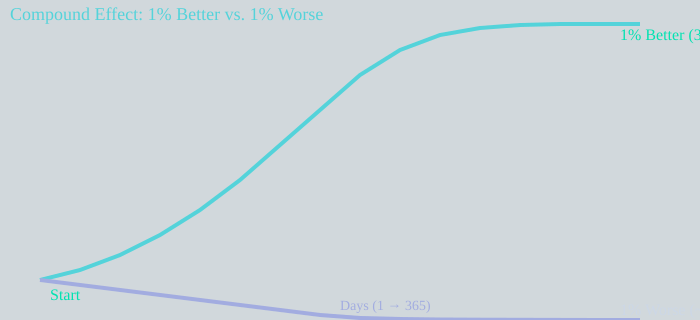
This chart shows how a 1% daily improvement skyrockets your results, while a 1% daily decline leads to almost nothing. That’s the real magic behind Atomic Habits and why tiny shifts always trump big leaps.
2. The Habit Loop, Demystified: Cue, Craving, Response, Reward (And My Phone Addiction)
If you’ve ever wondered why you keep reaching for your phone late at night, or why some habits seem impossible to break, the answer lies in understanding the habit loop. James Clear, in his bestselling book Atomic Habits, explains that every behavior—good or bad—follows a simple, four-step cycle: cue, craving, response, reward. This framework is the backbone of habit formation and the secret behind why tiny shifts can lead to big changes.
Anatomy of a Habit: My Late-Night Phone-Checking Case Study
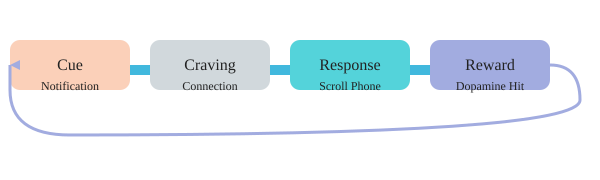
Let’s break down my own nightly phone addiction using the habit loop:
- Cue: My phone sits on my nightstand. A notification lights up or pings.
- Craving: I feel a sudden urge for connection, entertainment, or just a dopamine hit. It’s not the sound I want—it’s the feeling behind it.
- Response: I pick up the phone and start scrolling, often without thinking.
- Reward: I get a sense of satisfaction, relief, or distraction. My brain logs this as a win, making me more likely to repeat it tomorrow.
This cycle repeats, often automatically. As James Clear puts it,
“Habits are not about doing more. They’re about doing better, starting small, and trusting the compounding process.”
The Four-Step Loop: Cue → Craving → Response → Reward, Simplified
Every habit, from brushing your teeth to running every morning, follows this same pattern:
- Cue: A trigger that grabs your attention—like a notification sound, a time of day, or a feeling.
- Craving: The emotional or psychological desire that motivates you—such as wanting connection, relief, or pleasure.
- Response: The action you take—checking your phone, eating a snack, or going for a walk.
- Reward: The benefit you get—dopamine, satisfaction, or a sense of accomplishment.
Why Willpower Isn’t Enough (And Why You Shouldn’t Rely on It)
Most people try to change habits by using sheer willpower, but the habit loop shows why this rarely works. Once a behavior is ingrained, your brain runs the cycle on autopilot. Instead of fighting your instincts, design your environment to make good habits obvious and bad ones invisible. For example, if you don’t want to check your phone in bed, charge it in another room. If you want to read more, leave a book on your pillow—make the cue impossible to miss.
Practical Hack: Make It Obvious, Make It Satisfying
Here’s how you can use habit loop understanding for behavior change:
- Make cues obvious: Place triggers where you’ll see them. Want to practice guitar? Hang it on the wall.
- Make rewards satisfying: Celebrate small wins. Enjoy the calm after reading or the energy after a workout.
- Reduce cues for bad habits: Hide snacks, turn off notifications, or remove temptations from your environment.
Wild Card: If Habits Had Theme Music…
Imagine your habit loop had a soundtrack. Would your phone habit sound like a catchy pop song you can’t get out of your head? Or would your morning run have an energizing beat? Recognizing the “music” of your habits can help you notice when the loop starts playing—so you can change the tune.
Visual: Daily Habits and Their Underlying Loop Stages
| Habit | Cue | Craving | Response | Reward |
|---|---|---|---|---|
| Phone Checking | Notification sound | Desire for connection | Pick up phone | Dopamine hit |
| Reading Before Bed | Book on pillow | Craving relaxation | Read a chapter | Calm, satisfaction |
| Morning Run | Alarm clock | Desire for energy | Go for a run | Endorphin rush |
Habit Loop Flow Diagram: Phone-Checking Example
3. Identity Trumps Willpower: Why Lasting Change Starts in Your Head
Here’s the shocking truth: Willpower is overhyped. If you’ve ever tried to force yourself into a new habit—like waking up early or eating healthier—you know how quickly motivation fades. What actually shapes your outcomes isn’t just grit or self-control. It’s your identity. The way you see yourself is the foundation of every lasting change. This is the heart of James Clear’s Atomic Habits Summary: change sticks when it starts inside your head, not just on your to-do list.
The Power of Identity-Based Habits
Let’s get real. I used to tell myself, “I should read more.” But nothing changed until I started saying, “I am a reader.” That tiny shift made all the difference. Suddenly, picking up a book felt natural—not forced. This is the magic of identity-based habits. When you act in line with who you believe you are, habits become easier and more durable. As James Clear puts it:
“Every action is a vote for the type of person we believe ourselves to be.”
The Three Layers of Behavior Change
Most people try to change by focusing on results—like losing weight or writing a book. But Clear explains that real, lasting behavior change happens in three layers:
| Layer | Focus | Example |
|---|---|---|
| Outcomes | What you want (results) | “I want to run a marathon.” |
| Processes | How you get there (systems, habits) | “I train three times a week.” |
| Identity | Who you believe you are | “I am a runner.” |
Most people start with outcomes, but the deepest, most lasting personal change begins with identity. When your habits align with your sense of self, they stick—even when motivation runs low.
Identity-Based Habits vs. Outcome-Based Habits
- Outcome-based habits: Driven by external goals (“I want to lose 10 pounds”). They often fade after the goal is reached.
- Identity-based habits: Driven by self-perception (“I am a healthy person”). They last because they’re part of who you are.
Identity-based habits are far more durable than those rooted only in desired outcomes. Self-perception is the wellspring of behavior.
Every Action Is a Vote
Think of every small act as a “vote” for the person you want to become. Each time you write, you’re voting to be a writer. Each workout is a vote for being an athlete. You don’t need to win every vote—just keep voting in the same direction. Over time, these votes reinforce your identity until it feels natural.
Practical Tip: Start Small, Prove It to Yourself
Here’s how to use identity-based habits for real change:
- Decide the type of person you want to become (e.g., “I am organized”).
- Prove it to yourself with small wins (e.g., make your bed each morning).
These tiny actions aren’t insignificant—they’re the building blocks of a new identity. The process of habit formation is really the process of becoming someone.
Warning: Avoid Rigid Self-Definitions
Be careful: Rigid self-labels like “I’m not a morning person” or “I’m bad with money” can trap you. These beliefs become self-fulfilling prophecies, making change harder. Instead, keep your identity flexible. Focus on values and processes (“I’m resilient,” “I’m learning to manage money”) rather than fixed outcomes. Flexible identities last through setbacks—if a business fails, you’re still resilient and creative.
Identity and Habits: A Feedback Loop
Your identity and habits feed each other. The more you act in alignment with your desired identity, the more you believe it—and the easier it becomes to keep going. Old habits often resist change because they’re tied to entrenched identities. To move forward, be willing to let go of outdated self-definitions and embrace new possibilities, even if it feels vulnerable at first.
4. When Habits Fight Back: The Plateau, the Friction, and the Temptations
The Plateau of Latent Potential: Why New Habits Feel Pointless at First
If you’ve ever tried to start a new routine—like going to the gym, eating healthier, or writing every morning—you know the early days can feel like you’re getting nowhere. You show up, put in the effort, and… nothing changes. This is what James Clear calls the plateau of latent potential. Our brains crave instant results, but habit formation is more like watching grass grow. The real progress is happening beneath the surface, even if you can’t see it yet.
Clear compares this to breaking a rock with a hammer. You might strike it a hundred times with no visible effect, but on the 101st hit, it splits. That final blow only works because of all the effort before it. As Clear says,
“Many people fail not because they're doing the wrong thing, but because they abandon the process too early.”The key is patience—daily habits compound like interest, and the biggest changes come after consistent effort, not overnight.
Personal Tangent: My Failed Attempts at Quitting Late-Night Snacks—What ‘Friction’ Really Means
Let’s talk friction. I once tried to quit late-night snacking. I’d promise myself, “No more cookies after 9 PM!” But every night, there they were, right in the pantry. The truth? The real enemy wasn’t my willpower—it was friction. The snacks were too easy to reach. Every time I failed, it wasn’t because I didn’t care; it was because my environment made the bad habit effortless.
Environmental Design: The Sneaky Way Your Surroundings Fuel (or Sabotage) Your Routines
Your environment is packed with cues that nudge your behavior, often without you noticing. Want to practice guitar more? Hang it on the wall instead of hiding it in a case. Want to stop doom-scrolling in bed? Charge your phone in another room. This is the core of environmental design: change your space, and you change your habits. Research shows that environmental tweaks beat brute willpower every time.
Friction Reduction: Hide the Snacks, Move the Dumbbells—How It Works for Real People
Friction is the invisible force that makes habits easier or harder. If you want to reduce friction for good habits, make them obvious and accessible. If you want to kill a bad habit, add friction—hide the snacks, put your phone in a drawer, or log out of social media. Here’s how friction reduction and environmental design play out in real life:
- Keep a water bottle on your desk to drink more water.
- Lay out your workout clothes the night before.
- Store junk food on a high shelf or don’t buy it at all.
Studies show that friction reduction leads to higher rates of habit adoption. The less energy you spend resisting temptation, the more you have for building daily habits that stick.
Temptation Bundling: Pair What You Need with What You Want
One of the most practical strategies from the Atomic Habits Summary is temptation bundling. This means pairing a habit you want to build with something you already enjoy. For example, only listen to your favorite podcast while exercising, or watch your favorite show while folding laundry. This makes the new habit more attractive and increases your consistency.
Creative Analogy: Habits Are Like Invisible Escalators
Think of your habits as invisible escalators. Good habits, supported by smart environmental design and friction reduction, carry you upward with little effort. Bad habits, left unchecked, pull you down. The trick is to make sure your escalators go up, not down—by designing your environment, reducing friction, and making your daily habits attractive.
| Strategy | Impact | Example |
|---|---|---|
| Friction Reduction | Higher rates of habit adoption | Keep running shoes by the door |
| Environmental Design | Placement of cues alters behavior | Guitar on wall increases practice |
| Temptation Bundling | Increases consistency | Podcasts only at the gym |
| Plateau of Latent Potential | Leads to high dropout rates | No visible results in first weeks |
5. Systems vs. Goals: Why Your Process Outshines Your Resolutions
Let’s get real for a second. Every January, I used to set a big, shiny goal: “This year, I’ll finally write my novel!” But year after year, that bestseller never materialized. Why? Because I had a goal, but no writing system. No daily routine, no word count targets, no process—just wishful thinking. If you’ve ever set a resolution and watched it fizzle, you’re not alone. The truth, as James Clear explains in Atomic Habits, is that systems over goals is the real secret to personal change and continuous improvement.
Goals vs. Systems: What’s the Difference?
Here’s the simplest way to break it down:
- Goals are about what you want to achieve—write a book, lose 30 pounds, run a marathon.
- Systems are about how you get there—the daily habits, routines, and processes that drive progress.
James Clear puts it bluntly:
“You do not rise to the level of your goals. You fall to the level of your systems.”Goals are the outcome. Systems are the engine that gets you there.
Why Do Systems Matter More?
Here’s a mind-bender: Successful and unsuccessful people often have the same goals. Every athlete wants to win gold. Every writer wants to publish a bestseller. But outcomes vary wildly. The difference? Their systems. Focusing only on goals leads to frustration and burnout, especially when results don’t come fast enough. Systems, on the other hand, encourage steady, sustainable progress.
The Exponential Power of Small Improvements
Clear dives into the math of habit formation: If you get just 1% better each day, you’ll be 37 times better by the end of the year. That’s the magic of compounding—tiny shifts, repeated daily, lead to massive change. But here’s the catch: progress isn’t linear. There’s a frustrating “plateau of latent potential” where it feels like nothing’s happening. Most people quit here, thinking their efforts aren’t working. But, as Clear reminds us, habits are like compound interest. The payoff comes after consistent effort, not overnight.
Reframing Success and Failure
We’re wired to chase big, dramatic wins—publish that book, lose those pounds, land that dream job. But focusing only on outcomes sets us up for disappointment. Instead, ask: Where are my habits taking me? As Clear says,
“Success is the product of daily habits, not once-in-a-lifetime transformations.”When you focus on your system, you free yourself from short-term frustration and build a foundation for real, lasting change.
Systems vs. Goals: Real-Life Comparison
| Life Area | Goals-Focused Approach | Systems-Focused Approach |
|---|---|---|
| Writing | “Finish a novel this year.” Wait for inspiration. |
“Write 500 words every morning.” Daily writing habit. |
| Fitness | “Lose 30 pounds.” Crash diet, sporadic workouts. |
“Exercise 30 minutes daily.” Consistent movement routine. |
| Finances | “Save $5,000.” Hope for a big windfall. |
“Save $10 from every paycheck.” Automatic savings system. |
| Learning | “Learn Spanish this year.” Occasional study sessions. |
“Practice 10 minutes daily.” Language learning habit. |
TL;DR: Your System Shapes Your Success
Here’s the bottom line: It’s the system you live in, not just the goals you chase, that drives long-term results. Most people fail not because their goals are wrong, but because they abandon the process too soon. Build a system, stick with it, and let the power of continuous improvement work its magic. Remember, systems encourage daily progress; goals only measure delayed outcomes. If you want real, sustainable personal change, focus on your process—not just your resolutions.
6. Wild Cards: Surprising Strategies That Actually Work (and Might Make You Laugh)
The Two-Minute Rule: Why Starting Tiny Beats Aiming Big (and My Tragic Five-Minute Workout Story)
If you’ve ever tried to overhaul your life in a single weekend, you know how quickly motivation fizzles. Enter the Two-Minute Rule, a game-changer from Atomic Habits that’s all about starting so small, you can’t fail. The rule is simple: when building a new habit, make it take less than two minutes. Want to read more? Just read one page. Dream of running marathons? Start by putting on your shoes. My own attempt at “five-minute workouts” ended with me lying on the floor, staring at the ceiling, and wondering if I’d ever see my abs again. But two minutes? Even I can do that. The magic is in showing up, not showing off. Consistency, not intensity, is what builds momentum and identity. As James Clear puts it,
“The process of habit formation then is really the process of becoming someone.”
Habit Tracking: Turning Streaks Into Fun (Calendars, Apps, or Beans in a Jar)
Let’s face it: adults love gold stars just as much as kids do. Habit tracking is your grown-up sticker chart, and it works wonders. Whether you use a calendar, a habit-tracking app, or toss a bean in a jar every time you nail your new habit, tracking makes your progress visible and satisfying. Research shows that visual measures like these boost consistency and habit strength. Each checkmark or bean is a mini-reward, reinforcing your streak and making you less likely to “break the chain.” Habit tracking isn’t just about accountability—it’s about turning continuous improvement into a game. (Bonus: you’ll finally have an answer when someone asks, “So, what do you actually do all day?”)
The Goldilocks Rule: The Oddly Satisfying Science of Keeping Things Just Challenging Enough
Ever notice how you lose interest when something is too easy—or too hard? That’s the Goldilocks Rule in action. According to Clear, you’re most motivated when your habits hit the sweet spot: not too simple, not overwhelming, but just challenging enough to keep you engaged. This “optimal challenge” is where growth and joy collide. Studies show that maximum engagement—and even happiness—happens when you’re stretching your skills just beyond your comfort zone. So, if your new habit feels boring, dial it up a notch. If it’s stressful, scale it back. The Goldilocks Rule is your secret to making continuous improvement feel less like a chore and more like a flow state.
Creative Experiment: Track a Silly Habit for a Week
Ready for a wild card? Try tracking a habit that’s purely for fun—like doodling a cartoon every morning, smiling at strangers, or speaking in pirate slang at lunch. Use a calendar, app, or even a row of paperclips. You’ll discover that the act of tracking itself can make even the silliest habits stick. Plus, you’ll get a boost of joy from seeing your streak grow. This playful approach can lower the pressure and remind you that habit change doesn’t have to be all grit and grind.
Quick FAQ: Common (and Slightly Weird) Reader Questions
- Can I track habits with candy? Absolutely—just don’t eat the tracker!
- What if I forget to track? No worries. Habit tracking is about awareness, not perfection. Just start again tomorrow.
- Is it weird to track habits like “complimenting my cat”? Not at all. The weirder the habit, the more fun the tracking.
- Does the Two-Minute Rule really work? Yes! Starting small sidesteps procrastination and helps you build consistency—science backs it up.
- How do I find my Goldilocks zone? Experiment! Adjust the difficulty until you feel challenged but not overwhelmed.
Remember, the wildest strategies are often the most effective. Make your habits visible, playful, and just challenging enough—and watch your identity (and your streaks) transform.
7. FAQ: Atomic Habits, Debunked (Strange Questions, Real Answers)
Can you really get better by just 1%? (Short answer: math says yes, boredom says maybe)
Let’s cut to the chase: the 1% rule is not just motivational fluff. According to James Clear in Atomic Habits, if you improve by 1% every day, you’ll be 37.78 times better after one year. That’s the compound effect in action—think of it as habit formation with a calculator. But here’s the catch: while math is on your side, your brain isn’t always thrilled. The real challenge isn’t the math; it’s the monotony. Small improvements can feel invisible, and boredom is the enemy. Most people quit during the “plateau of latent potential,” when progress seems to stall. The trick? Trust the process and keep casting those tiny votes for your future self, even when it feels like nothing’s happening.
How do you break a bad habit that’s decades old?
Breaking a bad habit isn’t about heroic willpower or sudden declarations. It’s about understanding the habit loop: cue, craving, response, reward. Decades-old habits are deeply wired, so you need to change the environment and, more importantly, your identity. Instead of just “quitting,” ask: What triggers this habit? Can you remove or replace the cue? Most importantly, start seeing yourself as someone who doesn’t do that habit anymore. As Clear puts it, “Habits are the compound interest of self-improvement.” Each time you act in line with your new identity, you weaken the old habit’s grip. It’s slow, but science (and psychology) says it works.
What’s the fastest way to build a new identity?
Spoiler: there’s no shortcut, but there is a reliable path. Identity change is about proving to yourself, through action, that you are the person you want to become. Want to be a reader? Read one page. Want to be fit? Do one push-up. Every small win is a vote for your new identity. Over time, these votes add up and your self-image shifts. The fastest way is the most consistent way—start small, repeat often, and let the compound effect do its work.
Are there habits that backfire?
Absolutely. Not all habits are created equal. Some habits, even if they seem positive, can backfire if they’re not aligned with your values or if they become obsessive. For example, tracking every calorie can promote healthy eating—or trigger anxiety. The key is to ask: Is this habit moving me toward the person I want to become, or away from it? If a habit starts to feel like a chore or causes stress, it’s time to reassess your system.
Does habit stacking actually work, or is it just a buzzword?
Habit stacking—linking a new habit to an existing one—works, but only if you’re strategic. The science of habit formation shows that cues are everything. If you already brush your teeth every morning, stacking a new habit (like flossing) right after is smart. But if you try to stack onto a shaky or inconsistent routine, you’ll struggle. The secret is to make it easy: attach new habits to stable, daily cues, and let the habit loop do the heavy lifting.
How do you stay motivated during the dull ‘plateau’ stage?
Motivation is overrated; systems and environment win every time. During the plateau—when results are invisible and boredom creeps in—the key is to focus on the process, not the outcome. Redesign your environment to make good habits obvious and easy. Celebrate small wins, and remember: “You do not rise to the level of your goals. You fall to the level of your systems.” Progress is rarely linear, but the compound effect is always working, quietly, behind the scenes.
In the end, Atomic Habits isn’t about overnight transformation. It’s about understanding the math and psychology of change, embracing the power of tiny shifts, and trusting that the smallest habits, repeated consistently, will shape your future. The real secret? Start small, make it easy, and let time do the rest. Your future self will thank you.
TL;DR: Big breakthroughs are overrated. Atomic Habits (and this post) prove that your future is shaped by small decisions, not grand gestures. Forget chasing perfect—tiny, consistent changes add up to real transformation over time.
Post a Comment