

I have to admit: I never imagined I’d witness a turning point in history that feels both exhilarating and deeply unsettling. The year is 2025, and if you’re reading this, you’re living through one of those rare moments when everything shifts – just like the switch from clunky cell phones to the first iPhone, or the leap from horse-drawn carriages to highways. But this time, technology is just one piece of the puzzle. Economic systems are creaking, global governance feels wobbly, coral reefs are dying, and artificial intelligence is rewriting what it means to be human. Is all this chaos a sign we’re on the brink of collapse, or is it simply what progress looks like when history speeds up? Buckle up for a whirlwind tour across America’s wildest reinventions, the science of tipping points, and a dose of optimism for the planetary challenges ahead. (Don’t worry, I’ll throw in a few oddities I picked up along the way!)
A Walk Down the Innovation Spiral: How History’s Wild Turns Keep Coming Back
My First Day at Wired Magazine (and Why I Almost Didn’t Take the Job)
Imagine it’s the early 1990s. The internet is barely a whisper, and most people have no idea what “email” or “the web” even mean. That’s where I found myself—on the edge of something big, but uncertain. Wired Magazine was the only place truly obsessed with how technology could transform the world. I almost didn’t take the job. The future felt risky, and the idea of betting my career on “goofball startups” like Amazon seemed wild. But Wired’s founders saw something: the start of a new era in historical American innovation. They convinced me, and together we started tracking the digital revolution before most people even noticed it was happening.
America’s 80-Year Reinvention Cycle: What the Long Boom Got Right (and Wrong)
When my co-author Peter Schwartz and I wrote “The Long Boom” for Wired, we argued that America—and the world—was entering a new age of prosperity, powered by technology and globalization. What we didn’t fully realize at the time was just how deeply these cycles run. Every 80 years or so, America hits a tipping point where the old economic systems break down, and a new wave of technology adoption and innovation explodes. There’s a pattern: collapse, conflict, and then a 25-year burst of wild creativity.
“There’s been three previous junctions where Americans have found themselves in this exact place.”
Why Old Systems Die Hard – From the Civil War to the iPhone
History shows that old systems don’t go quietly. In the 1860s, the South clung to slavery even as the North pushed for a new manufacturing economy. The result was the Civil War—the ultimate example of resistance to change. Fast forward to the digital age, and you see taxi companies fighting ride-sharing apps, or critics dismissing early tech giants as “goofball startups.” Whether it’s slavery, the gold standard, or the skepticism around the iPhone, those invested in the old ways will fight hard to keep them alive.
Surprising Parallel: Each Tipping Point Is Followed by a 25-Year Burst of Wild Innovation
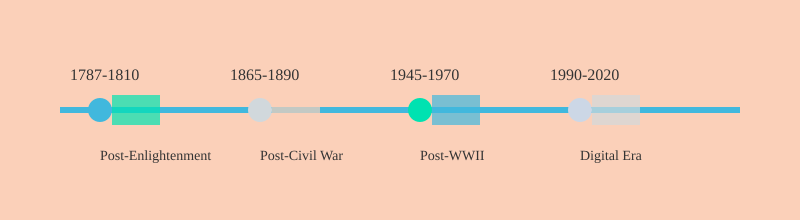
Here’s what’s remarkable: after every major crisis, America doesn’t just recover—it reinvents itself. The pattern is clear:
- Post-Enlightenment (1787-1810): The birth of the nation, inspired by Enlightenment ideas, set the stage for modern democracy and science.
- Post-Civil War (1865-1890): The Homestead Act, land grant universities, and 175,000 miles of new railways stitched the country together and fueled growth.
- Post-WWII (1945-1970): Massive public investments—think GI Bill, highways, and higher education—created the “Great Society.”
- Digital Era (1990-2020): The internet, personal computing, and globalization unleashed a new wave of historical American innovation.
Each of these 25-year bursts follows a period of intense conflict and resistance. The lesson? Understanding these cycles can help us see what’s next for economic systems future—not just in America, but worldwide.
Tale of Stubborn Resistance: Slavery, Taxis, and ‘Those Goofball Startups’
Every cycle has its holdouts. In the 1860s, it was slavery. In the 1990s, it was skepticism toward the internet and companies like Amazon. Today, it’s resistance to AI, clean tech, and other emerging fields. But as history shows, the spiral of innovation keeps turning—no matter how wild the ride gets.
Red Alert: Climate Tipping Points Are Already Here (And Why Coral Reefs Matter So Much)
2025: The Global Tipping Points Report—A Stark Warning
The Global Tipping Points Report 2025 has delivered a wake-up call: “Earth has crossed its first major climate tipping point with widespread mortality of warm-water coral reefs.” This isn’t just another headline—it’s a line in the sand for humanity. For the first time, scientists agree that a global climate threshold has been crossed, and coral reefs are at the heart of this crisis.
What’s a ‘Climate Tipping Point’ Anyway?
A climate tipping point is a critical threshold in the Earth’s system. Once you cross it, change happens abruptly and can’t easily be reversed. Imagine pushing a glass closer and closer to the edge of a table—once it tips, there’s no going back. In climate science, these points mark moments when gradual warming triggers sudden, often permanent shifts in natural systems. The Global Tipping Points Report 2025 confirms that the first of these—widespread coral reefs mortality—has already happened.
Why Warm-Water Coral Reefs Are the Canary in the Coal Mine
Coral reefs are more than just beautiful underwater landscapes. They are crucial biodiversity hotspots, supporting about a quarter of all marine life. But they’re also extremely sensitive to changes in ocean temperature. When the water gets too warm, corals expel the algae that keep them alive—a process called bleaching. If the heat lasts too long, the corals die. This is what scientists call the coral reefs tipping point.
The widespread mortality of warm-water coral reefs is a harbinger—a warning sign that other, even bigger tipping points could be next.
Impacts (and Heartbreak): Ocean Temperature Rise, Coral Mortality, and Why It Matters for Everyone
You might never swim among coral reefs, but their decline affects everyone. Here’s why:
- Food Security: Coral reefs support fisheries that feed millions.
- Coastal Protection: Reefs act as natural barriers, reducing storm damage and erosion.
- Economic Loss: Tourism and fishing industries suffer as reefs die.
- Biodiversity: The loss of coral reefs means the loss of thousands of marine species.
Rising ocean temperatures are directly linked to coral reefs mortality. As the planet warms, these impacts will only intensify.
Cascading Risks: What Happens If More Tipping Points Are Crossed?
Coral reefs are just the beginning. The Global Tipping Points Report warns that other systems—like polar ice sheets and the Amazon rainforest—are at risk. If these cross their own tipping points, we could see:
- Rapid sea level rise from ice sheet collapse
- Loss of the Amazon, turning it from a carbon sink to a carbon source
- Widespread disruption of weather patterns and food systems
These changes could trigger cascading tipping points, leading to abrupt, irreversible planetary shifts.
Urgency: Why Every Fraction of a Degree Now Makes a Huge Difference
The critical threshold for many climate tipping points is 1.5°C of global warming. Every fraction of a degree we can avoid matters. Immediate action is needed to keep warming below this level and prevent further irreversible changes.
| Year | Event | Key Data | Link |
|---|---|---|---|
| 2025 | First climate tipping point crossed | Coral reefs mortality at global scale (warm-water reefs) | Rising ocean temperatures = coral reef mortality |
| - | Critical threshold | 1.5°C: climate system tipping points | - |
Not All Tipping Points Are Disasters: Positive Surprises in Green Technology
When you hear the phrase “tipping point,” it’s easy to think of disasters—melting ice caps, wildfires, or economic shocks. But not all tipping points spell trouble. In fact, some can spark rapid, positive change. Nowhere is this clearer than in green technology adoption. Thanks to breakthroughs in renewable energy technologies like solar, wind, and advanced batteries, we’re seeing a new kind of tipping point—one that could help save ecosystems, reshape economies, and reinvent civilization itself.
Green Technology Isn’t Just a Buzzword: Prices Are Plummeting
Think about how quickly smartphones became affordable. The same thing is happening with solar panels, wind turbines, and batteries. There’s a simple rule in manufacturing:
“Double the number of solar panels produced, and you get about a 20% drop in cost.”This isn’t just theory—it’s happening right now. As more people and companies invest in renewables, the prices keep falling, making green technology adoption economically inevitable.
| Technology | Key Trend | Global Leader |
|---|---|---|
| Solar Panels | ~20% cost reduction per doubling of production | China |
| Lithium Batteries | Rapid advances, moving to solid-state batteries | China, US, Europe |
| Wind Turbines | Steady price decline with scale | Europe, China, US |
Case Studies: China, the US, and Europe Race Ahead
China has become the world’s top producer and deployer of renewables, using its manufacturing muscle to drive down costs. The US and Europe are also investing heavily, using a mix of clean technology mandates and market incentives. This global competition is speeding up innovation and making clean energy more accessible everywhere.
Technology Cost Curves: Like Dominos Falling
Here’s a weird but true fact: technology cost curves often look like a row of dominos. Once prices start to fall, adoption skyrockets. For example, as solar panel manufacturing doubles, costs drop by about 20%. This triggers more adoption, which leads to even more production and lower prices—a self-reinforcing loop that’s hard to stop.
Beyond Solar: Batteries and Electric Vehicles
The same pattern is playing out with batteries and electric vehicles (EVs). While some people still see EVs as expensive, battery technology is rapidly improving. We’re moving from traditional lithium batteries to solid-state batteries, which promise even better performance and lower costs. As these technologies scale, they’ll become more affordable and widespread.
Policy Mandates and Market Magic
Government policies—like clean technology mandates in the US and EU—are helping to kickstart adoption. But once the technology becomes cheap enough, market forces take over. That’s when you see real, unstoppable growth in renewable energy technologies.
Imagining the Upside: Tipping Points That Heal
What if positive tipping points in technology could help restore entire ecosystems? As clean energy becomes abundant and affordable, we could see rapid shifts away from fossil fuels, cleaner air and water, and even the revival of damaged landscapes. With each breakthrough, the odds of a green, thriving future get a little better.
Charting a Path: The Numbers Behind Tipping Points and Technology Adoption
When you look at the story of historical American innovation, you see a pattern: breakthroughs that once took decades and cost fortunes are now happening faster, cheaper, and at a scale never seen before. Understanding the numbers behind these tipping points helps you see just how quickly our world can change—and why the next wave of biotechnology advancements, like CRISPR or lab-grown meat technology, could reshape civilization itself.
Major Tipping Points: A Timeline of Change
| Year | Event | Type | Outcome |
|---|---|---|---|
| 1787 | U.S. Constitution Signed | Economic/Political | Growth |
| 1861–1865 | Civil War | Economic/Social | Collapse & Rebirth |
| 1930s | Great Depression | Economic | Collapse |
| 1950s | Widespread Electrification | Technological | Growth |
| 2003 | Human Genome Sequenced | Biotechnology | Growth |
| 2025 (projected) | Coral Reefs: First Global Climate Tipping Point | Environmental | Collapse |
Shock Drops: The Cost Revolution in Technology
Consider this: In 2003, sequencing the human genome cost $3 billion and took 15 years. As one expert put it,
"It took $3 billion, and it took 15 years to do it. Now it’s about $100."Today, you can get your genome sequenced for as little as $100–$1,000. This isn’t just about genetics. The cost of solar panels has dropped by about 20% with every cumulative doubling of production. Battery prices have plummeted, making renewable energy technologies more accessible than ever.
Speeding Up: How Fast Are We Moving?
- Railways: Took decades to connect the nation.
- Internet: Reached 50% of U.S. households in about 10 years.
- iPhone: Hit 1 billion users worldwide in under 10 years.
- Solar Power: Global installations double every 2–3 years.
- CRISPR Gene Editing: From billion-dollar labs to hundreds-of-dollars kits in under 20 years.
The adoption of new technology now follows an S-curve: slow at first, then a rapid surge as costs drop and benefits become obvious. Lab-grown meat technology is a prime example. Just as you can grow a cow cell in a vat with the same nutrients as a grazing animal, you can now produce real meat—cell for cell, taste for taste—without the cow. Twenty-five years ago, this was science fiction.
The Wild Card: What If We’d Moved Faster?
Imagine if we had cracked the code on renewable energy technologies or genome sequencing a decade earlier. Would we have slowed climate change? Could we have prevented some diseases before they spread? The numbers suggest that the faster we cross these tipping points, the more dramatic the impact on society, the economy, and the environment.
What the Data Says About Acceleration
You are living in a time where the pace of change is exponential. Each new breakthrough—whether in biotechnology, renewable energy, or digital innovation—arrives faster and cheaper than the last. The numbers behind these tipping points show that the future is arriving sooner than you think, and the next chapter of American innovation may be written in months, not decades.
When Governance Lags Behind: Political Upheaval and the Emergence of Digital Democracy
History in Fast-Forward: When Political Systems Fall Behind
If you look back, you’ll see that every time technology and the economy leap forward, political systems tend to lag behind. The United States, for example, built its economic system on financial capitalism—a model that has undeniably benefited the top 10%, and especially the top 1%. But for the other 80%, this system has stopped working. Frustration is boiling over, and you can feel the tension everywhere: in protests, in elections, and in the daily conversations about fairness and opportunity.
Digital Democracy Trends: Is Democracy About to Get a Reboot?
With so many people feeling left out, it’s no wonder that digital democracy trends are gaining attention. Imagine a system where your voice isn’t filtered through layers of bureaucracy or lost in translation. Instead, you could participate directly—voting, debating, and even proposing new laws from your phone or laptop. This is the promise of digital democracy, and it’s more than just a buzzword. It’s a response to the growing sense that representative democracy, while revolutionary in its time, needs an upgrade for the digital age.
National Governments vs. Global Problems: The Push for Global Governance
Here’s the challenge: many of today’s biggest risks—climate change, AI, pandemics—don’t stop at national borders. Yet, our political systems are still built around the nation-state. As the world heads toward a projected 10 billion people, the need for global governance trends becomes impossible to ignore. We’re moving from a world of empires to nation-states, and now, perhaps, to something beyond: a coordinated system that can manage planetary risks for everyone.
Can Global Governance Really Work?
Let’s be honest: global governance is messy. The United Nations, for example, is often criticized for being slow and bureaucratic. But as one expert put it,
“Global governance is currently inadequate to manage tipping point risks, necessitating equitable and coordinated international efforts.”The stakes are too high to ignore. That’s why forums like the UN Summit of the Future and the Global Tipping Points Conference 2025 are so important. These events are where leaders, scientists, and citizens come together to brainstorm new governance models that might actually work for a planet of 10 billion.
The Promise and Peril of Digital Democracy: A Personal Glitch
Digital democracy sounds great—until the technology fails. I remember almost missing a chance to vote in a local election because the voting app on my phone crashed. It was a small glitch, but it made me realize how fragile digital systems can be. While digital democracy trends could make participation easier and more inclusive, they also introduce new risks: hacking, technical failures, and digital divides. The challenge is to build systems that are both open and secure, so everyone has a real voice.
Why You Should Care: The UN Summit of the Future
Even if you’re allergic to bureaucracy, the upcoming UN Summit of the Future in 2025 matters. It’s not just another meeting—it’s a chance to rethink how we govern a rapidly changing world. With global governance trends in the spotlight, and digital democracy on the rise, these conversations will shape how we tackle climate, technology, and equity for decades to come.
From Sustainable Capitalism to Rewiring the Social Contract: What’s Next for Our Economy?
When you look at the history of economic systems in America, you see a pattern: after every major tipping point, the rules change. The Great Depression led to the New Deal coalition and, eventually, a whole new way of thinking about the economy. Today, we’re standing at another crossroads—one where the transition to sustainable capitalism isn’t just possible, but necessary. The future of economic systems may depend on how fast we can make this shift.
The Coming Shift: From Financial to Sustainable Capitalism
For decades, America’s economic system has worked best for the top 10%—and especially the top 1%. But as more people feel left behind, the pressure for change grows. The transition to sustainable capitalism is gaining traction because so many are ready for something different. Economic systems that only benefit a small slice of society are losing legitimacy. The next phase? An economy built for the many, not just the few.
Historic Precedent: How Fast Systems Can Change
After World War II, the U.S. made bold moves that would have seemed impossible just a decade before. The government taxed the rich at rates as high as 90%. Those funds fueled massive public investments—think interstate highways, the GI Bill, and the rise of the suburbs. As one observer put it,
"That all happened in 25 years, the great society, the whole thing."
This period is often called the high point of global capitalism, showing how quickly new economic systems can take root after a crisis. Today, the transition to sustainable capitalism could be just as rapid if the right conditions line up.
Imagining Alternatives: Circles of Sustainable Production and AI-Driven Industries
What could the future look like? Imagine economic circles where production is local, renewable, and designed to regenerate the environment. AI-driven industries could optimize resource use, reduce waste, and create new jobs that don’t rely on burning out the planet. The sustainable capitalism transition isn’t just about “going green”—it’s about rewiring the social contract so that prosperity is shared, and the planet is protected.
Wild Card: Is Sustainable Capitalism a Leap Like Feudalism to Democracy?
Sometimes, economic transitions are so big they feel like a leap into a new era. Moving from feudalism to representative democracy was one such leap. The shift from financial to sustainable capitalism could be just as dramatic. What if the next economic system is as different from today’s as democracy was from monarchy? This is the wild card that could define the next century.
Chart: Comparing Economic Systems After Major Tipping Points
| Era | System | Who Benefited | Key Features |
|---|---|---|---|
| Pre-1930s | Gilded Age Capitalism | Top 1% | Minimal regulation, huge inequality |
| 1945-1970 | Postwar Social Capitalism | Broad Middle Class | 90% tax on rich, public investment, GI Bill |
| 1980s-2020s | Financial Capitalism | Top 10% | Low taxes, deregulation, rising inequality |
| 2020s–Future | Sustainable Capitalism? | 80%+ of population | Green investment, shared prosperity, AI-driven innovation |
The lesson from history is clear: after every tipping point, new economic systems emerge—often faster than anyone expects. As the sustainable capitalism transition gains momentum, you have a front-row seat to the next reinvention of civilization.
A Glimpse at the Next Civilization: Riding Out the Chaos (and Maybe Loving It)
Beyond Tech: When Every Level of Life Changes in Sync
If you look around, it’s clear that we’re not just upgrading our gadgets—we’re watching every layer of society shift at once. Technology is the foundation, but the real story is what we’re building on top of it. Imagine the economic system, democracy, and even the idea of nations all being reimagined at the same time. We’re living through what some call a “once in 80-year reinvention,” but the scale is even bigger: “It’s even possible that what’s going on here is essentially the early days of building a 21st century civilization.”
Civilization as Jazz: Improvising at Every Historic Junction
Think of civilization as a jazz band. Every few generations, the band gets new instruments—steam engines, electricity, the internet, and now, generative AI. But the music isn’t written in advance. We improvise together, responding to each other’s cues, sometimes hitting discordant notes, sometimes finding a groove. This is collective improvisation: society riffing on new ideas, systems, and tools, searching for positive tipping points that can lead to a more sustainable future. The chaos isn’t a bug—it’s the birthplace of invention.
Personal Wild Card: The Power of Outrageous Ideas
Here’s something wild I’ve learned from watching the future unfold: sometimes the most outrageous, “impossible” ideas win. Who would have guessed, even a decade ago, that generative AI would impact society so deeply, or that digital democracy would be on the table? In times of upheaval, the rules are rewritten. The oddball concepts you hear today might be the foundation of tomorrow’s civilization. Embracing uncertainty is not just wise—it’s essential for innovation and survival.
Drafting the Next 120 Years—Right Now
The last great blueprint for civilization was drawn up after the Enlightenment, shaping the next 120 years of progress. Now, from 2025 onward, we’re sketching the next phase. We’re moving from financial capitalism—designed for the few—to sustainable capitalism that must work for everyone. Representative democracy, once a breakthrough, is morphing into digital democracy. Nation states, which replaced empires, could give way to new forms of global governance, coordinating the lives of 10 billion people. The speed and scale of these shifts are unprecedented. We are all composers of civilization’s next movement.
Your Role: Thriving in Uncertainty
So, what’s your part in this wild ride? The truth is, uncertainty is the one thing you can count on. But that’s not a reason to freeze—it’s an invitation to participate. Whether you’re an artist, coder, teacher, or entrepreneur, you have a role in shaping a sustainable future. The blueprint isn’t finished. Every action, idea, and collaboration adds a note to the symphony of change. The key is to ride out the chaos, stay curious, and maybe even learn to love the improvisation.
Are you willing to help invent the next civilization, or will you just watch? (No pressure!)
FAQ: Tipping Points, Technologies, and the Fate of the Planet
What exactly is a climate tipping point?
A climate tipping point is a critical threshold in the Earth’s system, where a small change can push the environment into a dramatically different state. Once crossed, these changes are often irreversible on human timescales. For example, the melting of Arctic sea ice or the collapse of major rainforests can trigger feedback loops that accelerate global warming. Understanding these tipping points is essential because they represent moments when gradual changes suddenly become rapid and disruptive—much like the adoption of transformative technologies in society.
How fast can new technologies really spread?
Technological adoption often starts slowly, with early experiments and limited use. But history shows that once a technology reaches a certain threshold—its own tipping point—it can spread with astonishing speed. Pete Lyden points to the example of the iPhone, which quickly redefined communication and business worldwide. Today, green technology adoption, such as solar panels and electric vehicles, is accelerating as costs drop and infrastructure improves. The same pattern is emerging with artificial intelligence and biotechnology, where breakthroughs are rapidly moving from labs to daily life, reshaping industries and expectations almost overnight.
Can economic and governance systems change that quickly too?
While technology often leads the way, economic and governance systems can also shift rapidly during periods of upheaval. American history reveals three major cycles—after the Revolution, the Civil War, and World War II—where new systems replaced old ones within a generation. Each time, society responded to crisis with innovation: new laws, institutions, and economic models emerged to meet the moment. Today, as you witness the rise of digital democracy and sustainable capitalism, it’s clear that systemic change can happen faster than many expect, especially when driven by urgent challenges and new possibilities.
Are positive tipping points possible, or is this all bad news?
Not all tipping points lead to disaster. Positive tipping points occur when beneficial changes reinforce themselves, leading to rapid improvements. For example, as green technology adoption increases, costs fall, making clean energy more accessible and accelerating the shift away from fossil fuels. Social and political tipping points can also drive progress, such as when new policies or cultural shifts open the door to more equitable and sustainable systems. Recognizing and nurturing these positive tipping points is crucial for steering the planet toward renewal rather than collapse.
How do I know if we’re heading for collapse or renewal?
It’s natural to feel uncertain during times of rapid change. History teaches that periods of crisis can lead to both breakdown and breakthrough. The outcome depends on how societies respond—whether they resist change or embrace reinvention. By staying informed, supporting innovation, and participating in civic life, you can help tip the balance toward renewal. The current convergence of climate tipping points and technological revolutions offers a rare chance to build a more resilient and just civilization.
Where can I go for more on these ideas?
If you want to dive deeper, start with Pete Lyden’s work, including his Wired Magazine articles and “The Long Boom.” Explore resources on climate tipping points from organizations like the IPCC, and follow developments in green technology adoption and digital democracy. Engaging with these ideas will help you understand the stakes—and the opportunities—of this pivotal era.
In conclusion, understanding tipping points—whether in climate, technology, or governance—empowers you to recognize the scale and speed of change shaping America and the world. By embracing the challenges and possibilities of this moment, you become an active participant in the reinvention of civilization itself.
TL;DR: Human civilization has reached a junction of overlapping tipping points—technological, environmental, and societal. Understanding the cycles of innovation, the urgency of climate threats, and the potential for new forms of governance is essential for building a future that’s not only sustainable, but surprisingly hopeful.
Post a Comment