

Here's a confession: just two years ago, if my nephew asked me about his career, I'd have said, "Go all in on coding." Fast-forward to now, and the ground has shifted like we're living in a tech earthquake. Sam Altman, the ChatGPT founder himself, is sounding alarms that obsessing over coding might be yesterday's news—AI is eating those jobs for breakfast. Even TCS, once the ironclad fortress of Indian job security, has let go of 12,000 employees citing "skills gaps," much of it thanks to AI tools. This isn't hype; it's real, it's personal, and it's here. So let me tell you how to stop fearing the wave and start riding it—AI-style.
AI Shockwaves: How the Job Landscape Is Rewriting Itself
The impact of AI on jobs is no longer a distant prediction—it's happening now, and at a scale that’s hard to ignore. In 2024, IT giant TCS, once seen as a symbol of job security in India, laid off 12,000 employees. While the company cited skill gaps, the reality is clear: AI automation and advanced tools are overtaking traditional roles, especially in coding and routine IT tasks. As Sam Altman, founder of ChatGPT, bluntly put it:
"AI is so advanced that it's eating up all the coding jobs—and it's already started here in India."
This shift isn’t limited to India. The AI job market acceleration is global. In the U.S., AI-related job positions jumped by 25.2% from Q1 2024 to Q1 2025, reaching 35,445 roles with a median salary of $156,998. Even more striking is the explosion in generative AI job titles. In January 2021, there were only 55 generative AI job postings; by May 2025, that number soared to nearly 10,000. This signals that roles like generative AI engineer have moved from niche tech circles to mainstream industries, including healthcare, finance, and education.
The AI impact on jobs is twofold:
- Displacement: Routine roles—such as data entry, basic coding, and customer service—are at risk. AI tools now perform these tasks faster and more efficiently.
- Creation: New opportunities are emerging. Demand for AI specialists, prompt engineers, data scientists, and AI tool experts is booming. Companies seek talent that can leverage AI, not just traditional skills.
Despite fears, research shows only about 2.5% of U.S. jobs are at risk of displacement if current AI use cases expand. The bigger story is workforce transformation: traditional job security is fading, but those who adapt and integrate AI into their skill set are thriving.
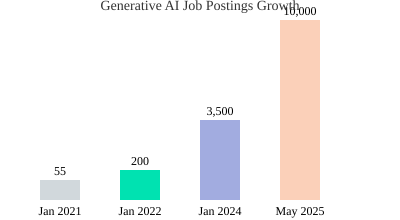
The message is clear: AI is rewriting the job landscape. The fastest-growing roles are those that harness AI, while jobs resistant to change face extinction. To stay ahead, integrating AI skills is now essential—not optional.
From Coding to Prompt Engineering: The Skills Earthquake and Wage Premiums
The job market is experiencing a seismic shift: AI skills demand trends are rewriting the rules for career growth and pay. Where coding was once the golden ticket, today, prompt engineering and creative mastery of generative AI tools are the hottest skills—commanding a significant AI skills wage premium across industries.
Sam Altman, founder of ChatGPT, recently stated that children should no longer focus solely on coding. AI is advancing so rapidly that it’s automating much of the coding work itself. This is not just theory—major companies like TCS in India have laid off thousands, citing “skill gaps” that AI now fills faster and more efficiently than human workers. The message is clear: AI skills demand growth is outpacing traditional tech roles, and those who adapt will reap the rewards.
The numbers back this up. In Q1 2025, the median salary for AI-related roles in the US reached $156,998, far above many traditional tech positions. Workers with AI and generative AI skills are seeing wage premiums that reflect their value. Whether you’re a content creator, business owner, or freelancer, learning to use tools like Nono Banano, Claude.ai, HeyGen, 11Labs, and Google VIO 3 can put you ahead of the curve.
“If you learn AI now, in one week you could outstrip the value of someone’s ten years’ coding experience.”
This shift is personal. Where I once told my nephew to learn coding, I now urge him to master AI tools and prompt engineering. The ability to craft effective prompts, automate workflows, and creatively leverage generative AI is now more valuable than years of traditional programming. In fact, someone who embraces AI can save 10+ hours a week and become more competitive in hiring and earnings—regardless of their previous experience.
Demand for prompt engineering and creative AI use is skyrocketing. Mastery of these tools is not just a tech trend—it’s a practical way to future-proof your career. Free and paid plans for leading AI tools (like HeyGen’s $5 starter or $99 pro plan) make these skills accessible to anyone willing to adapt.
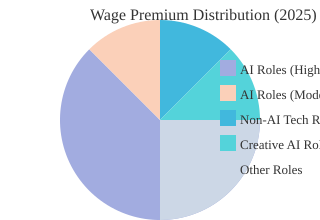
The advice to “just learn to code” is out. Expertise in AI-driven tools and prompt engineering is the new gold standard—one that can quickly outpace even a decade of coding experience in both earning power and efficiency.
Real Tools, Real Impact: How AI Supercharges Work and Creativity (No Matter Your Field)
AI adoption in industries is no longer optional—it's essential. Across sectors, from content creation to business management, AI-driven transformation is raising labor productivity by at least 15% in developed markets like the US. The demand for AI talent is surging, but you don’t need to be a coder to benefit. Today, over 21 standout AI tools are helping individuals and teams save dozens of hours every week, unlocking new levels of creativity and efficiency.
- Nono Banano: Hailed as the world’s top image editing model, this tool lets you create hyper-realistic images with simple prompts. Whether you’re a marketer or a solo creator, you can now generate professional visuals—no Photoshop skills required.
- Claude.ai: Outperforms ChatGPT for deep research and script writing. Upload long PDFs or books, ask questions, and get instant, well-informed answers—ideal for teachers, researchers, and content creators.
- HeyGen: If you’re camera-shy, HeyGen generates lifelike video avatars from text, complete with multilingual dubbing and lipsync. Pricing starts at $5/month, making high-quality video production accessible to all.
- 11 Labs: Clone your voice for podcasts or videos, even if you’re unavailable. Combine with HeyGen for fully automated, AI-powered video content.
- Kling.ai: Animate static images and create cinematic videos—perfect for viral marketing, education, or business presentations.
These tools—and many more like Google VIO 3, higgsfield.ai, opusclips, suno.ai, and Gamma—are rewriting workflows. You can now animate images, craft explainer videos, generate music, and automate research, all without advanced technical skills. The line between creative genius and AI-powered productivity is blurring, as a single user can outcompete entire teams.
AI job market trends show that saving at least 10 hours per week is the new baseline for staying competitive. As Sam Altman notes, “If you’re using AI right, you should be saving at least 10 hours a week. If you aren’t, you’re falling behind.”
| AI Productivity Baseline | Example Tool Pricing | Use Cases |
|---|---|---|
| 10+ hours/week saved | HeyGen: $5–$99/mo | Content creation, research, business ops, teaching |
Whether you’re a freelancer, teacher, entrepreneur, or business owner, integrating AI into your workflow is the fastest way to boost productivity and creativity—no coding required.
Not All Gloom: Why AI Won’t Eat Every Job (and How to Stay Relevant)
It’s easy to feel anxious about AI job displacement risk when headlines focus on mass layoffs and automation. But the reality is far more nuanced. According to recent AI job market analysis, only about 2.5% of US jobs are at genuine risk if current AI use cases expand. The so-called “AI apocalypse” is overblown—most jobs are not going away, but they are evolving.
| Estimated US Jobs at Displacement Risk | Fastest-Growing AI Job Titles |
|---|---|
| 2.5% | Data Scientist, AI/ML Engineer, Big Data Engineer |
While some roles—like basic coding or repetitive Photoshop editing—are being automated, new opportunities are emerging just as quickly. The fastest growing AI roles include Data Scientist, AI/ML Engineer, and Big Data Engineer. In fact, AI/ML Engineer is currently the fastest-growing job title in tech. There’s also a rising demand for creative prompt specialists and AI tool integrators—roles that didn’t even exist a few years ago.
What does this mean for you? Skills adaptation—not panic—is the real solution. Upskill, reskill, and repeat. As Sam Altman (founder of ChatGPT) recently advised, it’s no longer enough to just learn coding. Instead, focus on mastering AI tools, prompt engineering, and creative workflows. Someone who learns to use AI effectively in a week can outpace a decade of traditional experience.
- Integrate AI into your daily workflow—aim to save at least 10 hours a week.
- Explore new creative paths, like re-imagining movie endings or generating viral media with AI tools.
- Stay curious and experiment with platforms like Nono Banano, claud.ai, and HeyGen.
Media often overstates the threat, but the AI job market forecast shows that creative, adaptive, and AI-savvy workers are thriving. Even in fields hit hardest by automation, new niches are opening up. For example, AI-powered editing tools are not just replacing jobs—they’re enabling new forms of storytelling, such as re-editing movie endings for different audiences, or creating entirely new media experiences.
"Don't miss this train—those who hop on now will reach the success destination fastest."
Stay proactive, keep learning, and you’ll not only survive the AI wave—you’ll ride it to new heights.
Wild Card: Will AI Tools Actually Make Us Creatively Unstoppable (or Just Fakers)?
As generative AI job market trends accelerate, the line between authentic creativity and artificial trickery is blurring fast. With AI creativity tools like Nono Banano, HeyGen, and suno.ai, you can now generate viral “celebrity” selfies, deepfake movie endings, and even entire songs at the tap of a prompt. The temptation to flex with AI-powered achievements—Instagram-style—has never been greater. But it raises a crucial question: are we entering a new renaissance of everyday creative potential, or just diluting what we value as real skill?
Consider this: AI-generated content is already rewriting the rules in industries from entertainment to marketing. Directors have been shocked to see AI reanimate movie endings for different markets, as with the film Raanjhanaa, where the AI-altered ending surprised even the original creators. Online, AI recreations of celebrity encounters or alternate movie scenes routinely go viral, challenging our sense of what’s genuine. As one creator put it,
"You can use an AI tool to make it look like you're chilling with your idols—but does it really matter if you didn't earn it?"
Personally, I’ve experimented with AI-edited imagery—sometimes imagining myself in a crowd of thousands, sometimes just for fun. It’s thrilling, but it also makes me question: if anyone can generate these moments, what makes creative work truly valuable? Generative AI-driven roles are already shifting how we perceive and reward creative output. Authenticity, more than ever, remains the core currency—even as AI-enabled content surges across industries.
Ultimately, AI adoption across industries is not just about mastering new tools; it’s about anchoring your work in genuine value. Yes, you should own your AI tools and use them to save time, spark ideas, and push boundaries. But the real differentiator will be your ability to infuse your creations with meaning, context, and personal insight—qualities that can’t be faked by an algorithm. As the definition of authenticity and value evolves, your challenge is to use AI to amplify your unique perspective, not replace it.
So, what’s your take? Have you used AI to experiment with your own creative boundaries—or do you worry about the rise of “fake” achievements? Share your stories and thoughts in the comments. In the AI era, the tools are powerful, but your genuine voice is what will set you apart.
TL;DR: AI is transforming industries, roles, and skillsets faster than ever. Stay ahead by learning AI tools, adopting a growth mindset, and embracing change—because the AI train waits for no one.
Post a Comment