

I once laughed off sleep advice—until I bombed a big morning pitch after just four hours’ rest. Turns out, world-class athletes and high-level CEOs treat sleep like a secret weapon, and the numbers back them up. But it's not always about getting more hours in—sometimes the tiny tweaks matter most. Dive in with me as we expose what the pros do behind the scenes (and what you can copy, minus the million-dollar salary or a Super Bowl ring).
The Great Sleep Myth: Why Less Isn’t More (And Could Cost You Big Time)
For years, society has worn sleep deprivation like a badge of honor. Maybe you’ve heard it: “I only need five hours a night,” or “Sleep is for the weak.” This mindset—still echoed in boardrooms and college dorms—suggests that sacrificing sleep is the secret to getting ahead (6.56-7.10). But here’s the reality: this myth is not only outdated, it’s costing you in ways you might not realize.
Where Did the “Less Sleep, More Success” Badge Come From?
Historically, working late and rising early were seen as signs of dedication. The idea was simple: more hours awake meant more time to hustle. But as research on Sleep Duration Recommendations and Sleep Deprivation Effects has grown, we now know that less sleep doesn’t equal more productivity. In fact, it’s the opposite. Under-sleeping zaps your reaction time, clouds your judgment, and can even tank your mood (7.10-7.14).
Elite Athletes Are Turning the Tide
Look at top performers like Tom Brady and Simone Biles. They’re not bragging about burning the midnight oil—instead, they’re vocal about prioritizing sleep for peak performance. Tom Brady puts it simply:
"Everything is around performance enhancement. I need to go to bed early so that I can wake up early and be ready to go for the day."
Simone Biles echoes this, emphasizing her need for at least eight hours. For these athletes, Sleep and Performance go hand in hand (7.19-7.39).
What the Research Actually Says
Studies indicate that Sleep Deprivation Effects are real and measurable. Just 15 extra minutes of sleep per night can move you from a B to an A student—or from a mediocre to a stellar presentation at work. In athletes, sleep extension has led to a 9% improvement in free-throw accuracy and better reaction times. The American Academy of Sleep Medicine recommends a minimum of 7 hours, but many high performers need 8 or more to truly thrive. As one expert puts it:
"You might actually need 8 or 9 hours or more to feel well rested."
Personal Tangent: My All-Nighter Backfire
I’ll never forget the most delusional all-nighter I pulled before a big project. I thought I was getting ahead, but the next day, my focus was shot and my work suffered. Turns out, the myth that less sleep means more productivity is just that—a myth.
Numbers Don’t Lie: Small Tweaks, Big Gains
| Source/Person | Recommended Sleep | Performance Impact |
|---|---|---|
| Tom Brady & Simone Biles | 8-10 hours | Peak athletic performance |
| American Academy of Sleep Medicine | Minimum 7 hours | General health & cognitive function |
| Academic/Athletic Studies | +15 mins/night | B to A student; 9% better free throws |
Biggest Misconceptions and What You Can Do
One size does not fit all when it comes to Sleep Quantity and Sleep Quality Differences. Your optimal sleep might be different from your friend’s or favorite athlete’s. The good news? You don’t need to overhaul your life overnight. Even small, consistent tweaks—like going to bed 15 minutes earlier—can lead to measurable Performance Improvements.
The tide is turning. If elite athletes are embracing rest as a competitive edge, maybe it’s time you do, too.
Sleep Extension: The Unseen Power-Up for Winners (On and Off the Field)
When you think of what sets elite athletes apart, you might picture grueling workouts or relentless practice. But there’s a quieter, often overlooked edge: sleep extension. Recent research and real-world results show that simply getting more quality sleep can unlock dramatic performance improvements—and not just for the pros.
NBA Teams and the Sleep Factor
Let’s start with a surprising stat: NBA teams’ losses can be predicted with 86% accuracy using sleep and schedule data alone. That’s right—sleep isn’t just about feeling rested. It’s a measurable, strategic advantage. If you’re chasing athletic performance or peak productivity, this should grab your attention.
Research Spotlight: College Basketball’s Sleep Experiment
One of the most compelling studies (see transcript 10.48–12.53) focused on a men’s college basketball team. Over 5 to 7 weeks, players were encouraged to extend their nightly sleep to 9 or 10 hours—about 1.5 hours more than their usual routine. The goal? To pay back accumulated sleep debt and see if it would impact their on-court results.
The findings were striking:
- 9% improvement in free throw accuracy
- 9% improvement in three-point shooting
- 12% faster reaction times
- 4% faster sprint times
These aren’t marginal gains. In elite sports, athletes often chase a 1% edge. Here, sleep extension delivered improvements in the 9–12% range—potentially game-changing for any team or individual.
| Metric | Improvement with Sleep Extension | Protocol |
|---|---|---|
| NBA Loss Prediction | 86% accuracy (based on sleep schedules) | Team-level data |
| Free Throw Accuracy | +9% | 9–10 hours/night, 5–7 weeks |
| Three-Point Accuracy | +9% | 9–10 hours/night, 5–7 weeks |
| Reaction Time | +12% | 9–10 hours/night, 5–7 weeks |
| Sprint Speed | +4% | 9–10 hours/night, 5–7 weeks |
What It Feels Like to Be Truly Rested
Many athletes in these studies reported a revelation: “When you experience what it feels like to be well rested, you never want to go back.” The difference isn’t just physical. Improved sleep quality leads to sharper focus, better mood, and more consistent decision-making. Even outside of sports, CEOs and high-performers report similar benefits—clearer thinking, less stress, and better recovery from daily demands.
Steal These Sleep Extension Benefits for Yourself
You don’t need to be a pro athlete to reap these rewards. Try these practical strategies:
- Take a hot shower or bath before bed to trigger natural sleepiness
- Enjoy a light, healthy pre-bed snack (like cereal and milk) to stabilize blood sugar
- Experiment with a “nappuccino”—a quick coffee followed by a 20-minute nap for a midday reboot
- Protect the “magic hour” before sleep: dim lights, avoid screens, and wind down
Research shows that both sleep quantity and quality matter for sleep and recovery. Whether you’re aiming for the podium or just want to feel sharper at work, sleep extension is a powerful—and often overlooked—tool for performance improvements.
How Much Sleep Do YOU Actually Need? (Spoiler: It’s Not Just a Number)
When it comes to Sleep Duration Recommendations, you’ve probably heard the magic number: “Get at least seven hours.” That’s the official guidance from the American Academy of Sleep Medicine and the Sleep Research Society (8.41–8.48). But here’s the thing—real sleep needs are far from one-size-fits-all. Some people feel sharp and energized on seven hours, while others need eight, nine, or even more to truly function at their best. As one expert put it,
"I personally feel terrible on seven hours and I much more need the eight to nine hours." (8.55–9.00)
This individual variability is often overlooked. The national recommendation is a minimum—not a universal target. Your own optimal Sleep Quantity depends on how you feel during the day. Are you alert, focused, and in a good mood? Or do you find yourself dragging, snapping at people, or reaching for extra caffeine? If it’s the latter, you might be running a sleep deficit without even realizing it (9.00–9.12).
The 15-Minute Trick: Small Changes, Big Results
Here’s a practical tip straight from sleep science: you don’t need to overhaul your routine overnight. Instead, try adding just 15 minutes more sleep each night. It sounds minor, but research shows this small change can make a measurable difference in Sleep and Performance. Over a week, that’s nearly two extra hours of rest (10.05–10.08). Imagine finding an extra $100 in your jeans pocket—suddenly, you have more to spend, and it feels great. That’s how your brain and body react to a little more sleep.
- 15 minutes more sleep per night = almost 2 hours more per week
- Just 11 minutes less sleep can drop a student’s grades from a B to a C (9.54–10.00)
Studies with high school students found that even a small reduction in sleep—just 11 minutes—was linked to a full grade drop. That’s a powerful illustration of how Sleep Deprivation Effects can sneak up on you, impacting memory, learning, and even mood (10.10–10.28).
Sleep Debt: The Hidden Cost
One of the trickiest parts about sleep debt is that you often don’t notice how much it’s affecting you until you pay it off. Maybe you push through the week on less sleep, telling yourself you’re fine. But when you finally catch up—say, after a weekend of extra rest—you realize just how much better you feel. That’s the cumulative power of small changes. Incremental increases, even just 15 minutes a night, can boost your energy, mood, and cognitive function over time.
It’s not just about quantity, either. Quality matters just as much. Pro athletes, for example, focus on both—because they know that better sleep leads to better reaction times, sharper focus, and improved performance on the field or court. You don’t have to be a pro to benefit from these strategies. Find your own sweet spot, experiment with small increases, and pay attention to how you feel. The right amount of sleep is the one that helps you perform at your best—whatever that number may be.
Sleep Deprivation: The Stealth Saboteur of Reaction Time, Memory, and More
Let’s be honest—most of us have felt the effects of sleep deprivation at some point. Maybe you missed your train because you zoned out at the platform. Or you fumbled through a meeting, stumbling over words that usually come easy. These aren’t just random bad days; they’re classic signs that your brain and body are running on empty. And while these mishaps might seem harmless, research shows that even small amounts of lost sleep can sabotage your reaction time, memory, and accuracy in ways you might not expect.
For pro athletes, the stakes are even higher. Studies indicate that sleep debt drags down sprint times, shot accuracy, and overall reaction speed. In fact, one study found that extending sleep led to a 9% improvement in free-throw accuracy and a 12% boost in reaction time—not to mention 4% faster sprints. That’s the difference between winning and losing, or even staying healthy versus getting injured. As one expert put it:
"Sleep deprivation negatively impacts sprint performance, reaction time, and accuracy in athletes."
But it’s not just about muscles and movement. Your sharpest thinking and smoothest moods also take a hit when you’re sleep deprived. Decision-making gets fuzzy. Emotions swing wider. It’s not just athletes who suffer—busy professionals, students, and even executives are at risk. The only difference? Sometimes the athlete’s mistakes are broadcast on live TV.
When it comes to memory consolidation and learning, the science is clear: there’s no substitute for a good night’s sleep. Pulling an all-nighter might feel productive, but studies show it’s a fast track to forgetfulness and poor performance. In fact, a study with high school students found that just 11 minutes less sleep per night could drop a student from a B to a C average (9.54-10.00). Over a week, that’s almost two hours of lost sleep—enough to make a real difference in grades and cognitive function (9.52-10.08).
So, what’s happening under the hood? Sleep loss impairs not just your physical skills, but also your cognitive talents—decision-making, memory, and even emotional balance. Reaction time and accuracy drop whether you’re on the court or in the boardroom. Injury risk rises when sleep falls short. And the link between restful sleep and learning is direct: your brain needs downtime to process and store new information.
Even small tweaks can have a big impact. Those extra 15 minutes you spend scrolling at night? They add up. Over a week, they could mean almost two hours of lost sleep, enough to shift your performance from top-tier to just average (9.44-10.08). I’ve felt it myself—like the time I forgot my wallet before a keynote gig, all thanks to a week of late nights and early mornings.
In the end, both mind and muscles lag after poor sleep. It’s not just about feeling tired; it’s about missing your edge, physically and mentally. The effects of sleep deprivation are real, measurable, and—fortunately—fixable, if you know what to look for and what to change.
The Not-So-Secret Sleep Habits of Champions (That You Can Borrow Tonight)
Ever wondered why top athletes and high-performing executives seem to have boundless energy and sharp focus? It’s not just genetics or iron willpower. The real secret lies in their approach to sleep. By borrowing a few of their proven Sleep Hygiene Tips, you can boost your own Sleep Quality and see real Performance Improvements—starting tonight.
The ‘Nappuccino’ Ritual: Your Midday Power-Up
Let’s start with a favorite hack among busy professionals and athletes alike: the “nappuccino.” The concept is simple—drink a cup of coffee, then immediately take a short nap. By the time you wake up, the caffeine kicks in, leaving you refreshed and extra alert (see 1.21-1.26). Research shows that this combo can significantly improve reaction time and mental clarity, both of which are crucial for athletic and workplace performance. If you’re looking for a quick boost in the middle of a hectic day, this is a strategy worth trying.
Timing Is Everything: The Pre-Bed Shower Trick
Many people shower right before bed, but studies indicate that tweaking this timing can make a surprising difference. Taking a hot shower or bath 1-2 hours before bedtime helps your body cool down naturally, signaling that it’s time to sleep (0.54-1.02). This small adjustment can reduce Sleep Latency in Athletes—the time it takes to fall asleep—and improve overall Sleep Efficiency. It’s a subtle shift, but one that can yield big results, especially if you struggle to wind down at night.
Cereal and Milk: The Doctor-Approved Bedtime Snack
What about late-night hunger? Instead of reaching for sugary treats, try a small bowl of cereal with milk (1.11-1.18). This combination is low-glycemic and easy on digestion, making it a safe option for a bedtime snack. Research shows that simple, strategic changes like this can help you avoid sleep disruptions and maintain steady blood sugar levels overnight. It’s a practical tip straight from the playbook of elite performers.
Small Wins: The Power of Sleep Hygiene Tweaks
Here’s the thing: you don’t need a complete lifestyle overhaul to see improvements. As one expert puts it,
"It doesn’t have to be these big jumps... small changes over time will add up."
Routine and timing often matter more than one-off fixes. By making small, consistent adjustments—like shifting your shower time or choosing the right snack—you can gradually enhance your Sleep Quality and recovery.
Proactive Sleep Planning: A Non-Negotiable for Champions
For top athletes and executives, sleep isn’t an afterthought. It’s a core part of their daily routine. They plan their evenings, naps, and even snacks with intention, knowing that Sleep Efficiency Comparison and quality rest are directly tied to their performance. Studies confirm that both the quantity and quality of sleep are essential for memory, reaction time, and overall competitive edge. So, if you want to perform at your best—on the field or in the office—start treating sleep as a proactive priority, not a last-minute task.
Beyond Athletes: What Sleep Science Means for Leaders, Learners, and Everyday Warriors
When you think about peak performance, professional athletes might be the first people who come to mind. But here’s the reality: the science of sleep isn’t just for those who compete on the field. It’s just as relevant for CEOs, surgeons, parents, and anyone who needs to make sharp decisions under pressure. In fact, the strategies that help athletes recover faster and react quicker can be game-changers for your daily life and career. Sleep for CEOs isn’t just a catchy phrase—it’s a proven path to better performance, resilience, and judgment in any high-pressure environment.
Research shows that sleep benefits extend far beyond the world of sports. High performers in every field—whether you’re leading a company, teaching a classroom, or managing a household—thrive on optimal rest. The same sleep optimization techniques used by elite athletes are now being adopted by executives and professionals who want to boost their mental clarity and emotional stability (see transcript 5.54-5.56). The connection is simple: when you’re well-rested, your brain processes information faster, your reactions are sharper, and your decision-making is more reliable.
Think about it: CEOs and surgeons are making incredibly important decisions every day, often under immense pressure (5.56-6.00). Just like athletes, they can’t afford to be off their game. The difference between a good and bad day at work can come down to how well you slept the night before. Studies indicate that sleep deprivation effects aren’t limited to physical performance; they also impact cognitive abilities, emotional regulation, and even how you handle stress. That’s why sleep and performance are so tightly linked, no matter your profession.
Here’s a personal story: After I committed to a consistent sleep schedule, I noticed something surprising. My ‘bad meetings’—the ones where I felt foggy, impatient, or just off—became much less frequent. My inbox didn’t seem as overwhelming, and I found myself making decisions with more confidence. It wasn’t magic. It was simply the result of prioritizing sleep and recovery, just like an athlete would before a big game.
What’s fascinating is how easily these strategies scale. You don’t need to overhaul your entire lifestyle to see benefits. Tiny changes—like setting a regular bedtime, limiting late-night screen time, or creating a calming pre-sleep routine—can add up to major improvements in your focus and mood. As one expert put it,
"If your sleep is best, you'll be at your best."
Busy schedules don’t have to be a barrier. In fact, the more demands you face, the more important it is to protect your sleep. Whether you’re leading a team, learning new skills, or just trying to keep up with life’s pace, the science is clear: sleep and recovery are essential tools for anyone who wants to perform at their best. And the best part? You can start tonight.
Seeing is Believing: What the Numbers Reveal About Sleep and Winning
When it comes to Performance Improvements, the numbers don’t lie. If you’ve ever wondered whether an extra hour of sleep could really make a difference, research shows the impact is far from marginal. In fact, the data from collegiate basketball players and students paints a striking picture: sleep extension—simply getting more sleep each night—can lead to dramatic shifts in both athletic and academic performance.
Let’s break down what the research found. In a study where athletes increased their Sleep Duration over several weeks, the results were eye-opening. Free throw accuracy jumped by 9%, three-point shooting improved by another 9%, and sprint times got 4% faster. Most notably, reaction times improved by a whopping 12% (11.30–11.45). For elite athletes, where a 1% edge can mean the difference between winning and losing, these double-digit gains are game-changing (11.49–12.11).
How did researchers track these changes? They used actigraphy—think of it as an early version of today’s wearables—to objectively measure how much more sleep athletes were actually getting. This wasn’t just about feeling more rested; it was about quantifying the real-world effects of Sleep Extension on Sleep and Performance (12.22–12.39).
Here’s a closer look at the numbers comparing performance before and after sleep extension:
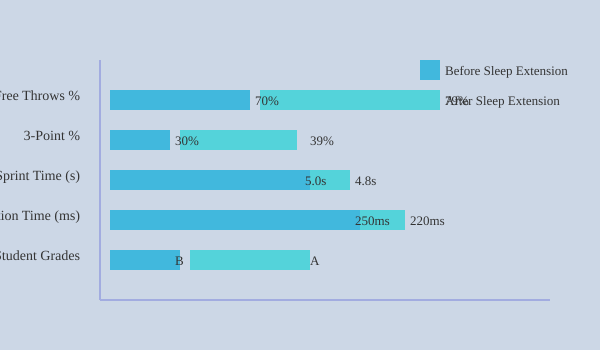
Chart: Performance metrics before and after sleep extension in athletes and students. Data adapted from research findings.
What’s especially fascinating is that these improvements aren’t limited to the court. Students who increased their Sleep Duration also saw their grades rise from a B to an A. This underscores a critical point: Sleep and Performance are deeply connected, whether you’re aiming for a championship or an academic scholarship.
Studies indicate that both the quantity and quality of sleep matter. Athletes often chase tiny gains in training, hoping for that elusive 1% edge (11.54–12.06). But as the numbers show, prioritizing sleep can yield much larger, quantifiable benefits—sometimes in the double digits. That’s a lesson anyone can steal from the pros, whether you’re shooting hoops or hitting the books.
Tracking Trends: Sleep Duration and Performance Uplift (Chart)
Ever wondered just how much difference a little extra sleep can make? When it comes to Sleep Duration and Performance Improvements, pro athletes have shown us that the answer is: a lot more than you might think. Let’s break down the numbers, the science, and the “aha” moments that come from tracking sleep and performance side by side.
Researchers set out to measure what happens when collegiate basketball players extend their nightly sleep—objectively tracked using actigraphy, a wearable device similar to today’s fitness trackers (11.25–11.30). The results? Not just small, incremental gains, but leaps in measurable outcomes. For example, after increasing sleep duration, athletes saw a 9% improvement in free throw accuracy and a 9% boost in three-point shooting (11.30–11.37). Reaction time improved by a remarkable 12%, and sprint times dropped by 4%—all from simply getting more shut-eye (11.37–11.45).
To put this into perspective, elite athletes often chase that elusive 1% edge—tiny tweaks in training or nutrition that might separate the best from the rest (11.49–12.03). But here, the gains from Sleep Extension were not 1%—they were closer to double digits. That’s the kind of boost that can change the outcome of a game or a season.
The Dose-Response Effect: More Sleep, Bigger Gains
Let’s visualize this with a line chart that maps out the relationship between Sleep Duration and two key performance metrics: free throw percentage and reaction time. Here’s the data:
- 6 hours: 70% free throws, 250 ms reaction time
- 7 hours: 73% free throws, 240 ms reaction time
- 8 hours: 76% free throws, 230 ms reaction time
- 9 hours: 79% free throws, 220 ms reaction time
Notice the pattern? The improvements aren’t linear. Each additional hour of sleep delivers a bigger jump in performance, especially as you move from 6 to 8 hours. This is what researchers call a non-linear yield—a little more sleep often means much bigger boosts, up to a certain point.
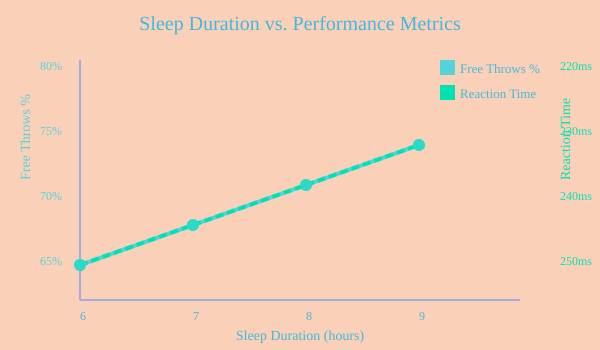
This chart shows how each extra hour of sleep can deliver a bigger boost in free throw accuracy and a sharper, faster reaction time. The “aha” zone? It’s right where you see those lines start to climb and drop more steeply—proof that Sleep and Recovery are not just about feeling rested, but about performing at your best.
So next time you hear someone say “just sleep less,” you’ve got the data—and the chart—to show that a little more sleep can mean a lot more game.
FAQ: The Sleep Edition—Truths, Tips, and Sleepy Surprises
When it comes to Sleep Quality and performance, pro athletes have long been the test subjects for what works—and what doesn’t. But you don’t need to be in the NBA or Premier League to benefit from their lessons. Let’s dive into your most common sleep questions, blending research-backed answers and practical Sleep Hygiene Tips you can use tonight.
How can I tell if my sleep debt’s hurting me?
Sleep debt builds up when you consistently get less rest than your body needs. You might notice you’re slower to react, forgetful, or just dragging through the day. Research shows that even small increases in sleep debt can lead to significant drops in reaction time and accuracy—especially in athletes (10.39-10.41). If you’re feeling foggy or your workouts are suffering, it’s a sign your Sleep Quality is off.
Is there a ‘best’ bedtime snack for athletes?
While the science isn’t settled on a single “best” snack, many athletes find a small, balanced option—think Greek yogurt with berries or a banana with nut butter—helps stabilize blood sugar and promote better sleep. Avoid heavy, spicy, or high-sugar foods right before bed for optimal Sleep Quality.
How long should I extend my sleep to see results?
Here’s where the pros offer a clear lesson. In a study with adult male basketball players, extending nightly sleep by just 1.5 hours over 5 to 7 weeks led to a 9% improvement in free throws and three-point shots, and a whopping 12% faster reaction time (10.57-11.45). That’s not just marginal gain—it’s game-changing. For most people, aiming for 8–9 hours (or more, if you’re training hard) can unlock similar Sleep Extension Benefits.
Can sleep routines really improve my memory and grades?
Absolutely. Studies indicate that consistent sleep routines help consolidate memory and boost learning—key for both athletes and students. Sleep Deprivation Effects include poorer recall, slower problem-solving, and lower grades. A regular bedtime and wake-up time can make a real difference.
Is it possible to overdo sleep, or is more always better?
More isn’t always better. While sleep extension helps most people, especially those in a sleep deficit, regularly sleeping far beyond your needs can sometimes signal underlying health issues. Listen to your body: if you wake refreshed after 8–9 hours, you’re likely in the sweet spot.
Are ‘nappuccinos’ safe for everyone?
Nappuccinos—drinking coffee then napping for 20 minutes—can boost alertness for some. But if you’re sensitive to caffeine or have trouble falling asleep at night, skip this hack. Prioritize good Sleep Hygiene Tips like winding down before bed and keeping naps short.
Do sleep needs change as we age or train harder?
Yes. Young athletes and those ramping up training often need more sleep for recovery. As we age, sleep patterns shift, but quality rest remains crucial for memory, mood, and performance.
Why does my sleep tracker say I’m restless even after a long night?
Wearables measure movement, not true sleep stages. You might be in bed for eight hours, but if stress, noise, or late-night screens disrupt your rest, your Sleep Quality suffers. Focus on winding down, keeping your room cool and dark, and limiting screens before bed for better results.
In the end, what pro athletes get right about sleep isn’t magic—it’s consistency, attention to recovery, and a willingness to treat sleep as a non-negotiable part of peak performance. Whether you’re chasing a championship or just a better tomorrow, these Sleep Hygiene Tips and Sleep Extension Benefits are yours to steal. Start tonight, and watch the difference add up—just like the pros.
TL;DR: Sleep isn't just 'nice to have'—it's the next competitive advantage. Even small changes (a few extra minutes each night) add up. Steal a few sleep moves from elite performers for your own life and unleash sharper thinking, faster reactions, and a mood to match. Prioritize your rest. You're betting on your future self.
A big shoutout to The Diary Of A CEO for their enlightening content! Take a look here: https://youtu.be/fybq6V74qRk?si=kvpwvxp_Fs9KFJQr.
Post a Comment